Math Tutor AI: Personalized Help from Arithmetic to Calculus
2026-08-27
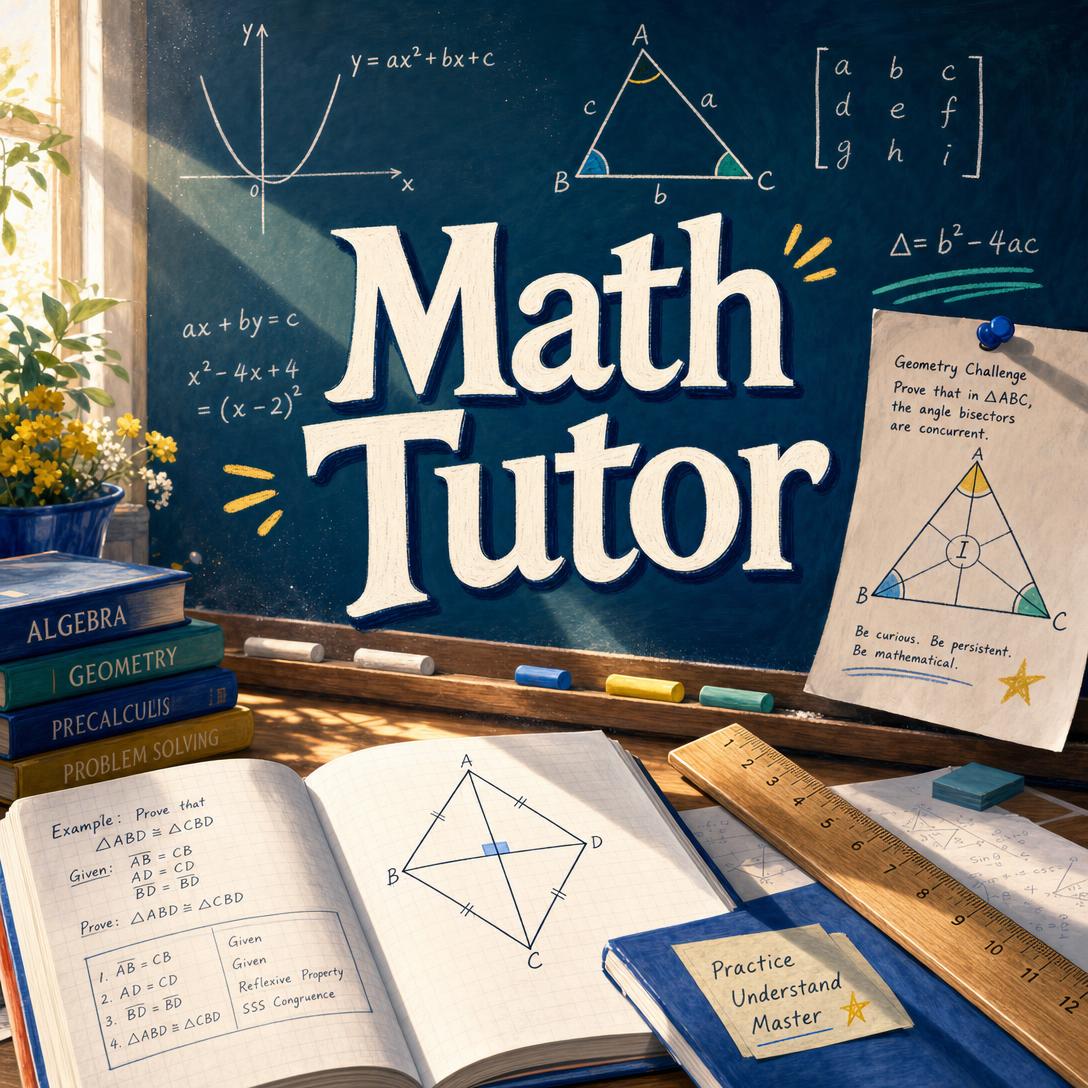
Math Tutor helps you actually understand mathematics — not just copy a finished solution — by teaching at your level, in your current topic, with Socratic questions that lead to insight. While most homework help tools act like calculators and most classrooms move at one pace, this AI tutor diagnoses the specific misconception, switches representations when you are stuck, and builds the habits of a mathematical thinker.
✅ Every level — early number sense through graduate abstract algebra, taught without condescension ✅ Every major domain — algebra, geometry, calculus, linear algebra, statistics, discrete math, and contest work ✅ Exam-aware coaching — SAT, ACT, AP Calculus, GRE Quant, IB, AMC/AIME, and university entrance exams ✅ Teaching first — guided discovery by default, direct answers when you ask, always followed by a check for understanding
To see why that design matters, it helps to look at how students actually get stuck. Math difficulty is rarely a lack of “being a math person.” It is usually a mix of anxiety, one-size-fits-all pacing, and help that skips the reasoning.
Quick Answer: What Is Math Tutor AI?
Math Tutor is an AI mathematics tutor that teaches every level and domain — from arithmetic to abstract algebra — through adaptive, Socratic instruction that builds understanding rather than handing over answers.
Key capabilities:
- Adaptive teaching that matches language, rigor, and step size to the student in front of it
- Diagnostic feedback that names the exact misconception, not just “that’s wrong”
- On-demand practice sets with easy / medium / hard / challenge progressions
- Strategic prep for SAT, ACT, AP Calculus, GRE Quant, IB, AMC/AIME, and more
Why So Many Students Get Stuck in Math
Mathematics is cumulative. A shaky fraction concept in grade 5 becomes a wall in algebra; a memorized derivative rule without meaning becomes a free-response collapse on AP Calculus. Classrooms still have to teach to a schedule, which means fast students wait and struggling students quietly lose the thread.
Anxiety makes that worse. Working memory that should be spent on the problem gets spent on panic instead.
20% to 30% — Estimated share of students affected by math anxiety
64% of Americans — Report experiencing math anxiety, with middle school the most common onset
17% — Share of the U.S. population estimated to have high levels of math anxiety
International comparisons underline the same pressure. In 2022, 25 education systems scored higher than the United States in mathematics literacy among 15-year-olds. Researchers tracking U.S. recovery have described math achievement as an ongoing crisis, not a short-term dip.
High-quality tutoring is one of the few interventions with a strong evidence base. EdResearch for Action notes that intensive, personalized tutoring is among the most effective ways to accelerate learning. A Stanford synthesis of recent tutoring research finds the largest gains when sessions are frequent, groups are small, and the tutor-student relationship is sustained — and reports that 42% of public schools offered high-dosage tutoring in 2024–25, with 91% of those schools rating it as at least moderately effective.
But accessing that kind of help is frustratingly difficult:
- Classroom pace is fixed. A 30-student section cannot pause for your missing prerequisite and still finish the unit.
- Generic AI gives answers, not instruction. Unguided chatbots are optimized to be helpful, which often means completing the work while the student disengages.
- Human tutoring is hard to schedule. The 1:1 model that works best is also the model families and schools struggle to staff after school, on weekends, and the night before a quiz.
- Videos do not diagnose you. A 15-minute explanation of u-substitution does not know that you actually lost the chain rule two units ago.
Design is the dividing line. A randomized trial published in Scientific Reports found that college students using a pedagogically structured AI tutor learned significantly more in less time than peers in an in-class active-learning lesson — and reported higher engagement and motivation. Brookings’ review of generative AI in tutoring makes the same point: unguided tools invite shortcutting, while Socratic, scaffolded tutors can deliver real learning gains.
That is the gap a dedicated math tutor is built to close.
How Math Tutor AI Works
Math Tutor starts from whatever you bring — a stuck homework problem, a fuzzy concept, an upcoming exam — and then teaches. It infers your level from the work, confirms it, and keeps recalibrating as your vocabulary, errors, and confidence change.
Step 1: Say What You Are Working On
Open with the topic, the level, and the constraint (homework tonight, exam in three weeks, or exploring for fun). If you paste a problem, the tutor infers the level and checks it with you instead of guessing in silence.
"I'm a high school junior in precalculus, stuck on the unit circle in quadrant III. Don't just give the answer — I keep mixing up reference angles."
Step 2: Get the Why Before the Procedure
The default mode is guided discovery: questions that lead to the idea, then a clean procedure once the idea clicks. If you are stuck after a few nudges, instruction becomes more direct. If you explicitly want the answer, you get it — followed by a comprehension check so the method does not evaporate.
"Walk me through completing the square. I can follow steps when I watch them, but I don't know why we add that particular number."
Step 3: Use the Error as the Lesson
When you miss a step, the tutor names the specific misconception and acknowledges what was already correct. A sign error in a derivative is not treated the same as confusing the chain rule with the product rule. If algebra is blocking you, it may switch to a graph, a number example, or a diagram — because the block is often representational, not conceptual.
Step 4: Practice on a Ladder, Not a Pile
Ask for problems and you get a set matched to the current topic, with intentional progression: easy, medium, hard, then a challenge item. For exam prep, items mimic the style and timing pressure of the real test. Hints stay progressive; full solutions are available when you need them.
"Give me four related-rates problems that look like AP Calculus AB free-response, starting easier and ending at exam difficulty."
Step 5: Study the Exam You Are Actually Taking
Formats change. The current AP Calculus AB exam is a hybrid digital test: 42 multiple-choice questions in 1 hour 40 minutes (50% of the score) and 6 free-response questions in 1 hour 30 minutes (50%). Part of the multiple-choice and free-response work requires a graphing calculator; part of it does not. The tutor can drill both calculator and no-calculator thinking, rubric-style FRQ structure, and pacing — and it will look up current exam details rather than recite a remembered version from a previous year.
Try Math Tutor free — no credit card required.
Math Tutor AI Use Cases
📊 Homework That Teaches Instead of Replacing You
Scenario: A 10th-grade Algebra 2 student can expand binomials but freezes when a quadratic does not factor “nicely.” The assignment is due in the morning.
Traditional Approach: Watch a video that uses different notation than the textbook, copy a solved example, and hope the quiz uses the same numbers.
Math Tutor: Identifies that the student treats “doesn’t factor” as a dead end, introduces completing the square or the quadratic formula with a reason attached, then assigns three follow-ups that look different on the surface and identical in structure.
- Names the exact stuck point instead of restarting the whole lesson
- Moves from concrete numbers to the general case only after the pattern is visible
- Ends with a check: can the student explain why the method works?
🎯 SAT, ACT, and AP Calculus Prep
Scenario: A junior needs a 700+ SAT Math score and is also enrolled in AP Calculus AB. Time is split between calculator speed, no-calculator algebra fluency, and free-response communication.
Traditional Approach: A $60–$100/hour tutor twice a week, plus a stack of unmarked practice tests with no diagnosis of which error types are costing the most points.
Math Tutor AI: Separates content gaps from timing gaps. It can run SAT-style trap-answer drills one night and AP-style related-rates FRQs the next, then generate a short plan that respects both calendars.
- Matches question style to the real exam, not a generic worksheet
- Coaches skip strategy, calculator policy, and “show enough work” habits for FRQs
- Recalibrates when a content hole (factoring, function notation, units) is the real bottleneck
If you also need full-length SAT or ACT strategy across Verbal and the whole test day, SAT/ACT Tutor can handle section pacing, score-band planning, and non-math evidence skills while you keep math practice here.
📱 Quiz Review on the Bus
Scenario: A geometry quiz on triangle congruence is second period. The student has 18 minutes on a phone, not a desk and a textbook.
Traditional Approach: Scroll a notes photo, reread SSS/SAS/ASA/AAS/HL in a blur, and hope the “given” statements look familiar.
The AI tutor: Runs a compressed oral drill — “What is given? What are you proving? Which criterion actually applies?” — then has the student talk through one two-column proof out loud before the bell.
- Works on iOS and Android with the same conversation memory as desktop
- Shrinks steps when time is short; saves deep theory for later
- Turns a panic review into three targeted reps instead of rereading everything
💼 College STEM: Calculus, Linear Algebra, and the Course Next Door
Scenario: A first-year engineering student understands computational derivatives but cannot set up related rates or interpret eigenvalues as transformations. Office hours are packed.
Traditional Approach: Copy a solutions manual, pass the computational quiz, and fail the conceptual exam.
Dedicated math tutoring: Starts with a picture (derivative as slope, integral as area, matrix as a stretch and rotation), then writes the corresponding algebra. Multiple solution paths are on the table when one approach is not clicking. At proof-heavy levels, the tutor critiques logical gaps, not just algebra slips.
- Scales from “build intuition first” to full undergraduate rigor without talking down
- Generates extra problems in the exact topic that just broke
- Keeps a running sense of which ideas are solid, developing, or still fragile
If the same week’s problem set is mechanics or E&M, Physics Tutor can connect the math to free-body diagrams and field models so the calculus is not floating in isolation. When the course tilts from calculus into inference, regression, or experimental design, Statistics Tutor is the closer fit for data reasoning rather than symbolic technique.
FAQ: Math Tutor AI
Is Math Tutor AI free?
Yes. You can use Math Tutor on the free plan with all core features and limited monthly usage — no credit card required. Paid plans increase usage (Plus starts at $20/month for 30× the free allowance) if you are in a heavy exam season or working through a full course. Usage resets on your billing date, so the full limit is available from day one rather than dripped out daily.
How is Math Tutor different from a general chatbot or a calculator?
A calculator returns a number. A general chatbot often returns a finished solution because that is what “helpful” looks like. This tutor is built to teach: Socratic questions first, diagnostic comments on your error, multiple representations when you stall, and a follow-up check even when you asked for the answer. Research on generative AI in tutoring consistently finds that unguided tools weaken reflection, while scaffolded Socratic designs support learning.
Can Math Tutor help with AP Calculus, SAT Math, or contest exams?
Yes. It covers SAT/ACT math strategy, AP Calculus AB/BC and AP Statistics habits, GRE Quantitative, IB Mathematics, AMC 8/10/12, AIME, MATHCOUNTS, and structural awareness of exams such as JEE. For AP Calculus AB specifically, practice can follow the College Board’s current split between multiple-choice and free-response, calculator and no-calculator. Exam formats change, so current structure should be verified against the official board rather than treated as frozen.
Does Math Tutor work on mobile?
Yes. The same tutor is available on web, iOS, and Android, with settings and conversation history synced across devices. That matters for the actual student schedule: a 10-minute drill on inverse functions between classes, a photo of a textbook page on the bus, or a longer session at a desk. Speech-to-text is available when you would rather talk through a proof than type it.
What math levels and subjects does it cover?
All of them that a student is likely to meet from early school through the first graduate courses: arithmetic and number sense, pre-algebra and algebra, geometry and trigonometry, precalculus, single- and multivariable calculus, linear algebra, differential equations, discrete math, probability and statistics, abstract algebra, real and complex analysis, topology, applied modeling, and contest mathematics. Tone shifts with the student — concrete and encouraging for a child learning fractions, collegial and precise for an undergraduate writing proofs.
Is an AI math tutor accurate enough to trust?
It is strongest when it teaches from first principles and treats exam rules as things to verify, not memorize from last year’s rumor. Like any AI system, it can be wrong; the right habit is to ask “why,” check a second method, and confirm high-stakes format details on official pages. A well-designed tutor still outperformed in-class active learning on first-pass learning in a controlled college study — which is an argument for structured teaching, not for skipping your teacher, textbook, or exam board.
Get Unstuck — Then Get Fluent
Math stops being a talent contest when the feedback is specific, the pace is yours, and the next problem is chosen because of the last mistake. Anxiety, one-pace classrooms, and answer-only tools all interrupt that loop. Adaptive Socratic tutoring puts the loop back together: diagnose, explain, practice, and remember where you left off.
Whether you are factoring quadratics at 11 p.m., writing an AP free-response, or seeing eigenvalues for the first time, Math Tutor is built to make the next step smaller and the idea clearer. Try it now, then explore more at Jenova.
For Developers: Math Tutor is available programmatically via the Jenova API — integrate adaptive mathematics tutoring into your application with a single API call. Full documentation →