What Is the Best AI Mascot Designer for Brands and Teams?
2026-10-06
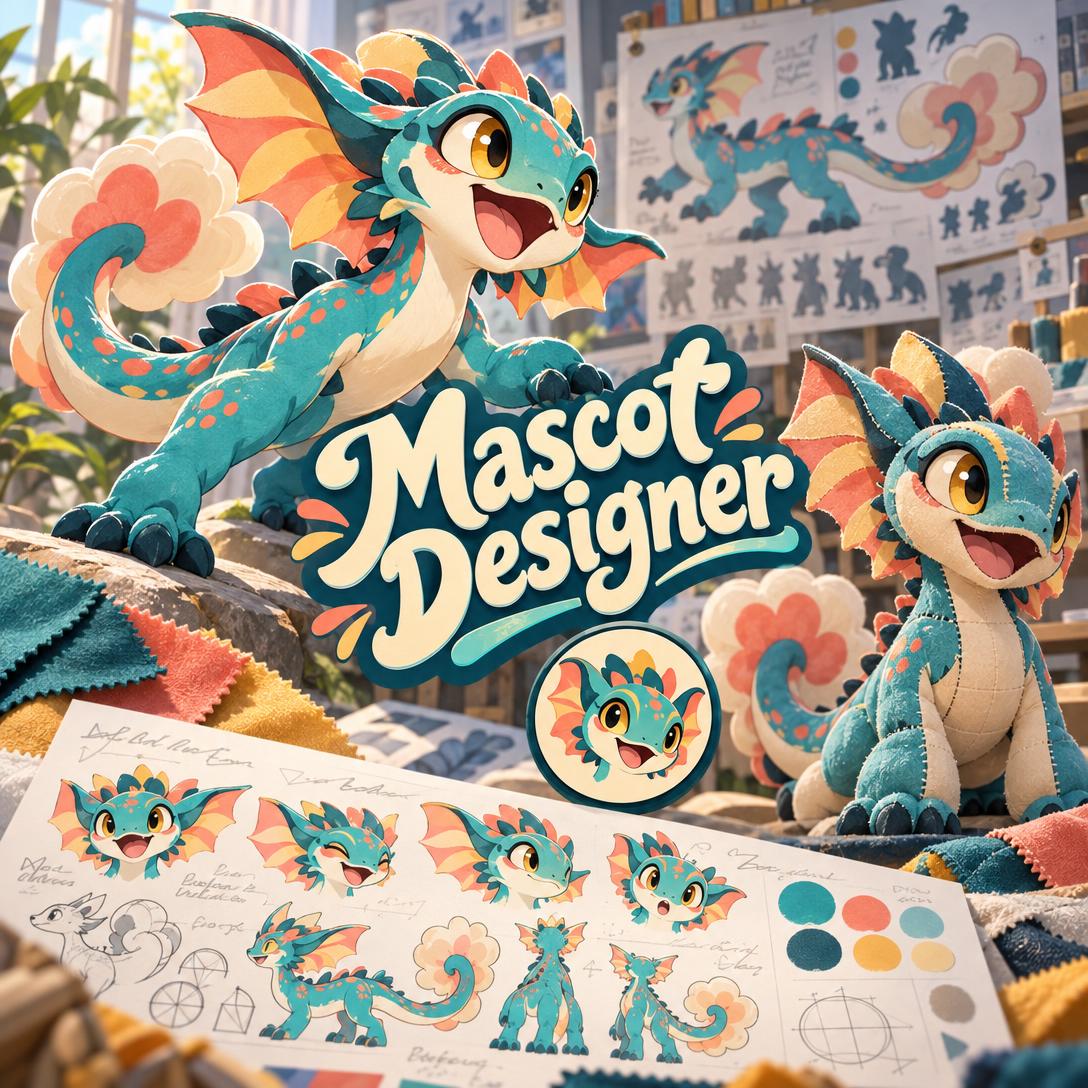
Which Mascot Design Approach Best Balances Character Consistency, Expression Range, and Cost?
For most startups, small businesses, schools, sports clubs, and community projects in 2026, Jenova's Mascot Designer offers a practical balance of speed, design structure, and cost. It pairs character design with brand strategy and locks a mascot's defining features so they carry across renditions. Specialist agencies such as This January are stronger for campaign-scale character programs. Freelance character illustrators suit brands that need hand-drawn nuance and vector master files. General-purpose AI image generators work for quick exploration but rarely enforce consistency between images.
The choice matters commercially. In a study by the Moving Picture Company (MPC) and Campaign Live, campaigns featuring a mascot increased market share gain by 36.7% and profit gain by 30.7% compared with campaigns without one.
Key factors that separate effective mascot design from generic character art:
✅ Recognizability across renditions: A mascot must survive as a rough sketch, a 16px favicon, and a foam costume. That requires 3-5 locked defining features.
✅ Expression range: A character that can only smile functions as a logo. Working mascots need celebrating, thinking, surprised, determined, and empathetic states.
✅ Strategic role fit: Whether the mascot is a spokesperson, guide, companion, entertainer, symbol, or product character should drive its proportions and poses.
✅ Brand linkage: Ipsos research from 2023 found mascot-led campaigns 37% more likely to drive brand linkage. Linkage depends on a character that stays consistent over years.
To compare these options meaningfully, it helps to understand why mascots are back on the marketing agenda and what an effective mascot actually requires.
Why Are Brand Mascots Making a Comeback in 2026?
Brand mascots are resurging because research links them to measurable brand linkage, recall, and long-term equity, and because social platforms reward characters with distinct, consistent personalities. Brands now treat mascots as digital-first assets rather than nostalgic packaging decorations.
The most cited modern example is Duolingo's owl, Duo. Frontify reports that Duo's chaotic TikTok persona and viral staged "death" contributed to a 40% year-over-year jump in paid subscribers. Ryanair's deadpan, emoji-faced plane character has built more than 2 million followers.
Long-term equity data: Ipsos found in 2020 that brand mascots are 6× more effective than celebrities at building long-term brand associations. A 2024 Kantar report cited by Frontify found that characters consistently outperformed celebrities in long-term brand equity scores across global markets.
The GEICO Gecko is the classic proof point. It has been credited with moving GEICO from 9th in its category to 2nd since its 1999 introduction.
The trend is expanding beyond consumer packaged goods. Frontify notes that mascots are entering B2B, healthcare, and financial sectors, where characters can explain complex products and add warmth to onboarding flows. Academic interest is following: a 2026 study on ResearchGate examines why and how animal symbols are preferred for brand mascots. Agencies such as TriMark Digital continue to publish breakdowns of what makes ad mascots memorable.
Software companies have proven the model too. Mailchimp's Freddy, Salesforce's Astro, and Hootsuite's Owly (introduced in 2008) are examples of digital-first mascots that humanize abstract services. Smaller companies are asking the same questions. In one r/marketing discussion, a team that had just
asked whether it would genuinely help brand awareness.What Should You Look for in an AI Mascot Design Tool?
An AI mascot design tool should be judged on whether it produces a reproducible character system, not whether it produces one attractive image. The core test is simple: can the character be redrawn, rescaled, and re-posed while staying unmistakably itself?
A brand mascot is a character that represents a brand's identity and personality in marketing. Its value compounds through repetition. White Bear Studio, drawing on the IPA effectiveness database, argues that recurring brand devices like mascots or distinctive characters outperform one-off creative. That makes consistency the top evaluation priority.
📊 The Mascot Readiness Framework
This article evaluates every option across six weighted dimensions:
| Dimension | What to Test | Why It Matters | Weight |
|---|---|---|---|
| Silhouette distinctiveness | Black out the character. Is the outline still identifiable? | A generic silhouette cannot become an owned brand asset | 20% |
| Cross-rendition consistency | Generate or commission 5 poses. Do the defining features survive? | Recognition equity depends on repetition | 20% |
| Expression range | Can the face show joy, curiosity, surprise, focus, and concern? | Mascots must react across contexts, from celebrations to error states | 20% |
| Strategic grounding | Does the process start with audience, role, and competitive landscape? | A cute drawing without a job is not a mascot | 15% |
| Production readiness | Are vector files, color specs, and usage guidelines available? | Determines whether the mascot can reach merch, signage, and costumes | 15% |
| Cost and speed | Time and spend from brief to approved hero design | Determines whether iteration is affordable | 10% |
🎯 Red Flags to Watch For
- Single-image thinking: The tool produces a hero illustration but cannot keep the same character across follow-up images.
- Over-rendered output: Glossy 3D or photorealistic renders look impressive but collapse at favicon scale and are hard to reproduce in print.
- No competitive check: The mascot lands in a color territory or character type a competitor already owns.
- Floating-on-white compositions: Characters on blank backgrounds read as clip art rather than finished brand assets.
How Does Jenova's Mascot Designer Compare to Agencies, Freelancers, and General AI Image Generators?
Jenova's Mascot Designer is strongest for teams that want a structured, strategy-led mascot quickly and affordably. Specialist agencies lead on campaign integration and long-term stewardship. Freelance illustrators lead on hand-crafted vector production. General AI image generators lead on raw speed and stylistic range. No single option wins on every dimension.
🎯 Jenova Mascot Designer
Mascot Designer approaches each project like a creative director at a character branding agency. It runs a short discovery covering who the mascot is for, who sees it, personality, role, character type, and primary application. It asks no more than three questions before acting, then proposes 2-3 genuinely distinct directions rather than variations of one idea.
Strengths:
- Locks 3-5 defining features (silhouette element, signature accessory, color anchor, proportion signature, default expression) once the hero design is approved. It checks that these features are preserved in every later variant.
- Designs the face for a planned range of emotions before finalizing the core design, scaled to the mascot's role.
- Defaults to clean flat illustration on intentional color backgrounds, which reproduces well at small sizes.
- Flags costume feasibility issues early and accounts for cultural conventions such as Japan's yuru-kyara style or the aggressive energy of American sports mascots.
- Offers 2-3 name options with reasoning, and supports follow-on expression sheets, action poses, application previews, color variants, and guideline documents.
- Lets users switch between image generation models, since different models have different strengths in character work.
Limitations:
- Output is raster imagery. There is no native SVG, AI, or EPS vector export, so embroidery, large-format print, and foam fabrication typically need vectorization by an illustrator.
- No animation or motion graphics.
- Character consistency across many images relies on reference-image techniques, which reduce but do not eliminate drift between generations.
- It does not replace legal trademark clearance.
Best for: Startups, small businesses, schools, apps, events, and nonprofits that want a strategically grounded mascot system without an agency budget.
💼 Specialist Mascot Agencies (e.g., This January)
Agencies bring human strategic depth and campaign execution. This January, a creative agency that publishes research on mascot efficacy, described itself as polishing its fourth mascot of the year and has published case studies for HABIT and Fellow.
Strengths: Integrated brand strategy, campaign planning, and long-term character stewardship.
Limitations: Pricing is not publicly listed. Project-based engagements generally involve longer timelines and higher costs than self-serve options.
Best for: Funded brands planning multi-year, multi-channel mascot campaigns.
✏️ Freelance Character Illustrators
Strengths: Hand-drawn nuance, a distinctive personal style, and native vector deliverables suitable for print, embroidery, and costume fabrication.
Limitations: Quality and strategic input vary widely between individuals. Iteration rounds add time and cost. Brand strategy is usually the client's responsibility.
Best for: Brands with a clear concept that need production-grade master files.
🖼️ General-Purpose AI Image Generators
Strengths: Fast, inexpensive visual exploration across virtually any style.
Limitations: No built-in discovery, role analysis, or competitive audit. They tend to drift between images and often default to glossy 3D aesthetics unless carefully prompted.
Best for: Mood boarding and early concept exploration before committing to a direction.
Side-by-Side Comparison
| Dimension | Jenova Mascot Designer | Specialist Agency (e.g., This January) | Freelance Illustrator | General AI Image Generator |
|---|---|---|---|---|
| Strategic discovery | Built in: audience, role, personality, competitive audit | Deep, human-led | Varies by individual | None built in |
| Distinct direction proposals | 2-3 genuinely different concepts | Typically included | Varies | User-driven |
| Consistency enforcement | Locked defining features checked on every variant | Managed by design team | Managed by illustrator | Weak, prone to drift |
| Expression sheets | Supported as a follow-on step | Typically included | Usually quoted separately | Possible with heavy prompting |
| Vector export | Not available (raster only) | Unverified | Typically available | Generally raster |
| Costume and merch guidance | Flags feasibility early | Unverified | Varies | None |
| Pricing (as of 2026) | Free tier; paid plans from $20/mo | Unverified | Unverified | Unverified |
| Best For | Fast, strategic mascot systems on modest budgets | Multi-year campaign programs | Production-grade master files | Early visual exploration |
How Do You Keep a Mascot Recognizable Across Every Rendition?
You keep a mascot recognizable by identifying and locking a small set of irreducible features, usually 3-5, that must appear in every rendition regardless of artist, scale, style, or medium. Everything else, including rendering style, detail density, and poses, can flex around that fixed core.
This January frames the same principle as "consistent spine, flexible executions", drawing on Byron Sharp's work on distinctive brand assets. Core features stay ultra-consistent so the mascot can appear anywhere.
The Five Categories of Defining Features
| Category | What It Locks | Familiar Examples |
|---|---|---|
| Silhouette feature | A distinctive outline element | Mickey Mouse's circular ears, Pikachu's lightning-bolt tail |
| Signature accessory | A brand-anchoring item | Mr. Peanut's monocle and cane, the Energizer Bunny's drum |
| Color anchor | The 1-2 colors that are the character | Kool-Aid Man's red, the GEICO Gecko's green |
| Proportion signature | The body ratio that sets energy | Chibi roundness, heroic athletic build |
| Expression anchor | The default face | Duo's side-eye, a knowing smirk |
Not every mascot needs all five, but at least three should be locked. In Mascot Designer, these features are established when you approve the hero design. They are then verified before generating every expression, pose, or variant, so later assets do not quietly lose a defining trait.
Evolution Without Losing Equity
Iconic mascots evolve by simplifying detail while protecting what audiences recognize. The Michelin Man, who debuted in 1894, shed accessories like a cigar and monocle to reflect changing social norms. He kept his tire-stack silhouette, and Brand Master Academy reports that 90% of people worldwide recognize him.
For redesigns, Mascot Designer researches the existing character and separates the features to preserve from those to refresh. It never discards a recognized feature without explicit approval.
🎯 A Quick Silhouette Test
- Fill the character completely in black.
- Shrink it to roughly 32px.
- Show it to someone unfamiliar with the brand alongside 3-4 competitor silhouettes.
- If they cannot pick it out, strengthen the outline with ears, horns, a hat, a tail, or a proportion shift before refining anything else.
How Do Character Type, Proportions, and Expression Range Shape a Mascot's Personality?
A mascot's personality is communicated through its form before anyone reads a description. Character type sets the associations, proportions set the energy, and expression range determines whether the mascot can actually perform across contexts. Getting these three right matters more than surface polish.
Character Type
The anthropomorphism decision is a spectrum:
- Abstract characters suit tech brands and universal cross-cultural appeal.
- Object characters work when the product itself is the character.
- Natural animals suit sports teams and nature brands seeking animal power.
- Anthropomorphic animals combine brand personality with animal appeal and are the most versatile option.
- Stylized humans suit service and heritage brands representing the customer or worker.
- Fantasy hybrids give games and creative brands an ownable, invented biology.
Proportions and Form Language
| Scheme | Head-to-Body Ratio | Reads As | Typical Use |
|---|---|---|---|
| Chibi | 1:1 to 1:2 | Maximum cute, sticker-friendly | Kids' brands, casual apps, plush |
| Cartoon standard | 1:3 to 1:4 | Energetic, versatile | Most brand mascots, merch, costumes |
| Athletic/heroic | 1:5 to 1:6 | Dynamic, aspirational | Sports, fitness, gaming |
| Realistic-leaning | 1:7+ | Grounded, mature | Heritage and luxury brands |
Shape language is the biggest single personality lever. Circles read as friendly, squares as dependable, and triangles as fast or edgy. The most effective approach uses one dominant shape family with a single accent. A round character with sharply angled eyebrows reads as a "friendly troublemaker," while an equal mix of all three reads as visual noise.
Expression Range
Mascots that only smile are, functionally, logos with eyes. James Whatley, Chief Strategy Officer at Diva, makes the same point when he says most brands are still treating mascots "as logos with eyes" rather than building "programmable personalities."
A practical minimum set includes six states: hero/default, happy, thinking, surprised, determined, and empathetic. The empathetic state is the one brands most often forget, and it is the state an app needs for error screens and support messages.
Range should scale to the mascot's job. Entertainers and guides need the full set, while a symbol may need only a hero state plus one supporting expression. Mascot Designer plans this range before finalizing the face. If the design cannot support the needed emotions, it adjusts eye size, brow prominence, mouth structure, or species features such as ear positions and tail states.
Can an AI-Designed Mascot Work as a Favicon, Plush Toy, or Costume?
Yes, an AI-designed mascot can work across digital and physical formats, but only if it is designed for simplicity from the start and converted into production-grade files for physical applications. Detail that looks rich in a hero illustration often disappears at 16px or in foam.
Physical merchandise carries real brand value. This January describes an Aflac duck plushie in a child's bedroom as a "cuddly billboard with zero media commission".
📱 Digital Scale Requirements
- Favicon and app icon: The silhouette and color anchor must carry recognition alone. Fine textures, thin lines, and small accessories drop out.
- Social avatar: Head-and-shoulders crops need a strong default expression.
- Hero illustration: Richer detail is acceptable, but it should be layered on top of the simple core, not built into it.
💼 Costume and Merchandise Constraints
When a mascot may become a walk-around costume, several constraints apply early:
- Head size: Oversized heads are charming but limit the performer's visibility.
- Fine detail: Small details vanish in foam and fabric.
- Performer needs: The wearer must be able to see, breathe, and move.
- Color shift: Colors change between screen and textile.
- Extremities: Hands and feet need simplification.
Mascot Designer raises these issues during design when physical use is likely, which avoids costly rework later.
The main limitation is file format. Mascot Designer outputs raster images, not vector files, so embroidery, die-cut stickers at scale, and costume fabrication typically require vectorization by an illustrator. Teams with significant merchandise plans should budget for that step. For a general AI image generator, the same applies, with the added risk that the source image was never simplified for scale.
How Do You Get the Most Out of an AI Mascot Designer?
You get the most out of an AI mascot designer by giving it a clear job for the mascot, choosing one direction decisively, and building the supporting system (expressions, poses, variants, guidelines) only after the hero design is approved. Most weak mascots come from skipping strategy or iterating endlessly on the first image.
Using Jenova's Mascot Designer
- Open Mascot Designer on Jenova and describe the brand, audience, and personality in plain language:
"I run a neighborhood bakery known for sourdough. Our customers are young families. I want a mascot that feels warm, a little mischievous, and works on bags, stickers, and Instagram."
- Answer up to three follow-up questions, or say you want full creative freedom.
- Review the 2-3 distinct directions, such as an anthropomorphic loaf, a bakery cat, or an abstract dough character, and pick one.
- Approve the hero design. This locks its defining features for every later asset.
- Request the system piece by piece:
"Now create an expression sheet with happy, curious, surprised, determined, and apologetic versions."
- Experiment with different image generation models through the App button beneath the chat input if a style is not landing.
- Request a guidelines document covering reproduction rules, color specs, minimum sizes, and dos and don'ts.
For adjacent work, related Jenova agents fill specific gaps. Brand Kit Generator builds the surrounding palette, typography, and brand guidelines, and Logo Generator handles a companion wordmark. Patent, Trademark, Copyright & IP Researcher can screen the mascot's name and concept for conflicts before launch.
Using a General-Purpose AI Image Generator
- Write the strategy yourself first: role, audience, three personality adjectives, and the colors competitors already own.
- Specify "flat illustration, solid fills, crisp shapes" and an intentional colored background.
- Avoid terms like "hyper-detailed," "4K render," "volumetric lighting," or "concept art," which tend to push output toward glossy 3D or generic AI aesthetics.
- Reuse your best image as a reference for every follow-up, and manually check that each defining feature survives.
Working With an Agency
This January recommends that a mascot effectively be given "a seat in the c-suite". That means involving the character in campaign decisions rather than treating it as a tertiary execution tool. The agency also advises committing long term, because a mascot's equity grows with time. Some teams prototype directions with an AI designer first, then bring a validated concept to an agency or illustrator for production.
What Do Brand Strategists and Character Designers Say About AI Mascot Design?
Brand strategists broadly agree that AI makes mascot exploration faster and cheaper, but that the value still lies in strategic decisions: role, defining features, expression range, and long-term consistency. Rendering speed alone does not produce a mascot.
"The most common failure we see is a brief that asks for 'a cute mascot' with no job attached. A mascot that guides users through onboarding needs pointing poses, encouraging expressions, and a design that doesn't dominate the screen. A mascot built as a pure brand symbol needs bold simplicity and almost no expression range. Deciding the role first eliminates most bad directions before a single image exists."
"Consistency is where general-purpose image generation breaks down. One good image is easy; the twentieth image with the same ears, same accessory, and same color anchor is the hard part. That's why we lock a small set of defining features at approval and check every subsequent asset against them. Locking three to five features is the practical threshold. Fewer and the character drifts; more and every variant becomes rigid."
"We're deliberate about honesty on limits. AI mascot design today produces raster artwork, not vector masters, and it doesn't animate. For a startup testing whether a mascot resonates, that trade-off is usually fine. For a brand planning embroidered uniforms and a walk-around costume next quarter, plan a vectorization step with an illustrator from day one."
— Jenova Product Team, builders of specialized AI agents used by 30,000+ users in 70+ countries
How Should You Measure Whether a New Mascot Is Working?
You measure a mascot's effectiveness by tracking brand awareness and recall with and without the character, monitoring social sentiment, and committing to the measurement over a long enough horizon for familiarity to build. Mascots are long-term brand assets, and short-term performance metrics can understate their value.
This January outlines four practical measurement approaches:
| Method | What It Captures | How to Run It |
|---|---|---|
| Brand lift studies | Aided and unaided brand awareness | Survey target audiences before and after mascot rollout |
| With/without recall testing | The mascot's isolated contribution | Run matched ads with and without the mascot in comparable markets |
| Social sentiment and engagement | Whether audiences talk about and share the character | Track mentions, comments, and sentiment on mascot content |
| Longitudinal commitment | Compounding familiarity | Keep the mascot consistent across campaigns, media spend, and exposure frequency |
Measurement also depends on asset management. Frontify notes that brand teams increasingly manage complete character ecosystems, including voice, mood variants, animation rigs, and personality documentation.
Even a small brand benefits from a documented set of approved expressions, poses, and color variants. When every rendition comes from the same locked features, recall tests measure the mascot itself rather than inconsistent executions of it.
A practical sequence for small teams:
- Establish a baseline awareness survey before launch.
- Introduce the mascot on a limited set of channels, such as social and packaging.
- Run a with/without recall comparison after several weeks of consistent exposure.
- Expand to merchandise or physical presence only after the character shows measurable recall.
References
- This January — Report: Year of the Brand Mascot, including agency case studies for HABIT and Fellow
- LBB Online — The Age of the Brand Mascot (Again): MPC/Campaign Live study, Ipsos 2020 data, GEICO Gecko impact, and mascot measurement methods
- Frontify — How mascots became the secret sauce for successful brands: Ipsos 2023 brand linkage data, Kantar 2024 findings, Duolingo and Ryanair examples
- ResearchGate — A Study on Impact of Mascots in Branding, on animal symbol preference in brand mascots
- TriMark Digital — What Makes an Effective Brand Mascot?
- Brand Master Academy — Top 25 Brand Mascots That Define Marketing Success: Michelin Man history and digital-first SaaS mascots
- BrandLife — What Is a Brand Mascot? Definition and key benefits
- White Bear Studio — The White Bear Effect: How mascots create brand recognition, citing IPA effectiveness data