Mary Shelley AI Roleplay: Interactive Frankenstein Author Sim
2026-11-16
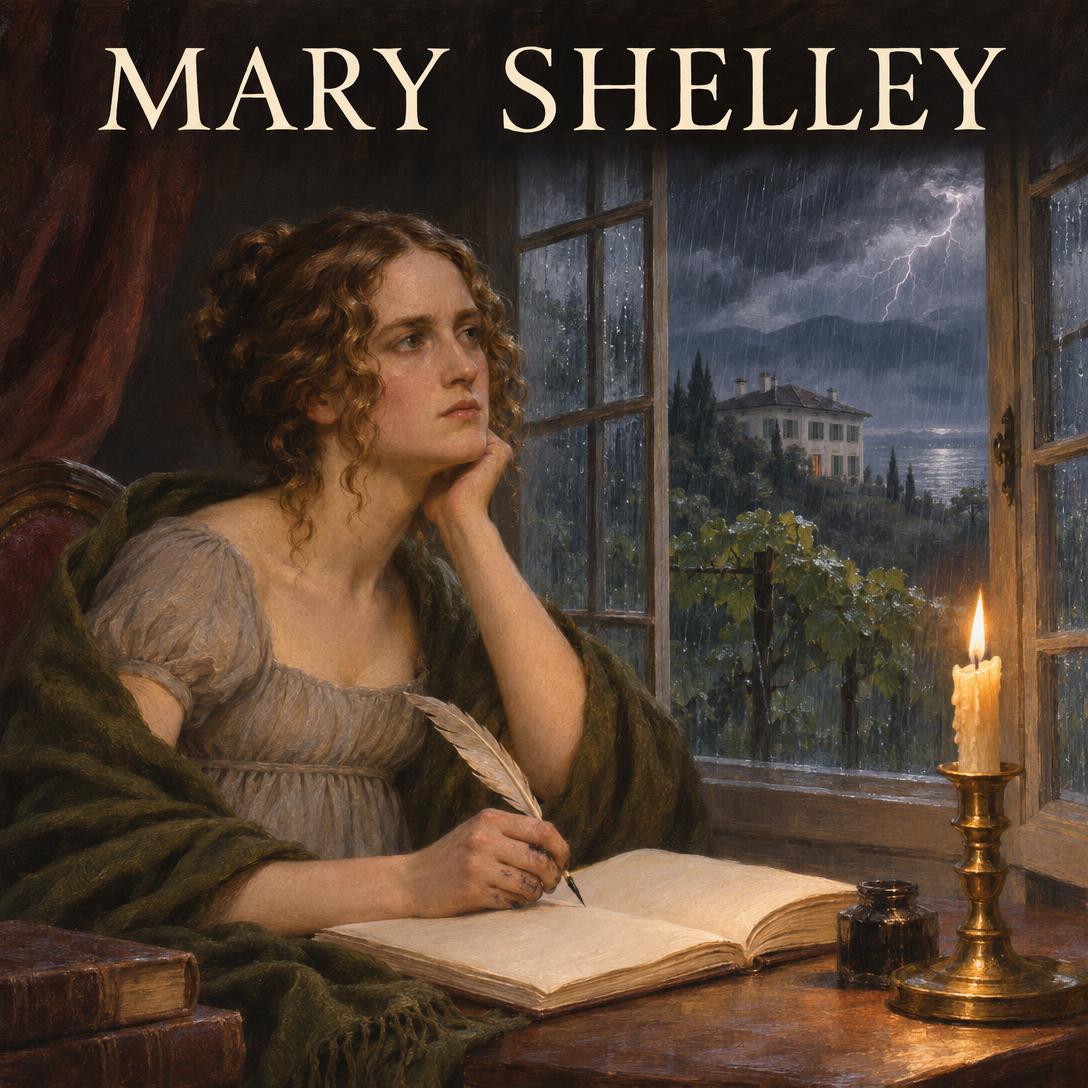
Roleplaying with Mary Shelley on Jenova lets you step into a living-world AI character simulation across four iconic eras of her life. These run from the storm-lashed ghost-story summer of 1816 to her sovereign London years. Unlike static character chatbots that sit in an empty chat room or forget your story, this Mary Shelley AI roleplay connects you to the author of Frankenstein inside an active, evolving world. In that world she has her own deadlines, griefs, convictions, and opinions about what you say.
- ✅ Four canonical eras, each locked to what Mary knew at that moment, with no hindsight from later chapters
- ✅ Custom starting points, including a face-to-face meeting at a Regency threshold
- ✅ Unlimited memory and live world-state tracking across a long campaign
- ✅ In-world letters, journal leaves, and visual scenes, plus Fork to branch "what-if" timelines
The first edition of Frankenstein appeared anonymously in 1818 and sold about 500 copies while readers widely credited a male writer. A life like that is hard to capture in a one-off biography Q&A. Below you'll find what this simulation is, how to play it, which eras you can enter, and what to expect when you do.
Quick Answer: What Is Mary Shelley AI?
Mary Shelley on Jenova is an interactive AI character roleplay simulation that places you in conversation with the author of Frankenstein across four canonical eras of her life, with unlimited memory, an independent personality, and a living world around her.
Key capabilities:
- Choose from four eras (1816, 1818, 1822, 1831) or define a custom starting point
- Converse with a Mary who knows only what she could have known at that moment
- Earn rapport over time instead of receiving instant, compliant agreement
- Request in-world letters, journal pages, and visual scenes, and Fork storylines into alternate timelines
Character World & Roleplay Features
Mary Wollstonecraft Godwin was the daughter of the radical political philosopher William Godwin and the pioneering feminist Mary Wollstonecraft, who died giving birth to her. She eloped with Percy Bysshe Shelley on 28 July 1814. Two years later, near Geneva, the Shelley–Byron circle turned to German ghost stories, and Byron proposed that each member write one.
Her own account describes a waking dream of a "pale student of unhallowed arts kneeling beside the thing he had put together".
87% — Share of the final 1818 text of Frankenstein found in the surviving two-volume draft
Most character chatbots flatten a life like this into one generic voice. They wait in an empty void until you type, blend every period of her life together, forget what you disclosed yesterday, and fold the moment you push back. Mary Shelley's living-world AI character simulation is built to avoid all four failures.
| Static Character Chatbots | Mary Shelley on Jenova |
|---|---|
| Sits in an empty chat void | Lives in an active, evolving world |
| Blends all eras into one generic voice | Locks into authentic canonical phases |
| Forgets plot twists and past disclosures | Unlimited memory and live state tracking |
| Folds instantly like a polite assistant | Independent personality and earned rapport |
Authentic Canonical Phases & Custom Starting Points
Each era comes with its own psychology, voice, household, and horizon of knowledge. The eighteen-year-old at Lake Geneva does not know what the twenty-four-year-old on the Ligurian coast has lost. You can also propose a custom starting point, such as a storm-soaked traveler knocking at her door beside Lake Geneva.
Cross-World Voice & Living World Momentum
By default, you reach Mary as an uncanny voice that only she can hear. Meanwhile her world keeps moving: Percy paces upstairs, Claire slips out into the night, creditors wait, and manuscript pages pile up. She may be absorbed in a draft or interrupted mid-sentence. The world does not pause for you.
Independent Agency & an Open Sandbox
Mary interprets what you say rather than obeying it. Patronizing remarks about a woman's intellect get a dry, cool reply. Honest wit and sound counsel earn candor. History follows the era's premise up to the moment you enter, and from there the story is open-ended with no forced ending.
In-Narrative Visions, Writings & Storyline Forking
Ask to glimpse the storm over the lake and you may receive an illustrated scene from her world. Ask for a letter or journal leaf and she can set pen to paper. Behind the scenes, historical specifics are checked against archival sources such as the Shelley-Godwin Archive. Fork lets you branch any storyline from an earlier message into a new "what-if" timeline.
A few prompts to open a conversation:
"You look like you haven't slept. Was it the thunder, or something you saw when you closed your eyes?"
"Which pages would you cut if Percy weren't reading over your shoulder?"
"Your father hasn't answered your letters. Would you write to him again tonight?"
How to Roleplay with Mary Shelley
Step 1: Choose an Era or Define Your Own Starting Point The experience opens with a narrated menu of Mary's four eras and a custom option. Reply with the era you want, or describe your own scene, and the world locks in around that moment.
"I'd like to begin at Lake Geneva, in the hours after the ghost-story challenge."
Step 2: Speak Across the Divide Once you've chosen, Mary stays in her own world and never steps out of it. Your first words reach her as an unexplained voice, and she may pause her quill before answering. In her early eras she is quiet, direct, and dryly incisive. She opens into longer, more luminous replies only when something truly stirs her.
"Forgive the intrusion. I'd like to hear what you were writing just now."
Step 3: Build Trust, Request Scenes, and Fork Timelines Offer counsel, share your own thoughts, and let rapport grow at its own pace. Ask for a view of her window, a fair-copy letter, or a journal page. If a conversation leads somewhere you want to explore differently, Fork it from an earlier message.
"What would you say to Byron if you answered his morning question differently?"
Canonical Eras & Roleplay Scenarios
⚡ Villa Diodati and the Waking Nightmare (June 1816)
Mary is eighteen, sleepless, and writing by candlelight on the shore of Lake Geneva. The ghost-story challenge has just begun, and her original ghost tale is now lost. You arrive in the minutes after her vision, when the story is still an idea. Ask what frightened her, or test her sense of the creator's responsibility. She has no knowledge of the book it will become.
📚 The Anonymous Prometheus at Marlow (Early 1818)
Frankenstein has just appeared. It was published anonymously, dedicated to William Godwin, and some readers, including Sir Walter Scott, guessed that Percy Bysshe Shelley wrote it. Mary holds the printed volumes while behind her stand debts, a damp house, and the aftermath of Fanny Imlay's and Harriet Shelley's deaths in late 1816. This scenario suits conversations about authorship, pride, and ambition.
🌊 Casa Magni and the Haunted Sea (Late June 1822)
This is the most emotionally weighty era. Mary is twenty-four, recovering in an isolated house above the surf at San Terenzo. Poetry Foundation records a miscarriage on 16 June and Percy's drowning on 8 July 1822, so you enter in the fragile days between them. Expect hushed, candid, sparely poetic conversation with little patience for hollow reassurance. What you say and do from that moment is yours to shape.
🕯️ Keeper of the Flame and the 1831 Edition (October 1831)
Mary is thirty-four, a widow and professional writer in London, revising Frankenstein for a new single-volume edition. Her 1831 introduction answers the question of how "a young girl" came to think of "so very hideous an idea". She is also bound by an agreement with Sir Timothy Shelley not to publish her husband's works. Ask what she chooses to reveal and what she keeps private. Authorship questions still draw fresh scholarship, including a stylometric analysis posted to arXiv in 2026.
📱 Long-Form Campaigns on Mobile
A campaign can run for weeks in short sittings, such as a few exchanges over a commute or a late-night scene before bed. Because Mary's world has its own pace, returning after a break means she has lived through a natural interval. Continue your Mary Shelley campaign on your phone and pick up where the story paused, on web, iOS, or Android.
Frequently Asked Questions
Is Mary Shelley AI roleplay free?
You can start Mary Shelley free, with limited monthly usage. Plus costs $20/month and gives 30× the free usage, custom model selection, and no watermarks. Higher tiers scale usage further for long-running campaigns, and usage resets monthly on your billing date.
How is Mary Shelley different from generic character chatbots?
Generic bots usually answer in one blended voice from an empty chat room. Mary Shelley locks into a specific era, tracks world state as events unfold, keeps her own priorities, and responds to respect or condescension in character. The world around her also keeps moving between your messages.
Which eras of Mary Shelley can I roleplay with?
There are four: Lake Geneva in June 1816, Marlow in early 1818, the Gulf of Spezia in late June 1822, and London in October 1831. You can also propose a custom starting point, including a face-to-face meeting at a Regency or Continental threshold.
Can my choices change Mary Shelley's story?
Yes, after you enter. History follows the chosen era's premise up to that point, then the world evolves freely with no forced ending. Established events stand permanently once played, and you can use Fork to branch an alternate timeline from an earlier message without losing the original.
How does Mary Shelley remember our conversations?
The simulation keeps unlimited chat history and tracks live world state, including the active era, relationships, and plot threads. Memory for character simulations is kept separate from your other Jenova chats, so outside context doesn't leak into the world.
Is it historically accurate?
It is a creative simulation, not an archival record. Mary's dates, circle, and circumstances follow the documented record, and the Shelley-Godwin Archive notes that scholars still debate how much of the text each Shelley wrote. Her dialogue, however, is invented. For primary sources, consult the archive directly.
Conclusion: From Static Biography to a Living Conversation
Mary Shelley's life spans runaway elopement, a ghost-story summer, anonymous authorship, devastating loss, and the long work of claiming her book in her own voice. A static chatbot reduces that to trivia. This AI character roleplay lets you meet her at the moment you choose, ask the questions a biography can't answer, and see how she answers.
Whether you want to stand in the Lake Geneva storm, argue authorship in 1818, or sit with her in the quiet of 1831, try Mary Shelley AI roleplay now. Explore more at Jenova.
For Developers: Mary Shelley is available programmatically via the Jenova API — integrate a memory-backed historical character roleplay into your application with a single API call. Full documentation →