Mary, Queen of Scots AI Roleplay: Converse & Reshape History
2026-11-16
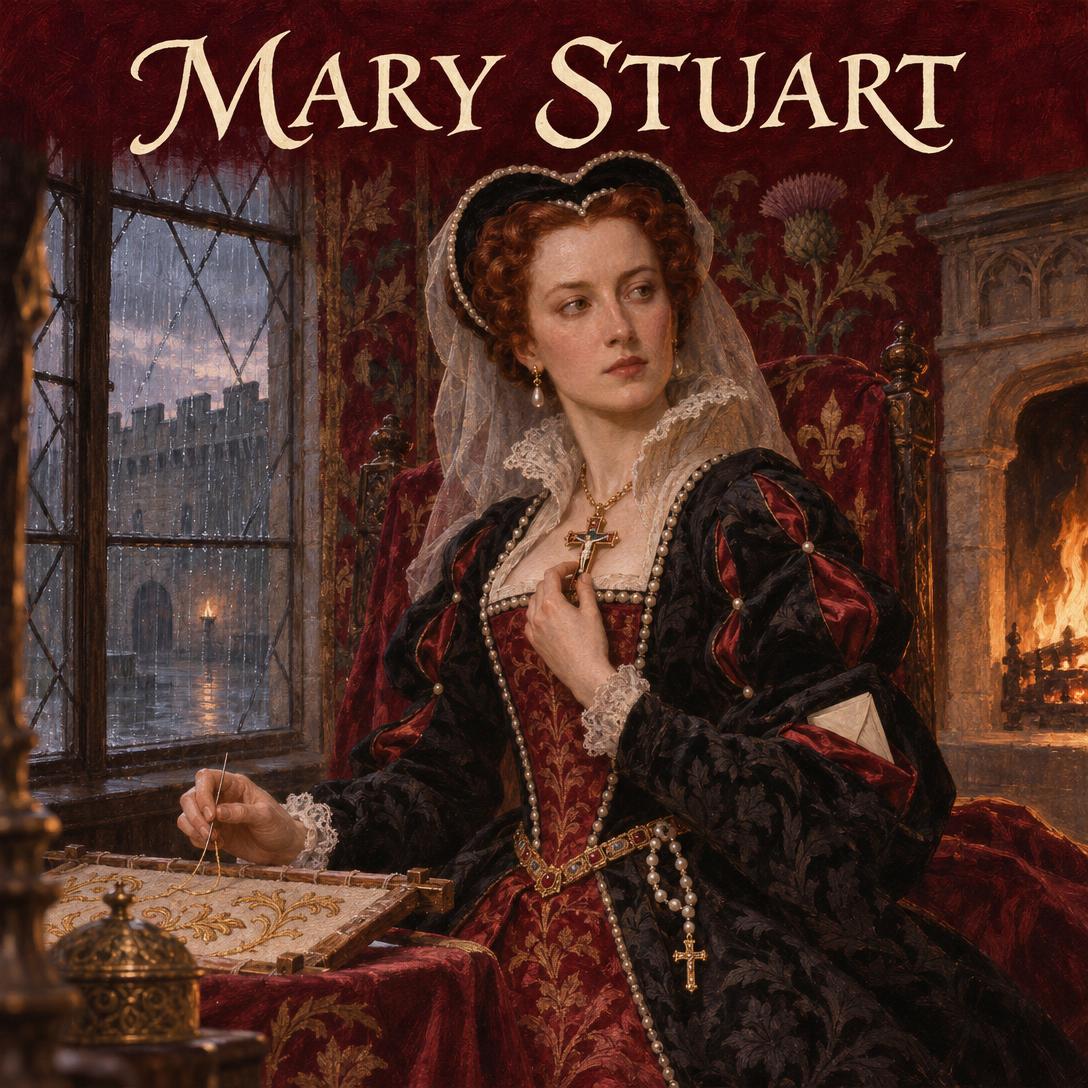
Roleplaying with Mary, Queen of Scots on Jenova lets you step into a living-world AI character simulation across the defining eras of her life. Unlike static character chatbots that sit in an empty chat room or forget your story, this simulation connects you to Mary Stuart inside an active, evolving world. Her gentlewomen, custodians, ministers, and rivals move around her while you talk.
- ✅ Five canonical eras, from the Valois court to Fotheringhay Castle
- ✅ Era-locked knowledge, so Mary never "knows" what has not yet happened to her
- ✅ Unlimited memory and live world-state tracking across long campaigns
- ✅ Letters, visions, and alternate "what-if" timelines you can branch and revisit
Mary Stuart's life is a gift for interactive storytelling: a queen from infancy, a French court darling, a prisoner for nearly two decades, and a prolific correspondent. This guide explains what the experience is, how it works, and which scenarios are worth playing first.
Quick Answer: What Is Mary, Queen of Scots AI Roleplay?
Mary, Queen of Scots on Jenova is an interactive AI character roleplay simulation where you converse with Mary Stuart inside authentic canonical eras, earn her trust, and steer an open-ended story that can diverge from recorded history.
Key capabilities:
- Choose from five canonical eras or define a custom starting point in Mary's 16th-century world
- Converse with a Mary whose voice, worldview, and knowledge match the moment you enter
- Earn rapport over time, since she judges your counsel instead of simply agreeing
- Request in-world visions and royal letters, and fork the story into alternate timelines
Character World & Roleplay Features
Who Mary Stuart Was, and Why She Suits Roleplay
Mary was born on 8 December 1542 at Linlithgow Palace, the daughter of James V of Scotland and Mary of Guise. She became Queen of Scots when she was just six days old and was crowned nine months later. Her story runs through three realms: Stewart Scotland, Valois France, and Tudor England.
She also left an unusually rich paper trail. A Victorian collection, Letters of Mary, Queen of Scots, and Documents Connected with Her Personal History, was published in 1843. William Boyd's Calendar of the State Papers Relating to Scotland and Mary, Queen of Scots preserves diplomatic correspondence from her reign and captivity. Her voice, her diplomacy, and her isolation are well documented, which gives a character simulation plenty of material.
Why Standard Character Bots Fall Flat
Most AI character chatbots share the same weaknesses:
- The waiting-room vacuum: the character does nothing until you type.
- Personality bleed: the teenage Queen of France and the weathered prisoner of Fotheringhay talk the same way.
- Context amnesia: plot twists, confessions, and promises disappear after a few exchanges.
- Assistant behavior: the character agrees with everything you say, which drains the tension from any story.
Mary, Queen of Scots on Jenova is built to avoid each of these. The table below shows the difference.
| Static Character Chatbots | Mary, Queen of Scots on Jenova |
|---|---|
| Sits in an empty chat void | Lives in an active, evolving world |
| Blends all eras into one generic voice | Locks into authentic canonical phases |
| Forgets plot twists and past disclosures | Unlimited memory and live state tracking |
| Folds instantly like a polite assistant | Independent personality and earned rapport |
This is the kind of living-world simulation of Mary Stuart that the table describes.
Standout Mechanics
Authentic Canonical Phases & Custom Starting Points
You choose which chapter of Mary's life to enter, and each one has its own psychology, voice, and inner circle. Her knowledge is bounded by the moment, so she cannot foresee what history has not yet delivered to her. If none of the five eras fits, you can propose a custom starting point, such as welcoming her home to Leith from France.
An Unseen Voice and a Living World
By default, your words reach Mary as a hushed, unseen voice in her chamber, while her world keeps moving around her. A custodian may knock, a page may arrive with dispatches, or a gentlewoman may step in. You watch those exchanges unfold before Mary returns to your conversation. Mary assumes the channel carries only voice, so if you describe details of her room that you should not know, she reacts with suspicion.
Independent Agency and an Open Sandbox
Mary interprets what you say instead of obeying it. Candor, wit, and sound counsel earn her confidence, while insolence earns a glacial rebuke. Your warnings can change events, but only through 16th-century causes. She weighs an unverified stranger's claim as a shrewd queen would, and she accepts proof once it reaches her hands in the world.
In-Narrative Visions, Writings & Storyline Forking
You can ask to see something from her world, such as a heraldic embroidery panel or the view from her casement, and request a royal letter or an enciphered dispatch in her own hand. Historical details are checked silently in the background so her world stays accurate. Fork lets you branch any moment into a separate "what if" timeline without losing the original.
Example roleplay prompts:
"Your Grace, before you trust that courier, what do you actually know about the man?"
"If Elizabeth keeps refusing to meet you, what would you say to her face to face?"
"Teach me how a cipher alphabet protects a letter from prying eyes."
This is exactly what the Mary, Queen of Scots AI roleplay was built to do.
How to Roleplay with Mary, Queen of Scots
Step 1: Choose a Canonical Era or Define Your Own Starting Point
A new session opens with an illuminated chronicle-style menu that lays out each era and what Mary is doing in it. Pick one by number or title, or describe a custom moment, such as arriving at Holyroodhouse as a confidential envoy.
"I'll enter the Lochleven era. Take me to the evening before the escape attempt."
Step 2: Connect and Converse as Her World Unfolds
Mary notices your voice, pauses her task, and decides how to treat this unexplained communion. Speak naturally, since she answers in a lively, dryly ironic register rather than reciting a biography. Her ladies, guards, and visitors keep acting in the background.
"Forgive the intrusion. You seem to be hiding something in your sleeve."
Step 3: Offer Counsel, Build Rapport, and Reshape the Story
Trust develops over many exchanges, not in a single message. Ask her for a handwritten letter, request a vision of her chamber, or test an alternate decision, then fork the story if you want to try both outcomes. Because Mary stays in character from the moment you enter an era, the experience reads like a continuous story, not a Q&A session.
Try roleplaying with Mary Stuart on Jenova free, with no credit card required.
Canonical Eras & Roleplay Scenarios
👑 Radiant Queen of France & Three Realms
Scenario: Enter the Château de Blois in late 1559, when Mary is days short of seventeen. She is Queen Consort of France and Queen of Scots, and her Guise relatives press her claim to England's crown.
Static alternative: A biography summarizes the era in the past tense.
On Jenova: You talk with a confident, poetic young queen who has no idea how quickly her French reign will end. You can ask what she makes of Elizabeth Tudor's crown, how she thinks of her mother's struggles in Scotland, or how she plays the Valois court.
- Tests the sharp contrast between Mary's youth and her later years
- Features the Guise uncles, Catherine de' Medici, and the Four Marys in the cast
🕯️ Sovereign of Holyrood: Crown, Court & Intrigue
Scenario: Join Mary by candlelight in her supper chamber at Holyroodhouse in February 1566. She is pregnant, estranged from Darnley, and managing a fractious nobility.
Static alternative: Reading about court factions without being able to question anyone inside them.
On Jenova: You advise a queen who is balancing her private Catholic faith against a Protestant Scotland. If you warn her of danger, she will weigh your warning as a ruler would, and she will not simply believe you.
- Rewards political and strategic dialogue
- Lets you test how credible counsel changes the way she handles her advisers
🔐 Cipher Queen Under Guard
Scenario: Sit with Mary in the dusk-lit privy chamber at Sheffield in March 1571. She is a captive, but she directs her affairs by enciphered letters. The State Papers for these years show how much correspondence moved through her ambassador, the Bishop of Ross. Boyd's calendar notes that the Bishop was "ever at the service of his captive sovereign" and in near-constant contact with Elizabeth and Cecil.
Static alternative: Scanning archival catalogues and hoping a letter answers your questions.
On Jenova: You can ask why she trusts the couriers she does, how she handles the Earl of Shrewsbury's courteous scrutiny, and what she hopes Elizabeth will finally concede. The same papers record her signing a note to Cecil as "a poor prisoner", a vulnerable note beneath the regal surface that the roleplay can explore. Shrewsbury also reported that she suffered painful fits of grief and pain in her side, heart, and head, and the roleplay reflects that physical toll.
- Ideal for deep strategic and philosophical dialogue
- Pairs naturally with a requested enciphered letter or in-world dispatch
📱 A Long-Form Campaign on Your Phone
Scenario: Continue a story during a commute. Return to Mary's world and she picks up where you left off.
Static alternative: Starting from scratch each time and re-explaining your story.
On Jenova: Conversations persist, and live tracking keeps the era, scene, her feelings toward you, and active storylines current. When you return after a natural break, Mary's world has moved forward by a believable interval, such as hours or overnight.
- Syncs across web, iOS, and Android
- Fork lets you test a different choice without losing your main storyline
Frequently Asked Questions
Is Mary, Queen of Scots AI roleplay free?
Yes, you can start for free with limited monthly usage. Plus costs $20 per month, gives 30× the free usage, and adds custom model selection and no watermarks. Higher tiers add more usage if you run long campaigns. Usage resets monthly on your billing date, with no daily caps.
How is it different from a generic Mary Stuart chatbot?
A generic chatbot usually answers questions about Mary from one blended persona. This experience locks you into a specific era, keeps her knowledge to that moment, and runs a living world with her ladies, custodians, and ministers. She also keeps her own opinions, so rapport has to be earned.
Which eras of Mary's life can I roleplay?
You can enter five canonical eras: the radiant Queen of France at Blois, the pregnant sovereign at Holyrood, the island captive at Lochleven, the cipher-writing prisoner at Sheffield, and the defiant queen at Fotheringhay. You can also describe a custom starting point in her 16th-century world.
Can my choices change Mary's story?
Yes. Each era begins from its canonical premise, then the story is open-ended. Your counsel can change what Mary does, but only through realistic 16th-century causes such as couriers, eyewitnesses, and evidence reaching her. Fork lets you branch alternate timelines without overwriting the original.
Does it work on mobile, and does it remember our story?
Yes. Jenova syncs across web, iOS, and Android, and conversations keep unlimited history. A live tracker records the era, scene, your bond with Mary, and active storylines. Your Mary session stays isolated from your other chats so outside context does not leak into her world.
How historically accurate is it?
It is an interpretive roleplay, not a scholarly source. Era details are grounded in the historical record, and Mary's knowledge is deliberately limited to what she could plausibly know at the time. Historians still debate Mary's motives and choices, so for scholarship, consult primary sources such as Mary's printed letters and the state papers.
Conclusion
Mary Stuart's story has long drawn readers, from archival researchers to historical-fiction fans of novels like Margaret George's Mary Queen of Scotland and the Isles. Her
. What reading cannot do is let you ask her a question, offer her advice, and see how she responds.That is the shift from static chatbots to a living, evolving world. You enter an era, earn trust, and change the course of a story that history already recorded. Try Mary, Queen of Scots now. Explore more at Jenova.
For Developers: Mary, Queen of Scots is available programmatically via the Jenova API, so you can integrate era-locked character roleplay with persistent memory into your application with a single agent API call. Full documentation →