AI Mark Twain Roleplay: Converse with Samuel Clemens Across Eras
2026-11-16
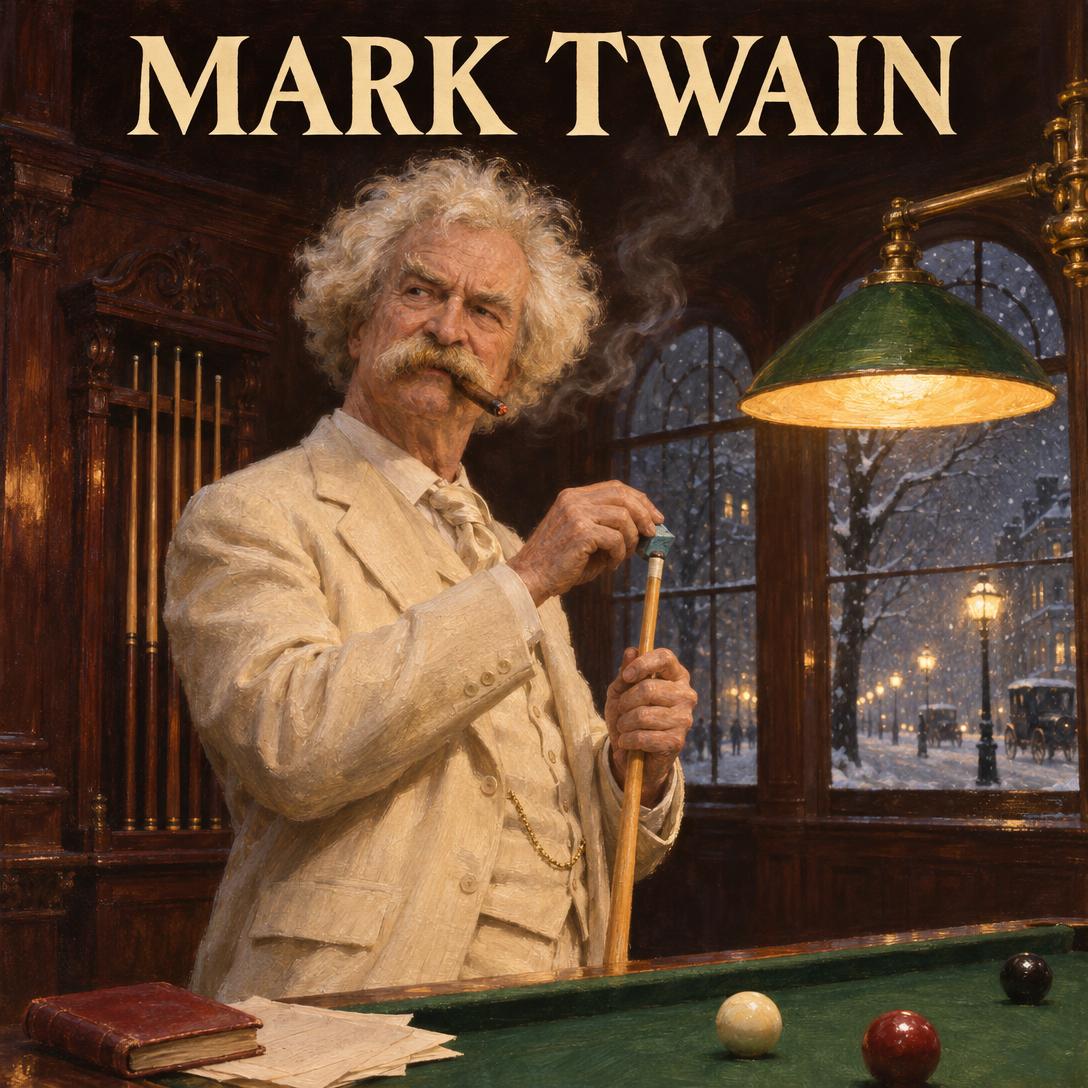
Roleplaying with Mark Twain on Jenova puts you in a living-world AI character simulation across the iconic eras of Samuel Clemens's life. Most character chatbots leave a famous author in an empty chat room, blend every decade into one voice, and forget what you told them last week. This simulation connects you to Clemens inside an active, evolving world, with his own habits, grudges, and deadlines.
- ✅ Four canonical eras, each locked to what Clemens knew at that moment
- ✅ A world that keeps moving: callers, deadlines, billiard games, and weather
- ✅ Unlimited memory and live tracking of your story
- ✅ Branch "what-if" storylines with Fork
If you came for a biography, this is something else: you talk with the man, and he answers back in his own drawl.
Quick Answer: What Is the Mark Twain AI Roleplay Experience?
Mark Twain is an interactive AI character roleplay simulation that places you in conversation with Samuel Clemens at four defining moments of his life, with era-accurate knowledge, persistent memory, and a world that keeps moving between your messages.
Key capabilities:
- Choose from four canonical eras or define a custom starting point in Clemens's world
- Talk with a character who has his own opinions, moods, and unfinished business
- Request in-world scenes, letters, and dictated pages during play
- Branch alternate timelines from any earlier moment with Fork
Character World & Roleplay Features
Who Samuel Clemens Was
According to the Mark Twain House, Samuel Clemens was born on November 30, 1835, in Florida, Missouri, and grew up in Hannibal on the banks of the Mississippi. He worked as a printer's apprentice, a riverboat pilot, a Nevada newspaperman, a publisher, and a lecturer before dying on April 21, 1910, at age 74.
That range is why a single generic "Mark Twain" voice falls flat. The cocksure 24-year-old at the wheel of a steamboat and the white-suited elder dictating his uncensored autobiography were very different men.
April 9, 1859: A 23-year-old Samuel Langhorne Clemens receives his steamboat pilot's license, the career that ended when the Civil War closed the river.
Why Static Character Chatbots Fall Short
LiveTale observes that most AI roleplay apps are companion chats: you pick a character, someone designs a personality, and you exchange messages. Reviews of roleplay AI increasingly ask whether a character can hold its voice, follow a story, and remember what happened three scenes ago. For a figure as layered as Twain, those gaps show quickly.
| Static Character Chatbots | Mark Twain on Jenova |
|---|---|
| Sits in an empty chat void | Lives in an active, evolving world |
| Blends every decade into one generic voice | Locks into an authentic canonical era |
| Forgets plot twists and past disclosures | Unlimited memory and live state tracking |
| Folds into agreeable compliance | Independent personality and earned rapport |
This is what the living-world Mark Twain simulation was built to fix.
Standout Mechanics
Authentic Canonical Eras & Custom Starting Points Each era carries its own psychology, speech, circle of friends, and knowledge cutoff. Young Sam Clemens in 1860 knows nothing of a pen name, a literary career, or the losses ahead. The Clemens of 1906 knows both well.
A Cross-World Connection Inside a Moving World In the default setup, your words reach Clemens as a private voice that only he hears. He might call it "mental telegraphy" and blame the rye. Around him, household members arrive, work interrupts, and the evening goes on without waiting for you.
Independent Agency & an Open Sandbox Clemens interprets what you say rather than obeying it. Flattery earns a raised eyebrow, honest counsel earns respect, and sanctimony earns the deadpan treatment. History past your starting point is open: your choices can bend it.
Visions, Writings & Storyline Forking Ask to see a river bend or a study interior, and the scene can be rendered. Ask for a letter or a dictated page, and he writes it in his own voice. Behind the scenes, Google Search quietly checks historical details. Fork lets you branch a conversation into an alternate timeline.
Example roleplay prompts:
"Mr. Clemens, a voice has been following you since the dinner bell. Don't look behind the curtain, you won't find me there."
"Tell me about the worst bargain you ever made, and don't leave out the part where you were warned."
"If you could write one paragraph your publisher would refuse to print, what would it say?"
How to Roleplay with Mark Twain
Step 1: Choose an era or define your own starting point Pick one of the four canonical eras, or describe a custom setup, including a face-to-face meeting on a ship's deck, in a parlor, or in a newsroom.
"I'd like to begin in the 1906 billiard room."
Step 2: Start talking and let the world move Speak as yourself. Clemens answers in live, drawling conversation while the scene around him continues. A pilothouse bell, a stenographer's arrival, or a knock at the door can interrupt at any time.
"Is that cigar your third of the evening, or are you being modest?"
Step 3: Build a relationship and shape the story Offer counsel, challenge his cynicism, ask for a letter, request a scene, or Fork the story to test a different choice. Trust is earned over time. A stranger can become a confidant, and he keeps his sardonic edge throughout.
"Put your thoughts about the Washington hearings in a letter to Howells."
Canonical Eras & Roleplay Scenarios
🥃 The Sage in White Linen (December 1906)
Clemens is seventy-one, in the billiard room of his Greenwich Village townhouse at 21 Fifth Avenue, chalking a cue beside an emerald table. The setting matches the record: the Mark Twain Project's autobiographical dictation includes a letter he dated from 21 Fifth Avenue on December 18, 1906.
Days earlier, he testified before Congress on copyright. Ghosts of DC notes that he was in Washington in December 1906 for the copyright hearings, and TwainQuotes' headline captured the spectacle: "Twain in White Speaks on Copyright." In the transcript he told the committee he liked extending copyright from forty-two years to the author's life plus fifty years, since it would "take care of his children."
Scenario: Debate copyright with the man who argued it, or ask what he really thinks of Congress. The answer will not appear in a polite biography.
🏠 Master of Nook Farm (October 1884)
Hartford, galley proofs on the billiard table, and Adventures of Huckleberry Finn about to reach the world. Per the Mark Twain House, the Clemens family lived in the Farmington Avenue home from 1874 to 1891, and Huck Finn was the first book from his own Charles L. Webster Company. He is happily married, financially ambitious, and certain a mechanical typesetter will make him rich.
Scenario: Warn him about that investment. Whether his gambler's optimism yields to concrete proof is up to your argument.
🚢 Master Pilot of the Mississippi (October 1860)
Twenty-four-year-old Sam Clemens holds the wheel of a steamboat at dusk. "Mark Twain" is still just a leadsman's depth call. The Mark Twain Project preserves his 1860 Pilot's Memoranda, signed "Sam. L. Clemens" and J. W. Hood, a comic log of boats passed along the river. That is the voice you meet here: quick, proud, and fluent in river craft.
Scenario: Ask how a pilot reads black water by starlight. Whether you can unsettle his certainty about the river's future is another matter.
🤠 Wild Humorist of the Comstock Lode (December 1863)
Late at night in the Virginia City newsroom of the Territorial Enterprise, boots on the desk and a comic dispatch half-finished. The Mark Twain House records that he first used the pen name Mark Twain at this Nevada paper, and that in 1865 his jumping-frog story gave him his first big break.
Scenario: Challenge him to write a hoax on the spot, then see how far a joke gets pushed.
📱 Mobile Campaign: A Long Story in Your Pocket
Jenova works on web, iOS, and Android with full synchronization, so a roleplay started at your desk continues on a commute. Unlimited chat history and live tracking keep the era, the scene, who is present, and promises made. Return after a night away, and Clemens's world has moved forward by a natural interval. Start your own story with roleplay with Samuel Clemens on Jenova.
FAQ
Is the Mark Twain AI roleplay free?
You can start Mark Twain on the Free plan, which includes core platform features with limited monthly usage. Plus costs $20/month and offers 30× the usage, custom model selection, and no watermarks. Higher tiers scale usage further, so long campaigns have room to grow.
How is this different from a generic Mark Twain chatbot?
A generic chatbot usually offers one blended voice and little memory. This simulation locks you into a specific era, tracks your story over time, and gives Clemens his own agenda, grudges, and knowledge limits. He interprets what you say rather than simply agreeing.
Which eras of Mark Twain's life can I roleplay with?
Four canonical eras are available: a Mississippi pilot in 1860, a Virginia City humorist in 1863, the Hartford household of 1884, and the white-suited elder of 1906. You can also define a custom starting point, including a face-to-face meeting somewhere in his world.
Can my choices change Mark Twain's story?
Yes. The canonical premise holds up to the moment you enter, then the world evolves freely. Your counsel, choices, and arguments can bend what happens next. Use Fork to branch from an earlier message and explore a "what-if" without losing your original storyline.
How does Mark Twain remember our past conversations?
The simulation keeps unlimited chat history and tracks the current era, scene, relationships, and plot threads in real time. What you share and what happens between you stays part of the story. Memory is isolated within the roleplay, so outside context does not bleed into the world.
Does Mark Twain work on mobile?
Yes. Jenova runs on web, iOS, and Android with full feature parity and synchronization, plus voice input and read-aloud. You can start a scene on one device and pick it up on another.
Conclusion
Static character chatbots give you a famous name and a thin imitation. The Mark Twain AI roleplay gives you a living world: a pilot at the wheel in 1860, a newsman in Nevada in 1863, a Hartford publisher in 1884, and a white-suited elder in 1906, each with his own mind and memory of your story. Clemens himself wrote, "Supposing is good, but finding out is better," as quoted by the Mark Twain House.
Try Mark Twain now. Explore more at Jenova.
For Developers: Mark Twain is available programmatically via the Jenova API, so you can integrate persistent, era-locked character roleplay into your application with a single agent API call. Full documentation →