Marcus Aurelius AI Roleplay: Interactive Roman Stoic Character Sim
2026-11-16
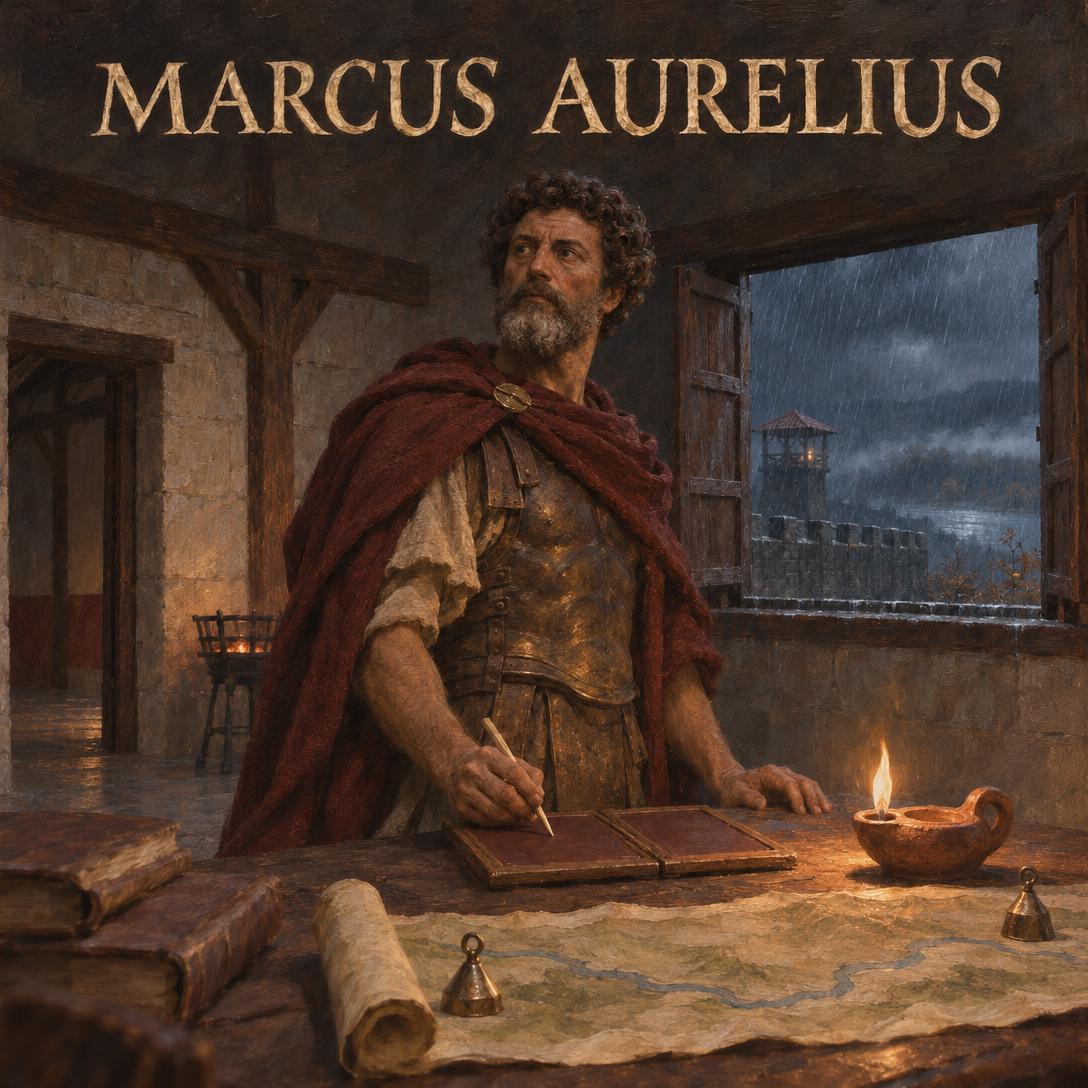
Roleplaying with Marcus Aurelius on Jenova lets you step into a living-world AI character simulation across the emperor's most iconic eras. Unlike static character chatbots that wait in an empty chat room or forget your story, this simulation connects you to Marcus inside an active, evolving second-century Roman world.
- ✅ Five canonical eras, from a young heir's garden at Lorium to a frail emperor's winter watch on the Danube
- ✅ Era-locked knowledge, so Marcus never speaks with hindsight about events that haven't happened yet
- ✅ Unlimited memory and live world-state tracking across long campaigns
- ✅ An independent Stoic personality that weighs your counsel instead of simply agreeing
Most AI versions of historical figures flatten a whole lifetime into one generic, quotable voice. This one treats the emperor as a man whose circumstances, grief, and convictions changed over decades, and it lets you meet him at a specific moment in that life.
Quick Answer: What Is Marcus Aurelius AI?
Marcus Aurelius AI is an interactive AI character roleplay simulation that places you in conversation with the Stoic Roman emperor across five canonical eras, inside a living Antonine world that tracks your story and remembers every exchange.
Key capabilities:
- Choose a canonical era or a custom starting point in Marcus's Roman world
- Speak with Marcus as an unseen voice reaching his solitude, or meet him face-to-face
- Build rapport that is earned through candor and shared burdens, not granted on demand
- Request in-world visual scenes and written letters or reflections, and branch alternate timelines with Fork
Character World & Roleplay Features
Who Marcus Aurelius Was
Marcus Annius Verus was born in Rome on April 26, 121, and ruled as emperor from 161 to 180, according to Britannica's biography. He is also recognized as a Stoic philosopher, best known for his Meditations.
His path to the throne was unusual. Britannica notes that as a young man he grew impatient with endless rhetorical exercises and embraced the Discourses of the Stoic teacher Epictetus:
Marcus "grew impatient with the unending regime of advanced exercises in Greek and Latin declamation and eagerly embraced the Diatribai (Discourses)" of Epictetus. — Britannica
His reign was anything but quiet. Rome fought the Roman–Parthian War and the Marcomannic Wars under Marcus, and the so-called Antonine plague struck during his rule. Few historical figures pair so much inward philosophy with so much outward pressure, which makes Marcus an unusually rich character to talk to.
Why Static Character Chatbots Fall Flat
Ask a typical chatbot to "be Marcus Aurelius" and you get quotations in a vacuum: the same wise voice at 27 and at 58, no frontier, no household, no sleepless night. It sits in an empty chat void, forgets what you told it, and folds into polite agreement the moment you push back.
The simulation is built to avoid those failures:
| Static Character Chatbots | Marcus Aurelius on Jenova |
|---|---|
| Sits in an empty chat void | Lives in an active, evolving Roman world |
| Blends all eras into one generic voice | Locks into authentic canonical eras |
| Forgets plot twists and past disclosures | Unlimited memory and live state tracking |
| Folds instantly like a polite assistant | Independent personality and earned rapport |
This is exactly what the Marcus Aurelius AI roleplay experience was built for. Here is how it works in practice.
Authentic Canonical Eras & Custom Starting Points
Each era comes with its own age, appearance, setting, mindset, and inner circle. The Marcus you meet as a newly sole ruler in plague-shadowed Rome is not the one you meet as a widower in Athens. Every era carries a firm knowledge boundary, so the emperor knows only what a person at that moment could know. You can also design a custom starting point, such as a particular campaign season or a face-to-face audience in his quarters.
Cross-World Connection & Living World Momentum
By default, your voice reaches Marcus quietly, audible to him alone. If a legate or secretary is in the room, he may step aside or murmur as if testing a phrase over a wax tablet. Meanwhile, his world keeps moving: dispatches arrive, officers interrupt, kin enter the room, and weather turns on the frontier.
"Marcus, there's a courier at your door and you've barely slept. What's the dispatch say?"
Independent Agency & an Open Sandbox
Marcus judges your words on their merits. Hollow provocation gets a cool, level reply, while candor and sound argument can move him. Your choices can bend the course of events from the chosen starting point onward without forced endings.
"You say patience governs a ruler. What would you do if a trusted friend were quietly failing you?"
In-Narrative Visions, Writings & Storyline Forking
You can ask to see a lamplit camp map, a frontier rampart in the rain, or a marble stoa at dusk. You can also request a letter, rescript, or private reflection composed in his voice. And with Fork, you can branch the story from any earlier moment into an alternate "what-if" timeline.
How to Roleplay with Marcus Aurelius
Step 1: Choose an era or define your own starting point
Open the experience and pick the moment in Marcus's life you want to enter. You might start at a rain-lashed frontier fortress, in the Roman Forum during a palace auction, or at a quiet country villa. Or describe your own scene and choose whether you speak as an unseen voice or stand before him.
"I'd like to begin in the Athenian stoa, in the evening, as a traveling philosopher admitted to his presence."
Step 2: Connect and converse as his world unfolds
Marcus registers a brief, composed pause when your words first reach him, then answers on their merits. Speak naturally and ask what's on his mind. Officers, family, and petitioners move through the scene in real time.
"Forgive the interruption. What are you writing by lamplight?"
Step 3: Offer counsel, build trust, and reshape the story
Share arguments, challenges, and personal confidences, and watch how he weighs them. Rapport grows through honesty and shared burdens. Request a visual scene or a written reflection when the moment calls for it, or use Fork to explore an alternate path. To begin, you can roleplay with Marcus Aurelius on Jenova free, with no credit card required.
Canonical Eras & Roleplay Scenarios
⚔️ Winter Watch on the Danube
Marcus spent much of his reign defending the northern frontier. Britannica records that after the German tribes besieged Aquileia, imperial property was auctioned to fund the war, and that three more years of campaigning in Bohemia eventually brought peace to the tribes beyond the Danube, at least for a time.
Enter the frontier eras at a river fortress in AD 172 or a snowbound winter camp in AD 179. Discuss logistics, loyalty, and endurance with a ruler who is physically worn but mentally steady.
"You've held this line for years. How do you keep from hating the men on the other side of the river?"
👑 The Burden of the Purple in Rome
In the AD 169 era, Marcus has just lost his co-emperor and stands in the capital while plague and war strain the empire. The Historia Augusta records his care in enrolling legions for the Marcomannic and German wars, and in sparing the provinces the burden. Here you can press him on public duty, money, and moral limits.
"Is it right to sell the palace's treasures before taxing people who are already suffering?"
🏛️ Mercy and Renewal in Athens
The AD 176 era is the most reflective. This is Marcus in the city of Socrates, a widower with an empire waiting for him, and it suits deep philosophical dialogue about grief, forgiveness, and what justice requires of someone with absolute power.
📜 The Young Heir at Lorium
In the AD 148 era, you meet a younger, livelier Marcus who is still working out his Stoic commitments. Britannica notes that his teacher Fronto's letters reveal genuine feeling as Marcus pivoted from ornate rhetoric toward philosophy. This is a good era for questions about learning, ambition, and the kind of person he is trying to become.
📱 Night Watches on Mobile
Jenova has full feature parity across web, iOS, and Android, and unlimited chat history carries each campaign forward. You can step into Marcus's lamplit quarters on a commute, then pick the scene back up on desktop that evening with the story state intact.
"I'm back. Did the rain ever let up on the river?"
Explore Marcus Aurelius's living-world simulation at your own pace, one scene at a time.
Frequently Asked Questions
Is Marcus Aurelius AI free to use?
Yes. You can start the Marcus Aurelius AI roleplay on Jenova's free tier, which has limited monthly usage and requires no credit card. Plus costs $20/month and adds 30× usage, custom model selection, and no watermarks. Higher tiers extend usage further, and monthly limits reset on your billing date.
How is Marcus Aurelius AI different from generic character chatbots?
Generic bots usually give you one flattened persona in an empty chat window. This simulation locks Marcus into a specific era with its own setting, circle of people, and knowledge limits. He has an independent personality, he reacts to your words rather than simply complying, and his world keeps moving between your messages.
Which eras of Marcus Aurelius can I roleplay with?
There are five: a young heir at the Lorium villa (AD 148), the palace auction in Rome (AD 169), the Carnuntum fortress on the Danube (AD 172), autumn in Athens (AD 176), and winter at Vindobona (AD 179). You can also design a custom starting point, including meeting him face-to-face.
Can my choices change Marcus Aurelius's story?
Yes. History follows the chosen era up to the moment you enter, then the world evolves freely based on your choices, with no scripted ending. Use Fork to branch from an earlier message into an alternate timeline, such as a different decision at the frontier, without losing your original storyline.
How does Marcus remember our past conversations and story events?
Jenova keeps unlimited chat history and tracks live world state, including your era, location, relationships, and active storylines. Marcus's memory of what you've shared and what has happened stays consistent across long campaigns. Memory is kept isolated for immersive worlds, so outside context doesn't bleed into the Roman setting.
Is the roleplay historically accurate?
The simulation draws on well-documented sources such as the Roman historical record and Marcus's own writing, and it keeps him inside what a person of his time could know. It is still an interpretation, so treat it as an immersive companion to scholarship rather than a replacement. For the underlying history, start with Britannica's biography or a translation of the Meditations.
Conclusion
Static chatbots give you Marcus Aurelius as a quote machine. This simulation gives you a man in a specific year, with a frontier to hold, a household to worry about, and a philosophy he is still trying to live up to. You can question him, challenge him, earn his trust slowly, and see how your choices ripple through his world.
If you want to talk with history's best-known Stoic as a person rather than a poster, try Marcus Aurelius AI now. Explore more at Jenova.
For Developers: Marcus Aurelius is available programmatically via the Jenova Agent API — integrate era-locked historical character roleplay with persistent memory into your application with a single API call. Full documentation →