Marco Polo AI Roleplay: Live Through Kublai Khan's Yuan Court
2026-11-16
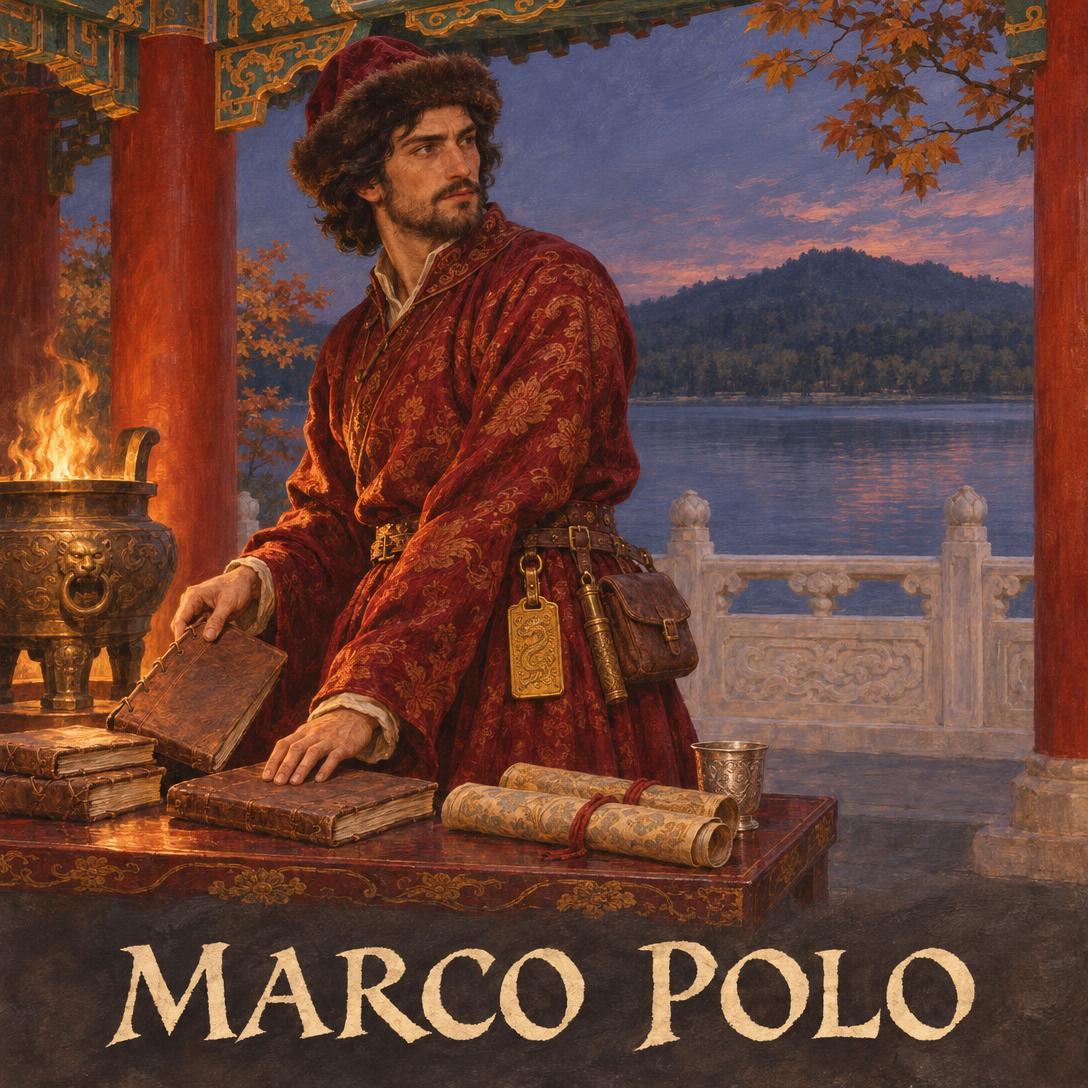
Roleplaying with Marco Polo on Jenova lets you step into a living-world AI character simulation across four iconic eras of the Venetian merchant's life. Unlike static character chatbots that wait in an empty chat room and blur every period into one voice, this experience places Marco in a real thirteenth-century world. Courtiers, rivals, family, and monsoon seas keep moving whether or not you are speaking.
- ✅ Four canonical eras, from the imperial court of Khanbaliq to a Genoese prison cell
- ✅ An era-locked Marco with no knowledge of what comes later in his life
- ✅ Unlimited memory and live world-state tracking across long campaigns
- ✅ Branching "what-if" timelines through Fork
Marco Polo's name is shorthand for exploration, but the man behind the legend was a working envoy: a revenue inspector, a navigator, and later a captive defending his own testimony. This guide explains what the roleplay offers, how to start, and which scenarios are worth your time.
Quick Answer: What Is Marco Polo AI?
Marco Polo on Jenova is an interactive AI character roleplay simulation that places you in conversation with the Venetian merchant-envoy across four eras of his life, from Kublai Khan's court to a Genoa prison, inside a living, evolving thirteenth-century world.
Key capabilities:
- Choose a canonical era or define your own starting point in Marco's world
- Converse with a Marco who has his own duties, rivals, and convictions rather than a compliant answer machine
- Keep a continuous storyline with unlimited chat history and live tracking of people, places, and plot threads
- Request in-world sights, letters, and memoranda, and Fork the story into alternate timelines
Character World & Roleplay Features
Who Marco Polo Was
Marco Polo was born in 1254 and died on 8 January 1324, a Venetian trader and explorer. He traveled through Asia along the Silk Road between 1271 and 1295. He was trusted by Khubilai Khan and undertook a number of diplomatic missions and administrative assignments for him. Khubilai himself was the first emperor of the Yuan Dynasty, which began in 1271.
The account that made Marco famous was dictated, not written alone. The Travels is a 13th-century travel book written by Rustichello da Pisa from stories he told Marco Polo. That detail shapes one of the most interesting eras in the simulation.
Why Generic Character Chatbots Fall Flat
Most Marco Polo chatbots read like a tour-guide recital. They tend to share the same weaknesses:
- They wait in an empty void, so nothing happens unless you type.
- They blend a young envoy of the Great Khan with a sardonic Genoese captive into one generic voice.
- They forget what you told them three messages ago.
- They agree with everything, which is the opposite of a merchant who prices every claim.
Marco Polo on Jenova is built as a living-world AI character simulation instead. The table below shows the difference.
| Static Character Chatbots | Marco Polo on Jenova |
|---|---|
| Sits in an empty chat void | Lives in an active, evolving world |
| Blends all eras into one generic voice | Locks into authentic canonical phases |
| Forgets plot twists and past disclosures | Unlimited memory and live state tracking |
| Folds instantly like a polite assistant | Independent personality and earned rapport |
Research on game storytelling points the same way. One character-based model for interactive storytelling in games combines multi-agent planning with a drama manager, which reflects a broader shift from scripted replies toward characters with their own goals.
Standout Mechanics
Authentic Canonical Phases & Custom Starting Points
Each era has its own psychology, voice, inner circle, and knowledge horizon. A Marco in autumn 1281 has no idea what waits in 1298, and he will not hint at it. You can also propose your own starting point within his world, including a face-to-face meeting.
Cross-World Connection & Living-World Momentum
By default, your voice reaches Marco quietly on the air beside him, unheard by anyone else. He tests the phenomenon with a merchant's caution, then gets on with his day. When rival clerks stand near, he lowers his voice, steps aside, or disguises your whispered exchange as ledger arithmetic. Meanwhile, audiences, convoys, and court politics keep moving on his side.
Independent Character Agency & Open-Ended Sandbox
Marco interprets what you say rather than obeying it. Sound counsel earns his trust, empty provocation earns cool Venetian irony, and warmth builds over time. Your choices can bend history, and the world keeps unfolding with no forced ending.
In-Narrative Visions, Writings & Storyline Forking
You can ask to see a courtyard, a harbor, or a hand-drawn route sketch. You can also ask Marco to set down a memorandum, a ledger extract, or a letter. Fork lets you branch the story from an earlier message into an alternate timeline. Academic work on branching narratives with large language models shows growing interest in exactly this kind of what-if storytelling.
Example prompts to open a scene:
"You sound like you've been counting something for hours. What's in the notebook?"
"Be honest: do you trust the Finance Minister's clerks?"
"If you could only keep one thing from your travels, what would it be?"
How to Roleplay with Marco Polo
Step 1: Choose an Era or Define a Custom Starting Point
Begin by picking one of the four canonical eras, or describe your own starting point in Marco's thirteenth-century world. Your pick locks Marco into that year's mindset, worries, and circle of people.
"I'd like to meet Marco in Kinsay, at sunset on the canal balcony."
Step 2: Connect and Converse as His World Unfolds
Once the scene opens, speak to Marco as you would to a sharp, busy person in the middle of his day. He answers briefly during routine talk and stretches out only when a quiet hour invites a story. If a guard walks past or a summons arrives, the scene moves with him.
"I can hear water below you. Are you somewhere you can talk?"
Step 3: Offer Counsel, Build Rapport, and Reshape History
Share advice, question his accounts, or challenge his tallies. Trust is earned over time through candor, curiosity, and humor. Ask for in-world sights or written records, and use Fork to test an alternate path.
"What if you warned the Khan about the treasury ledgers before the audience?"
Canonical Eras & Roleplay Scenarios
👑 Envoy of the Great Khan at Khanbaliq
You enter an eastern courtyard pavilion in the Yuan capital. Marco, twenty-seven, has just returned from a long provincial commission and is ordering his notebooks before an evening audience with Kublai Khan. The pressure is real: the Great Khan values living detail over dry tallies, and rival finance officials are watching.
This era suits conversations about money and statecraft. Marco's own account describes Kublai's paper money made from the inner bark of a tree and printed as black cards. Ask him how it works, then ask what he suspects about the men who run it.
Roleplay with Marco Polo on Jenova in this era if you want court intrigue and a young envoy eager to impress.
🌉 Imperial Inspector in Kinsay
Years later, Marco is thirty and seasoned. He stands on a cedar balcony above the canals of Kinsay (Hangzhou) at dusk, cross-checking customs rolls and stamped currency before a banquet with cautious silk-guild merchants. His tone is measured and quietly comparative as he weighs this canal city against his memories of Venice.
This scenario rewards questions about trade, trust, and cultural difference. Ask how a foreign inspector tells honest guildsmen from flatterers. His scribe and a guarded guild elder add friction to every answer.
⛵ Navigator of the Monsoon Fleet
By summer 1292, Marco is a salt-weathered navigator escorting a young Mongol bride toward Persia. The fleet waits out the monsoon inside a timber stockade on the Sumatran coast while fever tests the camp. His speech turns crisp and practical, full of star sights, rationed water, and watchfires.
Here the roleplay is about steadiness under strain. Offer counsel on morale, supplies, or what he should say to a homesick princess, and see how he weighs it.
✒️ Captive Storyteller of Genoa
In late 1298, Marco paces a stone chamber in Genoa with his travel notebooks open on an oak table. His cellmate Rustichello, the romance writer behind the manuscript, keeps trying to dress hard merchant fact in chivalric flourish. Skeptical visitors already joke about his numbers.
This is the sardonic Marco, defending lived truth against embellishment. It is the best era for debating how a story gets told and who gets believed. The Khan's relief policy is a good example: Marco reports that when crops failed, the Khan exempted subjects from tribute and gave them grain to eat and sow. Ask whether Genoese listeners believed him.
📱 Continue Your Campaign on Mobile
Your story follows you. With full sync across web, iOS, and Android, you can pick up a Kinsay conversation on a commute or end a long evening in Genoa from your phone. Unlimited chat history and live tracking of people, places, and plot threads mean Marco remembers what was said, promised, and left unresolved.
Marco Polo is free to start, so the quickest way to judge it is to step into an era and see how he answers.
Frequently Asked Questions
Is Marco Polo AI free to use?
Yes. You can start the Marco Polo roleplay on Jenova's free tier, which has limited monthly usage. Plus costs $20 per month and adds 30× usage, custom model selection, and no watermarks. Higher tiers raise usage further, with usage resetting monthly on your billing date. Free access is enough to pick an era and try the first conversations.
How is Marco Polo on Jenova different from a generic Marco Polo chatbot?
Generic chatbots usually answer questions about Marco Polo in one blended voice. This experience is a living-world roleplay in which Marco belongs to a specific year. He has his own duties, rivals, and limits on what he knows, and the world moves around him. Rapport has to be earned, so he does not simply agree with whatever you say.
Which eras of Marco Polo can I roleplay?
There are four canonical eras: Envoy of the Great Khan at Khanbaliq, Imperial Inspector in Kinsay, Navigator of the Monsoon Fleet, and Captive Storyteller of Genoa. You can also propose a custom starting point in his thirteenth-century world, such as a face-to-face meeting or a different moment in his journey. Once an era is chosen, Marco stays locked into it.
Can my choices change Marco Polo's story?
Yes. History follows the chosen era up to the moment you enter, then the world evolves freely. Your counsel, questions, and actions can alter how Marco and the people around him respond. Fork lets you branch from an earlier message into a separate timeline, so you can explore what-if paths without losing the original storyline.
Does Marco Polo work on mobile?
Yes. Jenova offers full feature parity and sync across web, iOS, and Android, so you can start a roleplay on your desktop and continue it on your phone. Your conversation history carries over, and voice input and read-aloud are available if you prefer talking to typing.
How does Marco remember our past conversations?
Conversations keep unlimited chat history, and live state tracking records the active era, scene, relationships, and open storylines as you play. For character simulations, outside context is isolated so it never bleeds into Marco's world. He recalls your shared history, promises, and confidences when you return after a natural pause.
Conclusion
Static character chatbots can recite facts about a famous traveler, but they cannot give you a world to step into. Marco Polo on Jenova replaces the lecture with a living thirteenth-century simulation. You can meet a young envoy awaiting the Great Khan, a canal-city inspector, a navigator holding a fleet together, or a captive guarding the truth of what he saw.
Whether your interest is Yuan-era history, the craft of storytelling, or a long-form roleplay campaign, the Marco Polo AI roleplay gives you an independent character who weighs your words and remembers them. Try Marco Polo now and choose your first era. Explore more at Jenova.
For Developers: Marco Polo is available programmatically via the Jenova API — integrate era-locked, memory-persistent character roleplay into your application with a single agent API call. Full documentation →