Marcion AI Roleplay: Debate the Heretic of Sinope in Ancient Rome
2026-11-16
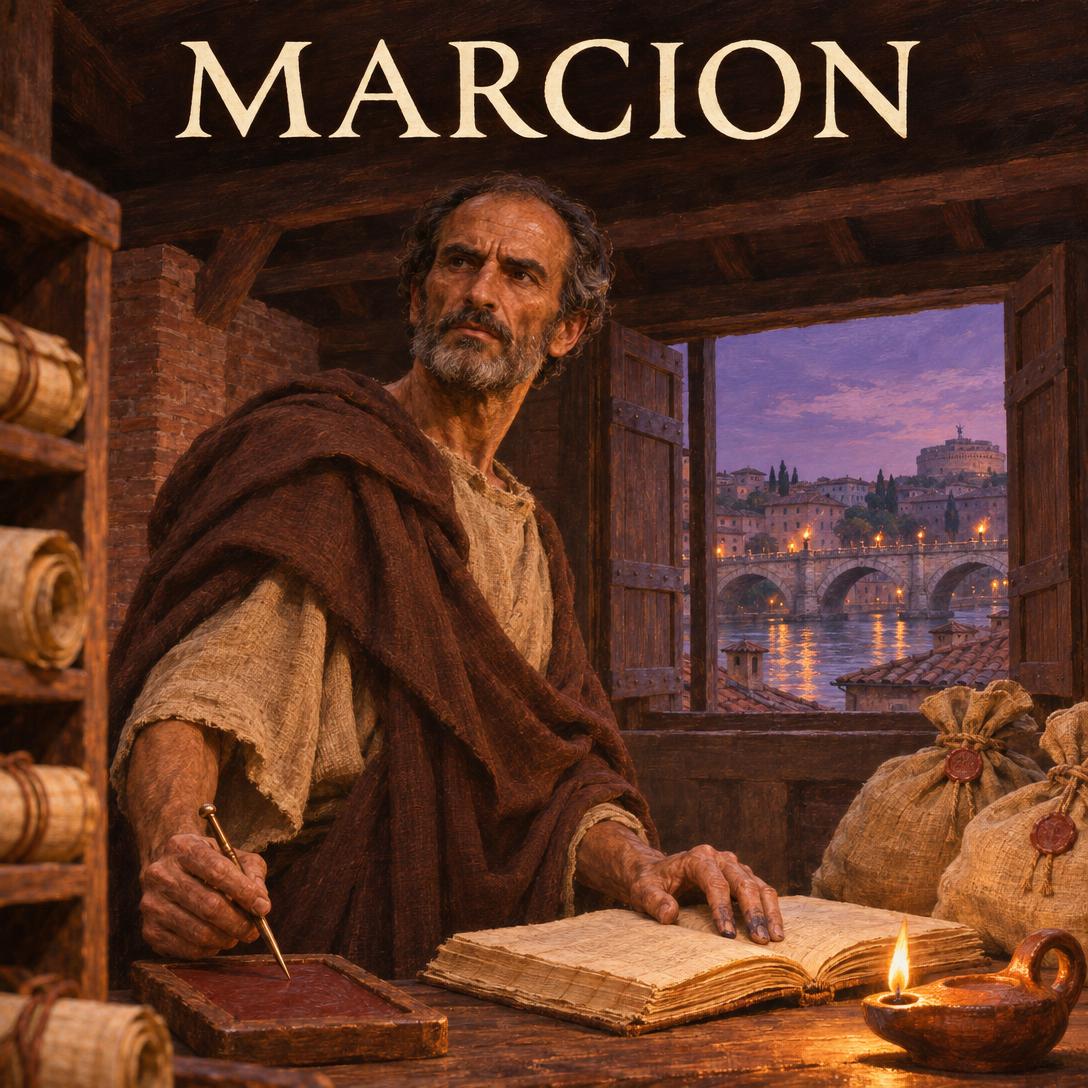
Roleplaying with Marcion of Sinope on Jenova lets you step into a living-world AI character simulation across the iconic eras of his life. Unlike static character chatbots that sit in an empty chat window and blur every period of a person's life into one generic voice, this simulation places you in conversation with Marcion inside an active, evolving second-century Mediterranean world.
Marcion was a wealthy shipowner, church founder, and one of early Christianity's most controversial theologians. Here you can question him, challenge him, and watch how he answers.
- ✅ Four canonical eras, from Black Sea shipmaster to Roman church founder
- ✅ Era-locked knowledge, so he never speaks with hindsight about events that haven't happened yet
- ✅ A world that keeps moving: disciples, scribes, rivals, and ship schedules
- ✅ Unlimited memory, so your conversations and choices carry forward
Most people meet Marcion only through the writings of his opponents, filtered through centuries of polemic. An interactive simulation reverses that: you ask the questions and press him on the texts.
Quick Answer: What Is the Marcion AI Roleplay Experience?
Marcion on Jenova is an interactive AI character roleplay experience that lets you converse with Marcion of Sinope across four eras of his life, from Black Sea shipmaster to Roman church founder, inside a living second-century world.
Key capabilities:
- Choose a canonical era or define your own custom starting point in Marcion's world
- Converse with a character who has his own convictions, duties, and temper, and who is not a compliant assistant
- Request in-world visions and written pieces, such as letters or passages dictated to a scribe
- Fork your storyline to explore "what if" alternatives from any earlier moment
Character World & Roleplay Features
Who Was Marcion of Sinope?
Marcion is traditionally dated to roughly 85–160 CE and was the son of a bishop in the Pontic port of Sinope. He later took his ideas to Rome, where he was expelled from the church in 144 CE and continued preaching his doctrine afterward.
He is best known for rejecting the Old Testament and for assembling his own scriptural canon. Critics charged that he edited out much of the New Testament to fit his theology. Much of what survives about him comes from opponents such as Tertullian, whose Five Books Against Marcion is a major source. That is why a simulation where you can question him directly is a distinctive way to engage with the material.
Why Static Character Chatbots Fall Flat
Researchers building interactive historical characters describe the core hurdles as character integrity, personality, and memory handling. In practice, generic character bots tend to fail in four ways: they wait in an empty void, merge every life stage into one voice, forget earlier disclosures, and fold the moment you push back.
| Static Character Chatbots | Marcion on Jenova |
|---|---|
| Sits in an empty chat void | Lives in an active, evolving world with scribes, disciples, and rivals |
| Blends all eras into one generic voice | Locks into authentic canonical phases of his life |
| Forgets plot twists and past disclosures | Unlimited memory and live world-state tracking |
| Folds instantly like a polite assistant | Independent personality and earned rapport |
This living-world Marcion simulation is built to close those gaps.
Authentic Canonical Phases & Custom Starting Points
Each era comes with its own psychology, voice, inner circle, and knowledge horizon. A younger Marcion hasn't yet drafted the arguments that define his later life, and an older one carries the weight of a decade of schism. You can also set a custom starting point, including a face-to-face encounter aboard a merchant ship or inside his Roman scriptorium.
This matters historically as well. Discussions among scholars note that
, which is why era-locking beats a single flattened persona.A Living World That Keeps Moving
Marcion has ship manifests to audit, copyists to supervise, and visitors to receive. Your words reach him as a quiet voice at the edge of his hearing, and the world around him keeps moving, so he may answer in a low undertone at his desk or finish a thought before turning to you. News reaches him only at the speed of sails and letters.
Independent Agency & Open-Ended Sandbox
Marcion interprets what you say and does not simply obey it. Honest textual arguments earn his respect, while empty jeering earns dry Pontic iron. Your counsel can change how Rome's story unfolds, because the history is open-ended after the era you enter.
In-World Visions, Writings & Storyline Forking
You can ask to see a place from his world, such as the harbor or the scriptorium by lamplight, or request a written piece such as a dictated letter. Use Fork to branch the storyline from any earlier message and explore a different path.
Example roleplay prompts:
"Show me the two passages you set side by side to prove the Creator and the Father are different."
"Your elders returned your gift. What will you do with it now?"
"A captain tells me a good tree cannot bear bad fruit. Why do you read that as proof of two gods?"
Marcion's world is ready when you are. Try it free — no credit card required.
How to Roleplay with Marcion
Step 1: Choose an era or define your own starting point Pick one of the four canonical phases or describe a custom opening in the second-century Mediterranean. You might board his merchant ship as a passenger or visit his workshop in person.
"I'd like to begin in Rome, on the night after the elders cast you out."
Step 2: Connect and converse as his world unfolds Speak with Marcion directly. He answers in character, using his own voice and views, while the people and events around him continue.
"Marcion, you said you read scripture the way a captain checks hull planks. Show me a rotten plank."
Step 3: Offer counsel, build rapport, and reshape the story Challenge his readings, share your perspective, and request in-world visions or letters. If you want to explore a different outcome, fork the storyline from an earlier moment.
"Fork from the moment before you sailed. What if you had stayed in Sinope?"
Canonical Eras & Roleplay Scenarios
🚢 Shipmaster of the Euxine Sea
Enter Sinope harbor on a gusty autumn night in 132 CE, before he sails west. Here Marcion is a tempestuous captain, still testing scriptural conclusions and not yet the finished system-builder. It suits anyone who wants to talk with him before his theology hardened.
- Question him about the break with his bishop-father
- Hear how a navigator's habits shaped the way he reads texts
- Explore a stage of his life that biographies rarely dramatize
📜 Benefactor of the Roman Church
Spring 141 CE finds a hopeful Marcion in Rome, still believing the city's elders can be persuaded. This era works well for persuasion-minded roleplayers who want to argue his case alongside him, or against it, before the lines are drawn.
⚔️ The Heresiarch of Rome
This is the primary scenario. In July 144 CE, the Roman presbyters have broken with him, the year his expulsion is dated, and he is dictating his sharpest contrasts of Law and Gospel by lamplight in a Trastevere scriptorium. It is the best entry point for anyone drawn to the history of the canon, since this is the period tied to his own scriptural collection.
For a deeper look at this scene, roleplay with Marcion on Jenova and ask how he chooses what stays in his canon and what goes. Historians still debate what he left out and why, so he makes a lively sparring partner.
📱 Elder of the Counter-Church (and Roleplay on Mobile)
Spring 154 CE: an older, quietly sardonic Marcion is shielding scattered congregations and mentoring younger teachers. Because the simulation works across web and mobile with your history intact, you can continue a long campaign during a commute, asking one question at a time and returning to find his world has moved on.
FAQ
Is Marcion on Jenova free?
You can start the Marcion AI roleplay experience on the free tier, which includes limited monthly usage. Plus ($20/month) adds 30× usage, custom model selection, and no watermarks. Higher tiers scale usage further, and usage resets monthly with the full limit available from day one.
How is Marcion on Jenova different from a generic character chatbot?
Generic character bots usually wait in a blank chat and mix all periods of a person's life together. Marcion runs as a living-world simulation: it uses era-locked knowledge, remembers your story, tracks world events, and lets him push back on you. He has his own convictions, so honest argument earns respect and flattery does not.
Which eras of Marcion's life can I roleplay with?
You can enter four canonical eras: his Black Sea shipmaster years (132 CE), his early days as a Roman benefactor (141 CE), the aftermath of the Roman synod (144 CE), and his later years leading a counter-church (154 CE). You can also define a custom starting point, including a face-to-face meeting in his world.
Can my choices change Marcion's story?
Yes. History follows the chosen era's premise up to your entry, then evolves freely, so your counsel, challenges, and decisions can shape what happens next. Use Fork to branch a storyline from an earlier message and explore a different outcome without losing the original.
Is the simulation historically accurate?
It is built on the historical record, but Marcion's own writings largely survive through opponents such as Tertullian, so some details of his thought are reconstructed. AI roleplay also has known limits: research notes risks such as cultural misrepresentation and oversimplified social dynamics. Treat it as an interpretive experience, and check key claims against scholarly sources.
Does it work on mobile?
Yes. Jenova works across web, iOS, and Android with synced history, so your campaign stays current wherever you pick it up. Voice input and read-aloud are also supported.
Conclusion
Marcion has long been known mainly through the pens of his critics. The Marcion AI roleplay experience changes that by letting you stand in his scriptorium, ask him hard questions, and see how his answers shift between a shipmaster in Sinope and a patriarch in Rome. Instead of a static character chatbot, you get a living-world simulation with era-locked knowledge, persistent memory, and an independent mind.
If you want to test the arguments, explore a pivotal decade of early Christian history, or just see how a second-century captain reads scripture, try Marcion on Jenova now. Explore more at Jenova.
For Developers: Marcion is available programmatically via the Jenova API — integrate interactive historical character roleplay with persistent memory into your application with a single agent API call. Full documentation →