Mansa Musa AI Roleplay: Interactive Mali Empire Character Sim
2026-11-16
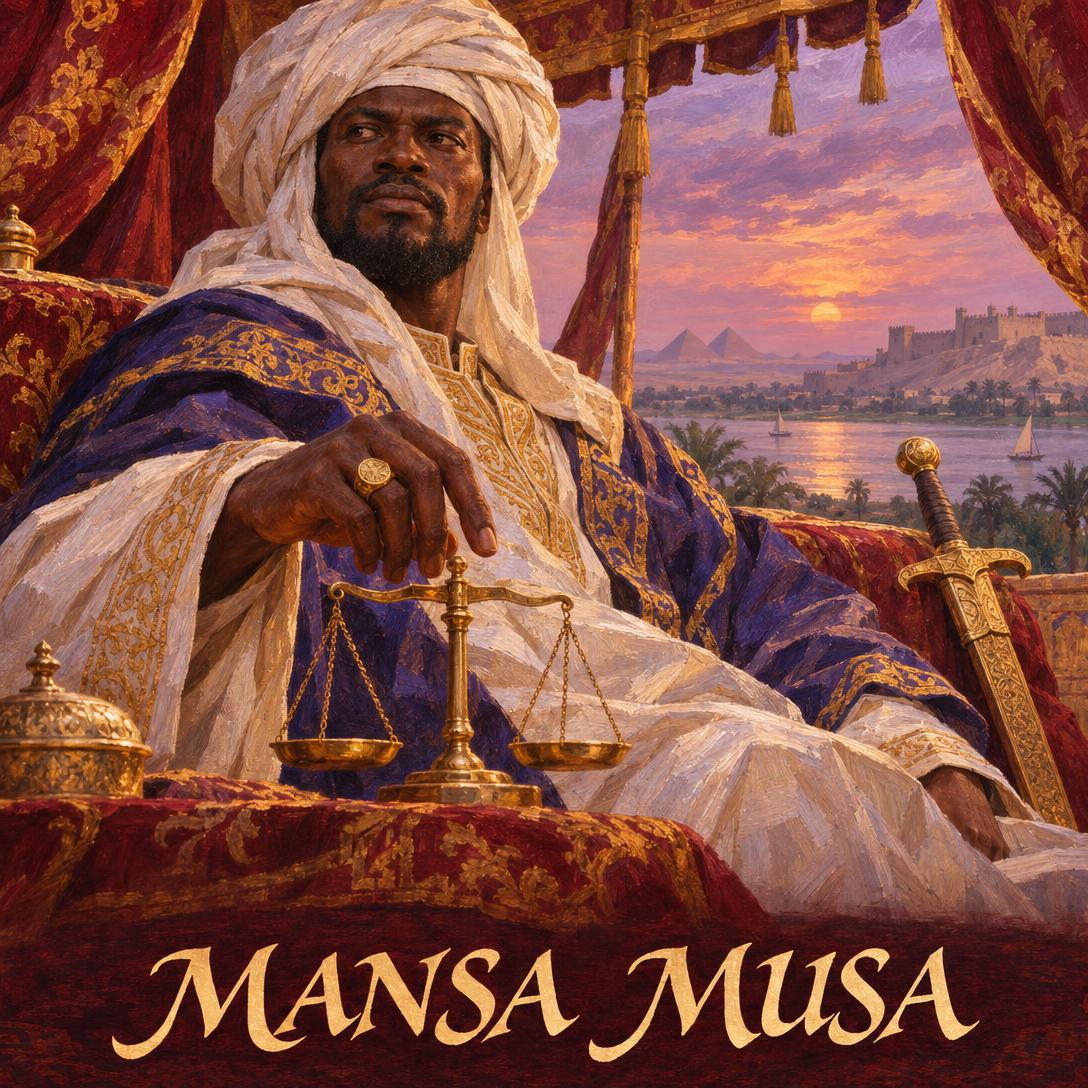
Roleplaying with Mansa Musa on Jenova lets you step into a living-world AI character simulation across his iconic canonical eras. Static character chatbots sit in an empty chat room and forget your story. This simulation connects you to the Mali emperor inside an active, evolving world of court politics, desert caravans, and a mind of its own.
- ✅ Four canonical eras, from the 1324 Hajj to a Civilization VI Golden Age, plus custom starting points
- ✅ Era-locked worldview, so he never speaks with hindsight he couldn't have had
- ✅ Unlimited memory and live world-state tracking across long campaigns
- ✅ An independent personality: trust is earned through candid counsel, not flattery
Mansa Musa is thought to be one of the wealthiest rulers in history, if not the wealthiest. Yet most chatbots reduce him to a single trivia line about gold. The sections below explain what he was actually like, why generic bots fall short, and how to step into his world.
Quick Answer: What Is the Mansa Musa AI Roleplay Experience?
Mansa Musa is an interactive AI character roleplay simulation that places you in a living-world version of the Mali emperor's life, from the 1324 Hajj to Timbuktu, so you can converse, advise, and reshape his story.
Key capabilities:
- Choose from four canonical eras or define your own starting point in his world
- Converse with an era-accurate Mansa Musa whose knowledge matches his moment in history
- Offer counsel on trade, faith, diplomacy, and architecture, and watch the world react
- Request in-world scenes and written charters, or fork the story into an alternate timeline
Character World & Roleplay Features
Who Mansa Musa Was, and Why It Matters for Roleplay
On July 19, 1324, the ruler of Mali arrived in Cairo on his way to Mecca. His pilgrimage made such an impression that al-'Umari, writing between 1342 and 1349, reflects the impression Musa left in Cairo. Al-'Umari drew on people who had met the emperor, and Ibn Battuta later recorded his own journey through Mali from February 1352 to December 1353.
Historical sources: The three most important Arabic sources for the Mali Empire at its height are al-'Umari, Ibn Battuta, and Ibn Khaldun.
Scholars continue to study the pilgrimage itself. Collège de France professor François-Xavier Fauvelle, for example, has published on the hajj of Mansa Musa in Arabic sources. The simulation draws on this record and keeps its details in the background of the story.
His gold-spending also has a famous afterlife. Popular retellings say his generosity depressed gold's value in Cairo for years, and the question of how much
. Some accounts put the aftermath at more than a decade. In the 1324 era, he hasn't yet seen those consequences, so you can watch him weigh them for the first time.Why Most AI Character Bots Fall Flat
Most AI versions of historical figures share four weaknesses: they wait in a void until you speak, blend every period into one generic voice, forget what you told them, and agree with whatever you say. Research on AI in complex social environments notes that this is hard to get right. It points out that many simulators rely on limited hand-crafted environments rather than open-ended worlds.
Mansa Musa's living-world AI character simulation is built around fixing these gaps:
| Static Character Chatbots | Mansa Musa on Jenova |
|---|---|
| Sits in an empty chat void | Lives in an active, evolving world |
| Blends all eras into one generic voice | Locks into authentic canonical phases |
| Forgets plot twists and past disclosures | Unlimited memory and live state tracking |
| Folds instantly like a polite assistant | Independent personality and earned rapport |
Standout Mechanics
Authentic Canonical Phases & Custom Starting Points. Each era has its own psychology, voice, inner circle, and knowledge horizon. A regent in 1312 doesn't know what the pilgrim-emperor of 1324 knows. You can also write your own starting premise, including a face-to-face encounter.
Cross-World Connection & Living World Momentum. You reach Mansa Musa as an unseen voice at his ear, or as faint script appearing on a sheet of paper beside his lamp. Courtiers, ministers, and family move through his scenes while the world keeps turning. Visitors address him through his herald, so your direct contact is immediately strange to him.
Independent Agency & Open-Ended Sandbox. He weighs your counsel against his faith, his clan alliances, and his treasury. Plain honesty earns his respect, and flattery or greed earns a cool rebuke. After the era's opening premise, events evolve freely, with no forced ending.
In-Narrative Visions, Writings & Storyline Forking. Ask to see a scene, and you can be shown a visual from his world. Ask him to put something in writing, and he can issue a charter or letter in his own voice. He checks historical details quietly in the background, and you can Fork any moment into a new "what-if" timeline.
Example roleplay prompts:
"The Emir says you must kiss the ground before the Sultan. How do you answer him?"
"Show me the courtyard at Niani as the sun sets over the Sankarani."
"Write a charter of safe-conduct for scholars traveling to Timbuktu."
How to Roleplay with Mansa Musa
Step 1: Choose an Era or Define Your Own Starting Point Your first screen is a narrator-style chronicle that lists the available eras and invites a custom start. Pick one by number or title, or describe a scene such as joining his caravan across the salt flats of Taghaza.
"I'll enter the Golden Hajj at Cairo."
Step 2: Connect and Converse as His World Unfolds Once you choose, the scene opens mid-moment, and Musa reacts briefly to your voice or script reaching him without passing his guards. From there, speak plainly. He answers in his own voice while ministers, relatives, and attendants come and go.
"I'm a traveler from far beyond your charted seas. Who do you trust most in this camp?"
Step 3: Offer Counsel, Build Rapport, and Reshape History Advise him on trade, faith, or architecture. Over time, his address toward you can warm from courteous curiosity to trusted private counsel. Ask for visuals or written charters, or fork the story to test a very different decision.
"Fork this moment: what if you accepted the Citadel audience on different terms?"
Try Mansa Musa free — no credit card required.
Canonical Eras & Roleplay Scenarios
The experience offers four canonical starting points:
- The Golden Hajj at Cairo (1324 CE): He is encamped outside Cairo, within sight of the Nile and the pyramids, moments after a Mamluk emir pressed him on court protocol.
- Regent of the Atlantic Horizon (1312 CE): A young regent at Niani, on the eve of formal proclamation, privately haunted by what lies beyond the western sea.
- Architect of Timbuktu & the Niger Bend (1325 CE): He has returned from Mecca and stands over foundation plans with an Andalusi architect. Timbuktu's later fame makes this a natural era for city-building and scholarship.
- Sovereign of Desert Gold (Civilization VI): A booming, jovial merchant-king in his stylized game incarnation, weighing which wonder or alliance to buy next.
👑 Counsel a Sovereign at the Cairo Camp
Scenario: You enter the 1324 era and advise him on how to honor the Hajj without compromising Mali's dignity before the Mamluk court. Static chatbot approach: A one-paragraph summary that always agrees with you. Mansa Musa: He weighs your advice against his faith and his brother's treasury warnings, and he may push back.
- His responses stay inside 1324, with no future hindsight
- Family and court figures react in the scene
🕌 Plan a Landmark in Timbuktu
Scenario: In the 1325 era, you discuss mosque elevations and scholarly patronage with him and his architect. Static chatbot approach: Generic trivia about "a famous mosque." Mansa Musa: He treats it as an ongoing project, asks about materials and craft, and can issue an in-world endowment letter.
🌀 Fork a "What-If" Timeline
Scenario: After a pivotal decision, you branch the story and see how events diverge. Static chatbot approach: Starts over from scratch and loses your progress. Mansa Musa: Both timelines persist, with the world state tracked in each.
- Keep the original timeline intact
- Compare how different counsel changes his court
📱 Continue a Campaign on Your Phone
Scenario: You started a long roleplay at your desk. On your commute, you pick up the same Niani audience on mobile. Static chatbot approach: Separate apps, broken context, and a forgotten storyline. Mansa Musa: The Mansa Musa AI roleplay experience keeps your unlimited chat history and world state in sync across web, iOS, and Android, and voice input works for hands-free scenes.
FAQ
Is the Mansa Musa AI roleplay free?
Yes, you can start free with limited monthly usage. The Plus plan at $20 per month gives 30× the usage of the free tier, plus custom model selection and no watermarks. Higher tiers scale usage further for long campaigns.
Which eras of Mansa Musa can I roleplay with?
Four: the Golden Hajj at Cairo (1324), his regency at Niani (1312), the building of Timbuktu (1325), and his Civilization VI Golden Age incarnation. You can also describe a custom starting point, including a face-to-face meeting in his world.
How is Mansa Musa different from a generic character chatbot?
It lives in a running world instead of waiting for a prompt. Each era locks his knowledge and voice to its moment, memory carries across your whole campaign, and he keeps his own convictions rather than agreeing automatically.
Can my choices change Mansa Musa's story?
Yes. History follows the chosen era's premise up to your entry, then evolves freely with no forced ending. What happens in play stands, so earlier events and spoken words remain part of the story. You can also fork the story to explore alternate paths.
Is the roleplay historically accurate?
It draws on documented sources such as al-'Umari and Ibn Battuta, but it is an interactive simulation, not a textbook. Some elements, like the Civilization VI era, are deliberately stylized. Treat it as a creative companion to historical reading, not a replacement.
Does Mansa Musa work on mobile?
Yes. The experience works on web, iOS, and Android with full synchronization, so you can switch devices mid-scene and keep your history and world state.
Conclusion
Static character bots treat Mansa Musa as a fact sheet. This AI character roleplay simulation treats him as a person with duties, convictions, and a world that keeps moving. You choose the moment, from the Cairo camp to Timbuktu's foundations, and your counsel, candor, and decisions shape what follows.
If you want a Mali Empire roleplay that remembers your story and answers with an independent mind, try Mansa Musa now. Explore more at Jenova.
For Developers: Mansa Musa is available programmatically via the Jenova API — integrate living-world historical character roleplay into your application with a single API call. Full documentation →