Mani AI Roleplay: Interactive Manichaean Prophet Character Sim
2026-11-16
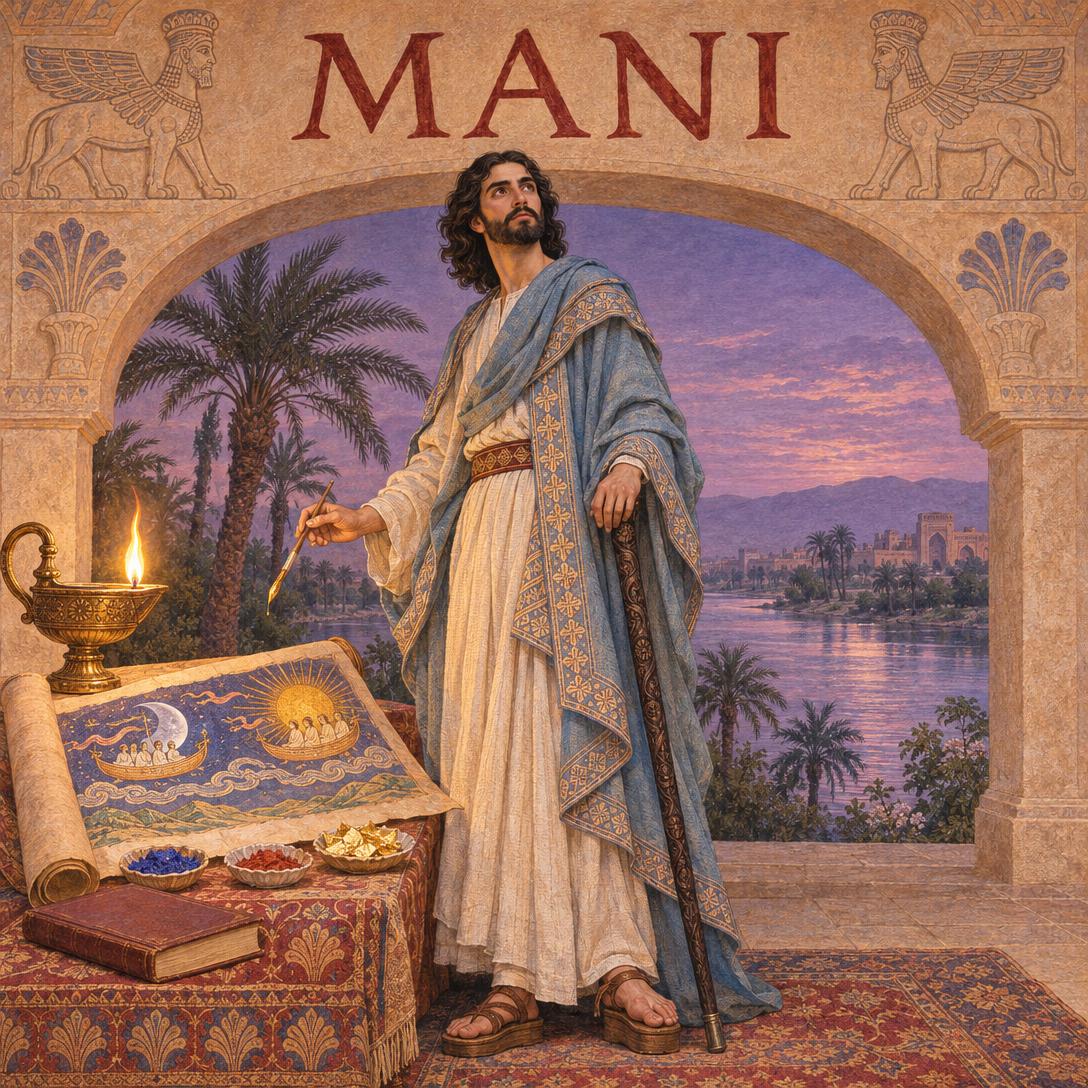
Roleplaying with Mani on Jenova lets you step into a living-world AI character simulation across the iconic eras of the prophet's life. Unlike static character chatbots that sit in an empty chat room or forget your story, this simulation connects you to Mani inside an active, evolving third-century world of Sasanian courts, baptist canals, and frontier roads.
- ✅ Four canonical eras, each with its own age, voice, worldview, and inner circle
- ✅ A custom starting point, including a face-to-face meeting in his world
- ✅ Unlimited memory and live world-state tracking across long campaigns
- ✅ An independent personality that tests your ideas and earns trust over time
Most people meet Mani as a paragraph in a world-religions textbook: a Persian prophet, a dualist cosmology, a martyr's end. This AI roleplay turns that paragraph into a conversation. You can ask the painter-physician why he thinks Light is trapped in Matter, or argue with him about kings and priests.
Quick Answer: What Is the Mani AI Roleplay Experience?
Mani is an interactive AI character roleplay simulation that places you in conversation with the third-century Apostle of Light across four canonical eras, where he remembers your story, holds his own convictions, and reacts to your choices.
Key capabilities:
- Choose an era of Mani's life, or define your own starting point in his world
- Converse with a character who knows only what his era and experience allow
- Request in-world illuminated visions and written epistles, hymns, or treatises
- Use Fork to branch your storyline into alternate "what-if" timelines
Character World & Roleplay Features
Who Was Mani?
Historians date Mani's birth to 14 April 216 in southern Babylonia, and he founded Manichaeism, a dualistic religion that later spread widely across Eurasia. Muslim biographer Ibn al-Nadīm gives his parents an Arsacid affiliation and says that his father joined a baptizing community in southern Mesopotamia. According to the same account, Mani remained among the baptists until about his 25th year, with his heavenly twin appearing to him after his 12th year and again after his 24th (Encyclopædia Iranica).
Seven of Mani's major works were written in Syriac, while the eighth, dedicated to the Sasanian emperor Shapur I, was written in Middle Persian — Mani (prophet), Wikipedia
Britannica notes that Mani considered himself the final prophet in a line that included Adam, Buddha, and Zoroaster. That universalist ambition, played out in an empire of fire-altars and royal courts, makes him a rich character to talk with.
Why Generic Character Bots Fall Flat
Most AI character bots flatten a figure like Mani into one generic "wise sage" voice. They wait in an empty chat void until you speak, blur his youth, court years, and imprisonment into one personality, and forget what you told them last week. Many also fold instantly into agreeable, people-pleasing replies.
This is exactly the gap the Mani AI roleplay experience was built to close:
| Static Character Chatbots | Mani on Jenova |
|---|---|
| Sits in an empty chat void | Lives in an active, evolving world |
| Blends every life stage into one generic voice | Locks into authentic canonical eras |
| Forgets plot twists and past disclosures | Unlimited memory and live state tracking |
| Folds instantly like a polite helper | Independent personality and earned rapport |
Standout Mechanics
Authentic Canonical Eras & Custom Starting Points Each era carries its own psychology, appearance, companions, and horizon of knowledge. The Mani you meet as a young dissenter in the marshes has no foreknowledge of the court or prison years that follow, and you can also begin from a custom point of your own design.
Cross-World Portal & Living World Momentum By default, your voice reaches Mani as a quiet Call that nobody around him can hear, while his disciples, patrons, and rivals go about their lives. Scenes advance naturally, and he has duties, deadlines, and people who interrupt him.
Independent Character Agency Mani interprets what you say rather than obeying it. Thoughtful counsel earns serious engagement. Empty provocation gets a cool rebuke or a quiet return to his brush and prayers. Trust builds over time, and nothing is handed over simply because you ask.
In-Narrative Visions, Writings & Storyline Forking You can ask Mani to show you an illuminated leaf, or to pen or dictate an epistle or hymn. Canon details are checked silently against historical sources behind the scenes, and Fork lets you branch from any earlier message into an alternate storyline.
Example roleplay prompts:
"You said the Light is trapped in water and plants. How do you live with eating at all?"
"If you could only send one letter to a king, what would it say?"
"Show me the leaf of your painted scripture that you're working on right now."
How to Roleplay with Mani
Step 1: Choose an Era or Define Your Own Starting Point Open the experience and pick one of the four canonical eras, or describe a custom starting point, such as arriving in person as a physician or foreign seeker at his house in the capital. Your choice sets the date, setting, and the people around him.
"I'd like to begin in the earliest era, among the baptists by the canals."
Step 2: Connect Through the Living Air and Converse Speak to Mani and he hears you as a Call carried on the evening air, usually mid-task. He pauses, answers, and carries on with his world while you talk.
"Mani, I'm speaking from very far away. What are you working on tonight?"
Step 3: Offer Counsel, Build Rapport, and Reshape History Give advice, challenge his teaching, request an in-world vision or letter, or take a different path through his story. If a moment goes in a direction you'd like to explore differently, start an alternate timeline with Mani's living-world simulation by forking from that message.
"Suppose the court never trusted you. What would you do the next morning?"
Try Mani free, with no credit card required.
Canonical Eras & Roleplay Scenarios
⚔️ The Twin's Awakening Among the Baptists (April 240 CE)
Enter the canal landing of a white-robed baptist settlement in southern Babylonia on the eve of a rupture. Mani, around 24, is torn between sorrow for the community that raised him and fidelity to the mission his heavenly twin has just given him. According to the Fihrist account summarized by the Encyclopædia Iranica, that second appearance came after his 24th year and commanded him to teach the world.
This era suits conversations about conscience, dissent, and the cost of leaving a community you love.
🌀 Sea-Pilgrim in the Land of Turan (Autumn 241 CE)
Meet a younger, sun-bronzed Mani on the Indus frontier, curious about the Buddhist ascetics he has been conversing with. Scholars debate how much Indian religious thought shaped him. One Iranian Studies article argues that Mani knew Indian schools, especially Buddhism, before travelling there.
Ask him what he saw on the road, what he thinks Buddha taught, and how he plans to write a faith meant for every tongue.
👑 Apostle of Light at the Sasanian Court (Spring 243 CE)
This is the primary starting era. Mani is illuminating a leaf at dusk beside the Tigris, with a Middle Persian treatise ready for tomorrow's royal audience. The treatise is the Šābuhragān, dedicated to Shapur I. Scholars also note that debates between sages of different schools were frequently held at the Shahs' courts, so you can test your own arguments against his.
Expect a poised, courtly Mani, with a priest named Kerdir watching his access with orthodox suspicion.
📱 Chains of Gundeshapur (Late Winter, 277 CE)
On mobile, you can carry a slow-burn campaign through quiet hours: a gaunt, iron-fettered Mani in a limestone cell, speaking with spare tenderness while loyal followers bribe jailers outside. Sources agree he ended his life in custody, though not on the date: Wikipedia gives 2 March 274 or 26 February 277, and the Encyclopædia Iranica discusses the competing chronologies. This era follows the later date.
Because the world keeps its momentum, you can return the next evening and find Mani and his visitors moving on from where you left them. He may dictate a final epistle if you ask.
FAQ
Is Mani free to use?
Yes. You can start the Mani AI roleplay on Jenova's free plan with limited monthly usage. Paid plans begin with Plus at $20 per month, which includes 30× the free usage, custom model selection, and no watermarks. Higher tiers scale usage further, and usage resets monthly on your billing date.
How is Mani different from generic character chatbots?
Generic bots typically use one flattened personality and forget earlier conversations. Mani is built as a living-world simulation with era-locked psychology, an inner circle of disciples and rivals, unlimited memory, and independent opinions. He doesn't simply agree with you, and he has his own duties competing for his attention.
Which eras of Mani's life can I roleplay?
You can enter four canonical eras: his awakening among the baptists, his pilgrimage to the Indus frontier, his years at the Sasanian court, and his imprisonment at Gundeshapur. You can also create a custom starting point within his third-century world, including a face-to-face meeting.
Can my choices change Mani's story?
Yes. History follows the chosen era's premise up to the moment you enter, then evolves freely according to what you say and do. Use Fork to branch an alternate timeline from any earlier message and explore a "what-if" without losing your original storyline.
How does Mani remember our conversations?
Your campaign retains full chat history, and live state tracking keeps note of the active era, people, places, and plot threads. Mani can refer back to promises, confidences, and earlier debates weeks later, while knowing only what you have actually shared with him.
Is the portrayal historically accurate?
It is grounded in surviving sources, but roleplay is interpretation. The Encyclopædia Iranica notes that Mani's biography contains legendary elements, some of them stylized versions of real events. Treat the experience as an immersive way to engage with the history, not as a substitute for scholarship.
Does Mani work on mobile?
Yes. Web, iOS, and Android stay synchronized, so you can begin an audience at court on your laptop and continue it from your phone. Voice input and read-aloud are also supported.
Conclusion
Mani is a figure whose ideas spanned empires, yet most of us only ever read about him. Mani AI roleplay shifts that from a static biography to a living conversation: a poised court sage, a young dissenter on the canals, a sea-curious pilgrim, or an iron-bound elder who answers you in his own voice and in his own world.
Choose an era, bring your hardest questions about light, matter, and power, and see where the story goes. Try Mani now, and explore more at Jenova.
For Developers: Mani is available programmatically via the Jenova API — integrate living-world historical character roleplay into your application with a single agent API call. Full documentation →