AI Manga Story: Create Professional Visual Narratives Without Drawing Skills
2026-02-25
The global manga market is expanding from USD 19.35 billion in 2025 to USD 23.12 billion in 2026—a remarkable 19.52% CAGR projected to reach USD 56.38 billion by 2031, according to Mordor Intelligence. Simultaneously, AI manga story technology has evolved from experimental curiosity to production-ready creative tool, enabling storytellers worldwide to transform their written narratives into professional visual stories—without years of artistic training.
Jenova's Manga Creator addresses the fundamental challenge that has historically locked independent creators out of visual storytelling: transforming compelling written narratives into professional manga with consistent characters, authentic panel flow, and publication-ready output across entire projects. Powered by frontier AI models including GPT-5.2, Claude Opus 4.5, Gemini 3 Pro, and Grok 4.1, these specialized agents understand both the craft of storytelling and the visual grammar of Japanese sequential narrative.
Why AI manga story tools have arrived:
- ✅ Story-to-visual pipeline enabling writers to create professional manga
- ✅ Character consistency solved through reference sheet systems
- ✅ Five professional art style templates (Shonen, Shoujo, Seinen, Slice-of-Life, Chibi)
- ✅ No drawing skills required—narrative-first workflow
Quick Answer: What Is an AI Manga Story Generator?
An AI manga story generator is a specialized tool that transforms written narratives—plot outlines, character descriptions, and scene directions—into professional manga pages with consistent artwork, authentic panel layouts, and visual storytelling that matches the narrative's emotional beats.
Key capabilities that distinguish AI manga story tools from generic image generators:
- Narrative-to-visual translation converting story beats into appropriate panel compositions
- Character reference systems that lock appearances across entire projects
- Style templates matching major manga traditions (Shonen, Shoujo, Seinen)
- Pacing optimization ensuring visual flow matches narrative rhythm
- Dialogue integration with appropriate speech bubble placement and styling
The Manga Creator specializes in maintaining these elements across one-shots to 200+ page serialized epics—solving the biggest pain point in AI-assisted visual storytelling.
The Problem: Why Manga Storytelling Remained Inaccessible
Despite the booming market, aspiring storytellers face substantial barriers that have historically excluded writers from visual narrative creation.
💰 The Prohibitive Cost Barrier
Professional manga production remains financially out of reach for most independent storytellers:
$50-$300 per page — Average cost for black-and-white manga illustration from professional artists (Vox Illustration)
$150-$500 per page — Cost for full-color pages or seasoned professionals
For a standard 100-page manga volume, professional illustration costs range from $5,000-$30,000 in illustration costs alone—prohibitive for writers testing story concepts or building audiences.
⏱️ The Artist Dependency Bottleneck
Writers with compelling stories face a fundamental challenge: they cannot visualize their narratives without finding artistic collaborators.
Traditional Collaboration Challenges:
- Months searching for compatible artist partners
- Revenue split negotiations that may not favor the writer
- Risk of project abandonment when collaborators leave
- Limited control over visual interpretation of the story
- Production delays dependent on artist availability
According to The Business Research Company, the manga market is growing from $16.28 billion in 2025 to $19.01 billion in 2026 at a 16.8% CAGR—yet most of this growth benefits established studios rather than independent storytellers.
🎭 The Visual Translation Challenge
Perhaps the most challenging aspect of manga storytelling is translating written narrative into visual language. Every story beat requires:
- Panel composition decisions — What moment deserves emphasis?
- Character expression choices — How does emotion translate visually?
- Pacing visualization — How many panels for action vs. dialogue?
- Visual metaphor deployment — When to use symbolic imagery?
According to Anifusion's 2026 AI manga generator comparison:
"Character consistency is absolutely critical for manga. Readers need to instantly recognize your characters across hundreds of pages and various scenes. This is where specialized manga tools vastly outperform general AI art generators."
Writers understand story structure instinctively—but translating that understanding into visual language requires entirely different skills.
The Jenova Solution: AI-Powered Manga Storytelling
| Traditional Approach | AI Manga Story Tool |
|---|---|
| $50-$300 per page for professional art | Unlimited page generation |
| Months finding artist collaborators | Immediate visual production |
| Limited control over visual interpretation | Direct story-to-visual control |
| Manual consistency tracking | Automatic reference system |
| Production delays | Pages generated in minutes |
| Revenue splits with artists | Full creative ownership |
📖 Story-First Methodology
The Manga Creator doesn't just generate images—it implements a narrative-driven approach to visual storytelling:
Story State Tracking: A persistent system tracks your position in the narrative, active plot threads, character arcs, and continuity notes. This ensures visual consistency with your story's internal logic.
Character Reference System: Every project begins with establishing visual anchors. The AI generates character reference sheets before any story pages, ensuring your characters look consistent from the first panel to the last.
Pacing Intelligence: The AI understands how narrative beats translate to visual pacing—when to use splash pages for dramatic moments, when to compress action into multiple panels, and when to let scenes breathe.
Quality Gates: Each generated page undergoes automatic review against criteria including character consistency, narrative coherence, panel clarity, and style adherence.
🎨 Five Professional Art Style Templates
Choose from templates matched to major manga traditions:
| Template | Best For | Visual Signature |
|---|---|---|
| Shonen Action | Battle manga, sports, adventure | Bold linework, speed lines, dynamic poses |
| Shoujo Romance | Romance, drama, coming-of-age | Soft lines, floral effects, emotional close-ups |
| Seinen Dramatic | Thriller, psychological, horror | Detailed anatomy, heavy shading, cinematic composition |
| Slice-of-Life | Comedy, daily life, food manga | Clean lines, warm expressions, cozy atmosphere |
| Chibi/Comedy | Pure comedy, parody | Super-deformed proportions, exaggerated reactions |
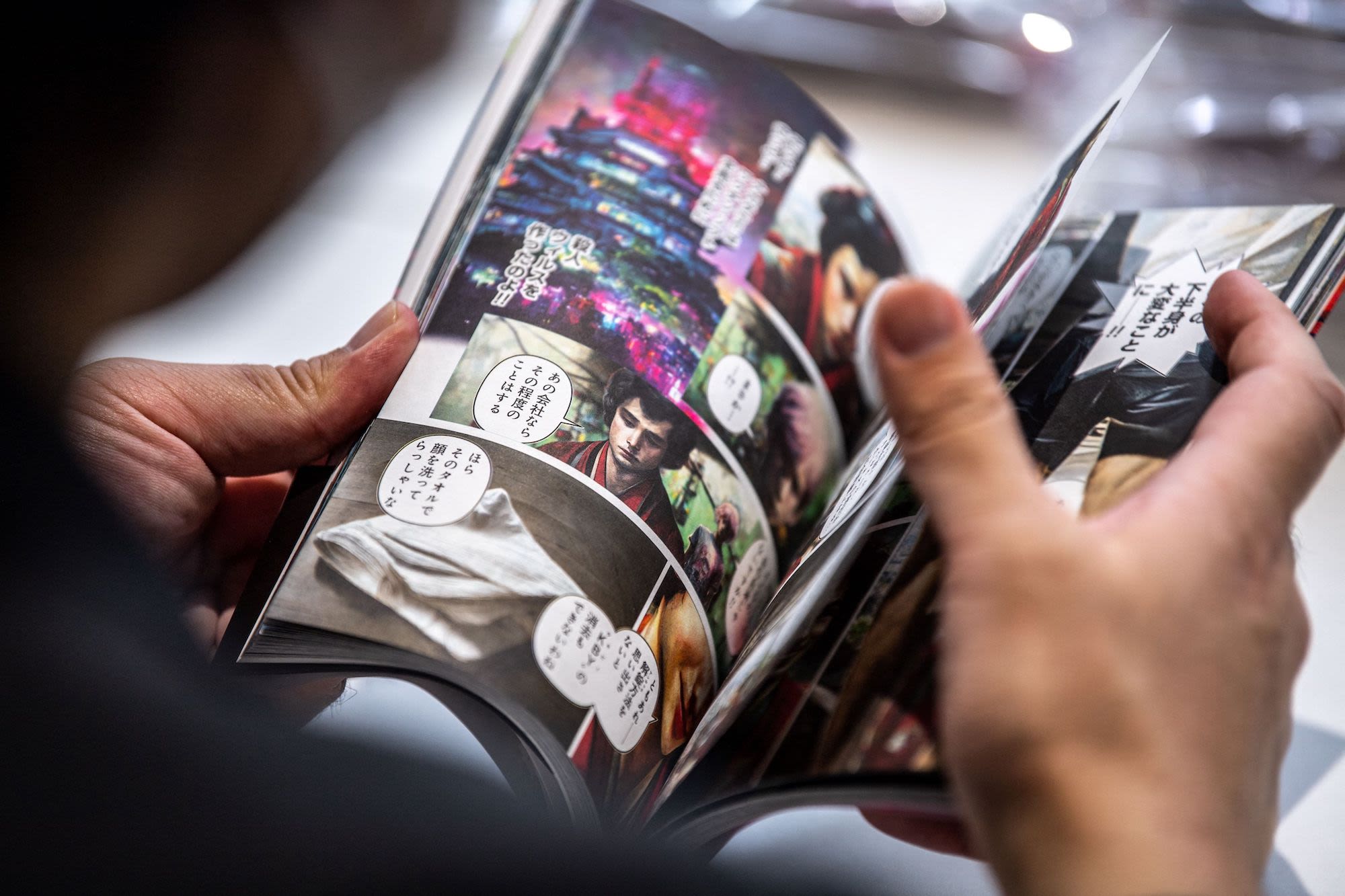
The Pioneer: Cyberpunk Peach John and the AI Manga Revolution
The image above shows Cyberpunk: Peach John, a landmark work in AI manga storytelling. According to CNN:
"'Cyberpunk: Peach John' is the world's first complete AI manga work. On sale in Japan from Thursday, it was illustrated using Midjourney, an online image generation tool."
Creator Rootport demonstrated that writers could become manga creators by focusing on what they do best—storytelling—while AI handled the visual execution. The manga reimagined the classic Japanese folktale of Momotaro in a cyberpunk setting, proving that AI tools could handle both consistent character design and complex visual worldbuilding.
🚀 The 2026 Watershed Moment
In January 2026, the industry reached a historic milestone. According to CBR:
"In a watershed moment for the manga industry, a fully AI-generated series has officially claimed the number one spot on Japan's largest digital comic platform."
My Dear Wife, Will You Be My Lover?, a four-volume series featuring 100% AI-generated artwork, outperformed established titles on Comic C'moA. Mob Psycho 100 manga editor Kazuaki Ishibashi observed:
"Readers don't seem to care whether the artist is AI or not. Perhaps it's only the creators themselves who are concerned. Has this era finally arrived? I expect it will explode in popularity this year."
This confirms what storytellers have long hoped: audiences care about compelling narratives, not production methods.
Specialized AI Agents for Manga Storytelling
Manga Creator
Your personal mangaka for creating complete stories with visual storytelling, panel flow, and consistent art style—from one-shots to 200+ page serialized epics.
Key Features:
- Dedicated reference sheets that lock character appearances across your entire project
- Panel flow optimization for proper manga reading rhythm
- Five distinct manga styles (Shonen, Shoujo, Seinen, Slice-of-Life, Chibi)
- Plot memory engine that tracks story continuity
- Quality gates that catch consistency issues automatically
Creative Fiction Writer
Storytelling partner for deep research, editorial insight, and polished prose—perfect for developing your manga's plot, character arcs, and dialogue before visual generation.
Key Features:
- Three-mode workflow: Planning (plot/character arcs), Writing (polished prose), and Critique (structural/line-level feedback)
- Real-time research with cited sources
- Character voice development and dialogue refinement
Webtoon Creator
Personal webtoon artist for mobile-first storytelling with vertical scroll rhythm, episode hooks, and full-color consistency. According to Mordor Intelligence, webtoons are projected to expand at a 35.62% CAGR through 2031.
Key Features:
- Vertical scroll rhythm optimization
- Episode hooks and cliffhanger pacing
- Full-color consistency throughout series
- Platform-ready exports for WEBTOON, Tapas, and similar platforms
Comic Creator
Personal comic book artist for crafting Western-style stories. Master sequential art, dynamic layouts, and bold visual styles—from single issues to epic graphic novel sagas.
How It Works: From Written Story to Finished Manga
Step 1: Develop Your Story Foundation
Begin by outlining your narrative concept, character profiles, and story structure. The more detailed your storytelling foundation, the more consistent your visual output.
"I'm creating a seinen psychological thriller called 'Mirror City' about a detective who can see people's suppressed memories as visual echoes. The protagonist Yuki is 32, has shoulder-length black hair with premature gray streaks, wears a rumpled trench coat, and carries her late partner's pocket watch. Her personality is analytically brilliant but emotionally guarded. She has a distinctive scar across her right palm from her first case."
Key story elements to define:
- Character physical attributes and personality traits
- Story setting and visual worldbuilding details
- Narrative arc and major plot beats
- Tone and emotional register of the story
- Key relationships and character dynamics
Step 2: Style Selection
Choose from professional art style templates based on your story's genre and tone. The AI explains how each affects visual narrative and recommends options based on your story type.
For Mirror City, a Seinen Dramatic template would provide:
- Detailed anatomy for emotional expressiveness
- Heavy shading for psychological atmosphere
- Cinematic composition for thriller pacing
Step 3: Character Reference Generation
Before creating story pages, the AI generates essential reference materials:
- Style Exemplar — One page establishing your visual language
- Character Reference Sheets — All significant characters in neutral poses with labels
- Expression Sheets — Key emotional states for each character
- Location References — Recurring important locations (as needed)
These references anchor every subsequent generation, ensuring your characters remain visually consistent as your story unfolds.
Step 4: Scene-by-Scene Story Translation
For each scene in your narrative, the AI:
- Analyzes the story beat and emotional weight
- Determines optimal panel count based on narrative rhythm
- Scripts the page with appropriate dialogue placement
- Selects panel layouts matching the scene's pacing needs
- Generates the page with all relevant references loaded
- Reviews output against quality criteria before presenting
Step 5: Iteration and Story Refinement
Request adjustments to any page based on your story vision. The Manga Creator maintains awareness of your narrative state, ensuring changes align with story continuity. Character evolutions (costume changes, emotional states, physical changes) are tracked with versioned reference sheets.
Results & Use Cases
📚 The Novelist Seeking Visual Adaptation
Scenario: Published author wanting to adapt their novel into manga format
Traditional Approach: License to manga publisher (limited creative control), or hire artist ($15,000-$50,000+ for complete adaptation)
With the Manga Creator:
- Direct control over visual interpretation of your story
- Chapter-by-chapter adaptation at your own pace
- Consistency with your narrative vision maintained throughout
- Test audience reception before major investment
💼 The Screenwriter Exploring New Formats
Scenario: Film/TV writer adapting screenplay concepts for manga
Traditional Approach: Find manga artist willing to collaborate on spec project
With AI manga story tools:
- Rapid visualization of screenplay scenes
- Test visual pacing before committing to full production
- Develop proof-of-concept for pitch materials
- Maintain story continuity across format translation
📱 The Webnovel Author Building Audience
Scenario: Serialized fiction writer wanting to expand into visual storytelling
According to Grand View Research, digital formats now account for 72.12% of manga consumption, with online platforms commanding 67.90% of revenue share.
With AI manga story generation:
- Convert popular chapters into visual episodes
- Build cross-platform audience engagement
- Test which story arcs resonate visually
- Create marketing materials featuring your characters
🎯 The Independent Publisher
Scenario: Self-publishing a complete manga volume on Amazon KDP
With AI manga story tools:
- Generate print-ready pages at proper resolution
- Maintain story and visual consistency across the entire volume
- Export in formats compatible with KDP specifications
- Iterate based on preview feedback without additional costs
2026 Market Context: Why AI Manga Story Tools Have Arrived
📈 A Booming Industry Ready for Disruption
The global manga market has reached unprecedented scale:
The market was estimated at USD 10,193.3 million in 2025 and is projected to reach USD 43,856.1 million by 2033, growing at a CAGR of 20.5% from 2026 to 2033. — Grand View Research
Key market dynamics:
- Digital formats account for 72.12% of consumption with continued growth
- North America is expected to grow at over 23% CAGR from 2026 to 2033
- Shonen titles lead with 39.10% market share, while webtoons expand at 35.62% CAGR
- International manga sales hit $1.92 billion in 2026, with non-Japanese markets contributing 34% of total industry revenue
🤖 The Storytelling Revolution
According to The Business Research Company, major trends in the manga market include:
"Growth of digital manga platforms, increased use of AR/VR for manga experiences, AI-driven personalized manga recommendations."
The convergence of AI storytelling assistance and visual generation has created unprecedented opportunities for writers to become manga creators.
🎨 Character Consistency: The Solved Problem
The breakthrough development in AI manga story tools has been solving the character consistency problem—the primary barrier to AI-assisted long-form visual storytelling.
Key innovations:
Identity Embedding: Modern AI models create mathematical "fingerprints" of characters from reference images, capturing facial structure, body proportions, distinctive features, and clothing details.
Story State Memory: Persistent tracking systems maintain awareness of character development, costume changes, and visual evolution throughout your narrative.
Reference Systems: Dedicated character sheets lock appearances across projects, ensuring Yuki looks like Yuki on page 1 and page 200.
Multi-Subject Consistency: Latest models handle multiple consistent characters simultaneously—an entire cast maintaining their unique appearances across all scenes.
📊 Industry Perspectives
According to Tokyo Scope's analysis of AI's impact on the anime and manga industry:
"Generative AI has sparked repeated confusion and backlash in the anime industry over the past two years. The impact goes beyond artwork, raising concerns about voice acting, scripts, and official merchandise."
However, the same analysis notes that industry leaders are finding constructive paths forward—using AI to augment human creativity rather than replace it. For independent storytellers, AI tools represent democratization of access to visual narrative creation.
Frequently Asked Questions
Is AI manga story generation free to use?
The Manga Creator is available through Jenova's platform with free access to core features and limited usage. For extended creation sessions and higher usage limits, paid plans start at $20/month. Visit www.jenova.ai for specific pricing details.
How does AI translate written stories into visual narrative?
The system analyzes your story input—including character descriptions, scene directions, and dialogue—and determines appropriate visual translation. This includes panel composition, character placement, expression selection, and pacing decisions. You provide the story; the AI handles the visual execution while maintaining consistency with your narrative vision.
What AI models power manga story generation?
Jenova provides unified access to frontier AI models including GPT-5.2, Claude Opus 4.5, Gemini 3 Pro, and Grok 4.1—all available through a single platform with no vendor lock-in.
Can I create manga in different visual styles?
Yes. The Manga Creator supports five professional art style templates: Shonen Action, Shoujo Romance, Seinen Dramatic, Slice-of-Life, and Chibi/Comedy. You can also mix styles within a project for different sequences—for example, shifting to Chibi for comedic relief moments.
Do I need any drawing skills to use AI manga story tools?
No drawing skills are required. These tools are designed specifically for writers, storytellers, and creators who have compelling narratives but lack traditional artistic training. You direct the visual output through detailed story descriptions, character profiles, and scene directions.
How does the AI maintain story continuity across pages?
The system uses a persistent Story State that tracks your narrative position, character states, active plot threads, and visual continuity notes. This ensures that story developments in earlier pages are reflected in later visual generation—characters remember their scars, costume changes persist, and emotional arcs build appropriately.
Can I sell manga created with AI?
Jenova allows commercial use of generated content. However, publishing platforms and marketplaces may have their own policies regarding AI-generated content. Always verify the terms of service for your target distribution platform. For self-publishing on platforms like Amazon KDP, AI-generated content is generally permitted with proper disclosure.
Transform Your Stories Into Professional Manga Today
The manga industry is experiencing unprecedented growth, with the global market projected to reach USD 56.38 billion by 2031 at a 19.52% CAGR. Digital platforms have democratized distribution—with 72.12% of consumption now digital—and AI manga story tools are democratizing creation itself.
The Manga Creator brings professional manga production methodology to anyone with a story to tell. No years of artistic training required. No thousands of dollars in illustration costs. No months searching for artist collaborators. Just your creativity and your narrative, guided by an AI that understands both storytelling and visual craft.
Whether you're adapting your novel into visual format, creating an original serialized epic, or testing story concepts before major investment, discover how AI manga story generation transforms your written narratives into professional visual stories—one panel at a time.
Your characters will stay consistent. Your story will drive the visuals. Your creative vision will remain intact.
Get started at www.jenova.ai and bring your stories to visual life.