AI Manga Character Creator: Design Consistent Characters and Full Stories
2026-08-11
The Manga Creator works as your personal mangaka — designing original characters with locked visual identity, then carrying those characters through complete panels, chapters, and serialized arcs. While most AI image tools generate a single pretty portrait and then forget your character exists, this agent treats character design as the foundation of a story, not a one-off output.
✅ Design original manga characters with consistent faces, hair, proportions, and costume details across every generation ✅ Build full expression sheets, turnarounds, and reference sheets from a single character concept ✅ Carry your cast directly into panel layouts, scenes, and multi-chapter narratives ✅ Works across shonen, shojo, seinen, josei, and any hybrid style you're chasing
To understand why character consistency matters more than raw image quality, it helps to look at what actually breaks when creators try to build a manga with general-purpose AI image tools. The gap between "generate an anime girl" and "produce 200 pages where she looks like the same person" is where most projects die.

Quick Answer: What Is an AI Manga Character Creator?
An AI manga character creator is a tool that designs original manga and anime characters from a written concept, then maintains that character's exact visual identity — face, hair, body, costume — across every subsequent illustration, expression, and panel.
Key capabilities:
- Generate original character designs from a text concept, personality brief, or story role
- Produce expression sheets, pose variations, and turnaround references from one locked design
- Maintain character consistency across scenes, chapters, and full series with Manga Creator
- Translate finished character designs directly into paneled sequential art
- Match established manga art styles — shonen action, shojo romance, seinen realism, chibi
The Problem: Why AI Character Design Keeps Falling Apart
Manga is not a small hobby market. The global manga market was valued at $10.2 billion in 2025 and is projected to reach $43.9 billion by 2033, with the U.S. segment alone growing at a 24% CAGR through 2030. More people want to make manga than at any point in history.
But actually creating a character you can build a story around is frustratingly difficult:
- Generic image generators forget your character between prompts
- Faces drift — eye shape, hair color, and proportions mutate scene to scene
- Character designs don't translate into panels, only isolated portraits
- Art style breaks the moment you change the pose, angle, or lighting
- No workflow bridge between "I designed a character" and "I made a chapter"
Character Consistency Is the Hardest Technical Problem
This is the core failure. As Kling AI's character consistency guide explains, "Most generators have issues with characters that alter facial characteristics from scene to scene. Hair color changes, eye shapes change, and body proportions fluctuate wildly. This occurs because AI models do not inherently recall past generations."
Creators end up maintaining manual character bibles, negative prompt lists, and personal keyword dictionaries just to keep one character stable. The same guide notes that most creators spend "2-3 hours on the initial attempt getting their character's overall appearance established, then an hour or so fine-tuning the small stuff" — before producing a single story page.
10-20 attempts — Typical iterations needed to lock in a consistent AI character
The Industry Is Prioritizing Consistency Over Polish
This isn't a niche complaint. Industry analysis now identifies character consistency as the dominant trend in AI anime creation, ranking it above raw visual quality: "Recurring characters create familiarity. Familiarity creates" audience attachment. A gorgeous one-off render is worth less than a slightly simpler character your readers actually recognize on page 40.
Character Design Doesn't Automatically Become Manga
Manga is sequential art. Panel flow, gutters, reading direction, camera angles, and pacing are separate disciplines from character illustration. A tool that produces a beautiful character sheet still leaves you with the hardest 90% of the work — turning that character into readable pages.
Readers Notice, and They Care
Audience research from the Arts Management and Technology Lab surveyed 108 comic readers and found that frequent readers responded significantly more negatively to AI-generated comics specifically on consistency and narrative conveyance — the two dimensions where amateur AI work fails hardest. Notably, when consistency was strong, "a majority of Group A participants were surprised and impressed that Midjourney was able to generate panels with such a high level of consistency."
The standard is clear: consistency is what separates a project readers take seriously from one they scroll past.
The Authorship Question Nobody Should Ignore
There's a legal dimension too. The U.S. Copyright Office maintains that outputs wholly generated by AI are not copyrightable, and that "outputs from GenAI systems resulting from human prompt engineering do not satisfy" the human authorship requirement. In the well-known "Zarya of the Dawn" case, the Office revised the registration to protect only "the selection, coordination, and arrangement of the Work's written and visual elements."
The practical takeaway for manga creators: your authorship lives in the story, the character arcs, the panel choices, and the direction you give. A tool that makes you a director rather than a slot-machine puller is the right tool.
This is exactly what Manga Creator was built for.
The Solution: Why Manga Creator Handles Characters Differently
Manga Creator approaches character design the way a working mangaka does — the character sheet is a production asset, not a deliverable. Every design decision it locks in becomes a constraint the agent carries forward into expression sheets, poses, and finished panels.
The difference is architectural. Instead of treating each image as an isolated request, the agent holds your character's full specification in persistent memory and applies it every time that character appears — through a one-shot or across a 200-page serialized epic.
| Generic AI Image Generator | Manga Creator |
|---|---|
| Character mutates between prompts | Locked design carried across every generation |
| You maintain manual character bibles | Character specs held in persistent memory |
| Produces isolated portraits only | Produces expression sheets, poses, and paneled pages |
| Style drifts when pose or angle changes | Art style stays consistent across the full series |
| No story structure — you're on your own | Panel flow, pacing, and visual storytelling built in |
| 10-20 attempts to stabilize one character | Design once, reuse indefinitely |
Character Design From Concept, Not Just Description
You don't need to write a technical prompt with exact hair measurements. Describe the character's role in your story, their personality, and their world — the agent translates narrative intent into visual design decisions the way a professional character designer would.
"I need a protagonist for a seinen thriller — late 20s, ex-detective, deliberately unremarkable so he can disappear into crowds, but something in the eyes should feel wrong. Silver hair, undercut. Give me three design directions."
Expression Sheets and Reference Assets
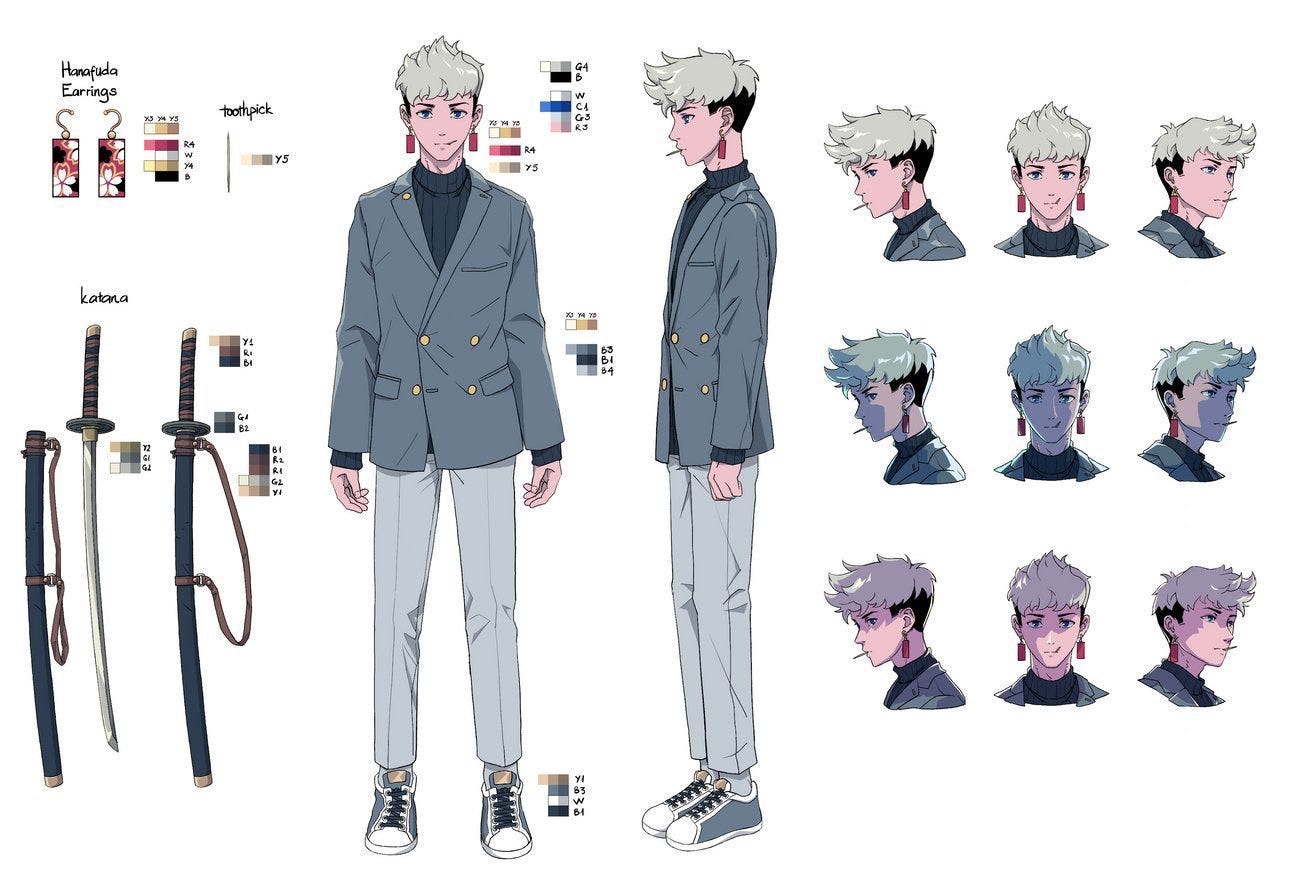
Once a design is locked, you can extend it into the assets an actual production needs — expression ranges for emotional beats, three-quarter and profile turnarounds, costume variants, and age progressions for flashback sequences.
"Build a nine-panel expression sheet for her: neutral, suppressed anger, genuine laughter, exhausted, terrified, cold contempt, forced smile, crying, and the exaggerated shocked face for comedic beats."
Style Fluency Across Manga Genres
Shonen action characters need different silhouettes, line weights, and proportional exaggeration than shojo romance leads. The agent understands these conventions as a design vocabulary, not as style filters — so a shojo character reads as shojo in her posture and framing, not just her eyelashes.
Characters That Become Pages
This is the capability that matters most. Your finished character carries directly into sequential art — panel layouts, camera angles, action lines, and the page-turn rhythm that makes manga readable. Design and production live in the same workflow instead of being separate tools you manually bridge.
"Take these two characters and give me the confrontation scene from chapter 3 — six panels, rooftop at dusk, building tension to a silent final panel with no dialogue."
Related Agents You'll Also Find Useful
Character design rarely lives alone. These agents cover the adjacent work most manga creators hit within their first few chapters.
Webtoon Creator
If your target platform is vertical-scroll rather than print-style pages, the format changes everything — pacing, panel spacing, and episode hooks all work differently.
- Vertical scroll rhythm and mobile-first composition
- Episode-level cliffhanger structuring for serialized releases
- Full-color consistency across 100+ episode runs
Comic Creator
For creators working in Western sequential art conventions, or hybridizing manga character design with a comic book page structure.
- Dynamic layout composition and sequential art fundamentals
- Bold visual styles across single issues and graphic novels
- Complete story crafting from concept to finished pages
Character Creator
When you need deep character writing — backstory, psychology, voice, and relationship dynamics — before or alongside the visual design.
- Guided character builds with narrative depth
- Portrait generation across genres and media
- Works for OCs, roleplay casts, and fiction ensembles
Creative Fiction Writer
Your characters need a story worth putting them in. Useful for prose-first creators developing the narrative before adapting it to panels.
- Story structure and arc development across any genre
- Editorial feedback on pacing and character motivation
- Polished prose from first draft through revision
Try Manga Creator free — no credit card required.
How It Works: From Concept to Character Sheet to Pages
Step 1: Describe Your Character's Role in the Story
Skip the technical specs. Tell the agent who this character is narratively — their function in the plot, their personality, their world, and what the reader should feel when they appear.
"Antagonist for a shonen tournament arc. She should look like she doesn't belong in a fight — elegant, composed, almost bored. The threat should be in how relaxed she is."
Step 2: Review and Refine the Design Directions
The agent will typically offer multiple visual interpretations. Pick the one closest to your vision and iterate on specifics — silhouette, costume detail, hair, distinguishing features.
"Direction two, but change the outfit to something with a longer coat silhouette. Keep the hair. Make the eyes narrower."
Step 3: Lock the Design and Build Reference Assets
Once the design is right, extend it into everything your production will need. This is the step most creators skip and later regret.
"Lock this design. Now give me a full turnaround — front, three-quarter, profile, back — plus an expression sheet covering her core emotional range."
Step 4: Bring Your Cast Into Panels
With locked characters, move into sequential art. Describe the scene and let the agent handle panel structure, composition, and visual pacing while your characters stay recognizable.
"Page 14 — she enters the arena. Five panels. Wide establishing shot, then tighten progressively until the last panel is just her eyes."
Step 5: Scale Into Chapters and Series
Your character designs persist across sessions. Come back weeks later and continue the same series with the same cast, without re-establishing anything.
"Pick up from chapter 4. I want to introduce her younger brother — design him so the family resemblance reads immediately but he's clearly softer."
Results & Use Cases
📖 Building an Original Cast for a First Manga
Scenario: A writer has a complete story outline for a 12-chapter supernatural mystery but can't draw. They need a protagonist, two supporting characters, and an antagonist who all look like they belong in the same world.
Traditional Approach: Commission a character designer at $150–$400 per character sheet, wait 2–4 weeks per revision cycle, and pay again for every new expression or costume variant.
Manga Creator: Four locked character designs with expression sheets in a single working session, revisable indefinitely at no additional cost per iteration.
- Consistent world-level art style across the entire cast
- Family resemblances and faction visual language handled deliberately
- Designs immediately usable in paneled pages
🎨 Expression Sheets for an Existing Character
Scenario: An artist already has a protagonist they love but needs a full emotional range reference to keep the character on-model across a long serialization.
Traditional Approach: Days of manual drawing, or repeated prompt-wrestling in a general image generator with drifting results.
Manga Creator: A complete expression sheet — subtle emotional beats through exaggerated comedic reactions — derived from the locked design.
- Covers the full emotional register manga actually requires
- Includes stylized reaction faces, not just realistic emotion
- Reusable as a reference sheet for future collaborators
📱 Designing Characters on Mobile Between Sessions
Scenario: A creator commutes 90 minutes daily and wants to develop character concepts during that time, then continue on desktop at home.
Traditional Approach: Notes app sketches and half-remembered ideas that never make it into the actual project file.
Manga Creator: Full character development on phone with persistent memory — the desktop session picks up exactly where the commute left off.
- Complete feature parity across web, iOS, and Android
- Voice input for describing characters while walking
- Everything syncs, nothing gets lost between devices
🎬 Cross-Format Character Adaptation
Scenario: A creator with an established webtoon cast wants to produce a print-style manga one-shot as a special release.
Traditional Approach: Redesign the entire cast for a different format, risking off-model drift that readers immediately notice.
Manga Creator: The same locked character identities adapted to page-based composition, with panel structure translated for the new format.
- Character recognition preserved across format changes
- Panel flow adapted from vertical scroll to page-turn pacing
- Complements work done in Webtoon Creator for the ongoing series
FAQ
Is the AI manga character creator free to use?
Yes — you can start designing characters on Jenova's free tier with access to all core features and limited monthly usage. Paid plans scale usage substantially and add custom model selection along with watermark removal on generated output. Usage resets monthly on your billing date with no daily caps, so your full limit is available from day one.
How is this different from a general AI anime art generator?
General generators produce isolated images and forget your character between requests, which is why creators typically need 10-20 attempts to stabilize one design. Manga Creator holds your character's full specification in persistent memory and carries it into expression sheets, poses, and finished panels — design and production in one workflow.
Can it keep my character consistent across an entire series?
That's the core function. Once a design is locked, it persists across sessions and chapters. You can return weeks later, reference the same character, and continue a serialized project without re-establishing the design. This matters because character consistency now ranks above raw visual quality as the trend defining serious AI-assisted anime and manga work.
What manga art styles does it support?
Shonen, shojo, seinen, josei, chibi, and hybrid approaches. The agent treats genre conventions as a full design vocabulary — proportions, line weight, silhouette language, and framing tendencies — rather than surface-level style filters applied to a generic base.
Can I own the copyright to characters I create with it?
Copyright law here is genuinely unsettled. The U.S. Copyright Office currently holds that purely AI-generated output isn't copyrightable, while protecting the human-authored "selection, coordination, and arrangement" of a work. Your story, character arcs, panel choices, and creative direction are where your authorship lives. Consult a qualified attorney for your specific situation, and check current guidance — this area is actively evolving.
Does it work on mobile?
Yes, with full feature parity across web, iOS, and Android. Character designs, series projects, and conversation history sync across all devices, and speech-to-text lets you describe characters hands-free.
Conclusion
The bottleneck in AI manga creation was never image quality. It was that characters wouldn't hold still — faces drifted, styles broke, and every new scene meant re-fighting a battle you'd already won. Readers notice this immediately, and industry data confirms that consistency is now the dividing line between work that gets taken seriously and work that gets scrolled past.
An AI manga character creator earns its place by treating your character as a persistent production asset rather than a disposable render — locking the design, extending it into real reference assets, and carrying it straight through into panels, chapters, and complete serialized stories.
Design your cast, lock it in, and start making pages. Try Manga Creator now.
Explore more at Jenova.
For Developers: Manga Creator is available programmatically via the Jenova API — integrate consistent manga character generation and sequential art creation into your application with a single API call. Full documentation →