AI Magic Item Generator: Themed Relics for D&D Campaigns
2026-09-04
Jenova is an AI magic item generator for dungeon masters who want relics players actually write on the sheet — not another nameless +1 longsword. In September 2026, more tables than ever are running fantasy campaigns, yet item prep still means rolling charts that ignore attunement, rarity, and the dungeon you designed. Describe the wielder, the ruin, and the power band, and this platform returns named weapons, cursed wonders, consumables, and read-aloud text you can drop mid-session.
✅ Named relics tied to faction, myth, and character fantasy ✅ Rarity and attunement that respect 5e bounded accuracy ✅ Curses, sentience, and inscriptions that start the next scene ✅ Works on web, iOS, and Android during weekday prep or at the table
To understand why that matters, it helps to look at how magic items actually behave in play — and why random tables keep handing you the wrong sword.
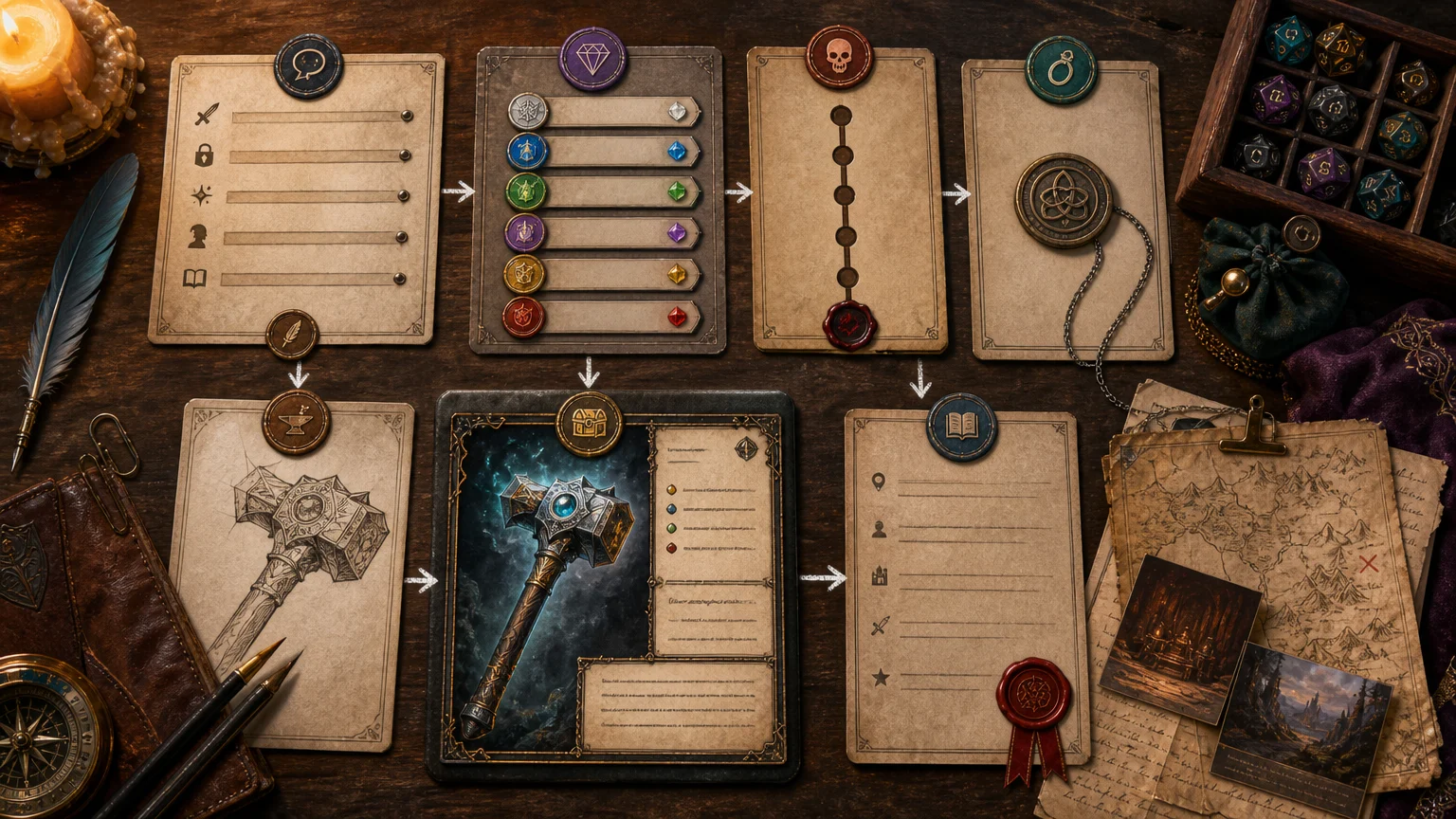
Quick Answer: What Is an AI Magic Item Generator?
An AI magic item generator is a tool that creates named, rarity-aware relics for tabletop RPGs so dungeon masters can reward players without rolling generic plus-one weapons. It replaces disconnected magic-item charts with objects that match level, lore, and the character who will wield them.
Key capabilities:
- Design rarity bands, attunement load, and item families with a Game Designer Assistant
- Award in-session relics that remember the campaign
- Name artifacts, pact blades, and cursed rings with cultural texture
- Ground wonders in real myth, burial custom, and faction theology
- Package flavor text, inscriptions, and printable item cards in one workflow
The Problem: Why Random Magic Item Tables Fail at the Table
Tabletop roleplaying is no longer a niche hobby. Industry analysis puts the global TTRPG market at USD 2.41 billion in 2026, on a path toward USD 6.59 billion by 2035. Fantasy titles still dominate that demand.
That growth shows up as more Saturday tables, more West Marches games, and more one-shots — and as the same awkward pause when someone asks what is in the lich's jewelry box. But getting magic items right is frustratingly difficult:
- Random tables ignore the culture that forged the object
- Permanent items are scarce by design, and easy to overspend
- Armor bonuses and ability-score items quietly break bounded accuracy
- Flavorless +1 weapons clutter sheets and never get used
- Mid-session improvisation produces either a potion or a vorpal sword
Random tables do not know who made the blade
A frost-elf barrow should not spit out the same cloak of protection as a clockwork foundry. Examining published treasure procedures shows why: hoard rolls are calibrated for challenge rating and rarity, not for metallurgy, funerary law, or the villain's vanity. The result is a legal uncommon item that feels like it teleported in from another module.
Players remember objects with a maker. They forget "longsword, uncommon."
Fifth edition treats magic items as optional — and scarce
Unlike earlier editions, 5e is balanced without magic items at high levels, and permanent items are meant to stay rare. Analysis of Dungeon Master's Guide hoard math finds that in a typical four-person party, a character acquires only about six permanent magic items by 20th level. Most characters reach 9th level with nothing better than uncommon permanents.
Six — Permanent magic items a typical 5e character acquires by 20th level, assuming a party of four
Hand out +2 armor too early and attack bonuses miss half the time against the people they were meant to threaten. Hand out nothing with a name and the win feels like a spreadsheet.
Armor, tomes, and summoned pets punish sloppy generators
Magic armor is the loudest offender. A character in +3 plate with a +3 shield sits at AC 26 — high enough that pit fiends, adult red dragons, and liches miss at least half the time. Manuals and tomes can push scores past 20. Creature-summoning items are not always overpowered, but they slow combat until nobody wants to use them.
Consumables are safer. They appear more than three times as often as permanent items, and they vanish after one decision. A generator that cannot tell a potion of climbing from a belt of giant strength is not generating items. It is rolling noise.
Crafting and live tables both punish slow prep
The 2024 Dungeon Master's Guide tightened player-facing crafting: community discussion of those rules notes that characters need proficiency in Arcana and the associated tool, and that a workday is eight hours. That is a feature, not a bug — rare items are supposed to cost time. It is also a prep problem. Someone has to invent the formula, the rare component, and the complication that makes downtime a scene.
Meanwhile the in-person table does not pause. A Merchoid survey of entertainment fans found 36.5% playing more tabletop games than before the pandemic, with 75.9% saying the in-person element matters. Interest in Dungeons & Dragons itself jumped 85% after 2020. That table wants a named hammer now, at the right rarity, with one sentence you can read aloud.
Prep is still part of the job. Experienced voices keep saying so: you fall to your highest level of preparation, and "no prep" is not the same as efficient prep. Magic items are one of the pieces DMs most often skip — then improvise badly.
This is exactly what Jenova was built for.
The Jenova Solution
Jenova treats a magic item as design work, not dice trivia. You bring party level, biome, attunement budget, and the story beat. Specialized agents return an object that could have come from this barrow, this pact, this jealous previous owner. The same conversation can name the relic, write its curse, keep the rarity in band, and produce a card you can slide across the table.
The platform is not a single randomizer. It is multi-model access, persistent memory across sessions, and custom agents you can tune to your table's tone — grimdark, fairy, or clockwork — without juggling five bookmarks.
| Traditional Approach | Jenova |
|---|---|
| DMG tables that ignore who forged the item | Relics tied to faction, myth, and the wielder |
| Generic +1 weapons that clutter sheets | Named items with hooks, drawbacks, and uses |
| Accidental +2 armor that breaks bounded accuracy | Rarity and attunement constraints in the brief |
| Separate tools for names, lore, curses, and art | Connected agents for systems, copy, and visuals |
| Hours of weekday prep for one chest | Minutes on web or phone, including at the table |
Design the item economy, not a shopping list
The Game Designer Assistant is the right starting point when you need rarity bands, attunement load, and item families that will survive a 20-level campaign. Ask for a consumable-heavy frost barrow, a pact-only wonder that never prints a legendary, or a crafting track that matches those eight-hour workdays. Testing this kind of brief shows the difference immediately: you get a system (what drops, how often, what it signals) instead of twelve unrelated gadgets.
Award the relic in the session that just happened
When the sarcophagus opens in play, the Roleplay Game Master already remembers the oath, the NPC who died, and the promise the paladin made. Unlimited conversation memory means the "random" sapphire can be the same stone the cult used in session four. Static generators cannot do that continuity.
Name it so it survives contact with the character sheet
A relic dies if every object is "cloak, uncommon." The Name Generator produces culturally fluent names for pact blades, moth-cloaks, and poisoner's rings. Product Copywriter turns those names into read-aloud text a DM can deliver in one breath. Pair that with Deep Research when you want an artifact rooted in real burial customs, silk-road trade, or a specific myth rather than "vaguely runic."
"Build an uncommon warhammer for a 5th-level cleric of a drowned god. Blue gem in the head, no AC bonus, one daily property that only works below the waterline, and a jealous previous owner who will notice if it is used in a city."
Specialized AI Agents for Magic Item Generation
A magic item is rarely only a bonus. The interesting drop is a puzzle, a creed, a portrait, or a song the last owner died mid-verse. These agents sit next to item generation so the relic can pull the next scene.
Game Designer Assistant — rarity, attunement, and item families
If you are stocking a hex crawl or rewriting a whole reward track, Game Designer Assistant stays in systems mode: drop rates, attunement caps, what "too many permanents" does to bounded accuracy, and how consumables should outnumber wonders. That last point matches published 5e guidance — consumables appear more than three times as often as permanent items.
- Campaign-long item tracks by tier
- Families (tide, moth, oath, rust, pact) instead of one-off gadgets
- Notes on attunement, armor bonuses, and shop value
Roleplay Game Master — relics that remember the story
Roleplay Game Master is what you open when the party loots a place you did not stock. It keeps character consistency and campaign facts, so the ring can belong to the missing sibling rather than "jewelry, 75 gp."
- Improvised items that still respect party level
- Objects that encode NPCs, debts, and unfinished quests
- Read-aloud box text you can use immediately
Name Generator — titles players actually write down
Name Generator is built for linguistic and cultural fit, which is what most "fantasy name" widgets skip. Ask for Old Solar, a dwarven maker's mark, or a blasphemous toast engraved inside a band.
- Artifact, pact, poison, and house-crest names
- Multiple options with etymology when you want it
- Consistent naming languages across a whole dungeon
Deep Research — wonders that survive a history nerd
Deep Research synthesizes sources when you want a funerary mask, trade ingot, or alchemical pellet that could pass a specialist at the table. For theological texture, the Daoist Sage can speak to elixir traditions and wu wei as item philosophy rather than costume.
- Historically grounded treasure and ritual objects
- Primary-source flavor without a weekend in the stacks
- Myth that is specific, not "generic ancient"
Lyric Writer and Quiz Maker — the object as a scene
Lyric Writer writes the inscription, sea shanty, or dying curse that makes the item a scene. Quiz Maker turns the lock, shrine, or sentient weapon's riddle into something better than another DC 15 thieves' tools check.
- Songs, oaths, and engravings as loot, not decoration
- Riddles and trials that gate the real reward
- Curses that are playable, not just flavor text
Poster Maker, comics, and origin stories
When you want the table to see the drop, Poster Maker builds campaign-ready item cards and crests. Comic Creator can storyboard a one-page legend of the last wielder. Film Screenwriter drafts the origin cold-open you read when someone attunes. For politically cursed gifts — the kind of ring a court would notice — Machiavelli Mentor maps who benefits if the party keeps it.
- Crests that identify which faction made the blade
- Item-card layouts you can print or send to a VTT
- Origin scenes and court intrigue attached to the object
Try Jenova free — no credit card required.
How It Works: Generate a Table-Ready Magic Item
Step 1: Brief the wielder and the dungeon, not the dice
Open Jenova and state party size, level, system (5e, Shadowdark, your homebrew), and who is supposed to want this object. One specific sentence beats "give me a magic item."
"Four 8th-level characters just opened a frost-elf barrow. I need one uncommon permanent item for the cleric, two consumables, no AC bonuses, and a drawback that matters in cities."
Step 2: Lock rarity and attunement before you fall in love with the toy
Ask for uncommon-only, consumable-heavy, or "no armor, no ability-score items." That constraint is how you stay inside the DMG-style curve where most characters reach 9th level with nothing better than uncommon permanents. The game design assistant is useful here if you want a reusable family rather than a one-off hammer.
Step 3: Name, curse, and hook the best piece
Send the favorite object to Name Generator for three options, then ask Roleplay Game Master to attach a cost: a geas, a jealous previous owner, or a faction that will notice it in town. The best magic item starts the next session.
"Rename this blue-gem warhammer for a drowned-god cult. Add a drawback that helps in storms and hurts in temples of rival faiths."
Step 4: Package it for the table
Request a five-line read-aloud, a weight/value line, attunement rules, and whether it is cursed or sentient. If you want a physical card, generate a crest and a still image, then drop both into your VTT or print them. On a phone between encounters, skip the art and keep the text.
Results & Use Cases
📊 Stocking a barrow before Saturday
Scenario: You have a nine-room frost-elf tomb and four hours of real-life time. The party is 5th level.
Traditional Approach: Roll magic-item tables room by room, then rewrite half the results because three rooms produced duplicate cloaks and a +1 weapon nobody will equip.
Jenova: One brief produces a themed set: moth-silk wraps, grave-knives that only cut in moonlight, tribute beads stamped with a winter calendar, and a single uncommon permanent item in the sanctum. The game design assistant can also output a one-page family you reuse if they return.
- Theme stays consistent across rooms
- Rarity clustered where the story peaks
- Consumables in side rooms, the named relic at the boss
💼 Rebalancing a table drowning in unused wonders
Scenario: Your tier-2 party owns six unused magic items and treats the next drop as clutter.
Traditional Approach: Stop giving items (players notice) or invent a tax (feels punitive).
Jenova: Ask for "story items, not buying power": a keep that needs a relic to consecrate, a ship whose figurehead is the next quest, cursed jewelry nobles will bid for. Deep Research can supply historical precedents for temples that accepted relics instead of coin.
- Shifts value from bonuses to decisions
- Makes the next uncommon item feel rare again
- Gives attunement slots something worth occupying
📱 Mid-session improvisation on your phone
Scenario: At a café table, the rogue picks the mayor's lock. You did not prep that study.
Traditional Approach: "Uh, a fancy pen," or a panic legendary.
Jenova: From your phone, Roleplay Game Master returns a signet that opens the next door, a blackmail letter, a modest uncommon trinket, and a consumable — all at 5th-level scale. You read two sentences and keep the scene moving.
- No laptop, no DMG
- Loot that creates the next scene
- Power band stays intact under pressure
🎯 A one-shot with one unforgettable relic
Scenario: Convention slot, three hours, new players. You want one object they will talk about on the way home.
Traditional Approach: Print a generic magic-item card or skip props entirely.
Jenova: Name Generator plus Lyric Writer plus Poster Maker give you a named lantern, a two-line curse in verse, and a house seal on a card. Comic Creator can add a six-panel legend of the last bearer. The mechanical bonus can stay small; the object does the work.
- Prop-ready without a graphic-design sideline
- One relic instead of a cluttered sheet
- Easy to drop into a VTT token or printout
FAQ
What is an AI magic item generator for Dungeons & Dragons?
An AI magic item generator is software that creates weapons, armor, wondrous items, and consumables from a plain-language brief instead of a printed random table. On Jenova, that usually means describing party level, location, rarity, and tone, then getting a named relic you can read aloud. Unlike a static chart, it can keep faction, biome, and prior sessions in mind so the object matches the dungeon you actually ran.
Is Jenova free to use as a magic item generator?
Yes. Jenova has a free tier with core features and limited monthly usage, which is enough to stock a dungeon or improvise a chest. Paid plans start at $20/month for substantially more usage and custom model selection, with higher tiers if you run multiple campaigns. You can try the workflow without a credit card and upgrade only if you outgrow the free limit.
Can this stay balanced for 5e magic items?
Yes, if you put rarity in the brief. Fifth edition treats magic items as optional and keeps permanent items scarce; a good prompt says "uncommon only," "consumables over permanents," or "no AC bonuses." The Game Designer Assistant is the better choice when you want a reusable family. Roleplay Game Master is better when you need one object right now. You still make the final call — the output is a draft, not a rules substitute.
How is an AI magic item generator different from DMG random tables?
DMG tables are calibrated for challenge band and rarity, not for your drowned temple or your paladin's vow. An AI magic item generator takes those constraints and the fiction: who forged this, what they worshipped, what would be insulting to find. You can still ask it to mimic hoard frequency — those seven / eighteen / twelve / eight hoard-roll bands are a solid scaffold — then replace the generic +1 with something the table will remember.
Does a magic item generator work on mobile at the table?
Yes. Jenova has full feature parity on web, iOS, and Android, so you can generate a study-looting result from your phone while players argue over who searches the desk. Speech-to-text helps if your hands are full of minis. For in-person groups that still treat the table as essential — as most surveyed players do — that matters more than another bookmark of static charts.
Can I generate magic items for games other than D&D?
Yes. Brief the system. Shadowdark, Daggerheart, OSR gold-for-XP, or a homebrew with no attunement all need different economies. Game Designer Assistant will ask (or you can state) whether magic items are rare by default, whether bonuses even exist, and whether you want rumor-grade wonders instead of plus weapons. Name Generator and Deep Research stay useful in any setting that cares what the object is called and where it came from.
Conclusion
Random magic-item tables solved a 1970s bookkeeping problem. They did not solve the problem dungeon masters actually have: relics that feel like they belong in this ruin, at this level, without stealing weeknight hours or breaking bounded accuracy. An AI magic item generator on Jenova closes that gap — named wonders, playable curses, and improvisation that still respects the math.
Use the Game Designer Assistant to build the economy, Roleplay Game Master to award the object in play, and Name Generator so the relic gets written on the character sheet. Then put the book back on the shelf and run the room.
Explore the full agent library at Jenova.
For Developers: Every agent in this article is available programmatically via the Jenova API — generate named relics, rarity-aware item families, and campaign-aware magic items inside your VTT or companion app with a single integration. Full documentation →