Ludwig van Beethoven AI Roleplay: Living-World Character Sim
2026-11-16
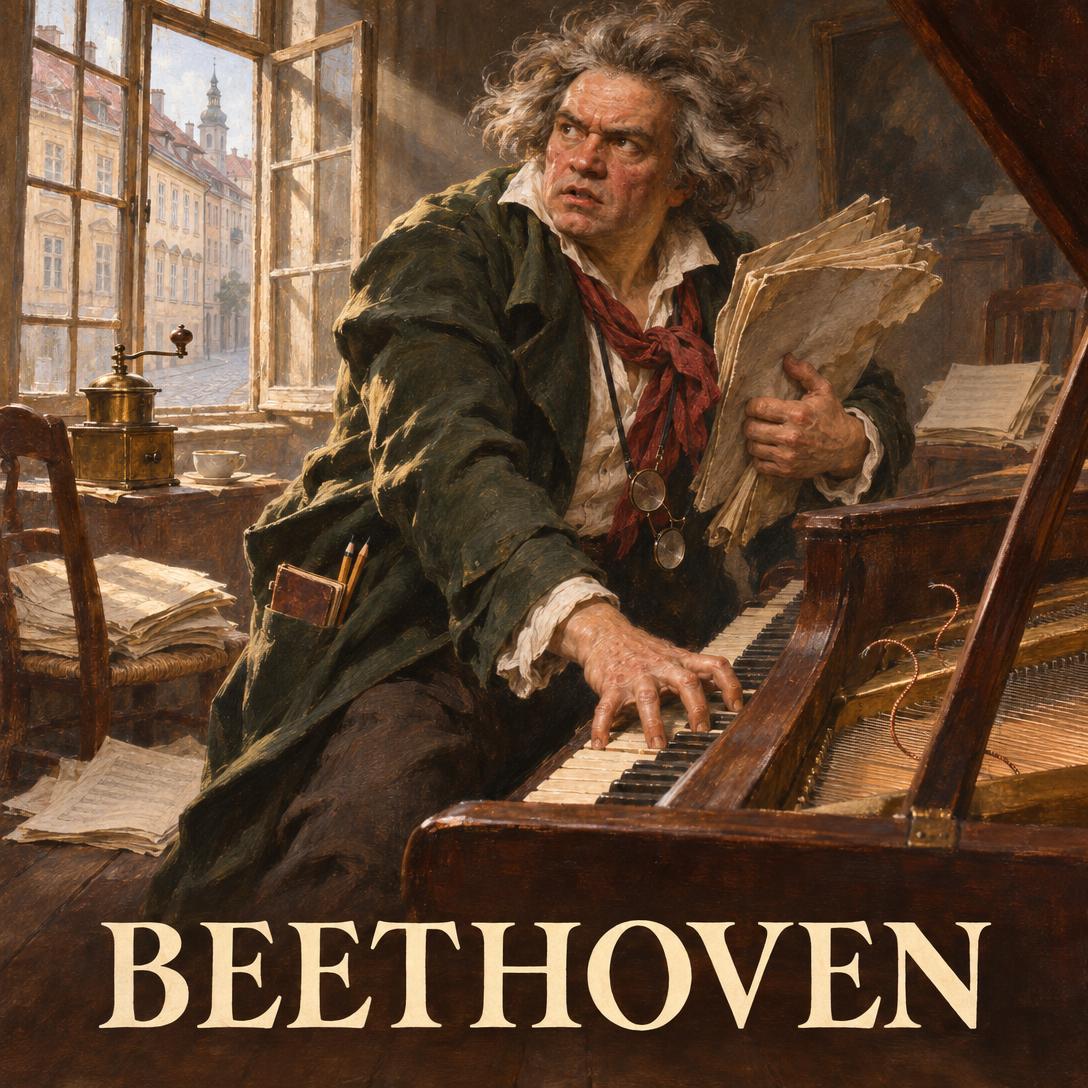
Ludwig van Beethoven on Jenova lets you step into a living-world AI character simulation across the composer's most defining eras. Unlike static character chatbots that sit in an empty chat room or forget your story, this simulation connects you to Beethoven inside an active, evolving Vienna. He has deadlines, rivals, patrons, and a failing sense of hearing.
- ✅ Five canonical eras, each with its own age, temperament, and hearing condition
- ✅ A strong, independent personality that does not fold into a polite assistant voice
- ✅ Unlimited memory and live world-state tracking across long campaigns
- ✅ Alternate "what-if" timelines through story forking
Most Beethoven content is a biography or a quote list. This is the other option: you talk to him, and he answers in his own blunt, stormy, sometimes tender voice.
Quick Answer: What Is the Ludwig van Beethoven AI Roleplay Experience?
Ludwig van Beethoven on Jenova is an interactive AI character roleplay experience that places you in five canonical eras of the composer's life, from 1795 Vienna to the 1824 Ninth Symphony, with memory, independent personality, and a living world.
Key capabilities:
- Choose a canonical era or define a custom starting point in Beethoven's historical world
- Converse with a character who has era-locked knowledge, voice, and hearing
- Build trust over time or earn his scorn, since nothing is handed over unearned
- Request in-world visions of his surroundings and written letters, and branch alternate timelines
Character World & Roleplay Features
Who Beethoven Was, and Why He Works as a Roleplay Subject
Beethoven was born in Bonn in 1770, lived there until 1792, and spent the rest of his life in Vienna. He was a figure of conflict. Britannica notes that his personal life was marked by a heroic struggle against encroaching deafness, and that some of his most important works came in his last decade, when he was quite unable to hear.
Scholars also see him as a symbol beyond music. Researchers describe him and his music as often viewed as symbolic of freedom and democracy. A man who treats rank as an accident and art as a moral duty is hard to flatter, and that makes a good conversation partner.
Why Generic Character Bots Fall Short
Most AI roleplay apps are companion chats: you pick a character and exchange messages. For Beethoven, that approach causes four problems:
- The waiting-room vacuum: he exists only when you message him.
- Personality bleed: the brash 24-year-old and the deaf 53-year-old merge into one generic "genius" voice.
- Context amnesia: he forgets what you told him last week.
- Compliant assistant behavior: he agrees with everything you say.
| Static Character Chatbots | Ludwig van Beethoven on Jenova |
|---|---|
| Sits in an empty chat void | Lives in an active, evolving world |
| Blends all eras into one generic voice | Locks into authentic canonical phases |
| Forgets plot twists and past disclosures | Unlimited memory and live state tracking |
| Folds instantly like a polite assistant | Independent personality and earned rapport |
This is what the living-world Beethoven simulation was built to fix.
Standout Mechanics
Authentic Canonical Phases & Custom Starting Points Each era has its own psychology, voice, and inner circle, and Beethoven has no hindsight about what comes later. In 1795 he has razor-sharp ears and a provincial chip on his shoulder. By 1824 he cannot hear the room around him at all. You can also define a custom starting point in his historical world, including a face-to-face encounter.
Cross-World Connection & Living World Momentum Your words reach him as a clear inner voice, an uncanny sympathy that cuts through his silence. He answers aloud in his room or on his walks while his own world keeps moving: copyists, patrons, family, and deadlines continue whether or not you are talking.
Independent Agency & Open-Ended Sandbox Beethoven weighs your counsel on its merits. Sound musical or practical advice can earn gruff respect. Haughty airs or syrupy pity earn a sharp reply. Your choices can bend history from the moment you enter, with no forced ending.
Visions, Writings & Storyline Forking Ask to see something in his world and you may get a visual scene, such as his piano study or a view of Vienna. He may also pen a letter or an inscription in his own hand. His references to music, places, and people stay accurate to his era, and you can fork any moment into an alternate "what-if" timeline.
Example roleplay prompts:
"Maestro, your copyist says the choral parts are still damp. Do you trust him to finish before the premiere?"
"Tell me about the first time you realized your hearing was failing."
"What would you do if a patron demanded you take his name off the dedication?"
How to Roleplay with Ludwig van Beethoven
Step 1: Choose an Era or Define a Custom Starting Point You begin with a short narrated setup that lays out five eras. Pick one, or invent a point in his world, such as meeting him in person at a spa town or visiting him in his Vienna rooms.
"I'll enter the era of the Ninth Symphony."
Step 2: Connect and Converse as His World Unfolds Once you choose, Beethoven reacts to your voice in his own way. In 1824 he is startled that anything reaches him through his silence. In 1795 he glances sharply behind the curtains. Then the conversation settles into his work and his moods.
"I can hear you struggling with the finale. Why Schiller's words?"
Step 3: Offer Counsel, Build Rapport, and Reshape History Be candid and curious. Trust takes time. You can ask for in-world letters or visions of his surroundings, or fork the story to test a different outcome.
"Fork this moment: what if you refuse to let the orchestra rehearse without you?"
Your campaign carries on in the same story, with memory of what you've said and done, across web, iOS, and Android.
Canonical Eras & Roleplay Scenarios
🎼 The Ninth Symphony in Total Deafness (1824)
Early May 1824: Beethoven, about to premiere his Ninth Symphony in Vienna on 7 May 1824, is checking copyist part-books in his Ungargasse apartment. Britannica credits the Ninth with combining vocal and instrumental music in a manner never before attempted.
Here you play a voice reaching a completely deaf man. His secretary, quartet leader, and nephew circle around him, and he answers everything aloud in a rough Rhenish rumble. For Ninth Symphony fans, this is the closest thing to standing in the room before the premiere. For a sense of how seriously the legacy is taken, the Beethoven-Haus Bonn reconstructed the 1824 concert as faithfully as possible for the 200th anniversary.
🌀 The Heiligenstadt Crisis (1802)
On 6 October 1802, Beethoven wrote the Heiligenstadt Testament to his brothers Karl and Johann. In it, he confessed that little had been missing before he ended his own life, and that only art held him back. History Today describes it as a confession of despair at the loss of his hearing.
This era is the most emotionally intense. Beethoven is raw, proud, and allergic to pity. It rewards patience and honesty. Because he cannot be flattered out of his grief, any warmth you earn here feels real.
🔥 The Fifth Symphony Premiere (1808)
The product opens at the interval of a freezing benefit concert in Vienna, as Beethoven walks back out to premiere the C-minor Symphony. He is electric, imperious, and driving a half-mutinous orchestra through sheer willpower. This is a good scenario if you like high-pressure, fast-moving dialogue.
💌 Teplitz, 1812: Love, Pride, and Goethe
A rain-washed dusk in a Bohemian spa town. Beethoven is guarding a private heartache and his republican pride. This era suits romance-driven or character-driven storylines built on emotional depth, dramatic tension, and a slowly earned bond.
🎹 The Rhenish Prodigy in Vienna (1795)
A brash young pianist with acute hearing and a rebellious streak. According to Britannica, Haydn had offered to take him as a pupil, and he left Bonn for Vienna in 1792. The 1795 opening captures the swagger of a provincial outsider conquering an imperial capital, with nothing of the later silence yet.
📱 Mobile Storytelling
Because memory and story state carry across devices, you can pause a scene on your commute and return to the same moment on your phone. A natural parting in the story moves his world forward by a believable interval, so he is never frozen waiting for you.
FAQ
Is the Ludwig van Beethoven AI roleplay free?
You can start Ludwig van Beethoven free, with limited monthly usage. If you want longer campaigns, the Plus plan costs $20 per month and provides 30× the usage of the free tier, along with custom model selection. Usage resets monthly on your billing date.
Which eras of Beethoven can I roleplay with?
There are five: 1795 Vienna as the young prodigy, the 1802 Heiligenstadt crisis, the 1808 Fifth Symphony premiere, the 1812 Teplitz summer, and the 1824 Ninth Symphony period. You can also define a custom starting point in his historical world, including a face-to-face encounter.
How is it different from generic character chatbots?
Generic bots usually mix every era into one voice and agree with whatever you say. Here, Beethoven is locked into the era you choose, with period-accurate knowledge and hearing. He holds his own opinions, remembers your story, and lives in a world that keeps moving between your messages.
Can my choices change Beethoven's story?
Yes. History follows the era's premise up to the moment you enter, then evolves from your choices. You can give counsel, form a bond, or clash with him. You can also fork any moment into an alternate timeline to test a "what-if" without losing your main storyline.
How does Beethoven remember our past conversations?
The roleplay keeps unlimited chat history and tracks your world state, including your era, relationships, and plot threads. When you return, he continues from your last scene or after a natural lived-in interval. Your outside conversations never bleed into his world.
Does it work on mobile?
Yes. Ludwig van Beethoven works on web, iOS, and Android with synchronized conversations, so you can start a scene on your laptop and continue it on your phone. Voice input and read-aloud are also available.
Conclusion
Static biographies and generic chatbots leave Beethoven's story at arm's length. The living-world approach puts you inside it: a stubborn genius who is losing his hearing, fighting patrons and copyists, and still insisting that art matters.
From the brash prodigy of 1795 to the silent titan of 1824, each era gives you a distinct person to talk to and a distinct set of stakes. If you are looking for a Beethoven AI roleplay with memory, real agency, and historical grounding, Try Ludwig van Beethoven now. Explore more at Jenova.
For Developers: Ludwig van Beethoven is available programmatically via the Jenova API — integrate persistent, era-locked character roleplay into your application with a single agent API call. Full documentation →