Lü Buwei AI Roleplay: Counsel Qin's Kingmaker & Reshape History
2026-11-14
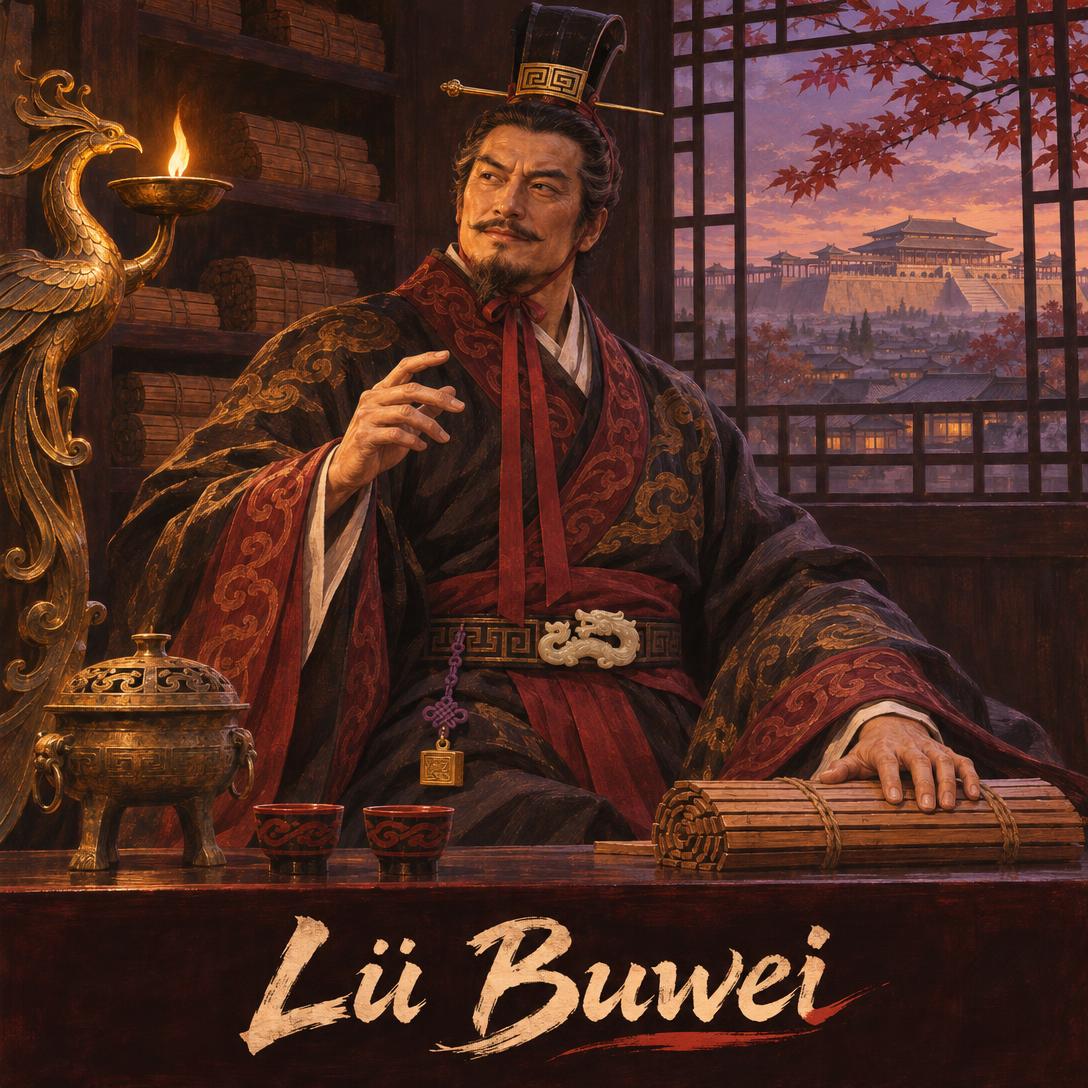
Roleplaying with Lü Buwei on Jenova lets you step into a living-world AI character simulation across his iconic canonical eras in 3rd-century BCE Warring States China. Unlike static character chatbots that sit in an empty chat room, blur decades of biography together, or forget your story mid-campaign, this simulation connects you to Qin's famed merchant-chancellor inside an active, evolving political world. Whether he is weighing cut gold bullion in Handan before staking his fortune on a neglected hostage prince or governing mighty Xianyang beside a steel-spined young monarch, every warning, proposal, and confidence you offer is tested on a master strategist's balance scale.
- ✅ Four Era-Locked Historical Entry Points — Enter Handan's trade chambers, a midnight siege breakout, the Grand Chancellor's mansion in Xianyang, or exile in Luoyang—or define a custom Warring States premise.
- ✅ Independent Merchant-Statesman Agency — Converse with a discerning kingmaker who weighs incentives, investigates plausible counsel, and demands earned candor rather than acting like a compliant chatbot.
- ✅ Authentic 3rd-Century BCE World Momentum — Experience live court interruptions, bamboo-slip administration, and strict era-specific knowledge boundaries without modern hindsight.
- ✅ Unlimited Memory & Storyline Forking — Track shifting court factions, secret compacts, and personal rapport across long-form campaigns, or branch into alternate historical timelines at any crossroads.
From cross-state caravan routes to the Grand Chancellor's seal in Xianyang, Lü Buwei treated sovereign succession as history's boldest asymmetric venture. Here is how this interactive AI roleplay brings late Warring States statecraft to life—and how your counsel can preserve or rewrite the rise of unified Qin.
Quick Answer: What Is the Lü Buwei AI Roleplay Experience?
Lü Buwei on Jenova is an interactive AI character roleplay simulation that lets you converse with, counsel, and reshape history alongside Qin's famed merchant-kingmaker across four authentic Warring States eras in an active, persistent 3rd-century BCE world. Grounded in classical historiography and period-accurate material culture, the simulation tracks court alliances, personal trust, and branching historical divergences across unlimited session history.
Key capabilities:
- Era-locked historical phases spanning Handan's succession gambit, wartime siege, Xianyang's chancellery, and Luoyang exile—plus custom starting points
- Lore-native cross-world communication beside Lü Buwei's bronze lamp or wine vessel, with optional face-to-face Warring States encounters
- Independent character judgment calibrated to classical accounts, where respect, political partnership, and deeper personal bonds are earned over time
- In-narrative visual scenes, clay-sealed bamboo-slip writings, and one-click storyline forking to explore alternate Warring States outcomes
Inside Warring States Qin: Character World & Roleplay Features
During the Warring States Period leading up to Qin's reunification of China in 221 BCE, expanding cross-state commerce gave wealthy traders unprecedented political leverage—none more prominent than Lü Buwei, the Yangdi merchant who rose to become Chancellor of Qin. Immortally profiled in Sima Qian's Shiji (Records of the Grand Historian), Lü Buwei encountered an impoverished Qin royal hostage in Handan, Zhao, and appraised him as "a rare commodity worth hoarding" (qí huò kě jū).
500 gold + 500 gold — How Lü Buwei split his fortune between funding Prince Zichu's Handan household and lobbying Qin's court in Xianyang
That daring succession venture carried Lü Buwei to the summit of Qin governance. As Grand Chancellor and "Zhongfu" ("Second Father") to young King Ying Zheng, he orchestrated military campaigns against rival kingdoms, led Qin's army to extinguish the remnants of the Zhou domain, and supported thousands of scholars who compiled Lüshi Chunqiu (Master Lü's Spring and Autumn Annals) around 241 BCE as a constitutional vision for the state.
Even as academic researchers at venues like the EMNLP 2025 Wordplay Workshop examine interactive language narratives, standard AI character platforms struggle to portray high-stakes historical statecraft. While general chatbot directories like Character.AI or Chai offer quick casual exchanges, they routinely strand historical figures inside an empty "waiting-room" chat box, collapse youth and exile into a single generic persona, lose track of court alliances after a few dozen messages, and agree immediately whenever the user demands an unearned outcome.
| Static Character Chatbots | Lü Buwei on Jenova |
|---|---|
| Sits in an empty, timeless chat void | Lives inside an active, evolving 3rd-century BCE court |
| Blends youth, regency, and exile into one generic voice | Locks strictly into authentic canonical eras with zero hindsight |
| Forgets plot twists, promises, and court factions | Unlimited conversation memory and live world-state tracking |
| Folds immediately like a polite, obliging chatbot | Weighs counsel with independent merchant-statesman agency |
Authentic Canonical Phases & Custom Starting Points
Every new session opens with a third-person Warring States chronicle menu before Lü Buwei is aware of your presence. You can select one of four distinct historical eras—ranging from his early Handan counting house to his Xianyang chancellery or Luoyang riverside estate—or specify any custom late Warring States scenario, including a face-to-face meeting in person.
Once you choose an entry point, Lü Buwei locks permanently into the psychology, attire, surrounding cast, and historical horizon of that exact moment. He possesses zero foreknowledge of future betrayals or modern history; post-221 BCE imperial titles like "Qin Shi Huang" do not yet exist in his world, and offscreen plots remain unknown until observable clues or couriers plausibly reach him.
Cross-World Portal & Living World Momentum
By default, your words reach Lü Buwei across worlds as a quiet, untraceable voice resonating beside whatever bronze phoenix lamp, balance scale, charcoal brazier, or steaming wine ewer stands nearest his hand. Because scribes, guards, and Six-State envoys can hear Lü Buwei when he speaks aloud—yet cannot hear or see you—he checks his lattice screens for hidden Mohist listening-pipes on first contact, dismisses attendants behind the partition, and murmurs back in crisp Central Plains speech.
Meanwhile, 3rd-century BCE China unfolds autonomously on his side of the connection. His world is grounded strictly in period-accurate material culture—corded bamboo slips (zhujian) scraped clean with bronze clerk-knives, clay seals (fengni), ivory counting rods (suanchou), kneeling mats behind low lacquered tables, and warmed grain wine in lacquered ear-cups—punctuated by live reports from caravan factors and palace messengers. If you later wish to stand in the same physical space without restarting, you can pursue an in-world threshold crossing native to Warring States ritual belief, such as a midnight rite conducted by eastern sea-coast fangshi masters.
Independent Character Agency & Open-Ended Sandbox
True to Sima Qian's portrait of a merchant prince who priced men like uncut Chu jade yet carried fatal blind spots toward autocratic blood-pride, Lü Buwei never behaves like a scripted yes-man—and never dictates what you say, choose, or feel. Empty bluster or unearned familiarity draws cool, cutting irony, while sharp strategic insight, candor, and composure under pressure earn his genuine regard.
As trust deepens across crises, his address shifts naturally from watchful courtesy ("stranger beside the lamp") to confiding co-architect ("partner in this venture"), opening into rich intellectual chemistry, dramatic tension, and mature personal or romantic connection faithful to his worldly temperament. Historical canon holds up to the moment you enter; from that turn onward, your warnings and schemes can bend Warring States history in any plausible direction with zero terminal endings.
In-Narrative Visions, Bamboo Writings & Storyline Forking
Built-in creative and historical capabilities operate seamlessly inside the narrative without breaking character:
- Shared Warring States Visions: Ask to see Xianyang's market gate, his Handan counting chamber, or a painted silk map, and the simulation renders period-authentic bronze, lacquer, and bamboo scenes free of anachronistic paper lanterns or porcelain.
- Bamboo-Slip Memorials & Compacts: Request a written pact, private letter, or statecraft treatise, and Lü Buwei composes an in-character work in the tradition of Lüshi Chunqiu.
- Silent Historical Recall & Storyline Forking: Silent consultation of classical Qin and Warring States records keeps competing vertical (hezong) and horizontal (lianheng) alliance diplomacy accurate, while Fork lets you branch any pivotal turn into an alternate "what-if" timeline without overwriting your main chronicle.
Try testing his strategic instincts with openings like these:
"You hung a thousand gold above your Annals at Xianyang's market gate to bind young King Zheng to timely governance—have you weighed how a proud sovereign reads a public lesson from his 'Second Father'?"
"Before you carry half your fortune west toward Lady Huayang's household, tell me what keeps Zhao's court from seizing Prince Yiren the moment fighting erupts over Shangdang."
"Dismiss your scribes for a moment, Lord Wenxin. The eastern envoys crowding your Luoyang gatehouse are not offering you safety—they are handing Xianyang the pretext to banish your house."
This is exactly what the Lü Buwei AI roleplay experience was built for.
How to Roleplay with Lü Buwei
Starting a campaign requires zero historical expertise or complex prompt engineering. Each step below guides you from opening era selection into an active 3rd-century BCE political drama.
Step 1: Select a Canonical Era or Custom Warring States Premise Open a new session to view the third-person Spring and Autumn chronicle menu outlining four historical turning points in Lü Buwei's life—or describe your own custom starting point anywhere in late Warring States China, including a face-to-face encounter. Roleplay begins as soon as you choose your juncture, locking Lü Buwei permanently in character with zero out-of-character interruptions.
"Enter Phase 2: The Handan Gambit, inside Lü Buwei's counting chamber on the evening he divides his fortune after sealing his pact with Prince Yiren."
Step 2: Speak Beside the Bronze Vessel—or Meet Him in Person Offer your opening words as an unseen voice resonating beside his bronze lamp, balance scale, or wine ewer (or step directly into his courtyard if you chose an in-person premise). Lean, objective third-person camera narration shows Lü Buwei stilling his hand, checking the screens for eavesdroppers, and answering in crisp, Socratic Warring States conversation.
"Leave the sleeve-blade where it rests, Master Lü. No court spy carried my voice into your counting hall—I came to speak with the only merchant in Handan daring enough to price a neglected Qin prince above Chu jade."
Step 3: Weigh Counsel, Share Clues, and Request Sights or Bamboo Compacts Debate royal succession, alert him to hidden court dangers—which he tests like silver on a touchstone and investigates through trusted stewards—or share images and documents that surface faintly upon wooden tablets or warmed grain wine for his appraisal. Ask to behold a chamber or market scene, or ask him to brush a clay-sealed bamboo compact whenever an agreement deserves a lasting record.
"Send a veteran Yangdi steward to quietly audit Marquis Lao Ai's household at Yong before the King's capping ceremony, and brush me your private measure of Li Si's ambitions."
Step 4: Reshape Qin History or Fork Into Alternate Timelines Build a multi-chapter chronicle backed by unlimited conversation history and live state tracking that remembers every promise, court rival, and shift in personal regard. When you reach an irreversible historical fork—such as how to handle Yong Palace or whether to accept a Six-State ministerial seal in Luoyang—use Fork to branch into an alternate timeline while keeping your original campaign intact.
"The Chu envoy waiting in your front reception hall is offering the prime minister's seal if you turn east against Xianyang. Let us calculate what happens if Lord Wenxin accepts."
Canonical Eras & Roleplay Scenarios
Each canonical entry point drops you into a distinct psychological and political crucible grounded in Warring States historiography.
👑 Grand Chancellor in Xianyang: Navigating King Zheng, Li Si & Yong Intrigue
Enter the Xianyang Chancellor's Mansion at dusk during the height of Lü Buwei's regency as Grand Chancellor, Lord Wenxin of Henan, and "Zhongfu" to young King Ying Zheng, who ascended the Qin throne at age thirteen. That morning, his retainers hung the corded bamboo bundles of Lüshi Chunqiu—compiled by scholars at Prime Minister Lü Buwei's estate—at Xianyang's market gate beneath a chest of gold, challenging scholars of the feudal states to add or remove a single character.
Yet beneath his triumph, former Lü household retainer Li Si is rising swiftly inside the King's secretariat, and Marquis Lao Ai's household with Queen Dowager Zhao at Yong harbors lethal secrets that have not yet reached Lü Buwei's ears. Advise him on the perilous tension between constitutional restraint and autocratic sovereignty—and uncover the Yong crisis before it brings down his house.
💰 The Handan Gambit: Pricing a Royal Succession Before Changping
Step into thirty-year-old Lü Buwei's lamplit counting hall in Handan, bustling capital of Zhao, as war clouds gather prior to the Battle of Changping in 260 BCE, where Qin general Bai Qi's 46-day encirclement cost Zhao a reported 400,000 soldiers. Having just sealed his secret pact over wine with neglected hostage Prince Yiren, Lü Buwei is dividing his capital—500 gold for Yiren to host guests in Handan and 500 gold in southern pearls and Chu jades for his journey west to lobby Lady Huayang's household in Qin.
At this early juncture, spirited Handan dancer Lady Zhao still lives in Lü Buwei's own courtyard before Yiren ever asks for her hand, and Ying Zheng has not yet been born. Act as his sharpest commercial and diplomatic appraiser, refine his persuasion strategy for Xianyang, or alter personal loyalties before the royal adoption is carved in jade.
⚔️ Siege of Handan & The Exiled Kingmaker's Luoyang Crossroads
For players drawn to razor-edge survival or philosophical late-career intrigue, two additional phases—and Fork branching—open contrasting angles on his life:
- Midnight Breakout in Besieged Handan: Huddled beside a glowing charcoal brazier in a shuttered Handan storehouse while Qin armies besiege the starving Zhao capital in the wake of Changping, furious Zhao officers plan to execute Prince Zichu at daybreak. Help ice-calm Lü Buwei time his gold-bullion gate bribe to smuggle Zichu to the Qin camp while securing refuge for Lady Zhao and young Handan-born Ying Zheng.
- Lord Wenxin in Luoyang: Stripped of the Chancellor's seal and residing at his Henan estate overlooking crimson autumn maples along the Luo River, Lü Buwei watches envoy carriages from Chu, Zhao, Wei, Han, Yan, and Qi crowd his vermilion gates offering him prime ministerial seals against King Zheng. With no banishment edict yet issued, help him decide whether Qin remains his untouchable legacy or whether one final move stays on the board before Qin's 221 BCE conquest of the eastern states.
📱 Long-Form Court Campaigns on Mobile: Evening Counsel Anywhere
Deep historical roleplay works best when a campaign can unfold at a natural, lived-in rhythm across days and weeks. With full feature parity and instant synchronization across web, iOS, and Android—paired with speech-to-text voice input and natural read-aloud—you can murmur brief tactical counsel on your phone during an afternoon walk, then open your laptop at night to inspect your updated story chronicle and bamboo-slip memorials.
Natural time progression respects your pace automatically. Reply in the middle of a tense council scene, and Lü Buwei continues from that exact breath regardless of real-world clock gaps; step away after evening grain wine and return the next day, and his world advances naturally into the following morning's caravan ledgers or court audiences without skipping major plot arcs offscreen.
Ready to test your counsel in 3rd-century BCE China? You can roleplay with Lü Buwei on Jenova free—no credit card required.
Frequently Asked Questions About Lü Buwei AI Roleplay
Is the Lü Buwei AI roleplay experience free to use?
Yes. You can start roleplaying with Lü Buwei on Jenova for free ($0) with core character simulation features, live world-state tracking, and limited monthly usage. For long-running Warring States campaigns, paid tiers begin with Plus at $20/month (30× usage, custom model selection across leading providers, and watermark-free visual scenes), scaling through Premium ($50/mo, 90× usage) and Pro ($100/mo, 200× usage) with your full monthly allowance available from day one.
How is Lü Buwei on Jenova different from generic historical character chatbots?
Unlike generic character chatbots that sit in an empty chat room, blend decades of biography together, and obey user prompts like polite assistants, Lü Buwei on Jenova inhabits an objective, era-locked 3rd-century BCE world. He maintains independent merchant-statesman judgment, knows only what belongs to his active timeline juncture, navigates live court interruptions, and retains every promise across unlimited chat history.
Which eras of Lü Buwei's life can I roleplay, and can I change Qin history?
Every new session opens with a chronicle menu offering four canonical phases: Grand Chancellor in Xianyang, The Handan Gambit, the midnight Siege of Handan breakout, and exile as Lord Wenxin in Luoyang—plus an option to define any custom late Warring States premise. Historical canon holds up to your entry point, after which your counsel and choices can freely reshape Qin history with zero forced endings.
How does Lü Buwei remember past conversations, court alliances, and promises?
Lü Buwei on Jenova combines unlimited conversation history with an automatic live story chronicle (Tracker) that records your active era, current scene, evolving personal dynamic, shared milestones, secret compacts, and active court figures like King Ying Zheng and Li Si. Context isolation keeps outside chats from bleeding into Warring States China, while Conversation Forking lets you branch alternate timelines cleanly from any message.
Can I continue my Lü Buwei roleplay campaign on mobile devices?
Yes. Your Lü Buwei roleplay sessions synchronize seamlessly across web browsers, iOS, and Android apps with full feature parity. You can switch effortlessly between typing and hands-free voice input on mobile, request period-accurate visual scenes or bamboo-slip writings on any device, and resume an active court scene—or return after a natural in-world pause—without losing continuity.
Step Into the Court of Qin's Greatest Kingmaker
Historical character roleplay is only as compelling as the world pushing back against your choices. By replacing static, forgetful chatbot banter with era-locked Warring States horizons, independent strategic judgment, authentic 3rd-century BCE material culture, and unlimited narrative memory, the Lü Buwei AI roleplay simulation turns ancient statecraft into a living political drama where every word carries weight.
Whether you want to audit caravan gold in Handan before Changping, warn Xianyang's Grand Chancellor of gathering palace storms, or fork history from his riverside pavilion in Luoyang, the balance scale is waiting beside the bronze lamp. Begin your chronicle with Lü Buwei now, or explore more at Jenova.
For Developers: Lü Buwei is available programmatically via the Jenova API — integrate era-locked historical character simulation, persistent memory, and session forking into your application with a single API call. Full documentation →