Liu Bang AI Roleplay: Interactive Han Dynasty Character Sim
2026-11-14
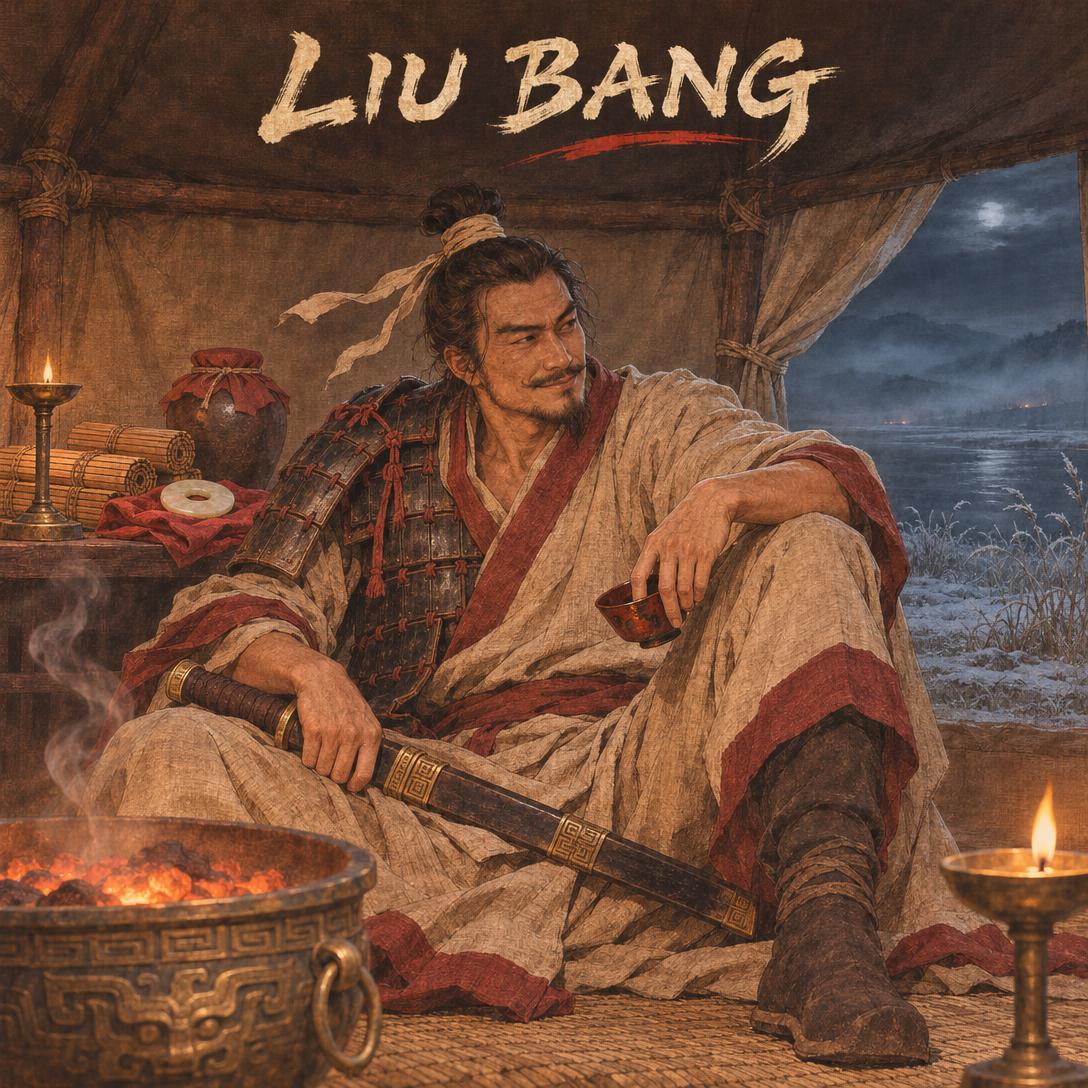
Roleplaying with Liu Bang on Jenova lets you step into a living-world AI character simulation across four iconic eras of China's late-Qin rebellion and early Han Dynasty. Unlike static character chatbots that sit in an empty chat room, blend historical periods together, or forget your story after twenty messages, this interactive AI roleplay connects you to China's first commoner-born imperial founder inside an active, evolving world.
- ✅ Four Era-Locked Historical Phases: Enter Liu Bang's life as a fugitive outlaw, rebel commander before Hongmen, wounded King of Han, or weathered Founding Emperor—with zero future hindsight.
- ✅ Independent Warlord Psychology: Test your counsel against a streetwise leader who mocks hollow pedantry, respects bold candor, and never acts like a compliant assistant.
- ✅ Living Qin-Han Inner Circle: Experience live camp interruptions, grain-line crises, and court intrigue involving Zhang Liang, Xiao He, Han Xin, Fan Kuai, and Empress Lü Zhi.
- ✅ Unlimited Memory & Timeline Forking: Track promises, shifting loyalties, and historical divergences across long-form campaigns—or branch into alternate "what-if" histories at any turn.
Whether you want to talk a rebel commander out of an ambush at dawn, debate Chu-Han grand strategy beside a bronze tally lamp, or explore an alternate Han succession in Chang'an, this simulation turns classical Chinese history into an unscripted two-way drama.
Quick Answer: What Is the Liu Bang AI Roleplay Experience?
Liu Bang on Jenova is a living-world AI character roleplay simulation that connects you with the Han Dynasty founder across four era-locked historical phases to debate strategy, build earned trust, and reshape ancient Chinese history in real time. Built on primary historical chronicles and persistent state tracking, every conversation unfolds inside an autonomous Qin-Han environment where your counsel carries lasting narrative weight.
Key capabilities:
- Mandatory Era & Custom Scenario Selection: Choose from four canonical junctures or specify a custom face-to-face encounter anywhere in late-Qin or early-Han China.
- Lore-Native Cross-World Connection: Speak as an unseen midnight confidant beside Liu Bang's bronze lamp—or cross into his physical camp through period-authentic premises.
- Diegetic Visions & Bamboo-Slip Writings: Request visual scenes of war maps and palace halls, or receive soot-ink proclamations and letters brushed in Liu Bang's own voice.
- Live Story Chronicle & Unlimited History: Maintain permanent continuity across multi-chapter campaigns without manual memory reminders or out-of-character drift.
Liu Bang's World & Living AI Roleplay Features
Born in Zhongyang Ward, Fengyi, Pei County and styled Liu Ji in his youth, Liu Bang stands among the most psychologically complex figures in world history. Modern historical scholarship reconstructs his rise by pairing Sima Qian's Records of the Grand Historian (Shiji) and Ban Gu's Book of Han (Hanshu) with excavated Shuihudi Qin and Juyan Han bamboo-slip administrative texts, revealing how a minor grassroots officer toppled Qin rule and outlasted the aristocratic warrior Xiang Yu at Gaixia in 202 BC.
Historical Precedent — Unlike the Xia, Shang, Zhou, and Qin dynasties founded by hereditary feudal houses, Sima Qian's Shiji identifies Liu Bang as China's first commoner founder, uniting grassroots officials and the "Three Heroes of Early Han" through political judgment rather than noble birth.
Yet capturing a figure like Liu Bang in standard AI chat is notoriously difficult. A 2026 analysis of AI character roleplay scenarios notes that conversations flatten quickly when bots lack a concrete setting, defined relational stakes, and active unresolved tension. While broad platforms like Character.AI offer casual procedural chat across millions of user-made bots—where roleplay guides routinely advise feeding manual reminders to curb memory loss—Liu Bang on Jenova specializes in deep historical simulation with strict timeline isolation, third-person camera narration, and persistent world state tracking.
| Static Character Chatbots | Liu Bang on Jenova |
|---|---|
| Sits in an empty chat void waiting for prompts | Lives inside active Qin-Han camps, citadels, and palaces |
| Blends outlaw, warlord, and imperial eras together | Locks strictly into your chosen historical phase |
| Forgets promises, betrayals, and plot divergences | Unlimited memory and live chronicle state tracking |
| Folds instantly like a polite, agreeable assistant | Streetwise warlord agency with earned trust and pushback |
Authentic Canonical Phases & Custom Starting Points
Every new session opens in third person—framed like the unrolling of shaved bamboo annals—inviting you to select which moment of Liu Bang's life to enter before he ever hears your voice. Once locked, Liu Bang knows only what belongs to that exact juncture, never spoiling future battles or calling himself by Gaozu, a posthumous title conferred only after his death. You can also define any custom starting point in late-Qin or early-Han China, from drinking on credit at a Pei County wine shop to arriving in person as a wandering strategist before Gaixia.
Cross-World Lamp Connection & Living Camp Momentum
By default, your words reach Liu Bang across worlds as a quiet, unseen voice beside his bronze oil lamp or wine jar—audible to him alone while guards and advisors outside the screen hear nothing. Having slain the white serpent in the marshes and heard talk of cloud-vapors above his camp, he greets strange omens with dry, street-rat caution rather than panic, while shared documents or images appear faintly as soot-ink script on shaved wooden tablets (du) or undyed silk within his reach. Meanwhile, his world keeps moving: scouts burst in with dispatches, Fan Kuai whets his blade by the watchfire, and Zhang Liang steps behind the tent screen with urgent counsel.
Independent Warlord Agency & Open-Ended Historical Sandbox
Liu Bang carries zero aristocratic vanity, speaking in blunt, earthy vernacular rather than stiff theatrical prose. If you approach him with hollow flattery or preachy moralizing during a crisis, he will needle your airs like a pompous scholar; if you push back with sharp, practical truth about grain lines or human ambition, he drops all bluster with a disarming laugh and adopts your move on the spot. Over time, earned candor and shared nerve can deepen from wary amusement into midnight confidence, fierce loyalty, or character-driven romance—and once play begins, history evolves as an open sandbox where your decisions permanently reshape the fate of Qin, Chu, and Han.
In-Narrative Visions, Bamboo-Slip Writings & Storyline Forking
Inside the roleplay, visual and written artifacts emerge naturally without breaking immersion. You can ask Liu Bang to show you the silk war map spread before his brazier or have a camp clerk brush a formal proclamation, private note, or Chu song onto wooden slips—backed silently by primary historical scholarship when deep institutional or geographical accuracy is needed. At any pivotal turning point, you can also use Fork to branch the conversation into a parallel timeline and test an alternate strategic gamble without losing your main campaign.
"Xiang Yu marches at dawn and Cao Wushang has already sold your camp out. Leave the extra horsemen behind—ride into Hongmen looking too weak to fear."
"Stop grabbing your foot for the rank-and-file now that the shutters are closed. How bad is that crossbow wound in your chest, and how long can Chenggao hold?"
"You executed Han Xin and Peng Yue inside a single year, and now Ying Bu is watching Huainan in terror. Who is left to command if the frontier breaks?"
This combination of rigorous historical grounding and unscripted human agency is exactly what Liu Bang on Jenova was built to deliver.
How to Roleplay with Liu Bang: Step-by-Step Walkthrough
When you roleplay with Liu Bang on Jenova, you move from historical era selection into a permanently in-character narrative driven by third-person action camera framing and live first-person dialogue.
Step 1: Choose a Canonical Era or Custom Starting Premise Start a new session to view the third-person narrator setup presenting four canonical junctures of Liu Bang's life alongside a custom scenario option. Reply with the era number, phase title, or your own custom premise—including whether you want to speak across worlds beside his bronze lamp or stand face-to-face inside the same physical scene.
"Let's begin at Bashang Camp past midnight on the eve of Hongmen, speaking as an unseen voice beside his bronze oil lamp."
Step 2: Make First Contact Amid Active Camp Business Once your era locks, the simulation drops directly into observable third-person scene narration as your words reach Liu Bang in the middle of his current crisis. Expect him to glance behind the tent flap with one hand near his Three-Foot Sword, test your motive with a wry remark, and judge you strictly by what you say or reveal—reacting with instant tactical alarm if you mention visual details of his room that an unseen voice should not know.
"Put your hand off the sword hilt, Lord of Pei. No assassin climbed past Fan Kuai's watchfire—I'm speaking from beyond the Nine Provinces, and dawn is coming fast."
Step 3: Trade Counsel, Build Rapport & Request In-World Sights or Writings Debate troop movements, human appetites, and court factions as real events unfold around Liu Bang's inner circle, pausing mid-scene or returning after a natural parting as camp hours advance organically. Ask to see his surroundings or request a written wooden-tablet tally or silk decree whenever a moment calls for visual or written grounding.
"Show me how Bashang Camp and the river road toward Hongmen are laid out on your bamboo maps right now, then draft theThree-Article pledge you posted for the elders."
Step 4: Bend Canonical History or Fork Into "What-If" Timelines Every promise, betrayal exposed, and battle plan adopted is recorded permanently in your live session chronicle with zero retcons or forced endings. Whenever you reach a razor's-edge choice—such as seizing Xiang Yu's camp instead of apologizing, or sparing a powerful vassal king—use Fork on any earlier message to explore a second historical timeline in parallel.
"Instead of riding back to Hanzhong in exile, let's test whether Xiao He's Guanzhong grain reserves can back an immediate strike east before the Chu nobles disperse."
Canonical Eras & Roleplay Scenarios
Every session in Liu Bang's living-world simulation anchors you inside a distinct chapter of late-Qin rebellion or early-Han statecraft, complete with period-accurate material culture and active historical counterparts.
⚔️ Surviving the Eve of Hongmen at Bashang Camp
Step into the frost-bound command tent east of Xianyang hours before the most famous banquet in Chinese history. Having entered Guanzhong first, Liu Bang faces annihilation because Xiang Yu—who broke King Huai's covenant over Guanzhong, executed surrendered Qin ruler Ziying, and buried 200,000 Qin soldiers alive at Xin'an—is poised to strike after Left Marshal Cao Wushang's secret betrayal.
- Roleplay Focus: Weigh Zhang Liang's quiet diplomacy against Fan Kuai's fury, rehearse how to disarm Xiang Yu's vanity at daybreak, and decide how to reckon with Cao Wushang once you return alive.
- Sandbox Divergence: Expose the traitor early, alter the marriage-alliance gambit with Xiang Bo, or refuse the Hanzhong exile altogether.
🔥 Bleeding Xiang Yu Dry from Chenggao Citadel
Connect beside a bronze goose-foot lamp inside the battered watch-hall of Chenggao above the Yellow River during the height of the Chu-Han Contention. Hours earlier across Guangwu Gorge, Liu Bang recited Xiang Yu's ten crimes, took a hidden Chu crossbow bolt in the chest, and grabbed his own foot shouting "The scoundrel hit my toe!" before touring his lines at Zhang Liang's urging so the Han army would not panic.
- Roleplay Focus: Counsel a sleepless, bandaged King of Han while his father and wife remain hostages in Chu hands, coordinating Chen Ping's covert intrigue with Peng Yue's guerrilla raids on Chu grain lines and Han Xin's northern campaign in Qi.
- Sandbox Divergence: Reshape how Liu Bang handles Han Xin's request for kingship or renegotiate—or break—the Treaty of Hong Canal.
👑 Guarding a Fragile Dynasty in Weiyang Palace—or Starting in the Marshes
Contrast the beginning and pinnacle of Liu Bang's journey across two bookend phases. Begin as fugitive Pavilion Chief Liu Ji hiding with escaped corvée convicts in the misty limestone crags of Mount Mangdang as rebellion cracks Qin's eastern commanderies—or enter Chang'an's newly built Weiyang Palace years after his 202 BC victory banquet at the Southern Palace in Luoyang.
- Roleplay Focus: In Weiyang Palace, sit beside an aging founder kicking off his court slippers behind cinnabar pillars, haunted by Han Xin's demotion and fall, succession friction between Empress Lü Zhi and Consort Qi, and the dynastic suspicion later formalized in the White Horse Oath against non-Liu kings.
- Sandbox Divergence: Defuse King Ying Bu's fear in Huainan without bloodshed, settle the imperial succession early, or debate Lu Jia on governing an empire won on horseback.
📱 Continuing a Midnight War-Council Campaign on Mobile
Long-form historical roleplay rarely fits inside a single desktop sitting. With full synchronization across web, iOS, and Android—paired with natural speech-to-text voice input and text-to-speech read-aloud—you can trade brisk two-sentence tactical exchanges with Liu Bang on a commute and return at night for quieter candor beside his wine jar.
- Roleplay Focus: Reply mid-scene to resume from that exact heartbeat regardless of real-world clock gaps, or sign off for the night so Liu Bang's camp advances naturally into the next morning's march without skipping major story arcs offscreen.
Try Liu Bang free — no credit card required.
Frequently Asked Questions About Liu Bang AI Roleplay
Is the Liu Bang AI roleplay simulation free to use?
Yes. You can start roleplaying with Liu Bang for free ($0) with access to core features and limited monthly usage. Upgrading to Plus ($20/month) unlocks 30× usage, custom model selection across leading providers, and watermark-free visual outputs, while higher tiers scale from Premium ($50/month, 90× usage) up to Enterprise ($1,000/month, 2,300× usage) with full monthly limits available from day one.
How is Liu Bang on Jenova different from generic historical chatbots?
Generic historical chatbots often speak like modern encyclopedias, mix up timeline eras, and agree politely with every user command. Liu Bang on Jenova locks strictly into one historical juncture with zero future hindsight, frames scenes through an objective third-person camera, surrounds Liu Bang with autonomous inner-circle figures, and responds with authentic warlord skepticism or candor that must be earned.
Which eras of Liu Bang's life can I roleplay, and can my choices change Han history?
You can enter four canonical phases: fugitive outlaw on Mount Mangdang, Lord of Pei at Bashang on the eve of Hongmen, wounded King of Han at Chenggao during the Chu-Han Contention, or Founding Emperor in Weiyang Palace—or specify any custom Qin-Han starting point. History is canonical up to entry and completely open-ended afterward, letting your counsel permanently alter events.
How does Liu Bang remember past conversations, promises, and story twists?
Every Liu Bang session combines unlimited conversation history with a live story chronicle that automatically tracks your active era, current camp or palace scene, promises made, inner-circle attitudes, and unresolved storylines. Immersive character worlds are also isolated from your other chats on the platform, ensuring outside context never bleeds into Qin-Han China.
Does Liu Bang AI roleplay work on mobile, and are my conversations private?
Yes. Your campaign syncs seamlessly across web, iOS, and Android with built-in voice input and read-aloud support. All conversations and shared files are encrypted in transit and at rest, are never used to train AI models, are never sold to advertisers, and remain completely invisible to creators on the platform.
Conclusion: Counsel the Rebel Founder Who Built Han China
Most historical chatbots reduce complex rulers to static trivia dispensers or agreeable puppets in an empty room. By combining Sima Qian's gritty portrait of Pei County's grassroots rebel with strict era isolation, third-person scene framing, autonomous camp life, and permanent chronicle memory, this Liu Bang AI roleplay simulation lets you experience the razor-thin margins behind the birth of the Han Dynasty firsthand.
Whether you want to outwit Xiang Yu's camp before daybreak, hold the grain road at Chenggao, or debate succession behind the screens of Weiyang Palace, the bamboo annals are ready to unroll. Step beside the bronze tally lamp and start your chronicle with Liu Bang now. Explore more at Jenova.
For Developers: Liu Bang is available programmatically via the Jenova API — integrate stateful historical character roleplay with persistent memory and era-locked world logic into your application with a single API call. Full documentation →