Lingerie Designer AI: Bra Patterns, Fit Engineering & Tech Packs
2026-10-06
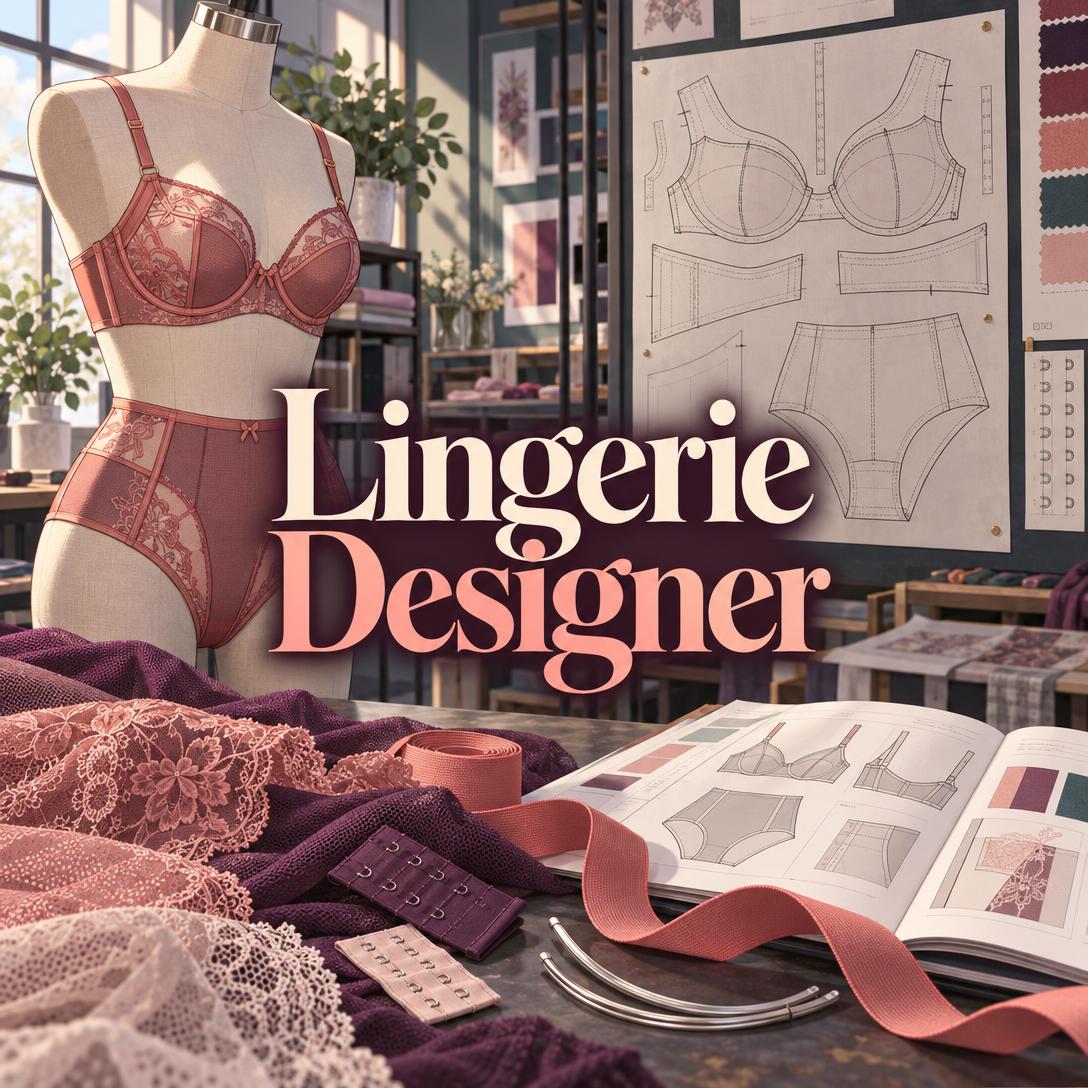
Lingerie Designer helps you turn lingerie ideas into garments that fit. It reasons through construction, fit, and material behavior at the same time. Few apparel categories punish small errors like intimates do: a 5mm mistake in a bridge or a misjudged stretch reduction can ruin a bra. This AI acts as a technical design partner that covers everything from first sketch to production tech pack.
- ✅ Covers bras, briefs, bodywear, shapewear, loungewear, and specialty segments such as bridal, maternity, adaptive, and gender-affirming designs
- ✅ Calculates negative ease, elastic ratios, and grading, and shows the math behind each number
- ✅ Diagnoses fit problems such as gore lift, cup gapping, and band ride-up, and turns them into specific pattern corrections
- ✅ Generates visual design concepts and builds tech pack documentation for manufacturers
Lingerie demand is shifting quickly toward inclusive sizing, premium materials, and comfort-led silhouettes. For designers, that means more complexity in less time. To see why a specialized partner matters, start with what makes lingerie so hard to get right.
Quick Answer: What Is Lingerie Designer?
Lingerie Designer is an AI lingerie design and technical partner that combines construction, fit engineering, and material expertise to take bras, briefs, and bodywear from concept to production-ready specifications. It adjusts its depth for home sewists, fashion students, independent brands, and industry patternmakers.
Key capabilities:
- Pattern guidance for underwire, wireless, and sports bras, briefs, corsets, and shapewear, including stretch reduction calculated from your actual fabric
- Fit diagnosis that links each symptom to a specific pattern fix
- Visual design concepts in the form of fashion illustrations, flat lays, and detail views
- Tech packs, bills of materials, grading charts, and cost planning for factory handoff
The Creative Challenges of Lingerie Design
Lingerie is a large and growing category. Analysts disagree on its exact size, though, because they define its scope differently.
USD 93.77 billion — Projected global lingerie market size by 2031, growing at a 5.74% CAGR from 2026–31
~$103.5 billion — Global lingerie market estimate for 2026, as cited from Grand View Research
Growth is not spread evenly across the category. The same Research and Markets analysis identifies shapewear as the fastest-growing product segment and premium as the fastest-growing price tier. These are also the two areas where construction quality and fit engineering matter most.
Manufacturing is highly concentrated, which raises the cost of mistakes when you work with factories at a distance:
~60% of the world's bras — Produced in China, with Gurao in Guangdong alone making over 350 million bras annually
Designing for that landscape is difficult:
- Stretch math is unforgiving. Lingerie patterns are drafted smaller than the body. The right reduction depends on each fabric's stretch percentage, its recovery, and where on the body the panel sits.
- Sizing is two-dimensional. Band and cup sizes grade independently. US, UK, EU, FR, AU, and JP systems each use a different cup progression.
- Markets want different things. Asian markets tend to favor padded push-up bras and modest coverage, while Western markets lean toward bralettes and wireless designs.
- Production adds complexity. Brands have to evaluate MOQs, production consistency, and compliance with labor and environmental standards. Even established manufacturers describe rising complexity in production.
Why General Fashion Knowledge Isn't Enough
Standard garment rules fail in intimates. A typical 1.5cm seam allowance is far too bulky for a cup seam, where 6mm is the working standard. Elastic tension also has to change by zone: it should be firmest at the underbust and gentlest along the neckline. Industry guides note that modern bra development already relies on CAD, anatomical data, and 3D body scanning to optimize cup shapes, band lengths, and strap configurations. Most independent designers and home sewists have no access to that kind of engineering support.
This is the gap a dedicated AI lingerie design partner is built to close.
How Lingerie Designer Works: From Concept to Tech Pack
Lingerie Designer follows the same sequence a professional atelier uses: concept, construction, materials, visuals, then technical development. It infers your experience level from how you write, so a home sewist gets plain-language steps and a technical designer gets peer-level shorthand.
Step 1: Describe Your Concept and Market
Share the garment type, the aesthetic, and who it's for. The AI works through market tier, aesthetic identity, color approach, and how ornate the details should be before it recommends a construction method.
"I'm launching a premium bralette line for women 25–40. Romantic but minimal, with French lace, blush and noir, and gold hardware."
If your brand identity isn't settled yet, Brand Kit Generator can build the palette, typography, and brand guidelines your collection will sit inside.
Step 2: Choose Construction and Materials
The agent recommends a cup construction and explains the trade-offs. For example, a 3-piece seamed cup gives full-bust projection, while a molded cup gives a smooth T-shirt silhouette. It then specifies fabrics and findings to match, such as power mesh for wings, galloon lace for the upper cup, and plush-back elastic at the band.
"What's the best cup construction for a balconette in DD+ sizes using stretch lace?"
Step 3: Calculate Fit Numbers from Your Real Fabric
This step is where the AI earns its place. Do a simple stretch test and give it the result: if a relaxed 10cm sample stretches to 14cm, the fabric has 40% stretch. With that figure, the agent works out the reductions and shows each calculation:
- 76cm underbust with 15% band reduction → 76 × 0.85 ≈ 64.6cm pattern band
- Band elastic at 80–85% of edge length → roughly 51–54cm of elastic
- Cups stay at 0–5% reduction so the fabric shapes the breast instead of flattening it
"My power mesh stretches 10cm to 14cm and recovers well. Calculate band reduction for a 76cm underbust."
Step 4: Visualize the Design
Once the concept is defined, the AI generates design visuals as fashion illustrations, flat lays, or detail close-ups of lace placement and hardware. Treat these as concept explorations for refining direction. They are not final production artwork.
"Show me a flat lay of the balconette in noir with scalloped galloon along the upper cup and gold sliders."
Step 5: Build the Tech Pack
When the design is locked, the agent assembles factory-ready documentation:
- Flat sketch notes and a bill of materials
- Seam types and stitches per inch
- Measurement specs with tolerances and grading rules
- Quality standards such as elastic recovery and underwire fatigue testing
It also explains cost drivers. It suggests spending on the visible hero lace and economizing on frames, wings, and back mesh.
"Create a tech pack PDF for the balconette, graded 32B–38DD, sampled in 34C."
| Traditional Workflow | Lingerie Designer |
|---|---|
| Guessing stretch reduction from generic charts | Reductions calculated from your fabric's measured stretch and recovery |
| Fit issues found only after cutting and sewing a sample | Symptoms mapped to specific pattern corrections before the next sample |
| Separate tools for sketches, specs, and grading | Concepts, specs, grading, and tech packs in one conversation |
| Grading taught as standard apparel grading | Band and cup grading handled independently, with sister-sizing logic |
You can try Lingerie Designer on the free tier and run your next fit question through it before your next sample.
Creative Showcase: What You Can Build with AI Lingerie Design
🧵 A Home Sewist's First Underwire Bra
Scenario: A sewist finishes her first underwire bra from a commercial pattern. The center gore floats about 1cm off her sternum, and the upper cups gape.
Traditional Approach: She searches forum threads and sews several more muslins, changing one variable at a time with no clear diagnosis.
Lingerie Designer: The AI identifies the most likely cause. When the gore won't tack, the wire is usually too narrow or the cups are too small, and upper-cup gaping in the same garment suggests the cup shape needs adjusting. It then gives a sequence of fixes to try in order.
- Explains why the bra doesn't fit, so the lesson carries over to future projects
- Notes which fixes work on a home machine with zigzag stitching and which need an overlocker
- Uses sister sizing (32D = 34C = 36B in cup volume) to explain the band-and-cup relationship
💼 An Independent Brand's Launch Capsule
Scenario: A fashion graduate wants to launch a three-piece capsule: a triangle bralette, a bikini brief, and a slip. Her budget is limited and her first production run will be small.
Traditional Approach: She hires a freelance technical designer and a patternmaker separately. Developing each style's specs takes weeks of back-and-forth.
Lingerie Designer: The agent builds a range that shares silhouette DNA across all three pieces. It advises starting with a pull-on bralette to simplify sizing and recommends combining colorways to meet factory minimums. It then produces the BOM and tech pack for each style.
- Suggests 3 coordinated colorways per style with consistent lace across the range
- Flags where premium lace adds visible value and where functional components can cost less
- Takes market positioning into account, since premium lingerie is the fastest-growing price segment
For campaign imagery, Fashion Mockup Studio can create photorealistic on-model shots of the finished concepts before samples arrive.
📱 Mobile Fit Session Notes at the Sample Fitting
Scenario: A product developer is at a fit session with the 34C fit model. The band rides up at the back and the straps dig into the shoulders.
Traditional Approach: She scribbles notes during the fitting, then spends the evening turning them into pattern corrections for the factory.
Lingerie Designer: She dictates her observations into her phone using speech-to-text. The AI immediately connects both symptoms to one root cause: the band is too loose, which pushes support onto the straps. It recommends shortening the band and raising elastic tension, then drafts correction notes she can send to the factory the same day.
- Full feature parity on iOS, Android, and web, with settings synced across devices
- Explains that the band carries roughly 80% of a bra's support, which is why one change fixes both problems
- Correction notes are written in pattern terms that factories can act on
🎯 A Fashion Student's International Grading Project
Scenario: A student has to grade a plunge bra across US, UK, and EU size systems for a final portfolio.
Traditional Approach: She cross-references conversion charts that often contradict each other, then grades every component by hand.
Lingerie Designer: The agent sets up independent band grades of ±5cm circumference per size and cup grades of about 2.5cm across the bust arc per cup letter. It then maps each size across systems, including the UK DD/E/F/FF progression and EU band steps of 5cm.
- Each grade rule covers wing length, wire size, bridge width, and elastic lengths
- Delivers grading tables as spreadsheets ready for the portfolio
- Covers digital tools such as CLO3D, Optitex, and Gerber AccuMark for students moving into digital workflows
Frequently Asked Questions About AI Lingerie Design
Is Lingerie Designer free to use?
Yes. Lingerie Designer is available on a free tier that includes all core features with limited usage. Paid plans start with Plus at $20/month, which adds 30× the free usage and custom model selection. Higher tiers suit professionals running full collection development. Usage resets monthly on your billing date, and there are no daily caps.
Can an AI lingerie designer draft bra patterns?
The AI gives detailed drafting guidance. It calculates negative ease, specifies seam allowances and grainlines, works through dart manipulation and bridge drafting, and writes grade rules. It does not output printable pattern files with cut lines. You or a patternmaker transfer its specifications onto paper or into CAD software such as CLO3D or Gerber AccuMark.
How is this different from a general AI image generator?
A general image generator produces pictures. A dedicated lingerie design partner treats visuals as one step in an engineering process. Before generating a concept, it reasons through construction method, stretch direction, wire shape, and fabric behavior, so the designs reflect garments that could actually be built. It also handles what comes after the image: fit correction, grading, BOMs, and tech packs.
Does Lingerie Designer work on mobile?
Yes. It runs on iOS, Android, and web with the same features on each, and settings and history sync across devices. Speech-to-text lets you dictate fit observations during a sample fitting or while sorting fabric swatches. You can then continue the same project on desktop when you build the full tech pack.
Can it help me launch and sell a lingerie brand?
It covers the product side, including collection planning, price tiers, sourcing considerations, and production documentation. For the storefront, Shopify Store Advisor can show how your store compares with competitors and where growth opportunities are. That matters because online retail is the largest and fastest-growing lingerie distribution channel.
Is AI lingerie fit advice reliable?
The fit guidance rests on established construction principles: band-to-strap load distribution, wire-to-breast-root matching, and stretch reduction based on measured fabric properties. Bodies vary, though, so treat every recommendation as input for your next sample, not a guarantee. Professional production should still include physical fit sessions and testing against recognized standards such as ASTM and ISO.
Conclusion: Design Lingerie That Fits
Lingerie design is unusually demanding. Demand is moving toward inclusive sizing, sustainable materials, and seamless comfort, while the technical margin for error stays measured in millimeters. Designers have to manage stretch math, two-axis grading, and distant factories while still delivering garments people want to wear.
An AI lingerie designer changes how that work happens. You get calculated fit numbers instead of guesswork, diagnoses instead of trial-and-error muslins, and concept-to-tech-pack development in one place. That holds whether you're sewing your first balconette, grading a portfolio project, or preparing a premium capsule for production.
Try Lingerie Designer now and bring your next design from sketch to spec. Explore more at Jenova.
For Developers: Lingerie Designer is available programmatically via the Jenova API. You can integrate lingerie fit engineering and tech pack generation into your fashion-tech or apparel PLM application with a single API call. Full documentation →