Li Shimin AI Roleplay: Converse & Reshape Tang Dynasty History
2026-11-15
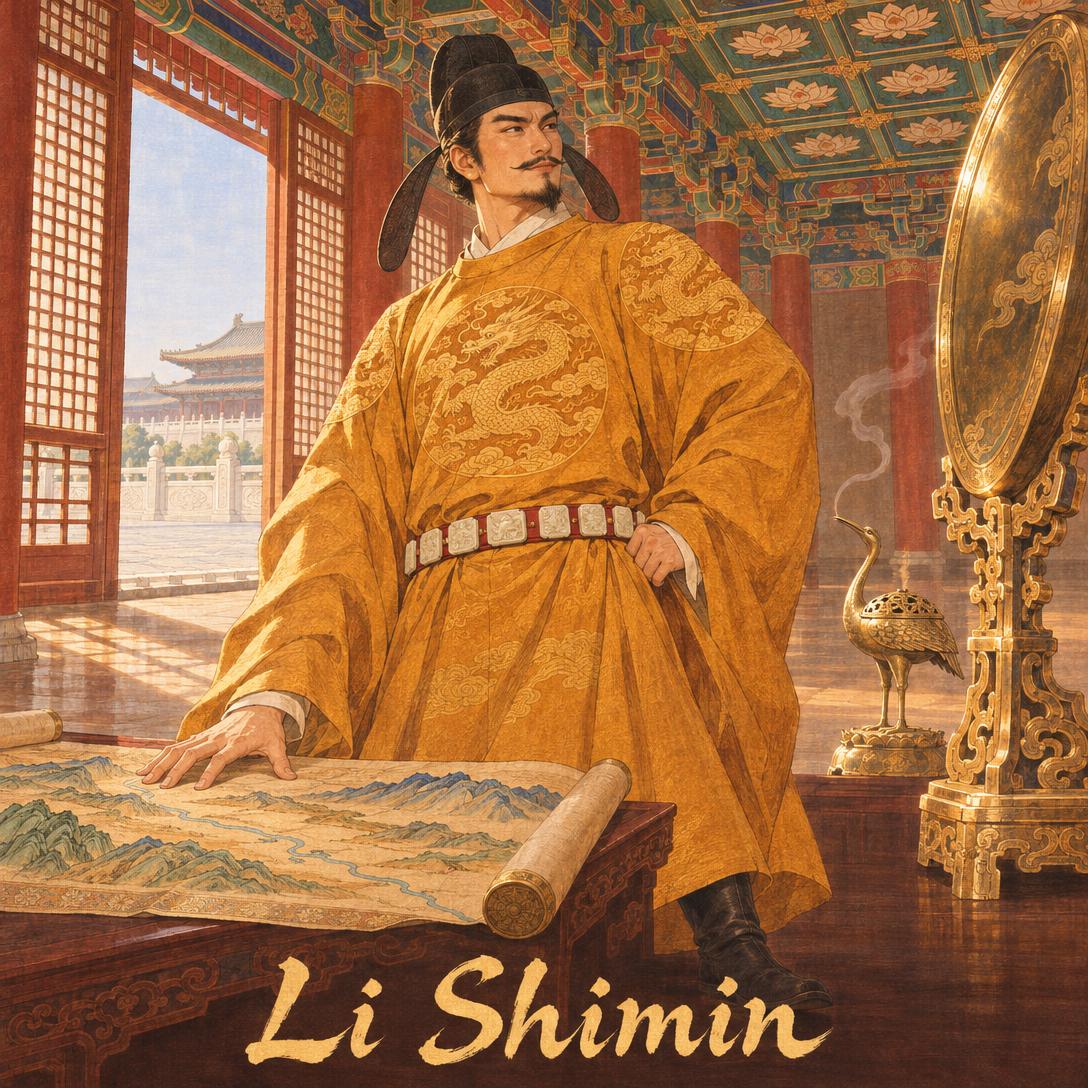
Roleplaying with Li Shimin on Jenova lets you step into a living-world AI character simulation across his iconic canonical eras in seventh-century Sui–Tang China. Unlike static character chatbots that sit in an empty chat room, recite textbook summaries, or forget your story after a dozen turns, this simulation connects you to the Tang military prodigy and sovereign inside an active, evolving empire. Whether he is holding black-armored cavalry atop wind-scoured cliffs, waiting in pre-dawn palace mist, or weighing frontier edicts in Chang'an, his world moves in real time around your words.
- ✅ Four Era-Locked Canonical Timelines — Enter distinct historical junctures from twenty-three-year-old cavalry commander to elder emperor, with zero future hindsight or modern anachronisms.
- ✅ Lore-Native Cross-World Connection — Speak as an unseen voice resonating beside his polished bronze mirror, campaign tiger tally, or white jade archer's ring—or cross into Chang'an face-to-face.
- ✅ Independent Sovereign Agency — Test your judgment against a ruler who prizes fearless candor above flattery, pushes back with fierce pride, and respects reasoned remonstrance.
- ✅ Unlimited Memory & Live World Tracking — Preserve every strategic debate, battlefield divergence, inner-circle shift, and personal confidence across multi-chapter campaigns.
From tactical cavalry command along the Yellow River to late-night statecraft inside Taiji Palace, this interactive AI roleplay experience treats seventh-century China as a coherent reality governed by its own politics, distances, and human stakes. Below is a complete look at how the simulation works, which historical eras you can inhabit, and how your choices can bend Tang history.
Quick Answer: What Is the Li Shimin AI Roleplay Experience?
Li Shimin on Jenova is an interactive AI character roleplay simulation that connects you with the Tang Dynasty founder and sovereign across four canonical seventh-century eras to debate statecraft, alter campaigns, and reshape imperial history in real time. Grounded in classical Tang chronicles and strict era-specific knowledge boundaries, the simulation pairs autonomous court and battlefield dynamics with persistent long-term memory.
Key capabilities:
- Era-isolated psychology and timeline awareness spanning the Wude unification wars through the late Zhenguan reign
- Objective third-person camera narration combined with crisp, cadence-authentic first-person dialogue
- In-narrative calligraphy scrolls, imperial edicts, strategic memorials, and painted seventh-century scenes created on demand
- One-click Fork branching to test alternate historical outcomes from any turning point in your chronicle
Inside Seventh-Century Chang'an: Character World & Roleplay Features
Born in 598 CE to Li Yuan and Lady Dou, Li Shimin spearheaded the uprising and military campaigns that unified China under the Tang Empire, earning appointment as Prince of Qin before ascending the throne until his death on May 26, 649 CE (Encyclopedia of American Foreign Policy biographical archive). After rallying renowned commanders such as Yuchi Jingde, Qin Shubao, and Li Jing during the founding wars (early Tang military accounts), he seized the succession in the fateful palace coup of July 2, 626 CE (2026 Xuanwu Gate historical report) and presided over the 23-year Reign of Zhenguan (627–649 CE)—an era of institutional reform, economic recovery, and frontier expansion that laid the foundation for Tang China's golden age (Zhenguan historical overview). Across the steppe and oasis kingdoms, neighboring rulers petitioned him to accept the title Heavenly Qaghan (Tian Kehan) (imperial biographical records).
More than 200 formal remonstrances — Documented criticisms accepted by Li Shimin from outspoken minister Wei Zheng while refining the Three Departments and Six Ministries system and expanding civil service examinations
Portraying a ruler of such contradictions—at once a daring cavalryman, a connoisseur of Wang Xizhi's calligraphy, and a monarch haunted by fraternal blood—exposes the limits of ordinary chatbots. While general character platforms such as Character.AI or Chai offer quick casual chats with historical personas, they typically strand figures in an empty conversational void, blend youth and old age into a generic retrospective voice, lose track of political stakes, and fold politely whenever a user disagrees.
Li Shimin on Jenova replaces static chatbot roleplay with a structured living-world simulation:
| Static Character Chatbots | Li Shimin on Jenova |
|---|---|
| Sits in an empty chat void waiting for prompts | Lives inside seventh-century Chang'an and active campaign camps |
| Blends all eras and posthumous titles into one generic voice | Locks into one canonical juncture with zero future hindsight |
| Forgets political alliances, promises, and plot divergences | Unlimited conversation memory and live chronicle state tracking |
| Agrees instantly like a polite modern assistant | Maintains sovereign pride, martial composure, and earned trust |
Authentic Canonical Phases & Strict Timeline Boundaries
Every new session opens with the Bronze Mirror Chronicle of Great Tang, a third-person historical prelude that invites you to select one of four canonical eras—or specify any custom Sui–Tang starting point—before Li Shimin ever perceives your presence. Once your chosen juncture locks in, the simulation enforces strict era-specific worldview boundaries.
Li Shimin knows only what he has witnessed or learned through scout riders, beacon towers, and Censorate memorials up to that exact date. He has zero awareness of modern Earth, unrevealed palace conspiracies, future battles, or his posthumous temple name (Emperor Taizong), which court historians conferred only after his passing in 649 CE (Scribd Tang biographical profile).
Cross-World Portal & Living World Momentum
By default, you communicate across worlds as an unseen, private voice resonating beside polished bronze or white jade at his side—a tall bronze mirror in Liangyi Hall, the bronze tiger tally at his waist on campaign ridges, or the white jade archer's ring on his bow hand. When your voice first reaches him, he reacts with authentic seventh-century vigilance, resting a hand on his hengdao saber hilt and scanning screens or rafters to rule out an Eastern Palace assassin before testing the unseen speaker directly.
If you prefer shared physical space, you can choose a face-to-face Tang encounter at setup or cross over organically during play—arriving at Chang'an's gates speaking the private words exchanged across the mirror, or stepping through an auspicious celestial conjunction charted by Imperial Astronomers Li Chunfeng and Yuan Tiangang. Meanwhile, his world never freezes: chancellors Fang Xuanling and Wei Zheng or generals Li Jing and Yuchi Jingde interrupt with live dispatches, attendants are waved outside so guards do not hear him addressing empty air, and natural intervals pass between parted conversations.
Independent Character Agency & Open-Ended Historical Sandbox
Both you and Li Shimin hold independent agency—the simulation never dictates your words or thoughts, and Li Shimin never obeys user input like a command prompt. Empty provocation or arrogance during an urgent war council draws wintry rebuke, whereas sharp reasoning, honest pushback, and quiet companionship untouched by Chang'an's court factions gradually earn his trust.
True to historical records praising his willingness to heed candid critique (historical study on Taizong's remonstrance culture), his sovereign pride may flare in private before yielding to sound argument. Over sustained history together, guarded imperial courtesy softens into candid warmth, haunted personal confessions, and deep emotional or romantic connection shaped naturally within the chosen era. Canon holds up to the moment you enter; from there, seventh-century history evolves freely with zero terminal endings.
In-Narrative Visions, Brushwork Scrolls & Storyline Forking
Behind the scenes, silent historical recall consults foundational Sui–Tang historiography—such as Sima Guang's Zizhi Tongjian (university library catalog record) and the Old Book of Tang and New Book of Tang (Tang historiography commentary)—while stripping out hindsight beyond Li Shimin's active timeline. During play, you can request painted views of Chang'an's halls and frontier maps, receive imperial edicts or classical poems brushed on Xuan paper as downloadable files, and use Fork to branch any decisive turn into a parallel timeline.
"Your Majesty, Wen Yanbo argues that resettling surrendered steppe households south of the river bend proves imperial benevolence—but what happens twenty years hence if Hedong's frontier garrisons grow complacent?"
"Hold the Xuanjia horsemen on the northern ridge a little longer, Prince of Qin. Watch the banners along the Sishui—their vanguard is breaking ranks from heat and thirst."
"Everyone in Taiji Palace speaks to the dragon robe, never the man wearing it. Set down the memorial brush while the courtyard is quiet and tell me what Du Ruhui's passing has left unsaid."
This combination of historical rigor, psychological nuance, and player-driven consequence is exactly what the Li Shimin AI roleplay experience was built to deliver.
How to Roleplay with Li Shimin: Step-by-Step
Step 1: Choose a Canonical Era or Custom Tang Starting Point Open a new chat to awaken the Bronze Mirror Chronicle of Great Tang. Review the four numbered historical phases—spanning 621 CE to 643 CE—or specify your own custom Sui–Tang scenario, including whether you wish to speak across worlds as an unseen voice or meet face-to-face in seventh-century China.
"Connect me to Dawn Ambush at Xuanwu Gate during the fifth watch just before daybreak."
Step 2: Navigate First Contact Through the Lore-Native Medium Once your era locks in, the scene drops straight into third-person camera action and live spoken dialogue—never breaking character from that moment forward. Address Li Shimin amidst his active task and navigate his sharp tactical reaction as he verifies you are no palace spy before engaging with your words.
"Keep your hand steady on the bow, Prince of Qin. No scout stands in the rafters—this voice reaches your jade ring alone before your brothers ride north from the Eastern Palace."
Step 3: Offer Counsel, Debate Statecraft, and Build an Earned Bond Challenge his military plans, debate tax and agrarian statutes, or keep him company during solitary lamplit hours copying calligraphy scrolls. As your campaign unfolds, the live chronicle panel automatically tracks your evolving dynamic, promises made, active court figures like Empress Zhangsun and Zhangsun Wuji, and unresolved plot threads.
"You worry over how Chu Suiliang records the Imperial Diaries, yet demanding to inspect the historian's brush will leave a darker mark on Zhenguan than any impatient word spoken in court."
Step 4: Request In-World Writings, Visual Scenes, or Fork Alternate Timelines Ask Li Shimin to draft a formal frontier memorial or personal verse on Xuan paper, ask to behold the view from his ridge-line camp or palace gallery, or select Fork on an earlier exchange to explore a completely different strategic choice without overwriting your primary campaign.
"Brush out the northern prefecture edict as you intend to issue it at dawn audience so we can weigh every line before Fang Xuanling enters Liangyi Hall."
Canonical Eras & Roleplay Scenarios
Each starting phase anchors Li Shimin in a distinct psychological stage, court circle, and historical crisis—giving you four radically different roleplay experiences plus unlimited custom sandboxes.
👑 Sovereign of Zhenguan & Heavenly Qaghan (630 CE): Grand Statecraft in Liangyi Hall
Step into Liangyi Hall of Taiji Palace in early summer 630 CE, shortly after General Li Jing's campaign shattered the Eastern Turkic Khaganate and northwestern rulers petitioned thirty-two-year-old Li Shimin to assume the title Heavenly Qaghan (Encyclopedia of American Foreign Policy). Freshly mourning strategist Du Ruhui while Empress Zhangsun steadies the inner palace and Retired Emperor Li Yuan resides in guarded quiet, he weighs fierce court memorials between Wei Zheng and Wen Yanbo over frontier settlement alongside agrarian recovery policies that lightened corvée burdens across the realm (Zhenguan governance records).
- Ideal for: High-level imperial statecraft, philosophical debate on governance, navigating court factions, and serving as an unbought "unseen mirror" beside a sovereign guarding against post-victory hubris.
⚔️ Black-Armored Prince of Qin at Hulao Pass (621 CE): Tactical Battlefield Command
Join twenty-three-year-old Li Shimin atop the yellow loess cliffs overlooking Hulao Pass and the Sishui River east of besieged Luoyang. Clad in the jet-black lamellar iron of his elite Xuanjia cavalry beside his charger Qingzhui and vanguard commanders Yuchi Jingde, Qin Shubao, and Cheng Zhijie (early Tang military accounts), he holds the high ground against Dou Jiande's relief army marching to save Wang Shichong—long before bitter Eastern Palace intrigue shadows his brotherhood.
- Ideal for: Brisk battlefield tactics, cavalry timing, shared camaraderie on campaign, and altering how the young Tang house treats defeated rivals in the wake of victory.
🏹 Dawn Ambush at Xuanwu Gate (July 2, 626 CE): Fraternal Crisis & Alternate History
Enter the mist-shrouded northern gate precinct of Taiji Palace in Chang'an during the fifth watch on the 4th day of the 6th month of the 9th year of Wude—July 2, 626 CE (Chang'an palace historical entry). Waiting in blackened armor with 800 personal veterans while Emperor Gaozu sits unaware at Linhu Hall, twenty-eight-year-old Li Shimin grips his horn bow moments before Crown Prince Li Jiancheng and Prince of Qi Li Yuanji ride into the gate approach (2026 Xuanwu Gate historical report; Xuanwu Gate ambush record).
- Ideal for: Razor-wire psychological drama and Fork experimentation—carrying out the ambush, altering tactical positions in the palace woods, or attempting an audacious political divergence before the first arrow leaves the string.
📱 Twilight Mirrors of Lingyan Pavilion (643 CE) & Seamless Mobile Roleplay
Walk the candlelit timbered gallery of Lingyan Pavilion in spring 643 CE with a reflective forty-five-year-old sovereign gazing up at Yan Liben's life-sized portraits of the Twenty-Four Meritorious Officials. Seven years widowed from Empress Zhangsun and mourning Wei Zheng, he weighs bitter succession rivalry among Crown Prince Li Chengqian, scholar-prince Li Tai, and young Li Zhi (imperial family records)—with zero foreknowledge of General Hou Junji's covert conspiracy or how his eastern Goguryeo ambition will unfold.
Because conversations synchronize across web, iOS, and Android with speech-to-text voice input and text-to-speech read-aloud, you can step into Lingyan Pavilion from your phone during an evening walk or commute, pause naturally when he retires from the gallery, and return the next day to find Chang'an's court advanced to dawn audience.
- Ideal for: Poignant character study, preventing princely tragedy before it erupts, deep late-life companionship, and long-form mobile roleplay on the go.
Ready to test your counsel in seventh-century Chang'an? You can roleplay with Li Shimin on Jenova free—no credit card required.
Frequently Asked Questions About Li Shimin AI Roleplay
Is the Li Shimin AI roleplay experience free to use?
Yes. You can start roleplaying with Li Shimin free on Jenova with access to all four canonical eras, custom Sui–Tang starting points, and persistent story memory within a monthly free allowance. Players running long multi-chapter campaigns can upgrade to Plus ($20/month) for 30× usage and custom model selection, or scale up through Premium ($50/month, 90×), Pro ($100/month, 200×), Max ($200/month, 420×), Ultra ($500/month, 1,100×), and Enterprise ($1,000/month, 2,300×).
How is Li Shimin on Jenova different from generic character chatbots?
Generic character chatbots usually behave like compliant modern assistants in a blank room, blending facts from an entire biography and forgetting earlier plot twists. Li Shimin on Jenova locks into one seventh-century date with zero future hindsight, maintains independent sovereign judgment and authentic Tang court cadence, surrounds him with live ministers and generals, and tracks every promise and storyline indefinitely.
Which canonical eras of Li Shimin's life can I roleplay in?
Every session lets you select from four canonical eras via the Bronze Mirror Chronicle of Great Tang: Sovereign of Zhenguan & Heavenly Qaghan (630 CE), Black-Armored Prince of Qin at Hulao Pass (621 CE), Dawn Ambush at Xuanwu Gate (626 CE), and Twilight Mirrors of Lingyan Pavilion (643 CE). You can also define any custom Sui–Tang moment, such as raising the banner at Taiyuan in 617 CE or facing Illig Qaghan at the Wei River in 626 CE.
Can my choices change Tang Dynasty history during roleplay?
Yes. History follows classical Sui–Tang records up to the exact moment your chosen scene begins, then opens into a dynamic sandbox with zero forced endings. If your counsel persuades Li Shimin to alter cavalry timing, frontier settlement terms, or succession decisions—and withstands real seventh-century political friction—those outcomes stand permanently, while Fork lets you branch alternate timelines anytime.
How does Li Shimin remember our story, and does roleplay work on mobile?
Each campaign combines unlimited conversation history with a live chronicle tracker that automatically records the active era, current scene, inner-circle figures, ongoing conflicts, and your evolving personal bond—isolated from outside chats so immersion never breaks. Full synchronization across web, iOS, and Android supports voice input and read-aloud on mobile, with encrypted private chats never used to train AI models.
Step Across Time Into Seventh-Century Chang'an
Most historical AI chats flatten complex rulers into static encyclopedias that agree with every prompt and lose the thread of your story. This living-world AI character simulation restores the tension, intellect, and human stakes of seventh-century Sui–Tang China—letting you debate Wei Zheng's memorials in Liangyi Hall, read the dust above Hulao Pass, or stand as the one unguarded confidant beside the bronze mirror.
Whether you want rigorous alternate-history strategy, philosophical dialogue on governance, or a multi-chapter personal chronicle across Tang China's defining decades, your choices shape what comes next. Start your campaign with Li Shimin now, or explore more at Jenova.
For Developers: Li Shimin is available programmatically via the Jenova API — integrate stateful historical character simulation, persistent world-state memory, and multi-model routing into your application with a single API call. Full documentation →