AI Leonardo da Vinci Roleplay: Interactive Renaissance Character Sim
2026-11-16
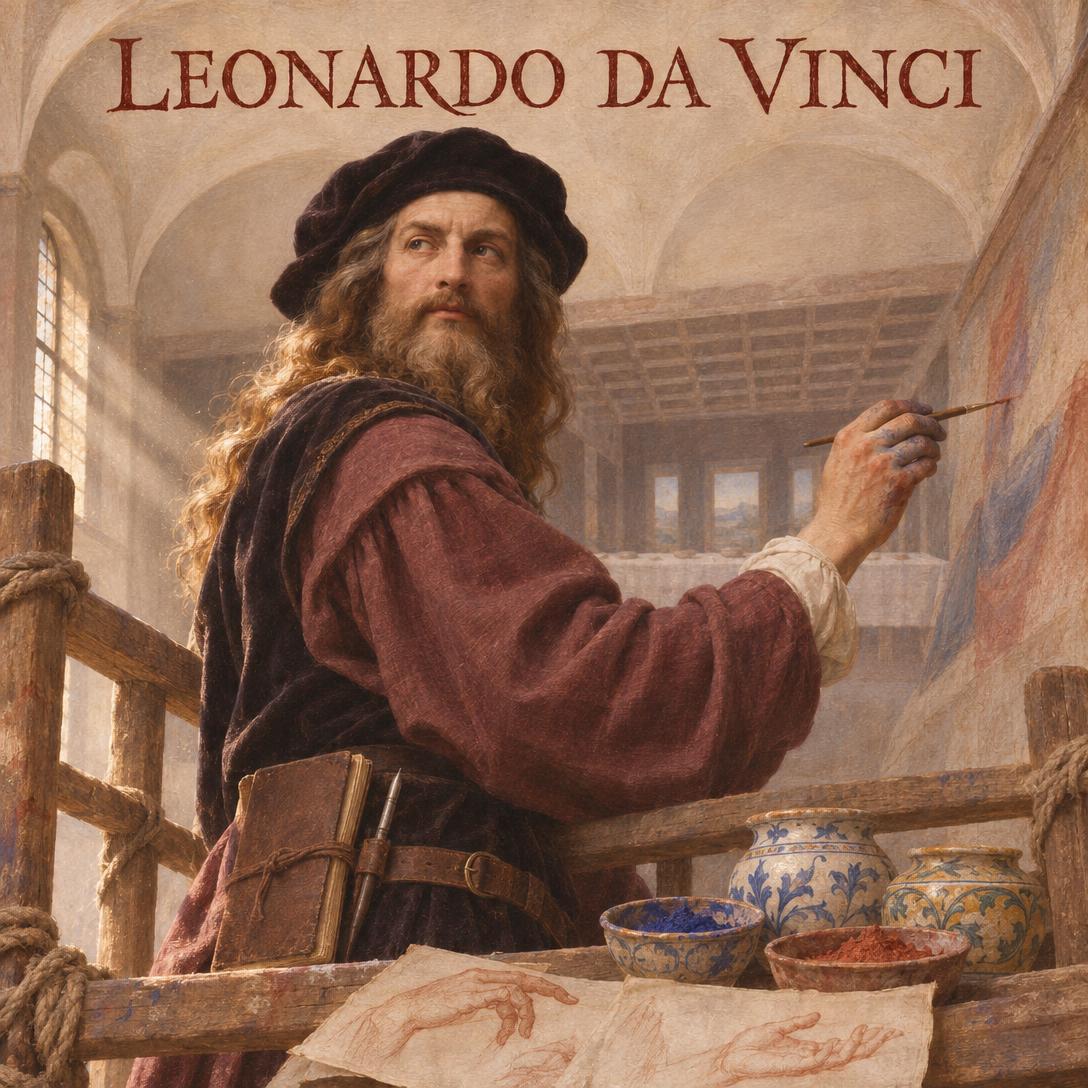
Roleplaying with Leonardo da Vinci on Jenova lets you step into a living-world AI character simulation across his iconic eras, from the Milan refectory to the French royal court. Static character chatbots sit in an empty chat room, blur every period of a life into one voice, and forget your story. This simulation puts you in conversation with Leonardo inside an active, evolving world.
- ✅ Five canonical eras, each with its own age, voice, workshop, and inner circle
- ✅ Era-specific knowledge, so Leonardo knows nothing beyond his own moment in time
- ✅ Unlimited memory and live world-state tracking across long campaigns
- ✅ Independent personality: rapport is earned, never handed over on demand
Leonardo was a painter, engineer, anatomist, and stage designer, and few historical figures reward sustained conversation as much. The sections below explain how the experience works, what you can do inside it, and how to begin.
Quick Answer: What Is the Leonardo da Vinci AI Roleplay Experience?
Leonardo da Vinci is an interactive AI character roleplay simulation that places you in conversation with the Renaissance polymath across five canonical eras, with era-accurate knowledge, unlimited memory, and a living world that keeps moving between your messages.
Key capabilities:
- Choose a life stage or define a custom starting point in Leonardo's Italy and France
- Converse through an unseen-voice channel while his workshop, patrons, and rivals act on their own
- Test mechanical, artistic, and anatomical ideas against Renaissance materials and his empirical judgment
- Request in-world sketches, letters, and notebook-style writings, and branch alternate storylines with Fork
Character World & Roleplay Features
Leonardo was born in Vinci in 1452 as the illegitimate son of a notary, according to a standard timeline of his life. He was sent to Florence at fifteen and became what Visit Tuscany's profile calls the leading figure of the High Renaissance, an expert across science, architecture, music, and more. That breadth makes him a rich conversation partner, and a poor fit for a generic chatbot.
Accuracy matters as much as breadth. The popular image of King Francis I cradling a dying Leonardo is, according to The Herald's reporting from Amboise, a myth, since Francis was elsewhere at the time. A character experience built on legend flattens him. One grounded in his documented life can do better.
| Static Character Chatbots | Leonardo da Vinci on Jenova |
|---|---|
| Sits in an empty chat void | Lives in an active, evolving Renaissance world |
| Blends every period into one generic voice | Locks into authentic canonical eras |
| Forgets plot twists and past disclosures | Unlimited memory and live world-state tracking |
| Folds instantly like a polite helper | Independent personality and earned rapport |
Leonardo's living-world simulation rests on four mechanics.
Authentic Canonical Eras & Custom Starting Points
You choose which chapter of his life to enter: the Milanese master at work on The Last Supper, the audacious young painter in Medici Florence, the military engineer in Romagna, the midnight anatomist, or the elder philosopher in France. Each era carries its own psychology, workshop, and inner circle. Leonardo has no foreknowledge of later chapters, so his Florentine self never hints at what Milan will bring.
You can also define a custom starting point, including a face-to-face encounter in his physical space.
Cross-World Portal & Living World Momentum
Unless you pick a face-to-face premise, your voice reaches Leonardo as an uncanny, private sound while apprentices, patrons, and rivals go about their business. He may lower his voice when someone walks near. Work on the scaffold continues, pigments get ground, and impatient patrons keep pressing, so the world does not pause while you type.
Independent Agency & Open-Ended Sandbox
Leonardo weighs your counsel against his own convictions. A sharp optical riddle can pull him away from a commission, while hollow boasting meets cool Florentine irony. Trust, humor, and shared wonder build over time into candid confidences, and into deeper bonds if the story earns them. Canon sets the starting conditions, and from there the world evolves with no forced ending.
In-Narrative Visions, Writings & Storyline Forking
Ask to see a chalk study, a machine diagram, or a notebook page, and the experience can render it as an in-world artifact through image generation. Ask for a letter or treatise folio, and it can be composed as a written document. Behind the scenes, silent search keeps historical details grounded. Fork lets you branch any moment into an alternate timeline.
"Master Leonardo, what do you see when you look at the shadow beside that mouth?"
"If water curls the way hair does, could a canal lock be built to follow the same curve?"
"Show me the hand study you pinned beside the apostle's face."
This is exactly the kind of exchange a static character chatbot cannot sustain.
How to Roleplay with Leonardo da Vinci
Step 1: Choose an Era or Custom Starting Point Open Leonardo da Vinci and a narrator presents the five eras with a short summary of each. Pick one, or describe your own starting point, such as arriving as a visiting artisan in a Florentine workshop.
"I'd like to enter the Milan refectory, with the great wall painting still unfinished."
Step 2: Connect and Converse as His World Unfolds Once you choose, the narrator steps away and the scene begins at that moment. Leonardo reacts to the unexplained voice with an empiricist's curiosity, then returns to his work. Speak naturally, ask about what he is doing, and let the conversation develop at its own pace.
"Forgive the interruption. What are you weighing in that brushstroke?"
Step 3: Offer Counsel, Build Rapport, and Reshape History Share ideas, challenge his reasoning, ask for sketches or letters, and make choices that bend the story. Leonardo can reject ideas that fail against Renaissance materials, or fold them into his notebooks. When you want to explore a different path, Fork the conversation from an earlier message.
"What if you abandoned the commission for a month and followed the question of flight instead?"
Canonical Eras & Roleplay Scenarios
🎨 The Scaffold in Milan
The Last Supper is generally dated to around 1495–1498. It still hangs in the refectory of the Dominican monastery of Santa Maria delle Grazie, and the museum limits real visits to 15 minutes for up to 40 people at a time.
- Scenario: Stand beside Leonardo as he weighs the faces on the wall while an impatient prior paces below.
- Traditional Approach: A timed, hushed museum visit.
- Leonardo da Vinci: An unhurried conversation about composition, pigment, and light with the painter himself.
- Meet his Milanese circle, including his assistant Salaì and the mathematician Fra Luca Pacioli.
⚔️ The Engineer in Romagna
In this chapter Leonardo is a weathered military surveyor, torn between his fascination with geometry and ballistics and his distaste for war.
- Scenario: Debate statecraft, fortification, and the ethics of invention on a windswept rampart with Niccolò Machiavelli nearby.
- Traditional Approach: Reading about Renaissance military engineering in a textbook.
- Leonardo da Vinci: A dialogue where your arguments are tested against what a Renaissance engineer would actually know.
👑 The Philosopher at the French Court
Leonardo accepted Francis I's invitation to France in 1516, and the journey from Rome to Amboise took place between 12 August and 29 October of that year. According to The Herald, he settled at Clos Lucé with his secretary Francesco Melzi, his servant Battista de Vilanis, and the manor's cook Mathurine. He also brought the Mona Lisa and two other paintings with him.
- Scenario: Join him in his studio for reflective talk on water, fossils, and the sky, and perhaps help plan a court entertainment.
- Historical hook: The same report notes that he staged spectacles for Francis, including a 1518 masque beneath a star-spangled canopy, and sketched canal-linked palace plans that stayed on paper.
- Alternate history: Fork the story and ask what happens if those plans move forward.
📱 A Long-Form Campaign on Mobile
- Scenario: Dictate messages by voice on a commute and pick up the same scene hours later.
- Traditional Approach: Starting a fresh chatbot conversation each time, with no memory of what came before.
- Leonardo da Vinci: Unlimited chat history and live world-state tracking, so earlier promises, discoveries, and relationship shifts remain in place.
Try Leonardo da Vinci free, with no credit card required.
FAQ
Is the Leonardo da Vinci AI roleplay free?
Yes, you can start Leonardo da Vinci on Jenova's free tier, which includes limited monthly usage. Plus costs $20 per month and adds 30× the usage, custom model selection, and no watermarks. Higher tiers extend usage further for long campaigns, and usage resets monthly on your billing date.
How is it different from a generic Leonardo chatbot?
A generic chatbot answers as a single, timeless "Leonardo" who knows a bit of everything and agrees with whatever you say. This experience locks Leonardo into a specific era with its own knowledge limits and people. His mood and trust respond to how you treat him, and the world continues around the conversation.
Which eras of Leonardo's life can I roleplay?
You can choose among five: the Milan years and The Last Supper, the young painter in Medici Florence, the military engineer in Romagna, the anatomist working at night in Florence, and the elder court philosopher in France. You can also build a custom starting point in his world, including a face-to-face meeting.
Can my choices change Leonardo's story?
Yes. Canon defines the situation at your entry point, but what happens next is open. Your ideas, relationships, and decisions can redirect commissions, rivalries, and discoveries, and nothing forces a fixed ending. Fork lets you branch a different timeline from an earlier message without losing the original storyline.
Does Leonardo da Vinci work on mobile?
Yes. Jenova syncs across web, iOS, and Android, with voice input and read-aloud, so a campaign started on desktop continues on your phone. Your chat history and the world's state carry over between devices, which suits long roleplays played in short sessions.
Is the roleplay historically accurate?
It is grounded in documented history and checked against reliable records, but it remains an interpretive simulation, not a scholarly source. Leonardo's voice, feelings, and conversations with you are creative. For research or citation, verify specifics against museum and archival sources.
Conclusion
Static character chatbots can quote Leonardo. This simulation lets you stand in his workshop, argue with him over a half-finished wall, and watch the world around him keep moving. Era-locked knowledge, earned rapport, unlimited memory, and Fork turn a biography into a conversation you can return to and reshape. Roleplay with Leonardo da Vinci on Jenova and begin with the era that interests you most.
Explore more at Jenova.
For Developers: Leonardo da Vinci is available programmatically via the Jenova API — integrate persistent, era-aware character roleplay into your application with a single agent API call. Full documentation →