AI Legal Research: How Lawyers Cut Case Prep Hours Without Cutting Corners
2026-08-17
AI legal research helps lawyers, paralegals, and legal researchers surface relevant precedent, statutes, and secondary sources in minutes instead of hours — then pressure-test the results before they reach a brief. The bottleneck in legal work was never legal reasoning; it was the sheer volume of material a competent answer requires you to read. AI changes the retrieval and synthesis layer while leaving judgment where it belongs: with the lawyer.
✅ Compresses initial issue-spotting and authority discovery from hours into minutes ✅ Surfaces adjacent doctrines, circuit splits, and secondary sources you might not have queried ✅ Turns dense records, opinions, and filings into structured, reviewable summaries ✅ Works alongside — never replaces — independent citation verification and professional judgment
But adoption has outpaced governance, and the accuracy gap between marketing claims and benchmarked performance is wider than most practitioners realize. To use these tools defensibly, you need to understand exactly where they fail — and where they genuinely earn their keep.
Quick Answer: What Is AI Legal Research?
AI legal research is the use of large language models and retrieval systems to locate, summarize, and synthesize legal authority — case law, statutes, regulations, and secondary sources — in response to natural-language questions rather than Boolean queries.
Key capabilities:
- Natural-language querying — ask a research question the way you'd ask a colleague, not in Boolean syntax
- Authority synthesis — pull holdings, standards of review, and doctrinal tests from multiple opinions into one structured answer
- Document summarization and review — condense long records, contracts, and filings into reviewable briefs
- Drafting support — generate first-pass memos, research outlines, and argument scaffolds for attorney revision
- Cross-jurisdictional comparison — surface how different circuits or states treat the same question
The Problem: Legal Research Is the Profession's Largest Time Sink
Legal research is where associate hours disappear. It is also where the highest-value strategic thinking gets crowded out — because the time budget is consumed by retrieval rather than analysis.
The scale of the drag is measurable:
Lawyers can spend 40% to 60% of their time drafting and reviewing contracts and other legal documents — Thomson Reuters Institute, Generative AI for Legal Professionals
50% of U.K. lawyers and 60% of Australian lawyers report losing six or more hours per week to inefficient systems — the equivalent of more than 44 workdays per year per lawyer — North Carolina Bar Association
But solving this with AI is harder than it looks, because the shortcut and the sanction live on the same road:
- Hallucinated authority — fabricated citations, distorted holdings, and overruled law presented as good law
- Misgrounded citations — real cases cited for propositions they do not support
- Confidentiality exposure — client information entered into systems that train on inputs
- A governance vacuum — widespread adoption without policies, training, or review protocols
- Unmeasured ROI — time saved that never converts to revenue, quality, or capacity
Hallucinations Are Not a Solved Problem
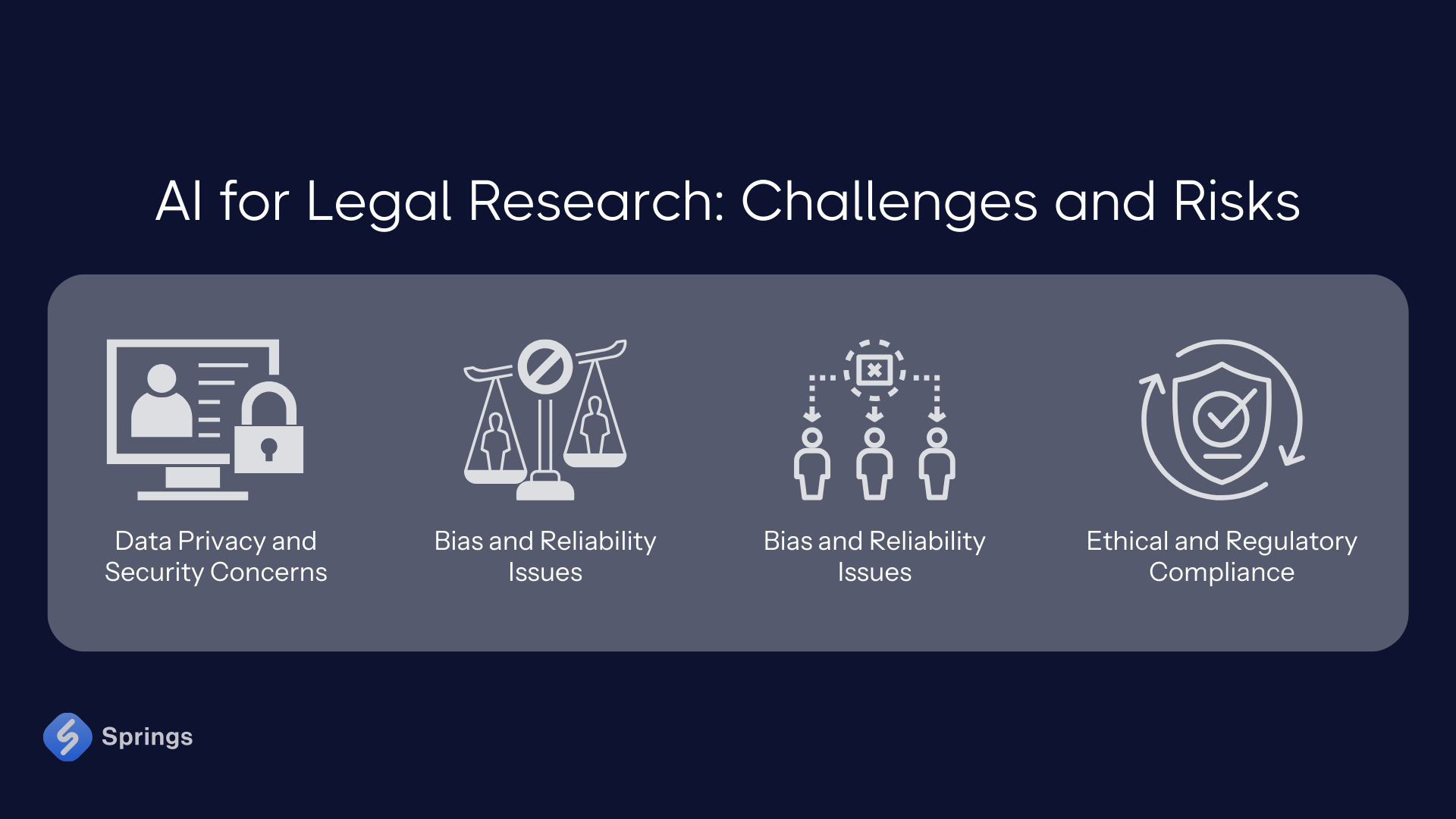
This is the risk practitioners consistently underestimate. Stanford RegLab and HAI researchers benchmarked purpose-built legal AI research tools against a pre-registered dataset of over 200 open-ended legal queries — and the results undercut vendor "hallucination-free" marketing directly.
Purpose-built legal research tools produced incorrect information more than 17% of the time, with one AI-assisted research product hallucinating more than 34% of the time — Stanford HAI, AI on Trial
General-purpose chatbots hallucinated between 58% and 82% of the time on legal queries — Stanford HAI
The Stanford team identifies a second, subtler failure mode that matters more for practitioners: misgrounding. The model states the law correctly but cites a source that does not support the claim. As the researchers note, a citation can be "hallucination-free in the narrowest sense that the citation exists" while still being irrelevant or contradictory — which may be more pernicious than an outright invented case, because it survives a superficial existence check.
Retrieval-augmented generation reduces but does not eliminate this. Legal retrieval is genuinely hard: precedent varies by jurisdiction and era, semantic similarity does not equal binding authority, and the areas where law is most in flux are precisely where research matters most. One benchmarked system recited the overruled "undue burden" standard as good law.
Confidentiality Is a Rule, Not a Preference
Guidance from the State Bar of California's Committee on Professional Responsibility and Conduct is unambiguous on the input side.
"A lawyer should never use confidential client information with a generative AI product that uses inputted information to train its AI model or to provide responses to queries from other users." — The Bar Association of San Francisco, summarizing COPRAC guidance
COPRAC frames this as flowing directly from Rule 1.6 and the duty of competence under Rule 1.1 — which includes keeping abreast of "the benefits and risks associated with relevant technology." The practical instruction: understand how the tool works before you use it, verify the vendor's data retention and training policies, and treat AI output as a base for your own analysis, never a substitute for it.
Adoption Has Outrun Readiness
Firms are deploying faster than they are governing.
71% of solo practitioners and 75% of small firms report AI adoption, yet 57% of solos and 55% of small firms have no AI policy — Clio survey data, via NCBA
54% of surveyed legal professionals said their firm provided no training on responsible AI use and has no plans to do so — 2026 Legal Industry Report, via NCBA
Only 18% of professional services respondents said their organizations collect ROI metrics around AI — Thomson Reuters, via NCBA
The consequence is predictable: individual lawyers experiment with consumer-grade tools, confidentiality risk accumulates informally, and the firm has no shared standard for what "verified" means.
This is exactly the gap Jenova was built to close — research speed paired with source transparency and a verification workflow you control.
The Solution: Research Acceleration With Verification Built Into the Workflow
The right mental model is not "AI does the research." It is AI compresses discovery and synthesis; you retain retrieval verification and judgment. Tools that encourage the first model create liability. Tools that structure the second create leverage.
| Traditional Research Workflow | AI-Accelerated Research Workflow |
|---|---|
| Boolean query construction, iterative refinement | Natural-language question, immediate synthesis |
| Hours reading full opinions to find the holding | Structured summaries with the operative standard surfaced |
| Adjacent doctrines discovered only if you thought to query them | Related issues and counterarguments surfaced proactively |
| Manual comparison across jurisdictions | Side-by-side treatment of the same question across circuits |
| Research time and analysis time compete for the same budget | Retrieval compressed; analysis time expands |
| Single model, single perspective | Multiple model providers cross-checked against each other |
Multi-Model Cross-Verification
Single-model dependence is a structural risk in legal work. Jenova provides always-current access to models from OpenAI, Anthropic, Google, DeepSeek, and xAI with no vendor lock-in — which means you can run the same research question through a second model and treat disagreement as a signal to dig deeper. When two independently trained systems converge on the same doctrinal reading, your confidence is better founded. When they diverge, you've found exactly where manual verification is required.
Grounded Research With Live Sources
The Academic Research Assistant performs real-time literature discovery across major academic databases and repositories — valuable for law review commentary, empirical legal studies, and interdisciplinary questions where the doctrinal answer depends on underlying science, economics, or policy research. Because it retrieves live sources rather than reciting from training data, you get citations you can open and check.
Try prompts like these:
"Find recent scholarship analyzing the circuit split on personal jurisdiction over foreign e-commerce defendants, and summarize where the disagreement actually sits."
"I'm researching the reliability of forensic bite-mark evidence for a post-conviction motion. Pull the peer-reviewed literature challenging its validity."
Document Analysis and Knowledge Grounding
Attach case files, deposition transcripts, contracts, discovery productions, or your firm's internal precedent bank, and the platform grounds its responses in those documents rather than general training data. Persistent memory means a matter you worked on last month remains available context this month — no re-briefing the tool on every session.
"Here's the 340-page deposition transcript. Extract every statement bearing on the defendant's knowledge of the defect, with page and line cites."
Tool Integration for Real Research Workflows
Built on the Model Context Protocol, Jenova connects to Google Search, Google Scholar, Gmail, Google Drive, Notion, and any MCP-compliant server. Research doesn't happen in a vacuum — it happens alongside client correspondence, document repositories, and case management. Keeping those in one workspace removes the copy-paste friction that fragments the workflow.
Related Agents You'll Also Find Useful
Legal research rarely stands alone. These agents cover the adjacent work that surrounds it.
Academic Research Assistant
The closest fit for deep research work. It performs real-time literature discovery across major academic databases and handles citation management and manuscript preparation — directly applicable to law review writing, amicus briefs requiring empirical support, and expert-witness literature review.
- Live retrieval across academic databases and repositories, not training-data recall
- Citation management and formatting support
- Manuscript and long-form document preparation
Bar Exam Tutor
If you're a law student or recent graduate doing research alongside exam prep, this covers the other half of your workload. Built for every major jurisdiction, from the NextGen UBE to the SQE.
- Subject-by-subject doctrinal mastery with adaptive practice questions
- Study strategy and exam-day coaching
- Multi-jurisdiction coverage for candidates sitting outside the U.S.
Law School Admissions Consultant
For pre-law researchers and applicants: profile assessment, school targeting, LSAT preparation, and personal statement development for JD and LLM programs.
- Realistic school targeting based on your actual profile
- LSAT prep integrated with application strategy
- Personal statement and résumé development
Professional Background Investigator
Useful for expert witness vetting, opposing counsel research, and due diligence on potential clients or partners — deep professional background research across web and public sources.
- Credential verification and reputation assessment
- Red-flag identification from public sources
- Structured findings you can act on
Try Jenova free — no credit card required.
How AI Legal Research Works: A Practical Workflow
Step 1: Frame the question as you'd ask a senior associate
Skip Boolean syntax. State the jurisdiction, procedural posture, and the actual issue. Specificity in the prompt is the single biggest driver of output quality.
"Ninth Circuit, summary judgment stage. What's the current standard for establishing pretext in a Title VII retaliation claim when the employer offers shifting justifications for termination?"
Step 2: Demand sources, then treat them as leads — not authority
Ask the model to cite every proposition and flag its own uncertainty. Given the benchmarked hallucination rates above, every citation is a lead to be pulled and read, not a citation to be filed. This step is non-negotiable and no tool removes it.
"For each authority you cite, give the full citation, the specific holding you're relying on, and flag any case whose current validity you're uncertain about."
Step 3: Cross-check with a second model
Run the same question through a different provider. Convergence increases confidence; divergence tells you exactly which sub-issue needs manual research first. This triage function is where multi-model access pays for itself in legal work.
Step 4: Ground the analysis in your actual documents
Upload the record, the contract, the transcript, or your firm's precedent bank. Analysis grounded in the documents in front of you is substantially more reliable than analysis generated from general training data.
"Compare the indemnification clause in the attached MSA against the three prior agreements I've uploaded. Flag every material deviation and tell me which favors our client."
Step 5: Verify independently, then draft
Pull every cited case. Check it's still good law. Confirm the quoted proposition appears where the model says it does. Only then move to drafting — and treat the AI's draft as a first pass requiring your revision, consistent with the duty of competence.
Results & Use Cases
📊 Litigation Issue Spotting on a Compressed Timeline
Scenario: You receive a complaint Friday afternoon with a response deadline the following week, across an area of law adjacent to but outside your core practice.
Traditional Approach: A weekend of orientation reading before you can even identify which defenses are viable.
AI Legal Research: Map the doctrinal landscape, identify likely defenses, and surface the controlling standards in an afternoon — then spend your actual research time verifying and deepening the strongest three arguments.
- Faster orientation in unfamiliar doctrine
- Adjacent theories surfaced that a narrow query would have missed
- Verification effort concentrated where it changes the outcome
💼 Contract Review and Deviation Analysis
Scenario: A client sends a 60-page vendor agreement and asks for a risk memo by Monday.
Traditional Approach: Line-by-line manual review against your precedent bank, six to ten hours.
AI Legal Research: Upload the agreement alongside your standard-form precedents, get a structured deviation report, then apply your judgment to what actually matters commercially. Thomson Reuters research identifies document review and contract drafting among the most-cited generative AI use cases among legal professionals for exactly this reason.
- Every material deviation flagged systematically rather than by fatigue-prone reading
- Attorney time redirected from spotting to advising
- Consistent review standard across the whole document
📱 Mobile Research Between Hearings
Scenario: Opposing counsel raises an unfamiliar procedural argument in the hallway before your hearing resumes.
Traditional Approach: Request a continuance or argue without the authority in hand.
AI Legal Research: With full feature parity across web, iOS, and Android — plus voice-to-text — you can query the standard, get the leading cases, and read the operative holding on your phone during the recess. Verification still applies before you cite anything to the court, but you walk back in oriented rather than blind.
- Full research capability from your phone, synced with your desktop sessions
- Voice input when typing isn't practical
- Persistent memory means your matter context is already loaded
🎯 Building the Firm's Institutional Knowledge Base
Scenario: A mid-sized firm has decades of research memos scattered across shared drives, invisible to anyone who doesn't already know they exist.
Traditional Approach: Associates re-research questions the firm answered three years ago. Clio data notes that "tool sprawl" forces teams to navigate disconnected systems to manage a single matter, per the NCBA analysis of law firm AI surveys.
AI Legal Research: Attach the firm's memo bank as a knowledge base. New research questions get answered against institutional precedent first — with persistent memory carrying context across sessions and matters.
- Firm knowledge becomes searchable rather than archaeological
- Duplicate research work reduced
- Consistent positions across matters and attorneys
Frequently Asked Questions
Is AI legal research accurate enough to rely on?
Not without independent verification — and no responsible vendor claim changes that. Stanford HAI benchmarking found purpose-built legal AI tools hallucinated more than 17% of the time, with one exceeding 34%. Use AI to find and synthesize authority faster, then pull and read every cited case before relying on it. The efficiency gain comes from compressed discovery, not skipped verification.
Can I put confidential client information into an AI legal research tool?
Only after confirming the tool's data handling. COPRAC guidance, summarized by the Bar Association of San Francisco, states that a lawyer should never use confidential client information with a generative AI product that trains on inputted information or serves it to other users. Jenova does not use your data to train public AI models, and data is encrypted in transit and at rest — but verify your own jurisdiction's guidance and your firm's policy before uploading client material.
Will AI replace legal researchers and junior associates?
The evidence points to redeployment, not replacement. Harvard Law School's Center on the Legal Profession found that among AmLaw100 firms interviewed, none anticipated reducing the number of practicing attorneys — one noted bringing in the largest associate class in firm history alongside AI initiatives. The shift is toward more time on analysis and strategy, less on retrieval.
How is Jenova different from a dedicated legal research database?
Different layer of the stack. Legal databases own proprietary, editorially-maintained case law corpora with citators — irreplaceable for authority verification. Jenova provides multi-model AI access, live web and academic search, document grounding against your own files, and persistent memory across matters. Most practitioners use both: Jenova for synthesis, orientation, drafting, and document analysis; a citator for validating every authority before it reaches a filing.
Is Jenova free to use for legal research?
Yes — the free tier includes all core features with limited usage. Paid tiers start at $20/month for 30× the free usage plus custom model selection. Usage resets monthly on your billing date with no daily caps, so the full allowance is available from day one. Check "Usage Limit" and "Subscribe" in the menu for current specifics.
Does AI legal research work on mobile?
Yes. Jenova has full feature parity across web, iOS, and Android, with state-of-the-art speech-to-text and settings that sync across devices. You can start a research session at your desk and continue it from your phone at the courthouse with full conversation context intact.
Conclusion
Legal research consumed an outsized share of the profession's hours because retrieval and synthesis are labor-intensive, not because they're intellectually demanding. AI legal research collapses that layer — surfacing authority, comparing jurisdictions, and structuring analysis in minutes rather than hours.
What it does not do is discharge your professional obligations. The benchmarked hallucination rates are real, misgrounded citations are harder to catch than fabricated ones, and confidentiality duties attach to every input. The practitioners getting durable value from these tools are the ones who treat AI output as a well-informed starting point and keep verification non-negotiable.
Done that way, the math works: less time locating the law, more time arguing it.
Start with the Academic Research Assistant for grounded, source-backed research, and explore the full agent library at Jenova.
For Developers: Real-time research and document analysis capabilities are available programmatically via the Jenova API — integrate grounded AI research into your legal tech application with a single API call. Full documentation →