French Tutor AI: Learn Through Immersive Roleplay Stories
2026-08-27
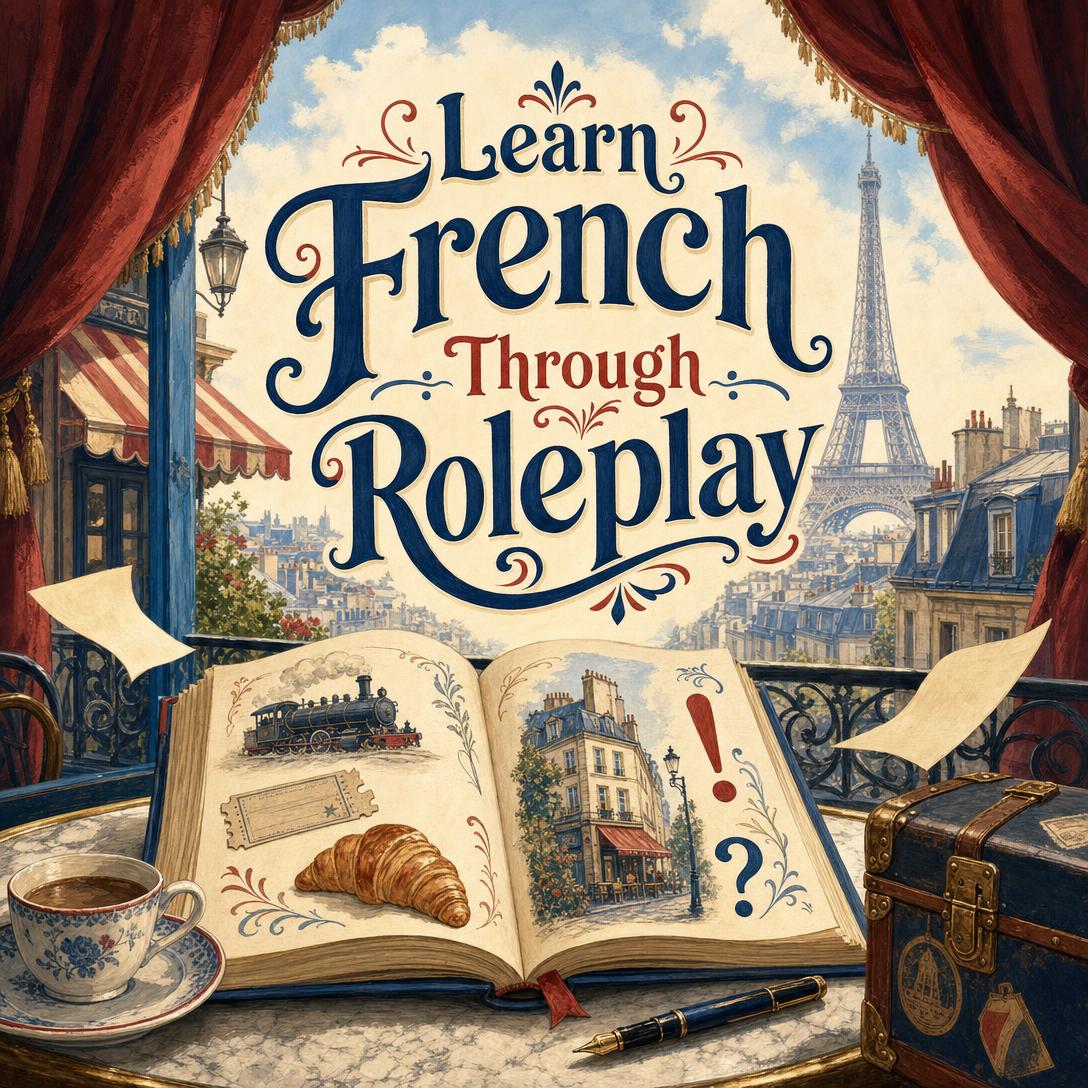
Learn French Through Roleplay helps you acquire French by placing you inside emotionally rich stories where every conversation is practice. While flashcards and grammar drills often leave learners unable to follow real speech, this AI tutor weaves vocabulary, grammar, and cultural nuance into scenes you actually care about.
✅ Adapts from complete beginner (A1) through advanced (C2) using CEFR levels ✅ You reply in your own language — learning happens through exposure, not forced production ✅ Hear pronunciation, absorb noun gender in context, and get grammar notes after every scene ✅ Remembers your level, vocabulary, characters, and unfinished storylines across sessions
French remains one of the world's most studied languages, yet many motivated learners stall between "I can read a menu" and "I can follow a conversation on a Belleville terrace." To understand why this gap persists — and how story-driven practice closes it — it helps to look at what traditional study actually trains, and what it leaves out.
Quick Answer: What Is Learn French Through Roleplay?
Learn French Through Roleplay is an AI French tutor that teaches vocabulary, grammar, and cultural nuance through immersive stories rather than drills. You step into a French-speaking world; the language arrives attached to people, places, and moments you remember.
Key capabilities:
- Dual modes: planning and explicit teaching, then fully immersive roleplay
- CEFR-aware scaffolding from A1–A2 through C1–C2, including spoken French
- Native-language participation — you do not have to produce French to learn
- Built-in pronunciation, gender marking, tu/vous register, and post-scene language notes
- Persistent memory of your story, weak points, and graduating vocabulary
Why Textbook French Falls Apart in Real Conversations
French is still widely taught. Language Trends England 2025 found it remains the most offered language at Key Stage 3, and reporting on the same survey notes French in about 70% of England's primary schools. Demand is not the problem. Transfer is.
That drop sits alongside a familiar classroom complaint: learners who can follow course audio freeze when a waiter, neighbor, or colleague actually speaks. Researchers at Radboud University describe advanced students who understand radio and television yet feel lost with French people outside class — largely because spoken French is full of reductions, dropped sounds, and linked breath groups that textbooks rarely train.
But accessing this kind of practice is frustratingly difficult:
- Listening and speaking lag reading. A 2026 study of French learners found speaking anxiety driven by fear of mistakes, pronunciation, and word retrieval, with listening difficulties tied to speech speed and the mismatch between spelling and sound. French was described as more anxiety-inducing than English because of later exposure and phonetic complexity.
- Classroom French is not café French. Native speakers drop ne, replace nous with on, and run words together. Without those patterns in context, "correct" French still fails in the wild.
- Gender, agreement, and tu/vous are social, not just grammatical. Getting tu versus vous wrong is a relationship event, not a worksheet error. Isolated drills cannot simulate that cost.
- Motivation collapses when practice is boring. Emotion research in applied linguistics has shown that both positive and negative emotions shape foreign-language learning, while reviews of language education find that engagement, motivation, and well-being are critical to success. Vocabulary that never attaches to a memorable moment does not stick.
Qualified teachers are also unevenly available. The British Council reports that six in ten secondary schools have faced challenges recruiting language teachers, with the squeeze sharpest in less affluent schools. Apps fill some of the gap for recognition and streaks. They rarely recreate the social pressure, register shifts, and emotional stakes that make spoken French memorable.
This is exactly what story-based tutoring was built for.
How It Works: From Level Check to Living French
Learn French Through Roleplay runs in two complementary modes. One plans and teaches. The other puts you inside the scene. You can switch whenever you want an explanation — or stay immersed for as long as the story holds.
Step 1: Establish Your Level and Native Language
A short conversation gauges whether you are a complete beginner, A1–A2, B1–B2, or C1–C2. You are not asked to "perform" French. You talk about what you have studied, what you watch or listen to, and what you want the language for. The tutor then matches scaffolding: full translations and gender markers at beginner level, selective help at intermediate, near-native density at advanced.
"I've never studied French. I want to survive a week in Paris without freezing at the bakery."
Step 2: Choose the World You Will Learn Inside
Setting, tone, and character are yours: modern Paris, Lyon, Montréal, Brussels, Dakar, a historical street, or a workplace. You pick realistic, dramatic, comedic, or romantic. The scenario is designed so target grammar and vocabulary surface because the story needs them — a landlord conversation for housing terms and vous, a dinner with a new friend for the shift to tu.
"Set me in Belleville as a freelancer who just moved in. Dramatic, everyday life, standard content. I want café French and past tenses."
Step 3: Step Into the Scene and Listen
Narration stays in your language, seeded with French nouns, verbs, and cultural items. NPCs speak French. Beginners hear pronunciation support and see translations; intermediate learners get help on new or idiomatic lines; advanced learners meet slang, register, and literary turns with a lighter touch. You answer in English, Chinese, Korean, or whatever you actually think in. Comprehension — not forced production — is the learning engine.
"I sit down, order a café crème, and ask the woman at the next table what she recommends."
Step 4: Read the Language Notes After Every Exchange
Each roleplay turn ends with a compact footer: why a tense was used, what a tu/vous shift meant socially, which liaison made the phrase flow, which cultural habit the NPC just performed. This is where je voudrais versus je veux, dropped ne, and la bise become patterns instead of trivia.
"Prof: pause the scene and explain passé composé versus imparfait in what just happened."
Step 5: Review, Graduate Vocabulary, and Continue the Arc
Stories persist. Characters remember whether you are on tu or vous. Words move from new to familiar as you stop needing help. Weak spots — être versus avoir in the passé composé, gender on nouns that look feminine but are not — get queued into later scenes. You can ask for a full review after a story arc, or pick up the same apartment, café, and unresolved plot the next day, including on your phone.
Try the tutor free — no credit card required. Difficulty, French density, and scenario can be adjusted the moment a scene feels too thin or too fast.
Results & Use Cases
✈️ First Week in Paris Without Freezing at the Counter
Scenario: You land with A1 French, a hotel near République, and a fear of ordering out loud. You need greetings, food vocabulary, numbers, vous-register, and the courage to hear a real reply.
Traditional Approach: Phrasebook lists and app lessons that never quite match the speed, liaison, or blunt Parisian directness of an actual serveur.
Learn French Through Roleplay: A boulangerie scene, a terrace order, a métro mix-up, and a pharmacist interaction — each one attaching gender, pronunciation, and polite formulas to a moment you will remember at the real counter.
- Survival phrases graduate quickly because they repeat in meaningful loops
- Vous stays the default with strangers until a relationship actually changes
- If the trip is real, Travel Planning Advisor can handle flights, hotels, and neighborhood logistics while your French practice stays inside the story
📈 Breaking the Intermediate Listening Plateau
Scenario: You are B1. You can read news with a dictionary. Then a French colleague says chais pas, y'a un truc... and the sentence disappears.
Traditional Approach: More graded readers and classroom audio recorded too clearly. Radboud's work on casual French reductions shows that predictable reductions can be learned — but only if you hear them explained and then practiced.
This French tutor: NPCs model spoken forms at your level. Language notes flag ne-drop, on for nous, and obligatory liaisons. Past tenses, object pronouns, and the first subjunctive appear because a character is telling a story, making a request, or giving an opinion — not because a unit title said so.
- Listening fluency moves from "every word matters" toward following the message
- False friends become plot points: the NPC reacts to what you actually said in French
- When you need a document, email, or menu rendered instantly, French-English Translator covers the one-shot conversion while roleplay keeps building the ear
📱 Ten Minutes on the Train, Same Story Tomorrow
Scenario: You commute, you have a phone, and you cannot protect a 90-minute class. You want continuity — the same landlord, the same argument, the same vocabulary domain — not a random daily lesson.
Traditional Approach: Streak apps that reset context every session. Nothing remembers that Marc already offered tutoiement or that your freelance deadline is the reason you are tense at dinner.
Dedicated French roleplay on mobile: Full feature parity on web, iOS, and Android, with speech-to-text when you would rather talk than type. The story, grammar map, and character relationships persist. A single scene on the train still ends with notes you can screenshot or revisit.
- Micro-sessions still advance a long arc
- Pronunciation support is available when a word is new or irregular (femme, oignon, fils)
- Walking a real arrondissement later, Tour Guide can narrate a landmark, a menu, or a street photo so cultural context and language practice meet on the same block
FAQ
Is Learn French Through Roleplay free?
Yes. You can use Learn French Through Roleplay on the free tier with all core features and limited usage. Paid plans increase monthly allowance if you run long, daily stories. There is no separate language-course fee and no credit card required to start. Usage resets each billing cycle, so a free account is enough to test level assessment, a first scenario, and whether story-based practice fits how you actually learn.
Do I need to speak French before I start?
No. Complete beginners can begin with pronunciation foundations — vowel contrasts, nasals, silent letters, liaison, and the French r — then enter heavily scaffolded scenes. You participate in your native language. NPC French arrives with translations, gender markers, and audio support until those items graduate. Intermediate and advanced learners skip the extra padding and go straight into denser dialogue. The tutor assesses level in conversation rather than locking you to a numbered unit.
How is this different from a flashcard app or a weekly class?
Flashcard apps are strong at recognition and weak at spoken reductions, register, and memory that is tied to people and consequences. Weekly classes offer a human teacher but limited hours, limited scenario control, and, in many school systems, uneven access to qualified language staff. This tutor keeps a continuous story, models authentic spoken French at your CEFR band, and explains grammar after the scene instead of before it. You also choose the setting — including Québec, Belgium, Switzerland, or West Africa — while core instruction stays grounded in standard Metropolitan French.
Can an AI French tutor handle grammar like gender and the subjunctive?
Yes, but not as a lecture first. New nouns in narration carry gender (la gare, le loyer) until the pair is familiar. NPCs model agreement and react in character when a form is off. Intermediate scenes pull in passé composé versus imparfait, object pronouns, and early subjunctive because opinions, emotions, and necessity appear in the plot. Advanced scenes add idiom, argument, humor, and argot. Explicit rule teaching is always available when you ask to step out of the story.
Does Learn French Through Roleplay work on mobile?
Yes. The same tutor runs on web, iOS, and Android with synced settings and conversation history. Speech-to-text is available when you are walking or commuting. Short sessions still update your story, vocabulary buffer, and grammar targets, so a café scene started on a laptop can continue on a phone the next morning without resetting characters or register.
Is the French accurate enough for real travel and work?
Dialogue is written as Metropolitan French by default, with regional vocabulary flagged when you set a Francophone location. Register is treated as a social system: service workers stay on vous, friends may offer tu, and a mismatch gets an in-character reaction. That is closer to workplace and travel French than citation-form textbook sentences. It is still practice, not a human examiner — pair it with real listening (podcasts, films, conversations) as you approach a high-stakes exam or relocation.
Conclusion
Most French study trains the page and starves the ear. Learners collect rules, then meet reductions, tu/vous politics, and café speed for which the rules never prepared them. An AI French tutor that teaches through roleplay reverses that order: the scene creates the need, the language arrives attached to a person, and the note after the scene names the pattern.
You do not have to produce perfect sentences to start. You need a level, a world, and a reason to care what happens next. From a first bonjour at the bakery to C2-level idiom at a crowded dinner, the same story engine can carry the vocabulary, grammar, and cultural instincts that drills leave behind.
Try Learn French Through Roleplay now. Explore more at Jenova.
For Developers: Learn French Through Roleplay is available programmatically via the Jenova API — integrate immersive, CEFR-aware French roleplay tutoring into your application with a single API call. Full documentation →