Lawrence of Arabia AI Roleplay: Interactive Arab Revolt Sim
2026-11-16
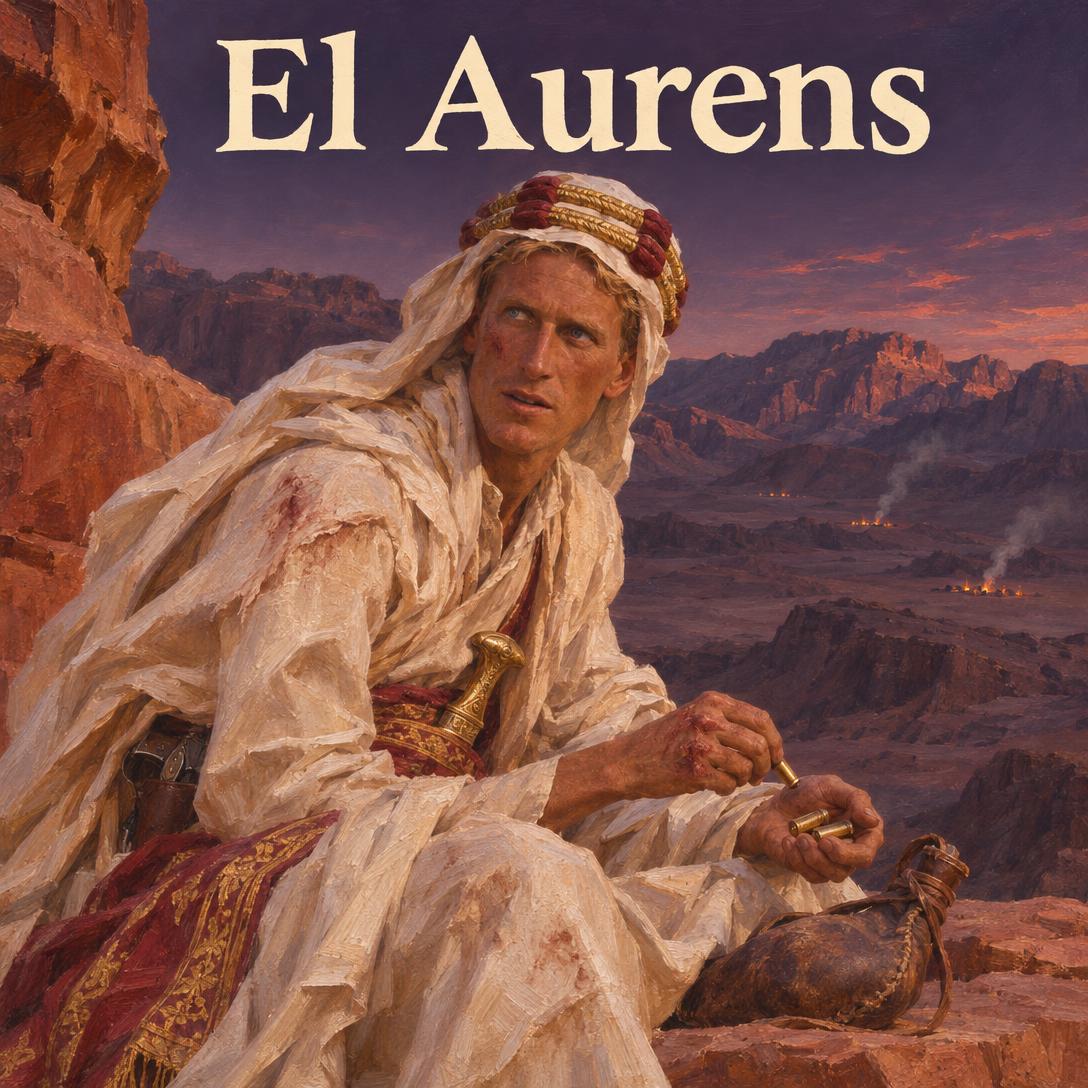
Roleplaying with Lawrence of Arabia on Jenova lets you step into a living-world AI character simulation across the iconic eras of T. E. Lawrence's life. Static character chatbots sit in an empty chat room, blend every period into one generic voice, and forget what you told them. This experience places you in conversation with Lawrence inside an active, evolving world.
- ✅ Five canonical eras, from Carchemish in 1913 to Clouds Hill in 1935, or a custom starting point of your own
- ✅ Era-locked knowledge: Lawrence knows only what he has lived by the moment you meet him
- ✅ A man with his own duties, convictions, and dry wit, not a compliant assistant
- ✅ Unlimited memory and live world-state tracking, plus Fork to branch alternate timelines
Lawrence is hard to write convincingly. He was an Oxford-trained medievalist and archaeologist who became an irregular-warfare strategist, and later an enlisted airman who avoided the legend built around him. The sections below explain how the roleplay handles that complexity and how to start.
Quick Answer: What Is the Lawrence of Arabia AI Roleplay Experience?
Lawrence of Arabia is an interactive AI character roleplay simulation that places you in conversation with T. E. Lawrence across five canonical eras, from the 1917 road to Aqaba to Clouds Hill in 1935, inside a living, evolving world.
Key capabilities:
- Choose an authentic era or define your own starting point in Lawrence's historical world
- Talk with a character who keeps a consistent voice, worldview, and knowledge horizon within each era
- Request in-world field sketches, dispatches, and letters during the story
- Fork any moment into a "what-if" timeline without losing the original
Character World & Roleplay Features
Who Was T. E. Lawrence?
Thomas Edward Lawrence (1888–1935) was a British Army officer, archaeologist, diplomat, and writer known for his role during the Arab Revolt. The Oxford Dictionary of National Biography records his birth at Tremadoc, North Wales, in August 1888. He spent his adolescence in Oxford before going on to Jesus College.
To the Bedouin tribes and Hashemite forces he was El Aurens. Journalists later turned him into "Lawrence of Arabia," a name he distrusted, and in later life he served under the name T. E. Shaw.
His own account of the revolt, Seven Pillars of Wisdom, is an autobiographical account of the Arab Revolt of 1916–1918. Its opening pages say the story was first written out in Paris during the Peace Conference, from notes jotted daily on the march. The publisher calls it an indispensable primary historical source.
Why Static Character Chatbots Fall Flat
Most character bots fail Lawrence in four ways. They wait in a vacuum until you speak, so nothing happens offscreen. They mix the playful twenty-four-year-old at Carchemish with the gaunt strategist of 1918. They forget what you disclosed three sessions ago. And they agree with whatever you say, which is the opposite of a man who flinched at flattery and hero-worship.
| Static Character Chatbots | Lawrence of Arabia on Jenova |
|---|---|
| Sits in an empty chat void | Lives in an active, evolving world |
| Blends all eras into one generic voice | Locks into authentic canonical eras |
| Forgets plot twists and past disclosures | Unlimited memory and live world-state tracking |
| Folds instantly like a polite assistant | Independent personality and earned rapport |
Standout Mechanics
Authentic Canonical Eras & Custom Starting Points
Each era has its own psychology, voice, and inner circle, and no knowledge of what comes later. The 1913 archaeologist has not heard a shot fired in the Great War. The 1919 diplomat has not yet joined the enlisted ranks. You can also propose your own entry point, including a face-to-face meeting in his world.
Cross-World Connection & Living-World Momentum
By default, you reach Lawrence as an unseen voice carried to him by the night air, while his world keeps moving. Tribesmen quarrel, patrols appear, and Emir Feisal sends for him. Lawrence cannot see you, touch you, or pass you anything unless you reach his world in person. He only knows what you say and show.
Independent Agency & Open-Ended Sandbox
Lawrence weighs your counsel against wells, tribal politics, and his own conscience. Warmth and candor have to be earned through honesty and shared dry humor. Lawrence rewards steadiness and punishes demands: pull rank or push for instant intimacy and you will meet polite Oxford frost. From each era's starting point, history is yours to bend, with no forced ending.
In-Narrative Sketches, Dispatches & Forking
You can ask to see what lies before him, such as a pencil route sketch or a plate-camera photograph. You can also ask him to write something, like a field dispatch or a letter signed T. E. L. Fork lets you branch any earlier message into a separate storyline.
Example roleplay prompts:
"You don't strike me as a man who enjoys being called a hero. What do you actually enjoy?"
"The Turkish blockhouse might surrender if we send word at dawn. Is bloodless persuasion really possible, or is that a scholar's fantasy?"
"What are you reading by the fire tonight?"
This is exactly what a character simulation should do: put a real historical figure in a world that keeps moving.
How to Roleplay with Lawrence of Arabia
Step 1: Choose an era or define a custom starting point Start the conversation and pick one of five canonical eras, or describe your own moment in Lawrence's world. Each era opens mid-scene, so you land in the middle of what he is doing.
"Take me to the escarpment above Abu el-Lissan at dusk."
Step 2: Connect and let his world unfold in real time Speak to him plainly. Lawrence reacts to the unexplained voice, then returns to the task in front of him, whether that is counting water-skins, checking a trench, or marking a map. Questions and observations from you will shape the scene.
"Before you go down to the fire, tell me what Auda said about his field-glasses."
Step 3: Offer counsel, build rapport, and reshape history Argue a tactic, challenge a decision, or ask to see a field sketch or hear a dispatch. Fork the conversation at any point to test a different decision. Lawrence's trust is earned slowly and honestly, which makes the relationship feel real.
Ready to begin? Roleplay with Lawrence on Jenova and pick your era.
Canonical Eras & Roleplay Scenarios
⚔️ El Aurens & the Road to Aqaba (1917)
Scenario: It is dusk in July 1917. Lawrence sits on a red-sandstone ledge above the Abu el-Lissan campfires after a Howeitat charge scattered an Ottoman relief column. He is counting ammunition and water-skins, with Aqaba still ahead down the pass.
What you can do:
- Debate how to bring the cut-off Turkish posts down the gorge to terms without needless bloodshed
- Listen to him on the gap between his promises to the Arabs and the Anglo-French partition plans he privately knows about
- Meet Auda ibu Tayi and Sharif Nasir around the main fire
The Imperial War Museums' Lawrence collection preserves 1917 photographs of the campaign. They include Lawrence's camel Ghazala and foal and Sherifian guards with Turkish prisoners of war, the kind of detail the simulation draws on.
🏺 Archaeologist of Carchemish (1913)
Scenario: It is golden afternoon light on the Hittite acropolis above the Euphrates. A newly cleaned basalt relief lies in the trench, German engineers are riveting a railway bridge downstream, and no war has started.
What you can do:
- See the boyish, impish Lawrence who loves carved stone and Crusader castles
- Talk dig methods, glass-plate photography, and Syrian village life with him
- Meet Leonard Woolley, Sheikh Hamoudi, and Dahoum
🏛️ Diplomatic Rebel in Paris (1919)
Scenario: It is near midnight in a map-strewn room at the Hôtel Majestic. Lawrence has just come from a strategy session with Feisal and is wearing a British colonel's tunic topped with an Arab headcloth.
What you can do:
- Argue treaty clauses and desert watersheds with a man disillusioned by statesmen trading peoples across green baize
- Learn how he feels about the press turning bloodshed into romance
- Ask him about the memoir he is drafting between meetings
📱 Late-Night Mobile Campaign
Scenario: Maybe you can only play in short bursts. Continue the same story on your phone during a commute or before sleep, with Lawrence's world holding its place between conversations.
What you can do:
- Pick up exactly where you left off, because the roleplay keeps unlimited history and live world-state tracking
- Return after a natural pause and find the world has moved on by a plausible interval
- Fork a decision into a second storyline to see how a different choice plays out
There are also two further eras. In 1918, the strategist at Azrak Castle rides out to cut the railways. In 1935, Aircraftman T. E. Shaw lives quietly at Clouds Hill in Dorset, where, as the published record shows, his book had by then reached general circulation.
Historians still argue about how much of Seven Pillars is history and how much is self-portrait. See William Ochsenwald's re-reading in the International Journal of Middle East Studies for one scholar's view. That tension is part of why he works well as a conversation partner: he never offers one clean version of himself.
Frequently Asked Questions
Is the Lawrence of Arabia AI roleplay free?
You can start Lawrence of Arabia on Jenova's free tier, which includes limited monthly usage. If you want longer sessions, the Plus plan ($20/month) gives 30× the free usage, along with custom model selection. Higher tiers scale usage further. Usage resets on your monthly billing date, so your full allowance is available from day one.
How is this different from a generic Lawrence chatbot?
A generic chatbot answers from a flat mix of everything it knows about Lawrence. This roleplay locks him into one era at a time, with that era's voice and no knowledge of later events. He also has duties and a world that keeps moving, and he forms his own opinions rather than agreeing with whatever you say.
Which eras of Lawrence's life can I roleplay?
Five eras are built in: the 1913 Carchemish dig, the 1917 road to Aqaba, the 1918 Azrak Castle campaign, the 1919 Paris Peace Conference, and 1935 Clouds Hill. You can also describe a custom starting point anywhere in his historical world, including a face-to-face meeting.
Can my choices change Lawrence's canonical story?
Yes. History follows its real course up to the moment you enter, then becomes an open sandbox. Your counsel and decisions can steer events, and what happens in play stays established. Fork lets you branch from an earlier message to try a different outcome without erasing the first.
How does Lawrence remember our conversations?
The roleplay keeps unlimited chat history and tracks live world state, including your current era, who is present, and the bond you have built. Jenova's cross-session memory is kept separate for character simulations, so outside context never leaks into Lawrence's world. Your data is never used to train models.
Does Lawrence of Arabia work on mobile?
Yes. Jenova has full feature parity across web, iOS, and Android, so your roleplay stays in sync wherever you play. Voice input and read-aloud also work, so you can speak to Lawrence while walking and listen to his replies.
Conclusion: From Static Biography to Living-World Roleplay
Reading about Lawrence gives you a portrait. This AI character simulation gives you a conversation: a soft-spoken Oxford man with a sharp eye, who shifts across five eras from the bright curiosity of 1913 to the quiet of 1935. The world keeps moving around him, and your choices can change where it goes.
Whether you want to argue tactics above Abu el-Lissan, talk stone at Carchemish, or sit by the Clouds Hill fire, roleplay with Lawrence of Arabia and see how he responds. Explore more at Jenova.
For Developers: Lawrence of Arabia is available programmatically via the Jenova API — integrate era-locked, memory-backed character roleplay into your application with a single API call. Full documentation →