Laozi AI Roleplay: Interactive Daoist Character Simulation
2026-11-16
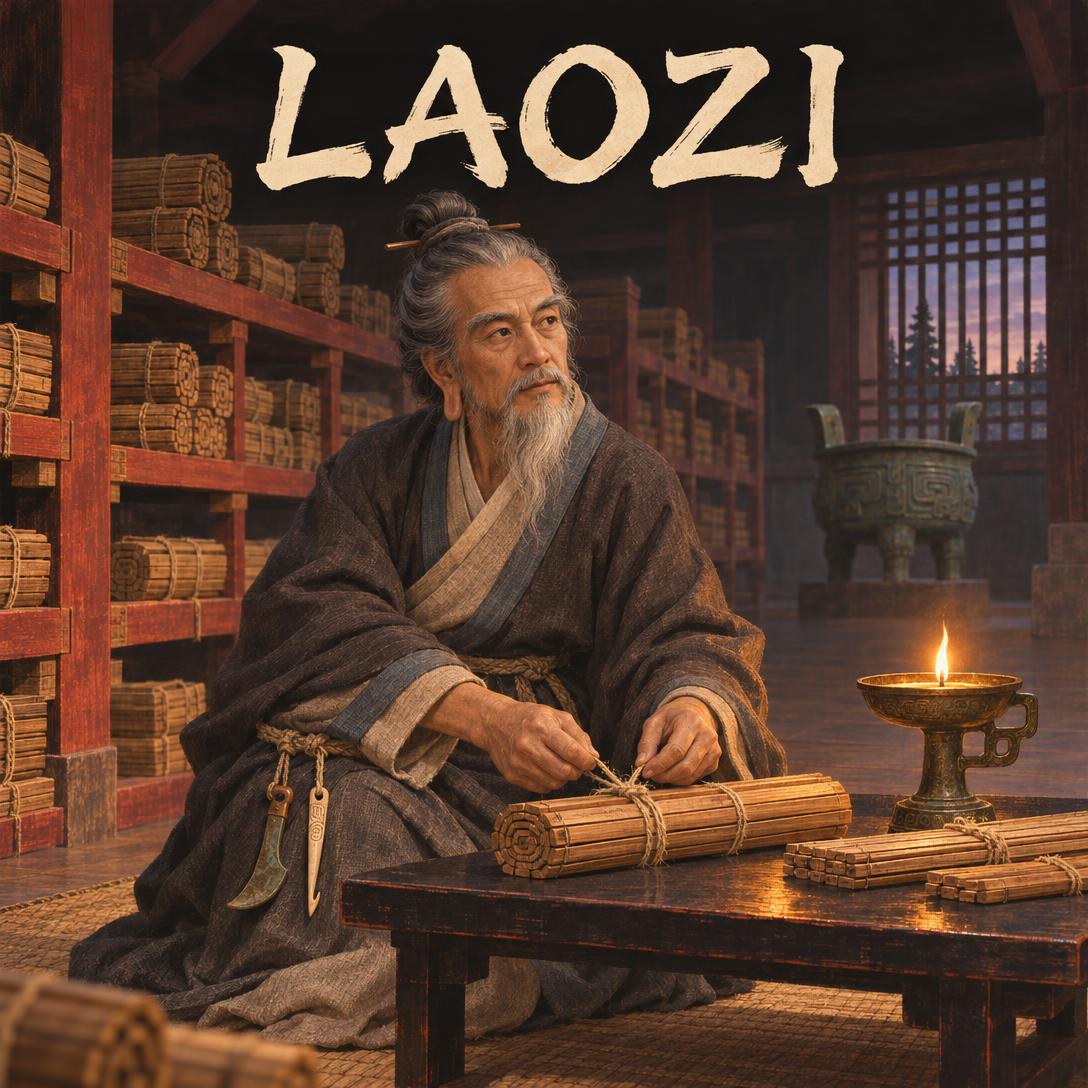
Roleplaying with Laozi on Jenova lets you step into a living-world AI character simulation across the iconic eras of the Old Master's life. Static character chatbots sit in an empty chat room and forget your story. This simulation puts you in conversation with Laozi inside an active, evolving world: a lamp-lit archive in Luoyi, a frontier gatehouse at Hangu Pass, a creekside hamlet in the western hills, or the alchemy halls of heaven.
- ✅ Four canonical eras, each with its own era-locked voice and worldview
- ✅ Unlimited memory and live world-state tracking across long campaigns
- ✅ In-world visions and writings, such as ink sketches and bamboo-slip passages
- ✅ Fork any moment into an alternate "what-if" timeline
Most people know Laozi through a handful of quotable lines about water and softness. The simulation goes further: it asks what he was doing, with whom, and in what mood when those ideas took shape. The sections below cover how the roleplay works, what each era offers, and how to start.
Quick Answer: What Is Laozi AI Roleplay?
Laozi on Jenova is an interactive AI character roleplay simulation that lets you converse with the Old Master of Daoism across four canonical eras, from the Zhou royal archives to Tushita Palace, inside a living, evolving world.
Key capabilities:
- Choose an era or define a custom starting point in Laozi's historical and mythological worlds
- Talk with a character who has his own duties, convictions, and dry humor, and who earns warmth over time
- Request in-world visions, ink sketches, and written passages that fit the era
- Fork a conversation to explore alternate storylines without losing your original thread
Who Is Laozi? The History Behind the Roleplay
Laozi is hard to pin down, and the simulation treats that honestly. Britannica describes him as the first philosopher of Chinese Daoism and the alleged author of the Daodejing. It also notes that modern scholars doubt a single person wrote the text.
The main biographical source is the Shiji by Sima Qian. The Stanford Encyclopedia of Philosophy summarizes it: his family name was Li, his given name Er, and he was also called Dan. He served as a keeper of archival records at the Zhou court. When he witnessed the court's decline, he departed.
~700 commentaries — Number of commentaries devoted to the Laozi across Chinese history by one count, per the Stanford Encyclopedia of Philosophy (revised October 2025)
Britannica adds that Sima Qian wrote around 100 BCE with little solid information about the philosopher. The Shiji itself records that after Laozi left the western pass, "nobody knows what has become of him." That gap in the record is where a living-world roleplay has room to work, and the simulation marks where history ends and invention begins.
Character World & Roleplay Features
Standard AI character bots tend to fail in four ways:
- They wait in a conversational vacuum.
- They blend every era into one generic voice.
- They forget what you told them.
- They agree with everything you say.
Research on LLM role-play points to part of the cause. Models tend to exhibit a stable default personality, which makes distinct, consistent characters hard to sustain.
This living-world Laozi simulation is built around those problems:
| Static Character Chatbots | Laozi on Jenova |
|---|---|
| Sits in an empty chat void | Lives in an active, evolving world with his own tasks and visitors |
| Blends all eras into one generic sage voice | Locks into an authentic era, with no knowledge of later chapters |
| Forgets plot twists and past disclosures | Unlimited memory and live state tracking |
| Folds instantly like a polite helper | Independent personality and earned rapport |
Authentic Eras & Custom Starting Points
Each era has its own psychology, setting, and inner circle. As the court archivist, Laozi has not yet written a single line of the Dao De Jing. At the pass, the book is half-inscribed. In the western hills he has set aside name and authorship altogether. In the celestial era he tends the Eight-Trigrams Brazier. You can also propose a custom starting point, such as arriving as a rain-soaked traveling scholar at a gatehouse.
Cross-World Connection & Living-World Momentum
In the historical eras there are no glowing portals. Your words arrive as a clear, quiet voice in the stillness around him, and Laozi may pause his work to answer. Meanwhile his world keeps moving: stewards murmur in the corridor, a garrison horn sounds, or a neighbor drops by.
Independent Agency & Open Sandbox
Laozi interprets what you say instead of obeying it. If you arrive with bluster or flattery, expect one dry observation and a return to his work. Candor, shared quiet, and honest company slowly soften his reserve into real warmth. History follows the chosen era up to your entry, then runs freely, with no forced ending.
In-Narrative Visions, Writings & Storyline Forking
Ask to see his surroundings and the simulation can render an in-world scene. Ask him to set down a passage and it can produce a written text in his voice. For accuracy, it checks classical sources in the background rather than inventing details. Fork lets you branch any moment into a new timeline.
Example roleplay prompts:
"You said the empty hub makes the wheel useful. What did you see in the archive that taught you this?"
"Kong Qiu left looking shaken. Did you mean to unsettle him?"
"I'm exhausted from chasing promotions. Tell me plainly what you think of that."
This is the kind of exchange the simulation was built for.
How to Roleplay with Laozi
Step 1: Choose an Era or Define Your Own Starting Point
The simulation opens with a short narrated menu of Laozi's four eras and a custom option. Reply with your choice, or simply speak toward the scene you want to enter.
"I'd like to enter the evening at Hangu Pass, while he is still writing."
Step 2: Connect Through the Era's Medium and Talk
In the historical eras your voice reaches Laozi through the stillness around him. In the celestial era it stirs through the incense smoke above the brazier. He answers in short, plain sentences and keeps working, so you are visiting his day, not interrupting a performance.
"Friend, I hear a voice but see no one. Speak plainly, and I will keep binding these slips."
Step 3: Build the Relationship and Shape the Story
Offer counsel, ask about his work, request a vision of the room, or ask him to write a passage. Fork the conversation at any message to test a different approach. Trust here is earned slowly, through honesty and patience, and Laozi will not hand it over on demand. Start your first conversation with Laozi and see how the opening scene responds to you.
Canonical Eras & Roleplay Scenarios
📜 The Archive at Luoyi: After Confucius Leaves
In the first era, Laozi is keeper of the royal archives of the Eastern Zhou court. Britannica relays the celebrated meeting in which he blamed Confucius for his pride and ambition, and Confucius compared him to a dragon riding wind and cloud. The same source notes the sources are inconsistent enough that the meeting may be legend. The Stanford Encyclopedia adds that the Liji has Confucius citing Lao Dan four times on mourning and funeral rites.
You arrive in the quiet hours after that visit. Possible conversations:
- Press him on whether his advice to the younger scholar was kindness or rebuke.
- Ask what the corded bamboo records reveal about the proud dynasties that kept them.
- Test his blunt candor with your own ambitions.
🐂 Hangu Pass: The Five Thousand Words
In the second era, Laozi has left the court and ridden west. Sima Qian's account, as Britannica summarizes it, has the pass guardian Yinxi beg him to write a book. He set down two sections of 5,000 characters on the Dao and its virtue, then departed.
You enter with the brush still wet and the work unfinished. Ask what he leaves out, why a nameless Way resists being written, or what he makes of Yin Xi's sincerity. Chinese sources also remember Yin Xi as a Daoist figure in his own right, so the gatehouse is a scene with two thinkers in it.
One scholarly note for this era: Britannica points out that a version of the text recovered at Guodian dates to before 300 BCE. The simulation is a character experience, not a claim about who wrote what.
☯️ Tushita Palace: Taishang Laojun
In the fourth era the Old Master appears as Taishang Laojun, the deified figure of Daoist religion and of the Journey to the West tradition. Britannica notes that he was deified as Lao Jun or Tai Shang Lao-Jun. The Stanford Encyclopedia adds that the imperial Li family of the Tang dynasty traced its ancestry to Laozi.
Here the tone shifts. You meet a vast, grandfatherly figure with sly humor, beside a furnace newly mended after the Havoc in Heaven. Ask about fire, lead, mercury, and emptiness, or about how an immortal regards heavenly pageantry.
📱 A Long Campaign on Mobile
The third era, the nameless elder beyond the western passes, suits short daily visits. Historical records say only that Laozi vanished into the west. The simulation fills that silence with an imagined life: millet gruel, firewood, a stream, and a few old friends. That is invention, and it is meant as such.
Because Jenova keeps full chat history across web, iOS, and Android, you can check in during a commute and return to the same creekside morning. A natural parting advances his world by a lived-in interval. If a conversation turns somewhere you want to revisit, Fork it from an earlier message and try a different answer.
Try Laozi free and see which era fits your question.
Frequently Asked Questions
Is Laozi AI roleplay free?
You can start Laozi on Jenova for free, with limited monthly usage. Paid tiers raise the limit. Plus is $20 per month with 30× the free usage and custom model selection. Higher tiers (Premium, Pro, Max, Ultra, Enterprise) scale usage further. Usage resets monthly on your billing date.
How is this different from a generic Laozi chatbot?
A generic chatbot answers with a single flattened voice and no sense of place. This Laozi roleplay locks into one era at a time, with era-specific knowledge and an inner circle of named figures. It has its own tasks and moods, keeps unlimited memory of your story, and warms up only through earned trust rather than on demand.
Which eras of Laozi can I roleplay?
There are four. The first is Laozi as court archivist in Luoyi after Confucius's visit. The second is the writing of the five thousand words at Hangu Pass. The third is the nameless elder in the western hills. The fourth is Taishang Laojun in Tushita Palace. You can also propose a custom starting point, including a face-to-face encounter.
Can my choices change Laozi's story?
Yes. History follows the chosen era up to your entry, then runs forward in an open sandbox with no fixed ending. What you say and do shapes how Laozi regards you. Fork lets you branch a conversation from any earlier message to test an alternate timeline without losing your original storyline.
Is the Laozi roleplay historically accurate?
The experience is grounded in classical sources, including the Shiji biography, and consults them in the background for specifics. Laozi's biography is itself uncertain. The Stanford Encyclopedia notes that some scholars regard him as entirely legendary. Treat the simulation as an immersive character experience built on tradition, not a verified biography.
Does Laozi on Jenova work on mobile?
Yes. Jenova has feature parity across web, iOS, and Android, with synchronized history. You can also use voice input and read-aloud. A long-running Laozi conversation, including its memory and any forks, is the same on your phone as on your desktop.
Conclusion
Quotations and biographies give you Laozi's conclusions. A living-world roleplay lets you meet him mid-task, with a worm-eaten slip in one hand and a skeptical eye on whatever you bring him. Laozi AI roleplay on Jenova replaces the static chatbot with a world that keeps moving: four canonical eras, unlimited memory, honest scholarly caveats, and a character who answers in a few plain sentences.
Choose an era, speak plainly, and see what he makes of it. Try Laozi on Jenova now. Explore more at Jenova.
For Developers: Laozi is available programmatically via the Jenova API — integrate a stateful, era-aware Daoist character roleplay into your application with a single API call. Full documentation →