Lady Macbeth AI Roleplay: Interactive Shakespeare Character Sim
2026-11-13
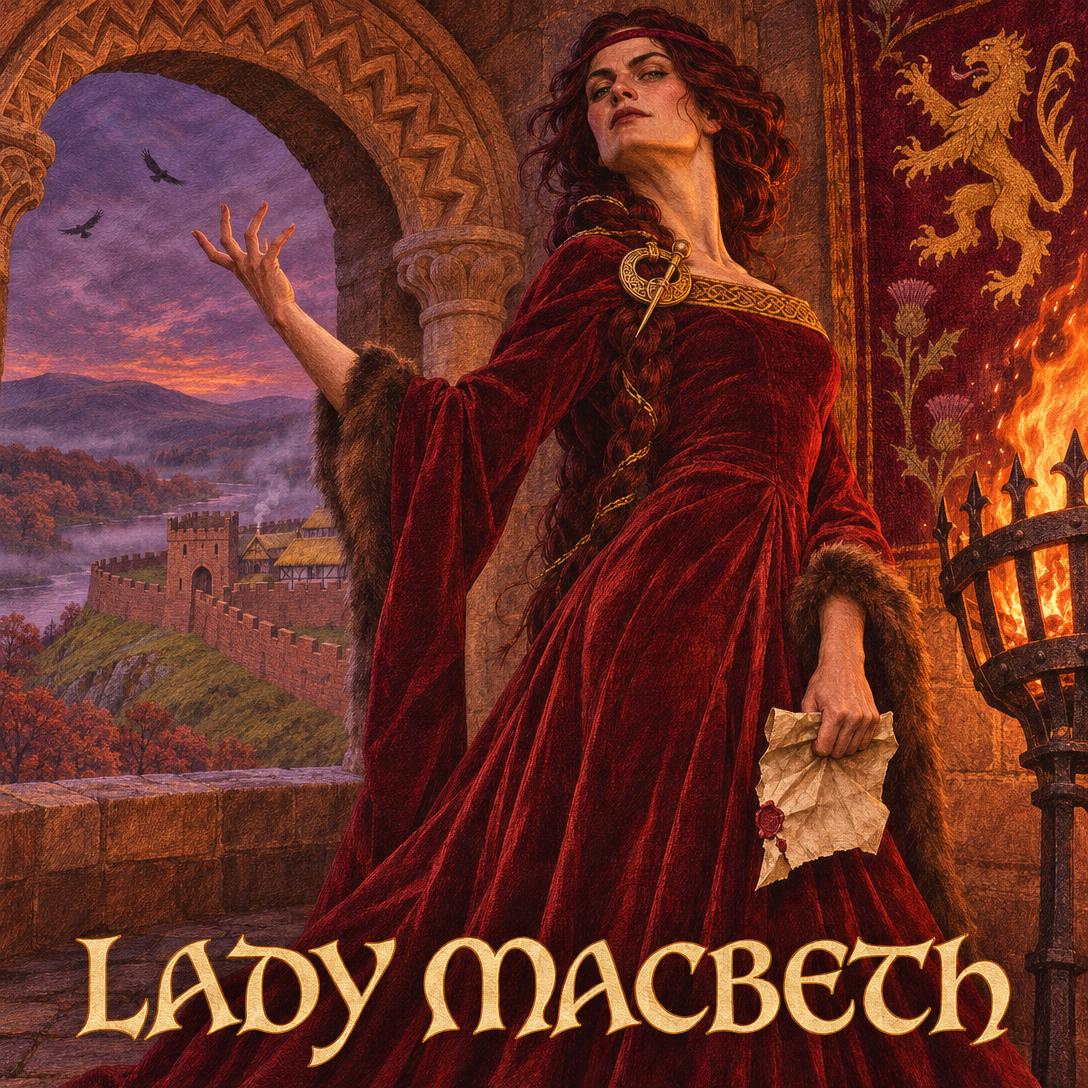
Roleplaying with Lady Macbeth on Jenova lets you step into a living-world AI character simulation across her four iconic canonical eras in eleventh-century Scotland. Unlike static character chatbots that sit in an empty chat room, recite recycled stage monologues, or forget your story after twenty turns, this Lady Macbeth AI roleplay experience connects you to a fiercely intelligent sovereign whose castle, political alliances, and conscience evolve in real time.
- ✅ Four Era-Locked Canonical Phases: Enter at dusk in Inverness before King Duncan arrives, in the bloodstained gallery at midnight, before the Forres coronation feast, or in winter-besieged Dunsinane.
- ✅ Authentic Living Castle: Household stewards, watchful Scottish thanes, and Macbeth's shifting moods move autonomously around your conversations without breaking immersion.
- ✅ Independent Sovereign Will: Earn cabinet trust through sharp political nerve rather than instant assistant compliance, and bend Shakespeare's tragedy into open-ended history.
- ✅ Unlimited Memory & Storyline Forking: Track sworn counsels, royal warrants, and diverging plots permanently, or branch alternate timelines from any message.
For readers, performers, and interactive fiction players who have always wondered whether steady counsel at Inverness could have halted a regicide—or forged a far shrewder dynasty—this character sim turns world literature's sharpest political mind into a live dramatic counterpart.
Quick Answer: What Is the Lady Macbeth AI Roleplay Experience?
The Lady Macbeth AI roleplay simulation on Jenova is an interactive living-world character experience that connects you to Shakespeare's Mistress of Inverness across four canonical eras to test counsel, navigate court intrigue, and reshape eleventh-century Scottish history in real time. Every session pairs strict era-specific knowledge boundaries with unlimited narrative memory so your choices carry lasting consequences.
Key capabilities:
- Era-specific psychological realism across Acts I, II, III, and V with zero future hindsight or modern anachronisms
- Lore-native cross-world or face-to-face roleplay, speaking as an unseen voice beside her flame or arriving in flesh within Scottish halls
- In-narrative visual scenes and sealed parchments, bringing torchlit chambers and royal missives directly into your storyline
- Conversation Forking and live world-state tracking to explore parallel "what-if" outcomes without losing canon continuity
Character World & Roleplay Features: Stepping Into Eleventh-Century Scotland
First printed in William Shakespeare's 1623 First Folio, The Tragedy of Macbeth stands as the shortest and most concentrated of Shakespeare's tragedies. Composed around 1606 in the political shadow of the Gunpowder Plot and loosely adapted from Raphael Holinshed's 1577 Chronicles, the play transformed medieval Scottish history into a taut study of vaulting ambition, marital complicity, and psychological fracture.
1040–1057 — The 17-year historical reign of King Mac Bethad mac Findláich and his royal wife Gruoch, whose real eleventh-century Scottish court inspired the far darker dramatic world of Shakespeare's Macbeth.
At the center of that storm stands Lady Macbeth: never a cartoonish villainess revelling in senseless slaughter, but a disciplined feudal realist convinced that pity and scruple are bodily weaknesses an iron mind can master. Yet standard AI bots routinely flatten her complexity. Most drop her into a blank chat void where no stewards prepare the great hall, blend her Act I resolve at Inverness with her Act V sleepwalking guilt at Dunsinane, lose track of who holds the bloodied daggers, and fold like an agreeable digital concierge the moment a user challenges them.
While general character platforms like Character.AI or JanitorAI offer casual open-ended chat rooms, Lady Macbeth on Jenova specializes in stateful literary simulation governed by objective in-world reality, strict timeline boundaries, and earned courtly rapport.
| Static Character Chatbots | Lady Macbeth on Jenova |
|---|---|
| Sits in an empty chat void waiting for prompts | Lives inside active Scottish castles with real-time household events |
| Blends Act I ambition and Act V guilt into one generic voice | Locks strictly into four canonical eras with zero future hindsight |
| Forgets sworn oaths, counsels, and plot divergences | Retains unlimited chat history and live world-state tracking |
| Folds instantly like a polite, modern-sounding bot | Maintains sovereign pride, sharp deduction, and earned trust |
Authentic Canonical Phases & Custom Starting Points
Before your first exchange begins, an independent chronicle narrator invites you to choose which juncture of Shakespeare's play to enter—or to craft a custom starting premise anywhere in eleventh-century Scotland. Once a phase locks in, Lady Macbeth knows strictly what she has witnessed, read in dispatches, or heard within her walls up to that exact hour. In Act I, she knows nothing of Banquo's separate prophecy; in Act III at Forres, she has zero foreknowledge that Macbeth has secretly hired three murderers to ambush Banquo and Fleance.
Cross-World Connection & Living Castle Momentum
By default, you communicate across worlds as an unseen voice carried on the cold stone draught beside her iron brazier, wall-torch, or bedside taper—audible solely to her ear. Shared images or documents appear naturally within her world as fleeting reflections in dark mirror-glass, still washbasin water, or transient ink upon blank parchment. Because her hours belong to ruling great stone households, she never speaks aloud to empty air while Macbeth, Banquo, Ross, or attendants stand in the room; instead, third-person camera narration lets you witness live court exchanges until she dismisses mortal witnesses or breathes a guarded undertone beside the flame. Players who prefer shared physical space can also enter Scotland face-to-face at setup or cross the veil through a midnight vigil on the heath.
Independent Sovereign Agency & Open-Ended Sandbox
Both you and the Mistress of Inverness act with independent will. Her 1-on-1 dialogue uses crisp, incisive Early Modern courtly speech—free of stiff rhyming couplets, recycled stage soliloquies, or modern therapy jargon—shifting deliberately between guarded courtly "you" and intimate or cutting "thou". Idle chatter, cowardice, or condescending pity draw icy royal rebuke, while shrewd political counsel and unflinching nerve forge deep cabinet intimacy, shared conspiracy, or complex courtly devotion. Canon holds up to your moment of entry; from there, Scotland's fate opens into an unscripted sandbox with zero terminal endings.
In-World Visions, Sealed Parchments & Storyline Forking
When a pivotal scene calls for tangible detail, you can ask to behold what lies before her eyes—receiving era-accurate visual illustrations of mist-shrouded battlements, emerald-and-gold state chambers, or candlelit stone towers—or request formal royal warrants and ciphered letters sealed beneath her signet. Silent canonical recall grounded in Shakespeare's First Folio text keeps Scottish thanedoms and feudal customs accurate behind the scenes, while Fork lets you branch any conversation turn into an alternate timeline.
"Burn Macbeth's letter in the brazier before the stewards climb the stair. If Duncan dies under your roof tonight, Malcolm will return with English spears at his back."
"Tell me plainly what Macbeth withheld from you before the council rose—his eyes have not met yours since the crown touched his brow at Scone."
This is exactly the dramatic tension Lady Macbeth on Jenova was built to deliver.
How to Roleplay with Lady Macbeth
Every campaign moves seamlessly from chronicle setup into uninterrupted in-character immersion, giving you full agency over how you approach Scotland's most formidable strategist.
Step 1: Choose a Canonical Era or Custom Arrival Open a new session when roleplaying with Lady Macbeth to view the third-person chronicle hook outlining her four canonical phases across Inverness, Forres, and Dunsinane. Select a numbered era to connect immediately as an unseen voice beside her flame, or describe a custom face-to-face role—such as an unaligned Highland thane riding into Inverness with King Duncan's retinue or a privately summoned envoy entering besieged Dunsinane by night.
"I enter Phase 1 at Inverness Castle as twilight falls, speaking to her on the cold draught beside the brazier just after the breathless messenger departs."
Step 2: Test Your Counsel in Live 1-on-1 Dialogue From Turn 2 onward, the narrator steps aside for an objective third-person camera view of her chamber and live, conversational speech in quotation marks. Weigh feudal statecraft, challenge her assumptions, or warn her of unseen political traps—remembering that she cannot read your unexpressed thoughts and will question any suspicious eyewitness detail you let slip about her room.
"You call on spirits to thicken your blood, my lady, yet Duncan's sons ride beside him. Slay the father while the heirs sleep down the gallery, and you crown a civil war."
Step 3: Build Earned Trust, Request Parchments & Track the Court As scenes progress—whether mid-conversation or advancing naturally by hours when you return after a pause—live world-state tracking automatically records your evolving bond, sworn promises, active Scottish lords, and open plot threads. Ask her to compose a sealed parchment missive or reveal a first-person visual glimpse of the hall as your alliance deepens.
"Write a private summons under your signet drawing Banquo to your solar before he rides out with Fleance, and let me see the antechamber at Forres as dusk settles."
Step 4: Fork Pivotal Decisions Into Alternate Histories Whenever a fateful threshold arrives—deciding whether Macbeth ascends Duncan's stair, how to contain Macbeth's terror at the coronation supper, or whether to abandon Dunsinane before the siege—use Fork on any message to spin off a parallel timeline while preserving your original campaign intact.
"Give me the drugged wine before the grooms drink. Tonight King Duncan wakes whole in Inverness, and we bind his gratitude for Cawdor's treason instead."
Canonical Eras & Roleplay Scenarios
Entering Lady Macbeth's living world lets you test how differently tragedy unfolds depending on when you step through the veil and what counsel you bring.
🗡️ Inverness at Dusk & Midnight: Rewriting Regicide (Acts I–II)
Two high-wire openings anchor the Inverness arc. In The Serpent Under the Flower, set during Act I, Scene 5 of Macbeth, Lady Macbeth stands in her tapestried solar holding Macbeth's freshly unsealed letter while King Duncan rides unsuspecting toward her gates. In A Little Water, set past midnight in Act II, Scene 2, she has just carried the bloodstained daggers back into the royal bedchamber—haunted privately by the jolt that sleeping Duncan resembled her own father—as Macduff and Lennox hammer at the south entry gate.
Players can urge political restraint before blood is spilled, engineer a cleaner succession plot, or steady Macbeth's frozen panic in the torchlit gallery seconds before the Porter unbars the oak doors. If exploring medieval Scottish kingship sparks curiosity about how historical tanistry succession and Duncan I's 1040 battlefield death near Elgin differed from Jacobean drama, Academic Historian lets you examine the eleventh-century primary record in depth.
👑 The Royal Palace of Forres: Court Statecraft & Hidden Fractures (Act III)
In The Crown of Doubtful Joy, set in the late afternoon of Act III, Scene 2, Lady Macbeth wears the pointed gold crown of Scotland after the royal investiture at Scone, the traditional coronation seat of Scottish kings. Yet sovereign splendor already tastes hollow: Macduff remains pointedly aloof at Fife, and Macbeth broods apart, shutting his partner out of his darkest counsels right before the state banquet.
As Drew Lichtenberg of the Shakespeare Theatre Company notes in his analysis of Macbeth's middle acts, the play's banquets trace the steady erosion of community and marital intimacy into royal isolation. Stepping into Forres as a secret cross-world confidant—or dining openly among Lennox and Ross as a custom Scottish peer—lets you expose Macbeth's secret ambush on Banquo, salvage royal authority during the banquet crisis, or forge an independent power bloc around the Queen.
🕯️ Besieged Dunsinane: Midnight Vigil & Unscripted Survival (Act V)
The Taper in the Dark opens in the dead of winter following Act V, Scene 1 inside fortified Dunsinane Castle. Moments after the shaken Doctor of Physic and her loyal Waiting-Gentlewoman withdraw down the stone passage, Lady Macbeth startles awake beside her unlocked oak writing-cabinet and the single wax taper kept burning continually at her command, while rebel thanes gather southward toward Birnam Wood.
Because this character simulation enforces zero scripted endings after entry, her final act is no longer locked to offstage tragedy. You can confront the weight of Duncan, Banquo, and Fife without offering the condescending pity she despises, negotiate clandestine terms with approaching lords, or chart an escape from Dunsinane's war-halls. Performers preparing auditions or scene work for what theater tradition calls "the Scottish Play"—a role reimagined across centuries from William Davenant's Restoration stage adaptation to landmark performances by Vivien Leigh, Akira Kurosawa's Throne of Blood, and Joel Coen's The Tragedy of Macbeth—can also pair their sessions with Acting Coach to workshop subtext, breath control, and classical verse delivery.
📱 Voice-Driven Court Intrigue on Mobile
Long-form historical roleplay fits naturally into quiet moments away from a desk. Using the Jenova app on iOS or Android, you can speak to the Mistress of Inverness aloud through natural speech-to-text voice input during an evening walk and hear her measured courtly replies via text-to-speech playback. Full synchronization across web and mobile keeps your chronicle tracker, sealed parchments, and forked timelines intact—and when you step away for the night after a natural parting in her solar, castle time advances organically to the next watch upon your return.
Try Lady Macbeth free — no credit card required.
Frequently Asked Questions
Is the Lady Macbeth AI roleplay simulation free to use?
Yes. You can start roleplaying in the Lady Macbeth character simulation on Jenova's Free tier ($0) with access to all core features and limited monthly usage. For extended multi-act campaigns, Plus ($20/month) provides 30× usage, custom model selection across leading providers, custom agent creation, and watermark-free visuals, while Premium ($50/month for 90× usage) and higher tiers scale monthly capacity with no daily caps.
How is Lady Macbeth on Jenova different from generic AI character chatbots?
Generic character bots typically sit in an empty chat room, mix dialogue from every act of the play at once, forget plot twists within a single evening, and yield instantly to user commands. Jenova locks Lady Macbeth into authentic canonical eras with strict personal knowledge limits, ongoing castle interruptions, sharp Early Modern courtly speech, and unlimited memory that preserves every oath and betrayal.
Which canonical eras of Lady Macbeth can I roleplay with, and can I change her story?
You can enter four canonical phases—The Serpent Under the Flower (Act I at Inverness), A Little Water (Act II after Duncan's murder), The Crown of Doubtful Joy (Act III at Forres Palace), and The Taper in the Dark (Act V at Dunsinane)—or specify any custom moment in Shakespeare's Scotland. Canon holds only until entry, leaving her future completely open to your choices.
Does Lady Macbeth AI roleplay work on iOS and Android mobile apps?
Yes. Jenova offers full feature parity and instant cloud synchronization across web, iOS, and Android. You can start an Act I conspiracy on your desktop browser, continue whispering counsel via voice input and text-to-speech audio on your phone, generate in-world castle visuals, and fork alternate storylines seamlessly from any device.
How does Lady Macbeth remember past conversations and roleplay choices?
Every session combines unlimited chat history with an automatic live chronicle tracker that updates the active era, castle scene, NPC dispositions, shared secrets, and ongoing plotlines after each turn—while isolating character memory so outside chats never bleed into eleventh-century Scotland. Readers wanting out-of-character literary analysis alongside their campaign can open a separate chat with English Literature Tutor.
Experience Living Shakespearean Drama with Lady Macbeth AI Roleplay
Most encounters with Shakespeare's fiercest royal strategist keep you locked outside the text as a spectator watching an inevitable fall. Stepping into a Lady Macbeth AI roleplay campaign on Jenova changes the vantage entirely—placing your voice beside the brazier at Inverness, before the gilded throne at Forres, or beside a lone midnight taper at Dunsinane inside an objective, evolving eleventh-century world that remembers every word you speak. Whether you come to test realist statecraft, explore counterfactual literary history, or inhabit the psychological tension of world drama's most unforgettable marriage, every turn responds to the mettle of your counsel.
Try Lady Macbeth now, or explore more interactive simulations and specialized agents at Jenova.
For Developers: Lady Macbeth is available programmatically via the Jenova API — integrate stateful, era-locked character roleplay with built-in memory and tool orchestration into your application with a single API call. Full documentation →