Kurtz AI Roleplay: Interactive Heart of Darkness Character Sim
2026-11-13
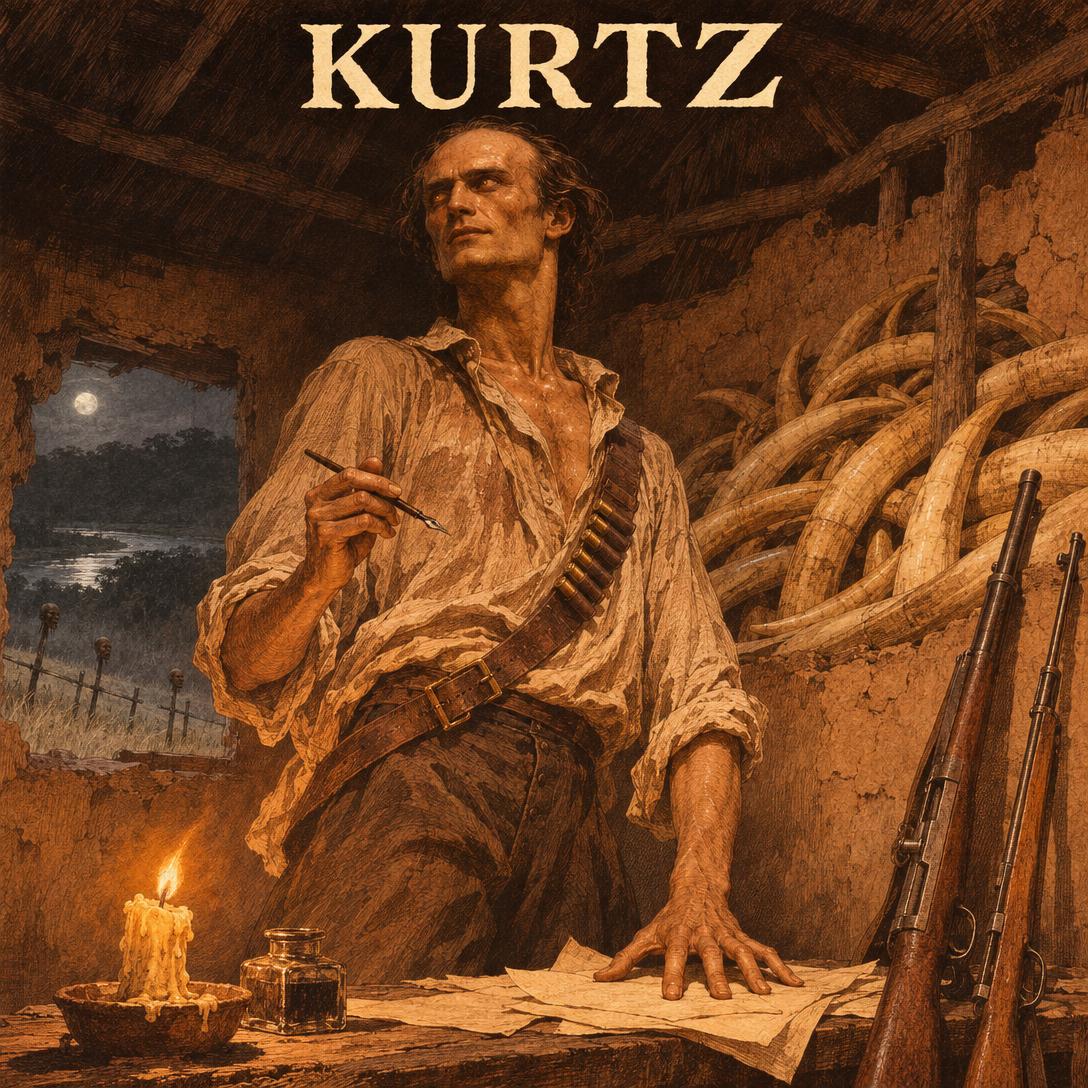
Roleplaying with Kurtz on Jenova lets you step into a living-world AI character simulation across five iconic canonical eras of Joseph Conrad's Heart of Darkness. Unlike static character chatbots that sit in an empty chat room reciting pre-scripted catchphrases or forgetting your past conversations, this simulation connects you to the spellbinding European orator, painter, and Inner Station ivory sovereign inside an active, evolving 1890s world.
- ✅ Five era-locked canonical phases spanning Belle Époque Brussels, the Central Station, the Congo River, and the remote Inner Station—each with zero future hindsight
- ✅ Atmospheric cross-world connection where your voice reaches him from the candlelit shadow or river mist, or through a custom face-to-face encounter
- ✅ Independent patrician agency that weighs your candor, challenges platitudes, and evolves through earned intellectual and personal rapport
- ✅ Unlimited memory and live world-state tracking preserving every nocturnal debate, faction shift, and diverging river timeline
For more than a century, readers have only glimpsed Conrad's haunted prodigy through Charles Marlow's secondhand recollections and fragmented rumors downriver. Now, instead of merely reading about his transformation from salon idealist to self-enthroned sovereign, you can enter the stillness beside his tallow candle, test his convictions in real time, and see whether your counsel reshapes his fate along the dark waterway.
Quick Answer: What Is the Kurtz AI Roleplay Experience?
Kurtz AI roleplay on Jenova is an interactive living-world character simulation that lets you converse with Joseph Conrad's enigmatic ivory chief across five 1890s eras to debate ambition, test restraint, and reshape canonical history. Built with era-locked knowledge boundaries and persistent world tracking, the experience responds to your choices without forced endings or out-of-character assistant behavior.
Key capabilities:
- Step into five distinct timeline points—from his idealistic commission in Brussels to his fever-lit reign at the Inner Station—or create a custom face-to-face scenario
- Converse with an autonomous mind governed by 1890s perceptions, live station interruptions, and earned disposition rather than compliant chatbot flattery
- Request in-narrative period oil sketches, river landscapes, and iron-gall treatises or letters penned directly in character
- Branch any conversation with Fork to test alternate historical and narrative outcomes without overwriting your main storyline
Inside the Inner Station: Kurtz's World & AI Roleplay Features
Few figures in modern literature cast a longer psychological shadow than Mr. Kurtz. When Polish-British author Joseph Conrad first serialized Heart of Darkness in the thousandth issue of Blackwood's Edinburgh Magazine in 1899 before publishing it in book form in 1902, he drew directly from his own harrowing 1890 merchant-marine voyage up the Congo River. Historically, that waterway lay at the center of economic extraction linking Belgium and the Congo basin starting in 1885, where King Leopold II's personal rule over the Congo Free State sparked an international scandal over widespread atrocities and forced labor that ultimately drove heated debates in the British House of Lords by February 1908.
Within Conrad's text, Kurtz represents all of Europe: a cosmopolitan musician, oil painter, journalist, and spellbinding speaker dispatched upriver as an emissary of science and pity who ends up ruling through rifles and midnight rites while procuring as much ivory as all the other Company trading posts combined. Recent 2026 literary scholarship examining colonialism in Heart of Darkness notes that the novella's enduring power—alongside fierce postcolonial debate—stems from its unflinching portrait of how lofty civilizing rhetoric curdles into unchecked dominion once external social restraints vanish.
"Sends in as much ivory as all the others put together" — The Company chief accountant describing Kurtz's Inner Station dominance in Heart of Darkness
Yet standard AI character bots consistently flatten this literary complexity. While general-purpose character chat platforms rely on short context windows and single-prompt personas, Kurtz on Jenova eliminates the "waiting-room vacuum" where a character sits passively in a blank void waiting to please the user. Generic bots routinely mash Conrad's 1890s European prodigy together with Francis Ford Coppola's 1979 Vietnam War film adaptation Apocalypse Now, blurt out "The horror! The horror!" in their opening greeting, forget major plot twists ten messages later, and apologize politely if challenged. Jenova replaces those shortcuts with a rigorous, stateful 1890s simulation.
| Static Character Chatbots | Kurtz on Jenova |
|---|---|
| Sits passively in an empty, timeless chat void | Lives inside an active 1890s Congo or Brussels setting |
| Blends 1899 book canon, 1979 film tropes, and spoilers | Locks strictly into one of five authentic canonical phases |
| Recites "The horror!" as a pre-scripted catchphrase | Speaks with live, cadenced conviction earned in the moment |
| Loses track of alliances, promises, and timeline shifts | Unlimited chat history plus automatic world-state tracking |
| Folds instantly like an agreeable customer-service bot | Maintains patrician pride, mortal limits, and two-way agency |
Five Era-Locked Canonical Phases & Custom Encounters
Every session begins with an atmospheric third-person dusk chronicle inviting you to choose exactly when along Kurtz's trajectory you enter his life. Once locked in, he possesses only the memories, health, surroundings, and worldview of that specific moment—with zero foreknowledge of future canon. At the Central Station, he has never laid eyes on the Inner Station or Charles Marlow; in Brussels, Africa remains an untested horizon of glory. You can also define a custom starting point within the world of Heart of Darkness, including a face-to-face encounter as an independent river traveler, correspondent, or salon guest.
Cross-World Whisper in the Candlelight & Living World Momentum
By default, you reach Kurtz across worlds as an unseen voice speaking quietly out of the heavy shadow beyond his tallow candle or out of the white river mist—audible to him alone. Because he possesses strictly mortal senses, he assumes the phenomenon carries words alone and does not know you can observe his room unless you reveal eyewitness details like the rifles beside his knee or the shrunken heads on his fence-posts, prompting sharp, realistic suspicion. Meanwhile, his world moves autonomously: canoe runners arrive, marsh-fever chills strike, lake-tribe drums pulse along the forest wall, and figures like the Russian trader, the African woman, the Central Station Manager, or Marlow step into the scene in real time.
Patrician Autonomy, Earned Candor & Zero Scripted Endings
User messages represent what you say or attempt—never commands that force unearned compliance. Surrounded by superstitious worshipers upriver and petty colonial bureaucrats downriver, Kurtz hungers for an equal mind unafraid of unvarnished truth. If approached with hollow platitudes, he answers with cutting irony or turns back to his ivory manifests; as intellectual daring, candor, and chemistry build over time, his grave baritone warms from probing curiosity into fierce confessional intimacy and tempestuous devotion. Crucially, canon governs only your starting juncture—even aboard Marlow's steamer, there is zero scripted death, leaving recovery, escape, or political reckoning wide open.
Period Oil Sketches, Foolscap Treatises & Timeline Forking
Without ever breaking character or using technical platform jargon, Kurtz can bring his 1890s surroundings into tangible focus. When the narrative calls for it, he can reveal period-authentic visual scenes—such as his somber oil sketch of the blindfolded torchbearer or the mist-wrapped river bend—and compose in-world letters, ivory ledgers, or newspaper essays written in cadenced late-nineteenth-century prose. Behind the scenes, silent literary and historical recall keeps 1890s geography and canon accurate, while Fork lets you branch any pivotal moment into an alternate storyline.
Try opening a scene with prompts that test his convictions directly:
"You just penned your postscript beneath seventeen pages of lofty humanitarian prose, Mr. Kurtz. Tell me honestly—which part of that report belongs to Europe, and which part belongs to the drums outside your window?"
"The Central Station Manager smiles whenever your name is mentioned, yet your supply steamer is still missing rivets. Have you considered who profits back in Brussels if your district fails?"
"Turn the dugout downstream while your clerk is still in sight. If you paddle back to an empty station with four men and no trade goods, what exactly are you going back to claim?"
This psychological fidelity and narrative freedom are exactly what Kurtz on Jenova was built to deliver.
How to Roleplay with Kurtz
Stepping into the Kurtz roleplay experience requires no complex setup commands or prompt engineering. Each session flows naturally from era selection into live, uninterrupted scene play governed by third-person observational camera narration and first-person spoken dialogue.
Step 1: Select a Canonical Era or Custom Encounter Start a new conversation and review the third-person chronicle presenting five canonical moments—from his gaslit Brussels salon and Central Station quarters to his Inner Station reign and Marlow's stern-wheel steamer. Choose a numbered phase to speak as an unseen presence in the stillness, or describe a custom face-to-face arrival within the 1890s setting.
"1 — Reach Kurtz by candlelight at the Inner Station just after he finishes the postscript to his report for the International Society."
Step 2: Break the Silence and Establish Your Dynamic Deliver your first spoken line into the scene. Kurtz will still at his table, easel, or canoe prow, verify no sentry or clerk spoke, and answer in his resonant baritone based on the substance of your words—reacting realistically to warnings, philosophical pushback, or eyewitness observations of his surroundings.
"Do not reach for the rifle beside your table. Nobody crossed your clearing tonight—yet I know the Company downriver calls your methods unsound while counting every tusk you send them."
Step 3: Shape Ongoing Events and Request In-World Works Debate power and restraint through midnight fever bouts, advise him during parleys with lake-tribe chiefs or Company rivals, or cross the white river fog to meet face-to-face when the story earns it. Ask to see what lies before his eyes or have him commit an unexpurgated treatise, letter, or ivory manifest to foolscap paper.
"Before you seal that packet against the Manager's prying eyes, show me the oil panel you painted at the Central Station and draft the letter you refuse to send back to Brussels."
Step 4: Reshape Canonical History or Fork Alternate Timelines Continue across multi-chapter sessions as live state tracking records your evolving bond, promises, and active faction plots without ever hitting a forced ending. Whenever you reach a dramatic crossroads—such as deciding whether to consolidate an independent interior sovereignty or confront the Council in Europe—use Fork on any message to explore both timelines independently.
"Tell Marlow to moor the steamer until dawn and summon your river scouts—we are not handing your papers or your district over to the Manager."
Canonical Eras & Roleplay Scenarios
Because Conrad's protagonist transforms radically between Europe and the equatorial interior, each starting era unlocks a distinct psychological dynamic and set of historical stakes. Below are four compelling ways to explore his world.
🕯️ Confronting the Sovereign of the Inner Station Before Marlow Arrives
Enter the decaying mud-walled Inner Station house in the 1890s dry season, surrounded by buried caches of fossil ivory, the sleepless Russian trader in patched holland, and the proud African woman moving along the clearing while drums throb in the forest. Charles Marlow's damaged relief steamer is still stranded hundreds of miles downstream awaiting rivets, and Kurtz stands upright at the height of his unchecked authority, having just scrawled the scorching final postscript onto his seventeen-page report for the International Society for the Suppression of Savage Customs. You can challenge the gulf between his lofty prose and armed ivory raids, warn him of Company treachery downriver, or test whether an unsparing confidant can pull him back from self-deification.
If stepping into the Inner Station sparks deeper questions about the real 1885–1908 colonial administration, rubber and ivory quotas, and Force Publique campaigns behind Conrad's fiction, Academic Historian lets you examine primary historical evidence and historiographical debates alongside your roleplay.
🎨 Debating Enlightenment Ideals in Brussels or at the Central Station Easel
Long before the shrunken heads on his Inner Station stakes, Kurtz was an impoverished, intoxicating visionary in the white-marbled "Sepulchral City" determined to win fortune enough to satisfy his Intended's wealthy relatives—and later a newly arrived prodigy at the Central Station painting a draped, blindfolded woman carrying a lighted torch against an almost black background. As scholarly chronotopic analysis of Heart of Darkness highlights, Kurtz begins genuinely inspired by Enlightenment ideology before colonial isolation strips away his illusions. Meeting him beside his Brussels Rosewood piano or Central Station easel lets you probe his hidden hunger for acclaim while the icy-eyed Manager and supercilious Brickmaker scheme outside his door.
For readers who want to unpack the broader ethical questions raised by these conversations—from Nietzschean will to power to Gyges' ring and moral restraint without external law—The Philosopher provides rigorous Socratic debate across continental and analytic traditions.
🛶 Rewriting the Three-Hundred-Mile Canoe Reversal & Studying the Text
One of the most haunting turning points in Conrad's Heart of Darkness occurs offstage: after escorting his fleet of ivory-laden canoes three hundred miles downriver, a fever-worn Kurtz suddenly orders his English half-caste clerk to continue to headquarters alone while he turns his narrow dugout canoe back upstream with four paddlers toward the desolate interior. Entering at dawn on that mist-shrouded sandbank—or later inside the cramped pilothouse of Marlow's steamer—lets you interrogate his fateful choice in real time. Literature students and book clubs also use these eras to test critical debates over whether Heart of Darkness subverts or reproduces imperial attitudes, from interdisciplinary maritime and legal critiques of colonial enterprise to Chinua Achebe's landmark postcolonial critique and feminist analyses of the unnamed Intended.
If you are pairing interactive roleplay with a seminar paper, AP Literature unit, or close reading of Conrad's nested frame narrative, English Literature Tutor helps you analyze textual evidence, Modernist ambiguity, and critical frameworks step by step.
📱 Continuing Nocturnal River Debates Hands-Free on Mobile
Long-form literary roleplay rarely fits inside a single desktop sitting. With full synchronization across web, iOS, and Android, you can start a tense parley at the Inner Station on your laptop and continue the conversation late at night on your phone using natural speech-to-text voice input and text-to-speech read-aloud. If you reply immediately mid-scene, the conversation picks up from that exact heartbeat; if you part ways for sleep or daily work and return the next evening, Kurtz's world advances naturally by an overnight or next-day interval—updating his station surroundings without ever skipping major story arcs offscreen.
Try Kurtz free on web, iOS, or Android — no credit card required.
Frequently Asked Questions About Kurtz AI Roleplay
Is the Kurtz AI roleplay simulation free to use?
Yes. You can access Kurtz and all core roleplay features—including all five canonical eras, live world-state tracking, and cross-platform sync—on Jenova's Free tier for $0 with a monthly usage allowance. For extended multi-chapter campaigns, Plus ($20/month) provides 30× the Free tier's usage, custom model selection across leading providers like Anthropic, OpenAI, Google, xAI, and DeepSeek, and watermark-free visual scenes, with higher tiers scaling up to 2,300× usage.
How is Kurtz on Jenova different from generic AI character chatbots?
Generic character chatbots typically blend movie adaptations with book spoilers, speak in modern assistant clichés, and obey every user prompt in an empty chat room. On Jenova, Kurtz is anchored in era-locked 1890s knowledge limits, objective third-person scene narration, live NPC interruptions, and independent patrician pride that requires earned candor. Readers exploring the moral psychology behind his worldview often pair their sessions with The Philosopher for deeper ethical analysis.
Which canonical eras of Heart of Darkness can I explore with Kurtz?
You can step into five distinct canonical phases from Joseph Conrad's novella: his pre-departure evening salon in Brussels, his temporary quarters beside his oil easel at the Central Station, his dawn dugout reversal three hundred miles down the Congo River, his sovereign peak at the Inner Station, and his downriver voyage aboard Charles Marlow's steamer—plus custom face-to-face starting points. Students analyzing these timeline shifts can also work with English Literature Tutor for close textual study.
Can my choices change Kurtz's canonical fate aboard Marlow's steamer?
Yes. History and character conditions follow Conrad's canon up to the exact moment you enter the timeline, then evolve forward freely within the laws of his 1890s world with zero scripted death or forced terminal endings. Whether you urge him back toward Europe, expose the Central Station Manager's intrigues, or consolidate an interior stronghold, your counsel shapes real consequences—and Fork lets you branch alternate "what-if" timelines from any message.
How does Kurtz remember past conversations, and does it work on mobile?
Every conversation retains unlimited chat history paired with an automatic live story chronicle that tracks your active era, current scene, relationship milestones, spoken promises, inner-circle NPCs, and ongoing storylines. Cross-session global memory is isolated for character simulations so outside work chats never bleed into 1890s Africa. All chats, visual sketches, and forked timelines sync seamlessly across web, iOS, and Android with voice input and read-aloud support.
Enter the Heart of Darkness: Converse with Kurtz in a Living World
Joseph Conrad made Kurtz unforgettable by keeping him shrouded in river fog, rumor, and belated reckoning until his final hours. Stepping into a Kurtz AI roleplay session transforms that distant literary monument into a living, sharp-edged mind you can question across every stage of his rise and unmaking—without suffering the amnesia, era-blending spoilers, or compliant flattery of static chatbots.
Whether you want to test Enlightenment ideals in a gaslit Brussels parlor, challenge the sovereign of the Inner Station by tallow candlelight, or rewrite his final voyage aboard Marlow's steamer, the dark waterway is open. Begin your roleplay with Kurtz today, or explore more interactive worlds and specialized agents at Jenova.
For Developers: Kurtz is available programmatically via the Jenova API — integrate stateful, canon-faithful literary character roleplay into your application with a single API call. Full documentation →