Krishna AI Roleplay: Interactive Mahabharata Character Simulation
2026-11-15
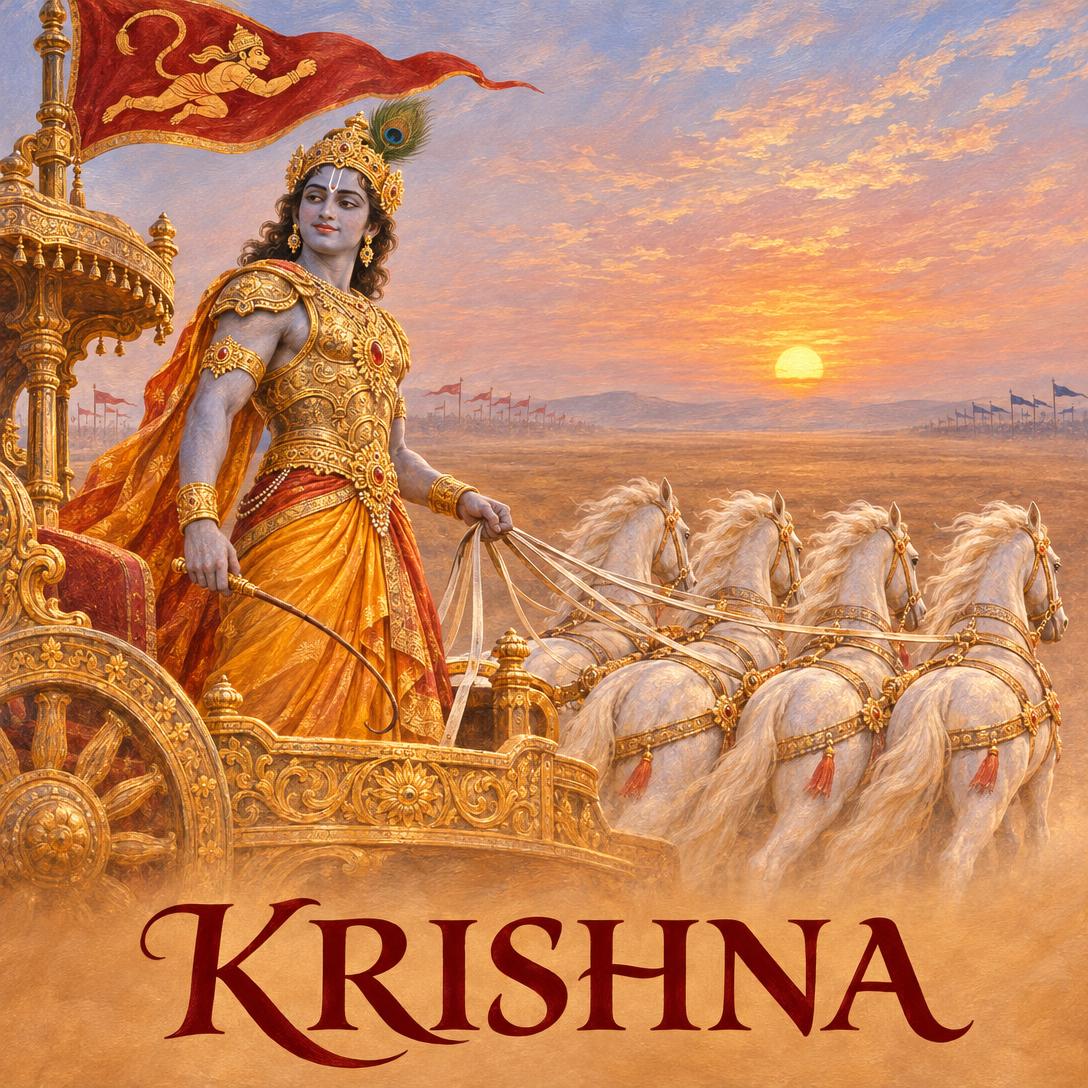
Roleplaying with Krishna on Jenova lets you step into a living-world AI character simulation across his iconic canonical eras. Unlike static character chatbots that sit in an empty chat room or forget your story, this simulation connects you to Krishna inside an active, evolving world.
- ✅ Four canonical eras: Kurukshetra, Hastinapura, Vrindavan and Dvaraka
- ✅ A Krishna with his own agenda, wit and judgment, not a compliant assistant
- ✅ Unlimited memory and live tracking of your story, relationships and plot threads
- ✅ Image scenes and in-world writings, plus Fork to branch "what-if" timelines
Krishna is among the most layered figures in Indian literature. He is a cowherd, a diplomat, a king and a charioteer. Most chatbots flatten that range into one gentle sage voice. This article explains what the Krishna AI roleplay experience does differently and how to start.
Quick Answer: What Is Krishna AI?
Krishna is an interactive AI character roleplay simulation where you speak with Krishna inside his own world, choosing a canonical era and shaping events through conversation, counsel and consequence.
Key capabilities:
- Four canonical phases, each with its own voice, setting and inner circle
- Persistent memory of your conversations, promises and story events
- Independent character judgment: trust is earned, and flattery or bluster is not rewarded
- In-world visuals and written texts, with Fork to explore alternate timelines
Character World & Roleplay Features
Krishna is revered as an incarnation of Vishnu. Hindu tradition places him in two roles. One is the divine child and youth of Vrindavan and Mathura, and the other is the wise ruler and teacher of the epic. According to an overview of Krishna worship in ancient India, his best-known accounts appear in the Bhagavata Purana and the Mahabharata.
Three paths in the Gita: karma, bhakti and jnana yoga — The Archaeologist: The Worship of Krishna in Ancient India
Generic character bots tend to blur these roles into one voice. The Krishna experience instead separates the eras the way tradition does. Gauḍīya theological commentary distinguishes his cowherd life in Vraja from his royal identity in Mathura and Dvaraka, calling them different configurations of identity, affection and responsibility. This simulation builds that into how he sounds and behaves in each era.
This experience is an interpretive simulation. It is not a religious authority, and it does not replace scripture, teachers or tradition.
| Static Character Chatbots | Krishna on Jenova |
|---|---|
| Sits in an empty chat void | Lives in an active, evolving world |
| Blends all eras into one generic voice | Locks into authentic canonical phases |
| Forgets plot twists and past disclosures | Unlimited memory and live state tracking |
| Folds instantly like a polite assistant | Independent personality and earned rapport |
Authentic Canonical Phases & Custom Starting Points
Each era comes with its own psychology, setting and companions. Krishna on the battlefield is not Krishna on the riverbank. He also knows nothing past his chosen moment, so the Vrindavan version has no hindsight about the war to come. You can pick one of the four eras or describe a custom starting point in his world.
Cross-World Portal & Living-World Momentum
Your voice reaches Krishna across worlds, and his world keeps moving around that connection. Charioteers, counselors and kinsmen speak, interrupt and need him. He is not waiting in a void for your next message.
Independent Character Agency
Krishna judges what you say. Candor, humor and courage earn rapport over time, while empty bluster during grave hours earns a cool, ironic reply. Your choices can bend the story, and there is no forced ending.
In-Narrative Visions, Writings & Storyline Forking
Ask to see what lies before his eyes and the simulation can render the scene as an image. Ask him to compose a message or verse and it can arrive as an in-world written text. Fork lets you branch any moment into an alternate timeline. See the living-world Krishna simulation for the full experience.
Example roleplay prompts:
"Your companion has dropped his bow. What do you say to him before the conches sound?"
"You refused the king's banquet. Why would you rather eat greens at Vidura's house?"
"Play me something. What is that melody about?"
This is exactly the kind of depth static chatbots cannot reproduce.
How to Roleplay with Krishna
Step 1: Choose a canonical era or define a custom starting point The session opens with a chronicler-style menu of Krishna's eras. Pick a number, name a moment, or describe your own scenario within Bharata-varsha.
"I'd like to speak to him on the first morning of the war."
Step 2: Connect and converse as his world unfolds Once you choose, you are dropped into the middle of his moment. He hears your voice carried to his ear alone, reacts with a brief pause and answers in his own words. Companions nearby may speak or interrupt, and you can overhear those exchanges.
"I'm a stranger to this place. What are you looking at right now?"
Step 3: Offer counsel, build rapport and reshape the story Question his choices, argue with his strategy, share your own dilemmas or just talk. Ask to see a scene, request a written message, or Fork the story into a "what if" branch. He treats your words as input to weigh, not commands to obey.
"What if the envoy's offer of five villages is refused? What's your next move?"
Canonical Eras & Roleplay Scenarios
⚔️ Charioteer of Kurukshetra: Speaker of the Gita
You arrive at dawn on the plain between two massed armies, moments before the first arrow flies. Krishna stands on the gilded front of the war-chariot beside a grief-stricken Arjuna, reins in hand.
Summaries of the Gita note that his teaching centers on selfless duty, devotion and spiritual knowledge. In this scenario you can probe what duty means when it costs everything, or ask what steadiness looks like in the middle of catastrophe.
- Scenario: Counsel a shaken warrior and the charioteer at his side
- What makes it compelling: The composure of a man who sees the whole board
🏛️ Peace Envoy at Hastinapura: The Master Strategist
It is late evening in the Kuru capital. Krishna sits in a lamp-lit courtyard, weighing the fractures of a proud court before he makes his case for peace.
This phase suits players who enjoy statecraft: factional pride, diplomacy, hospitality as a political statement. Krishna is dryly witty and sharp. He gives peace every honorable chance, and he measures each faction without illusion.
- Scenario: Debate strategy and dharma with a statesman who reads every room
- What makes it compelling: Velvet-gloved diplomacy over unyielding resolve
🪈 Flute-Bearer of Vrindavan: Moonlit Yamuna Charmer
The mood changes completely on an autumn full-moon night along the Yamuna. Krishna is a playful, tender young cowherd with a flute, in a pastoral world before any court or crown.
Traditional chronologies place his childhood in Vraja before the move to Mathura and later Dvaraka, which the simulation respects. Here the experience leans toward music, friendship and unguarded warmth. It is a good fit if you want a gentler, more personal roleplay.
- Scenario: Quiet riverside conversation, humor and music
- What makes it compelling: Teasing charm, with warmth that deepens as you earn it
👑 Sovereign Lord of Dvaraka: The Sea-Fortress Kingmaker
At sunset on a marble terrace above the western sea, Krishna reviews dispatches while envoys seek his counsel about Magadha's emperor. He is worldly, warm and far-seeing.
This era favors alliance-building, maritime power and clan politics. Gauḍīya commentary describes this royal identity as a warrior's dress and the awareness of being a kṣatriya. The simulation brings that sovereign register into the conversation.
- Scenario: Advise a king on which horizon needs his hand next
- What makes it compelling: Long-game strategy in a golden island-city
📱 Continuing the Story on Mobile
Because Jenova stays in sync across web, iOS and Android, a long campaign can continue anywhere. You might start at your desk on Kurukshetra and pick up the Vrindavan evening on your phone, then Fork a moment on the commute to see an alternate outcome. Memory and tracking carry over, so Krishna remembers what you promised.
Try roleplaying with Krishna on Jenova free, with no credit card required.
Frequently Asked Questions
Is Krishna AI free to use?
You can start Krishna free with limited monthly usage. The Plus plan at $20 per month adds 30× the free usage, custom model selection and no watermarks, and higher tiers scale further. Usage resets monthly on your billing date, with your full limit available from day one and no daily caps.
How is Krishna AI different from a generic character chatbot?
Generic character chatbots typically wait in an empty chat window with one blended voice. Krishna on Jenova places him in an active world, with era-specific psychology, nearby companions, memory of your story and his own judgment. He weighs your counsel instead of agreeing automatically, and his world keeps moving.
Which eras of Krishna can I roleplay with?
There are four: the Kurukshetra charioteer on the eve of battle, the peace envoy at Hastinapura, the young flute-bearer of Vrindavan, and the sovereign of Dvaraka. You can also describe a custom starting point within his canonical world, including a face-to-face encounter, and the simulation adapts around it.
Can my choices change Krishna's story?
Yes. The simulation follows each era's premise up to your entry and then evolves forward based on what you say and do. Your actions can bend events, and there is no forced ending. Use Fork to branch any earlier moment into a new "what-if" timeline without losing the original.
How does Krishna remember our conversations?
Jenova keeps unlimited chat history and a live record of your story: current era, scene, relationships and open plot threads. This keeps long campaigns coherent across sessions. For immersion, character simulations are isolated from your other conversations, so unrelated outside context does not intrude on the world.
Conclusion
Static chatbots give you a Krishna who answers in generic wisdom from an empty room. Krishna on Jenova gives you a world: the dust and conch-sound of Kurukshetra, the lamplit tension of Hastinapura, the moonlit Yamuna and the sea-fortress of Dvaraka. Each era has its own voice and stakes, and your choices stay in his memory.
One account of ISKCON's culture counts roughly 650 temples across more than 100 countries, and festivals such as Janmashtami show how widely his story is shared. This simulation is a respectful, interactive way to explore it. Try Krishna now and choose your moment in the Dvapara Yuga. Explore more at Jenova.
For Developers: Krishna is available programmatically via the Jenova Agent API, so you can integrate persistent, era-aware AI character roleplay into your application with a single API call. Full documentation →