What Is the Best AI Korean-English Translator?
2026-08-28
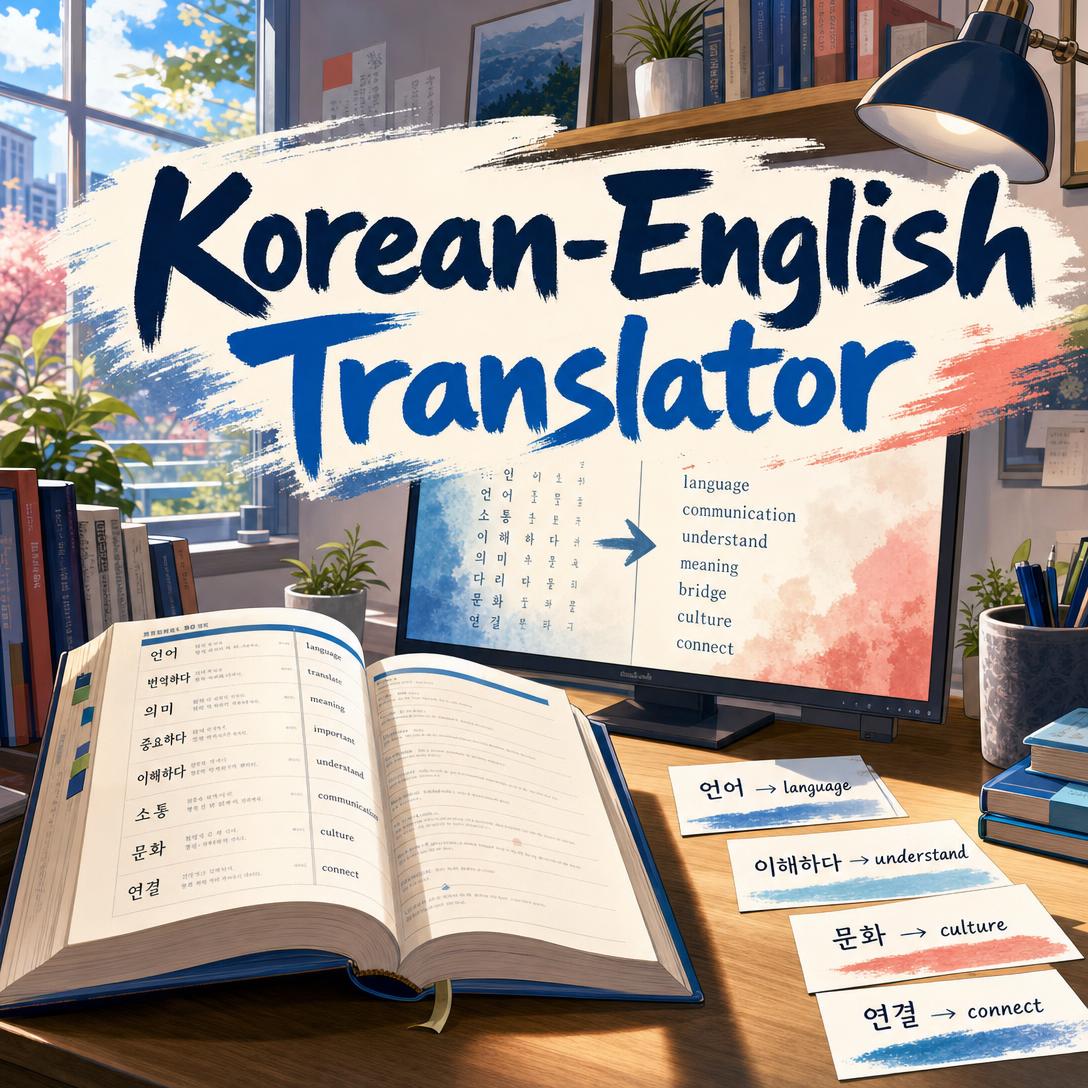
How Do AI Korean-English Translators Compare on Honorifics, Idioms, and Back-Translation?
For text-only Korean–English work that depends on honorifics, idiom meaning, and a second-pass check, Jenova's Korean-English Translator is built around those three jobs, while Naver Papago is better suited to camera and voice on the ground in Korea, DeepL to document-centric neural machine translation, and Google Translate to wide language coverage. Korean–English is not a generic pair: speech levels, omitted subjects, and meaning-first idiom mapping decide whether a translation is usable or socially off.
Korean is spoken by about 81 million people. In 2025, Korean rose to sixth among languages studied on Duolingo globally, moving past Italian. U.S. learners of Korean on that platform increased by more than 20% in 2025. Demand for accurate Korean–English AI translation in 2026 is no longer a niche traveler problem.
Key factors that separate usable Korean–English AI translation from generic chatbot output:
✅ Honorific fidelity — matching 해요체, 합쇼체, and 반말 to the situation rather than defaulting to stiff formal endings ✅ Idiomatic equivalence — rendering fixed expressions by meaning, not word-for-word calques ✅ Verification — a back-translation that can expose fluent but wrong output ✅ Register control — chat Korean versus legal, academic, or business Korean ✅ Input fit — pasted text versus camera, voice, conversation, or offline use
To compare these tools usefully, it helps to score them on those dimensions rather than on how many languages they advertise.
Why Is Korean-English Translation Harder Than Most Language Pairs in 2026?
Korean–English translation is harder than most major pairs because the two languages disagree on what must be said: English usually requires subjects and pronouns, while Korean routinely drops them and encodes social relationship in the verb ending instead. A sentence that is grammatically perfect in English can still be the wrong Korean if the speech level is off.
That structural gap shows up in daily use. English “I need to reschedule the meeting” does not need an explicit “I” in natural Korean. Inserting 나는 or 저는 to mirror English syntax is a common machine-translation tell. Korean also distinguishes polite informal 해요체 (-요), formal 합쇼체 (-습니다/-ㅂ니다), and intimate 반말. Choosing the wrong level is not a style nit; it can sound cold, overly stiff, or inappropriately casual.
Interest in the language is rising at the same time. The Korean language-learning market exceeded USD 7.2 billion in 2024 and is projected to grow at a 25.1% CAGR from 2025 to 2034. Hallyu, study abroad, K-content, and Korea-facing business all increase the volume of messages, captions, contracts, and customer emails that have to move between Hangul and English.
Professional translators have long treated this pair as context-heavy work. The American Translators Association notes that neural machine translation predicts likely output from training data, so quality collapses when the phrase is uncommon or the required subject, tone, or speech act is underspecified. Korean makes that underspecification the default.
The practical result in 2026 is a split market. Camera and conversation apps help travelers decode menus and subway signs. Text-specialized agents help people send KakaoTalk messages, rewrite emails, and check whether an English rendering still means what the Korean said. Those are different jobs, and no single product leads on both.
What Should You Look for in an AI Korean-English Translator?
You should evaluate a Korean–English translator on a six-dimension scorecard: honorific fidelity, idiomatic equivalence, register control, verification transparency, modality coverage, and cost. Language count is a weak proxy for Korean quality and often hides the failures that matter most.
This article uses that Korean MT Scorecard as the comparison frame:
- Honorific fidelity. Does the engine default to natural 해요체 for everyday speech, shift to 합쇼체 for official or professional content, and preserve 반말 when the source is intimate? A Korean-focused review of Papago notes that it is often preferred for Korean language nuances over general-purpose engines.
- Idiomatic equivalence. Fixed expressions should land on a natural equivalent, not a literal stack of words. “Break a leg” is not a useful Korean anatomy lesson.
- Register control. Legal, academic, and technical Korean should not read like a text message, and a casual check-in should not read like a government notice.
- Verification transparency. A second rendering back into the source language is one of the few user-facing checks that can catch meaning drift without a human editor.
- Modality coverage. Text paste, image/OCR, voice, live conversation, handwriting, website, document, and offline each serve different settings. Papago’s consumer app lists text, image, voice, offline, conversation, handwriting, website, and document translation across 14 languages.
- Cost. Free consumer tiers, usage-capped AI agents, and API pricing produce very different economics for a student versus a localization team.
A professional ATA tester who compared free apps concluded that accuracy “depends on the context” and that more surrounding text usually improves results. That finding is especially relevant for Korean, where the verb ending and omitted arguments only make sense in situation.
Two criteria that look impressive on feature pages are easy to overweight. Supporting 249 languages, as Google Translate does in that comparison, does not guarantee better 해요체. Offline camera translation is essential in a Seoul subway car and irrelevant if you are polishing an English abstract of a Korean paper.
How Do Papago, Google Translate, DeepL, and Jenova Compare for Korean-English Work?
Papago is the strongest on-device Korean companion, Google Translate is the broadest multilingual fallback, DeepL is the document-oriented NMT option, and Jenova’s Korean-English Translator is the text specialist with speech-level defaults and a built-in back-translation. Each one is limited in a way that matters for some users.
As of 2026, a reference-grade comparison looks like this:
| Feature / Dimension | Naver Papago | Jenova Korean-English Translator | DeepL | Google Translate |
|---|---|---|---|---|
| Honorific / speech-level control | Honorific option in the app; users report it has drifted toward 요 endings rather than consistent 니다 formality | Defaults to 해요체; shifts to 합쇼체 for legal, academic, technical, or professional content; preserves 반말 when the source uses it | No Korean-specific speech-level controls comparable to a dedicated honorific mode | No dedicated Korean honorific controls; output can sound generic |
| Idioms and natural phrasing | Often stronger on Korean nuance than general engines | Meaning-first idiom mapping; drops pronouns when Korean context already makes them clear | Strong NMT fluency, especially on longer formal text | Variable; weaker on Korean-specific nuance in several comparisons |
| Verification | Dictionary view beside translations; no mandatory back-translation | Every output includes an independent back-translation separated from the primary rendering | Alternative phrasings in some interfaces; no forced reverse check | No standard back-translation step |
| Camera / voice / offline | Image, voice, conversation, handwriting, and offline text | Text only; no camera, voice, or offline mode | Document and text focus; voice products exist separately | Camera, voice, and offline available |
| Language coverage | 14 languages, Korean-centered | Korean ↔ English only | 35 languages in the ATA comparison | 249 languages in the same comparison |
| Pricing (as of 2026) | Consumer app entirely free; Naver also sells a commercial Papago NMT API | Free tier with limited usage; Plus starts at $20/month for 30× usage | Individual Pro from $8.74/month billed annually | Free consumer app; Cloud Translation is a separate paid API |
| Best for | Travel, menus, signs, live conversation in Korea | Chat, email, and professional text that needs honorific control plus a meaning check | Document workflows and teams already in the DeepL stack | Quick gist translation across many languages, including Korean |
Naver Papago
Papago is Naver’s Korean-first neural translator, named from the Esperanto word for parrot. Independent explainers argue that it outperforms Google Translate on Korean, Japanese, and Chinese because it uses hybrid neural machine translation tuned for those pairs.
Its practical strengths are modalities Jenova does not attempt: snap a menu, speak a taxi instruction, or run conversation mode so both people talk in their own language. The consumer app is free, which makes it the default download for many visitors.
Limitations are real. Coverage stops at 14 languages. App reviews on the App Store listing describe awkward sentence structure for learners and an honorific toggle that no longer reliably produces -니다 endings. Papago also does not keep long-running project memory the way a persistent chat agent can.
Google Translate
Google Translate remains the widest net. In the ATA four-app test it offered far more languages than DeepL and included offline and voice-to-text features. For travelers who bounce between Korean, Japanese, and a third language in one afternoon, that breadth is the product.
On Korean specifically, several side-by-side writeups still give Papago the nuance edge. Google is often “good enough” for signs and gist reading, then uneven on speech level, omitted subjects, and colloquial chat. It is a general engine asked to do a pair that punishes generality.
It is also not a verification workflow. You can paste the output back in yourself, but the product does not force that check, so fluent mistakes are easy to send.
DeepL
DeepL markets itself as a high-accuracy translator for text and documents, with Individual Pro starting at $8.74 per month when billed annually. Teams that already live in Word, PowerPoint, and CAT-adjacent workflows often prefer it for that reason.
Korean is part of DeepL’s set, but it is not the pair DeepL is most famous for. A Human Science evaluation compared DeepL’s Korean accuracy with Google and Microsoft, and an MT Summit paper examined DeepL Korean–English legal MT quality and post-editing productivity versus human translation. Those studies treat Korean legal and technical text as a serious test, not a solved problem.
DeepL’s limitation for this article’s use case is specialization. It is not a Korean honorific controller, it is not a travel camera, and its language list is much smaller than Google’s. For European document pairs it is frequently the quality pick; for KakaoTalk tone, it is not purpose-built.
Jenova Korean-English Translator
Jenova’s agent is a bidirectional Korean–English specialist: it detects the source language, translates, and always returns a second block that translates the first result back as an independent check. Everyday input lands in 해요체. Clearly legal, academic, technical, or professional content moves to 합쇼체. Idioms are rendered by meaning. Numbers, symbols, and emojis pass through. Foreign names in Korean output use standard Hangul transcription.
Examining that design shows a deliberate trade: it refuses commentary, romanization, labels, and follow-up questions so the only thing on screen is the translation pair. That is efficient for people who already know what they want to say. It is a poor fit if you needed a dictionary, a pronunciation guide, or a clarification about whether 일 meant “work,” “day,” or “one.”
It also has no camera, voice, conversation, or offline mode. For a restaurant table or a rural bus, Papago or Google Translate is the more complete tool. On Jenova, usage is limited on the free tier; paid plans start at $20/month. Readers who are actually studying the language, rather than shipping a sentence, get more from Learn Korean Through Roleplay than from a silent translator.
Microsoft Translator is a fifth option for developers more than for chat users. Comparisons of MT APIs in 2026 still cite a 2 million character monthly free tier and about $10 per million characters, which can undercut DeepL on raw throughput. It does not solve honorific design on its own.
How Does Korean Speech-Level Control Change Translation Quality?
Speech-level control changes Korean translation quality more than vocabulary choice because the ending encodes the relationship between speaker and listener. A correct gloss with the wrong ending is still a social error.
Most English speakers do not have an equivalent system, so generic engines optimize for “polite.” In Korean, that often becomes blanket 합쇼체. The result sounds like a news broadcast inside a group chat. The opposite failure is also common: intimate 반말 leaked into a message for a professor, a client, or an older stranger.
A specialized Korean–English agent can encode a simple policy that matches how people actually write:
- Default to 해요체 for ordinary requests, travel questions, and conversational English.
- Move to 합쇼체 when the source is clearly a report, contract clause, academic abstract, or official notice.
- Keep 반말 when the source already uses it, instead of “correcting” intimacy into politeness.
- Avoid stuffing 나는, 저는, or 당신은 into sentences where Korean would drop the pronoun.
Papago exposes an honorific option in the consumer app, which is the right idea. User reports on the Naver Papago App Store page say that control has become less consistent, with more 요 endings where speakers wanted 니다. That gap is why speech level belongs on the scorecard as its own dimension, not as a footnote under “accuracy.”
For business or ceremonial settings, translation is only half the problem. How you greet, who speaks first, and how directly you refuse can matter as much as the sentence. An Etiquette Coach is the better follow-on when the question is conduct rather than wording.
Why Does Back-Translation Improve Korean-English Accuracy?
Back-translation improves Korean–English accuracy because it is a cheap way to catch the most dangerous MT error: a fluent target sentence that no longer means what the source meant. It is not proof of correctness. It is a drift detector.
The workflow is simple. Translate English to Korean, then translate that Korean back to English without looking at the original. If the return trip says something different, the first pass is untrustworthy even if it reads smoothly. The same loop works in the opposite direction.
This matters more for Korean than for many European pairs. Omitted subjects, context-dependent verbs, and speech levels can all survive into a polished English sentence that answers the wrong question. ATA’s app test found that even common restaurant Spanish can be misread without situation, and that feeding more context improved results. Korean withholds even more grammatical information, so the reverse pass is doing extra work.
Jenova makes that loop mandatory: primary translation, then an independent back-translation, with no labels and no commentary. You compare the two blocks yourself. Papago and Google Translate can approximate the method if you paste output back in, but most people do not. DeepL’s alternative phrasings help stylistically; they do not automatically test meaning preservation.
The limitation is correlated error. If both directions share the same misunderstanding of a homograph or a name, the back-translation can agree with itself and still be wrong. Legal, medical, and immigration text still needs a human translator. Researchers studying DeepL on Korean–English legal material treat post-editing, not raw MT, as the professional workflow.
How Do You Get Better Results From an AI Korean-English Translator?
You get better Korean–English results by giving the model a complete situation, choosing the tool that matches the input type, and reading the reverse pass before you send anything. Short, decontextualized fragments are the main way these systems fail.
For Jenova’s Korean-English Translator, the loop is:
- Open the agent at jenova.ai/a/korean-english-translator.
- Paste the full message, not a stripped keyword. Include whether it is a chat, an email, or a report if that is visible in the wording.
- Read both blocks. If the back-translation changes the request, the promise, the date, or the politeness level, rewrite the source and run it again.
- Do not wrap the text in instructions such as “translate this politely.” This agent treats all input as source text, including commands and greetings.
Everyday English tends to come back in 해요체:
I need to reschedule the meeting
A formal report should already look like a report in the source, which is what pushes the Korean into 합쇼체:
The quarterly report shows a 15% increase in revenue
For Papago, pick the modality first. Type for messages. Use image translation for a chalkboard or packaged food. Use conversation mode for a pharmacy counter. Keep the honorific setting in mind if you are addressing someone older or in a service role, and do not assume it still yields -니다 endings.
For Google Translate and DeepL, paste more than one sentence when you can. ATA’s poetry test is an extreme case, but the same rule applies to Korean email threads: isolated lines hide the subject and the relationship.
Travelers who need restaurants, trains, and neighborhood context — not just a sentence — should pair any translator with a Travel Planning Advisor. A translation app decodes the sign. It does not tell you whether that bus actually goes where you think.
What Do Translation Experts Say About AI Korean-English Tools?
Translation specialists treat Korean–English AI as a high-context pair where neural fluency can hide social and semantic errors, so they recommend engines that expose register and let users check meaning rather than engines that only maximize language count.
"Korean punishes generic machine translation in a way French or Spanish often does not. The verb ending is doing social work that English puts into names, titles, and extra words. If your tool cannot tell 해요체 from 합쇼체, it will keep producing Korean that looks careful to an English speaker and feels wrong to a Korean reader. We see that failure more often than outright vocabulary mistakes."
"Back-translation is the cheapest quality gate we can give a non-linguist. It will not catch every homograph, and it can agree with itself when both directions share a bias. What it does catch is the fluent miss — the email that now confirms Thursday, or the apology that became a complaint. For chat and office text, that check is more useful than a twelfth language in the menu."
"Camera and voice still belong to Korean-first apps like Papago. A text agent that refuses to chat is the right design for people who already know what they want to say and need the sentence to survive contact with another language. It is the wrong design for a learner who needed a dictionary sense of 일. Matching the tool to the job is the actual expertise here, not declaring a universal winner."
— Jenova Product Team, AI agent design, 8 years building domain-specific language agents
That view lines up with the ATA conclusion that apps are useful for getting by and for gist, while style, tone, and audience still require human judgment. It also lines up with Korean-specific comparisons that give Papago an edge on nuance without claiming it replaced professional translators.
When Is a Specialized Korean Translator Better Than a Multilingual App?
A specialized Korean–English translator is better when the text is the product — a message, caption, abstract, support reply, or email — and a multilingual app is better when the world is the input, as with signs, speech, and photos. The wrong category wastes time even if the engine is strong.
Use a Korean-specialized text agent when:
- You already typed the sentence and need it to sound like chat Korean or business Korean, not like translated English.
- You need a reverse pass before you hit send to a colleague, client, or in-law.
- The pair is only Korean and English, so extra languages add interface noise rather than accuracy.
- You will return to the same thread and want the conversation history to remain available.
Use Papago, Google Translate, or a similar multimodal app when:
- You are standing in front of Hangul you cannot type.
- You need two-way spoken conversation.
- You may lose data service and still need offline text.
- You are moving among Korean and other languages in the same hour.
DeepL sits between those poles for people whose “world” is a stack of documents. Its Pro tier is priced for that habit, and API cost roundups in 2026 still place DeepL higher per character than Microsoft’s roughly $10 per million public translation API. If your bottleneck is file volume rather than 해요체, that is the rational pick.
The contrarian point is that “best translator” is usually a category error. Papago can win the restaurant and still lose the apology text. Google can win the mixed-language trip and still leak the wrong speech level into a KakaoTalk message. Jenova can produce a clean two-block rendering and still be useless when the input is a photo of a street sign.
Choose the scorecard dimension that matches the next sentence you have to send. For Korean and English in 2026, that dimension is usually honorifics, idiom meaning, or verification — unless you are holding a camera.
References
- Wikipedia — Korean language speaker population
- Duolingo — 2025 Duolingo Language Report, Korean global ranking
- American Council of Trustees and Alumni — U.S. Duolingo Korean learner growth in 2025
- Global Market Insights — Korean language learning market size and 2025–2034 outlook
- American Translators Association — comparison of Google Translate, DeepL, and other translation apps
- Talkpal — Papago versus Google Translate for Korean nuance
- Apple App Store — Naver Papago AI Translator features and language list
- Linguise — Papago hybrid NMT performance on Korean, Japanese, and Chinese
- MachineTranslation.com — Papago consumer app pricing and commercial API
- DeepL Pro — individual and team translation plan pricing
- Human Science — DeepL Korean translation accuracy versus Google and Microsoft
- ACL Anthology / MT Summit — DeepL Korean–English legal MT quality and post-editing
- Taia — DeepL versus Google Translate versus Microsoft Translator pricing
- SimpleLocalize — AI machine translation API cost comparison