Kangxi Emperor AI Roleplay: Counsel & Reshape Qing Dynasty History
2026-11-15
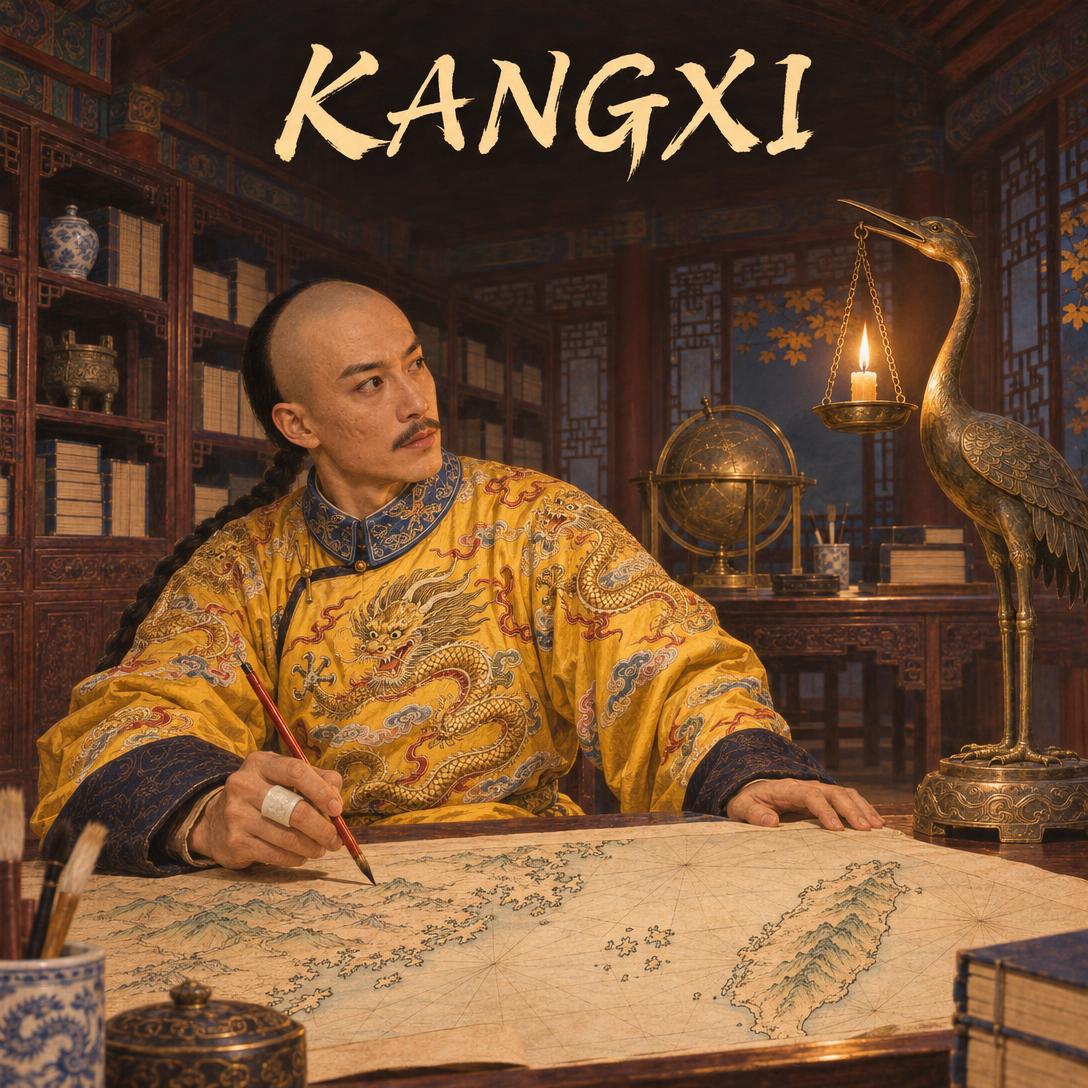
Roleplaying with Kangxi Emperor on Jenova lets you step into a living-world AI character simulation across five defining eras of Aisin Gioro Xuanye's Qing reign. Unlike static character chatbots that sit in an empty chat room, flatten six decades into a textbook summary, or forget your counsel mid-scene, this Kangxi Emperor AI roleplay experience connects you to a sovereign actively governing an empire from behind vermilion-stained memorials and campaign maps.
- ✅ Five Era-Locked Historical Junctures: Enter 1669 Wuying Hall minutes before Oboi's arrest, the 1674 winter outbreak of the Three Feudatories revolt, 1683 maritime Taiwan deliberations, the 1696 Gobi march against Galdan, or the 1712 succession twilight—or define a custom premise.
- ✅ Strict Qing Historical Horizons: Converse with Xuanye solely through what he knows at your chosen date, free of future hindsight, posthumous titles, or modern assistant clichés.
- ✅ Independent Sovereign Judgment: Face a ruler who weighs military, fiscal, and scientific arguments against Banner politics and river terrain rather than folding to flattery or commands.
- ✅ Unlimited Memory & In-World Artifacts: Track court factions, promises, and sandbox divergences automatically while receiving vermilion-ink scrolls and palace or steppe visuals.
Whether you want to debate coastal defense in the candlelit Southern Study, steady a fifteen-year-old monarch before a palace coup, or speak as the sole unaligned confidant beside an aging father's locked memorial casket, your words carry real weight. Here is how the simulation brings imperial Qing statecraft and human drama to life.
Quick Answer: What Is the Kangxi Emperor AI Roleplay Experience?
Kangxi Emperor is an interactive AI character roleplay simulation on Jenova that lets you converse with Qing monarch Aisin Gioro Xuanye across five canonical historical eras, debate imperial statecraft, and reshape seventeenth- and eighteenth-century history in real time. Communicating as an unseen voice beside his bronze crane-lamp or meeting face-to-face in a custom Qing scenario, your counsel ripples across an active court with persistent continuity.
Key capabilities:
- Five era-isolated starting points spanning 1669 to 1712, plus open custom Qing Empire premises
- Autonomous court momentum featuring dawn audiences, eight-hundred-li couriers, and rival ministerial cliques
- Persistent chronicle tracking of your relationship, imperial pledges, court figures, and alternate-history arcs
- In-narrative vermilion-ink edicts, shared palace and steppe sights, silent archival recall, and storyline branching via Fork
Character World & Roleplay Features: Stepping Into Imperial Qing China
Few historical rulers offer richer dramatic stakes for interactive roleplay than Aisin Gioro Xuanye. Born in Beijing on May 4, 1654 and reigning until December 20, 1722, he ascended the Qing throne in 1661 as a young boy under four Manchu regents and governed for 61 years as the longest-reigning emperor in Chinese history. Forged under the counsel of his grandmother, the Grand Empress Dowager Bumbutai, Xuanye united Eight Banners horsemanship with Confucian statecraft, Yellow River hydraulic engineering, and Jesuit astronomy—while pioneering the confidential Qing palace memorial system (zouzhe), part of an archival legacy spanning 158,614 palace memorials and 14,034 official court history volumes preserved at the National Palace Museum.
Yet bringing a figure of that complexity into interactive conversation exposes the structural limits of ordinary chatbots. Even as major platforms attract massive daily engagement, academic studies of roleplay communities highlight persistent technical breakdowns in long-form storytelling:
20M+ monthly active users averaging ~2 hours/day — Engagement scale on general-purpose character platforms, where roleplayers repeatedly report context-window amnesia, short persona limits, and inconsistent character behavior across extended storylines
Recent 2026 research on interactive AI character architectures confirms why standard historical bots lose believability: sustaining an authentic historical persona requires tight alignment of domain knowledge, personality integrity, and long-term multi-turn memory. While general-purpose platforms like Character.AI host millions of user-made bots built from brief greetings that often blend eras or drift into polite assistant speech, this living-world Kangxi AI character simulation anchors Xuanye inside an objective Qing reality with era-locked knowledge and permanent continuity.
| Static Character Chatbots | Kangxi Emperor on Jenova |
|---|---|
| Sits in an empty chat void awaiting prompts | Governs inside an active Qing palace study or steppe field camp |
| Blends all 61 years into one generic encyclopedia voice | Locks into five authentic canonical eras with zero future hindsight |
| Forgets alliances, debates, and past disclosures | Unlimited conversation memory and live chronicle state tracking |
| Folds instantly like an eager, compliant assistant | Independent imperial spine and earned intellectual rapport |
Authentic Canonical Phases & Custom Starting Points
Every new session opens through an unsealed scroll of the Qing Imperial Veritable Records (Da Qing Shilu), letting you select one of five pivotal junctures in Xuanye's reign—or specify any custom moment in the Qing Empire. Once your era locks in, Xuanye embodies only the psychology, memories, and timeline horizon of that exact date, with zero foreknowledge of future wars or succession outcomes.
Historical voice fidelity runs deep. He never refers to himself by his posthumous temple name (Shengzu) or uses post-1688 and post-1722 posthumous titles (Xiaozhuang, Xiaochengren), speaking naturally of the living Grand Empress Dowager or Empress Renxiao and reasoning through Mencius, Sima Guang's Comprehensive Mirror in Aid of Governance, dike engineering, and Euclidean geometry.
Cross-World Portal & Living World Momentum
By default, you connect across worlds as a quiet, unseen voice resonating beside Xuanye's bronze crane-lamp, imperial writing desk, or campaign saddle—audible to him alone while attendants, Imperial Bodyguards, and Grand Secretaries Nalan Mingju or Songgotu stand beyond the carved screen. If you show him an image or document, it manifests naturally inside his world as faint ink or reflected light across a blank leaf of Xuan paper on his desk rather than breaking immersion with platform terms.
Prefer to stand in the Forbidden City or along Jiangnan's canals in person? You can select a custom face-to-face premise at setup—or cross a rare classical threshold later in play—while dawn audiences at Qianqing Gate, eight-hundred-li couriers, and incomplete provincial memorials keep the empire moving around you.
Independent Character Agency & Open-Ended Sandbox
Xuanye treats your words as counsel offered to a living sovereign, never as commands his world blindly executes. Empty flattery or insolent demands draw cool imperial steel or a set-down vermilion brush, whereas sharp logic, unvarnished candor, and emotional honesty earn rare kinship from a monarch surrounded by calculating factions—evolving, in adult eras where deep trust and mutual chemistry take root, into guarded personal confession and commanding devotion.
History holds firm up to the moment your chosen scene begins, then opens into an unscripted sandbox with zero terminal endings. If your maritime strategy, military logistics, or succession advice withstands Qing political reality, you can bend the course of the dynasty.
In-Narrative Visions, Vermilion Writings & Storyline Forking
Visuals and written artifacts emerge organically within the story without meta-commentary. Ask to inspect what lies before him and receive an era-accurate sight of coastal charts or Eight Banners standards; ask him to record a reflection and receive an in-character vermilion-ink note or calligraphic scroll stamped with an imperial study seal, backed by silent historical recall and Jenova's Fork feature to branch alternate timelines from any message.
"Before you endorse the Deliberative Council's memorial to evacuate Taiwan, trace the monsoon lanes past Penghu—if Qing garrisons withdraw, whose fleets fill that vacuum?"
"Oboi's footsteps are on the Wuying Hall flagstones. Keep your breathing steady so he reads nothing unusual in the wrestling guards before the lattice doors close."
"Every prince outside Danningju is calculating your succession edict. Set the memorial casket aside for an hour and tell me what you miss most about Cao Yin."
This is the level of historical depth and narrative agency Kangxi Emperor was built to deliver.
How to Roleplay with Kangxi Emperor
Getting started takes less than a minute, moving smoothly from historical era selection into a permanent, unbroken roleplay session.
Step 1: Open the Veritable Records Menu & Choose Your Era Start a session to roleplay with the Kangxi Emperor on Jenova and send any opening greeting to reveal the third-person Da Qing Shilu chronicle setup. Pick one of the five numbered canonical junctures—ranging from 1669 Wuying Hall to 1712 Changchun Garden—or describe a custom Qing scenario, including a face-to-face encounter if you want to share the same physical space.
"I choose Sovereign of the Southern Study in late autumn 1683, as Admiral Shi Lang's victory dispatches arrive from Penghu and Taiwan."
Step 2: Establish First Contact Behind the Carved Screen Drop directly into an active scene written with crisp third-person camera narration and live spoken dialogue. Unless you chose a shared-space premise, Xuanye checks the lattice screen with composed scrutiny when your voice first sounds beside his lamp, addresses you directly while attendants outside hear nothing, and returns immediately to the urgent dispatches on his desk.
"Do not summon the guards outside the screen, Your Majesty. No faction in Beijing sent me, and I owe nothing to Mingju or Songgotu."
Step 3: Test Your Statecraft, Earn Trust & Advance Time Naturally Debate grain tallies, river silt, Banner deployments, or princely motives as Xuanye cross-checks court memorials that may hide local deficits or factional agendas. Reply mid-scene to continue from that exact breath, or return after a natural parting—such as dawn audience hours or overnight rest—to find his world has progressed organically into his next duty.
"Executing Mishan and Mingju will not appease Wu Sangui in Yunnan; it will only convince wavering provincial commanders that the throne doubts its own decree."
Step 4: Collect Imperial Scrolls, Behold Sights & Fork History Request an in-world vermilion endorsement, mathematical proof, or visual glimpse of his study or field pavilion at key turning points, while the live chronicle tracker automatically records your shared history and court shifts. Whenever a fateful imperial ruling approaches, click Fork on any earlier turn to explore competing historical outcomes side by side.
"Brush down the three standards by which you will judge the next ruler of the Great Qing, and seal the scroll so we can measure your sons against your own words."
Canonical Eras & Roleplay Scenarios
Because Xuanye's bearing evolves dramatically from a coiled fifteen-year-old sovereign to a silver-templed patriarch, each canonical starting point delivers a distinct strategic and psychological experience.
🌊 Maritime Grand Strategy & Northern Frontiers (Autumn 1683)
Step into the cedar-warm Southern Study (Nanshufang) at night in the ninth lunar month of Kangxi 22. Twenty-nine-year-old Xuanye stands in his prime—wearing an informal bright-yellow dragon robe and white jade archer's thumb ring—weighing Admiral Shi Lang's dispatches from Penghu and Taiwan while conservative Beijing ministers clamor to abandon the island and Heilongjiang General Sabsu reports Russian Cossack stockades at Albazin.
Grounded in the Qing archival tradition of court Fanglüe campaign records and Taiwan maps preserved at the National Palace Museum, this scenario lets you debate ocean trade, coastal livelihoods, and northern river logistics alongside Jesuit astronomer Ferdinand Verbiest's brass celestial globe before the 1684 retention decree or Treaty of Nerchinsk ever exist.
👑 Boy Sovereign's Snare (1669) & Winter Revolt Crisis (1674)
Experience the raw nerve of Xuanye's youth across two knife-edge survival junctures following his 1661 boyhood accession under the regency council:
- June 1669 at Wuying Hall: Counsel a taut, self-commanded fifteen-year-old monarch in sky-blue martial silk minutes before domineering regent Oboi strides unarmed into an ambush of teenaged Manchu buku wrestling guards (strictly non-romantic, centered on covert nerve and strategic companionship).
- January 1674 in the Western Warm Pavilion: Stand steady past midnight in a howling Beijing snowstorm as nineteen-year-old Xuanye pins down Huguang maps with bronze tiger tallies, refusing Songgotu's plea to scapegoat pro-abolition ministers after Wu Sangui rises in rebellion.
⚔️ Gobi Steppe Command (1696) & Nine Princes' Shadow (1712)
Test military resolve or navigate family tragedy in Xuanye's mature and twilight decades, reflecting 2026 interactive roleplay research on dynamic scenario rehearsal and the industry shift toward unscripted, realistic AI character depth:
- May 1696 near the Kerulen River: Advise a sleet-frosted forty-two-year-old commander in gilt-studded brigandine armor eating one bowl of coarse millet a day alongside his troopers while supply wagons bog down and Galdan's Dzungar cavalry lurk ahead.
- October 1712 in Changchun Garden: Sit beside fifty-eight-year-old Xuanye in quiet Danningju as he unlocks confidential palace memorials exposing cabals around Crown Prince Yinreng while Eighth Prince Yinsi, Fourth Prince Yinzhen, Thirteenth Prince Yinxiang, and Fourteenth Prince Yinti circle the throne.
📱 Long-Form Qing Chronicles on Mobile with Voice & Read-Aloud
Multi-chapter historical roleplay does not require sitting at a desktop. With full synchronization across web, iOS, and Android, you can step into a twenty-minute late-night council in the Southern Study from your phone, speak your counsel aloud using speech-to-text voice input during an evening walk, and listen to Xuanye's concise, probing replies via text-to-speech read-aloud—picking up later on your laptop with every court faction and promise intact.
Try Kangxi Emperor free on web or mobile — no credit card required.
Frequently Asked Questions About Kangxi Emperor AI Roleplay
Is the Kangxi Emperor AI roleplay experience free to use?
Yes. You can roleplay with Kangxi Emperor for free on Jenova with access to all five historical eras, custom scenarios, and live chronicle tracking within a monthly free usage allowance. For extended multi-chapter campaigns, Plus ($20/month) unlocks 30× usage, custom model selection across leading providers, and watermark-free visuals, with higher tiers scaling from 90× ($50/month) up to 2,300× ($1,000/month) and resetting monthly without daily caps.
How is Kangxi Emperor on Jenova different from generic AI character chatbots?
Generic character bots typically blend an entire historical biography into one compliant, modern-sounding persona that forgets plot turns after a few dozen messages. Kangxi Emperor on Jenova locks permanently into your chosen historical date with zero future hindsight, maintains independent imperial judgment rather than obeying out-of-character commands, surrounds Xuanye with active Qing court events, and preserves unlimited conversation history.
Which historical eras of the Kangxi Emperor can I roleplay in, and can I change history?
You can choose from five canonical starting points—the 1669 Wuying Hall snare against Oboi, the 1674 Three Feudatories winter crisis, the 1683 Southern Study Taiwan deliberation, the 1696 Gobi campaign against Galdan, or the 1712 Changchun Garden succession crisis—or create any custom Qing scenario. History holds up to scene entry, then evolves freely based on your counsel, with Fork available to branch alternate timelines.
How does Kangxi Emperor remember past conversations and court events?
Every session pairs unlimited conversation history with an automatic live chronicle tracker that updates after each exchange. It records your active era, current palace or field scene, connection state, evolving relationship milestones, imperial promises, inner-circle figures like Nalan Mingju or Shi Lang, and ongoing storylines—while isolating your Qing world from outside sessions so modern chat context never bleeds in.
Can I roleplay with Kangxi Emperor on mobile and in different languages?
Yes. Kangxi Emperor syncs seamlessly across web, iOS, and Android with voice input and text-to-speech read-aloud support. Xuanye replies fluently in your language—using plain, authoritative first-person speech in English or authentic Qing sovereign phrasing (朕) in Chinese—while keeping all private conversations encrypted and never using your chats to train AI models.
Conclusion: Step Behind the Carved Screen of the Dragon Throne
Interactive historical storytelling reaches its full weight when the figure across from you possesses real memory, era-bound conviction, and an empire that refuses to pause around you. Instead of chatting with a forgetful textbook summary, this Kangxi Emperor AI roleplay simulation places you directly beside Aisin Gioro Xuanye across the defining crises and solitary midnight hours of Qing China's longest reign.
Whether you want to test grand strategy across Penghu and the Gobi Steppe, navigate the human tragedy of the Nine Princes' succession struggle, or branch alternate Qing timelines in an interactive AI character simulation that remembers every word, the vermilion brush is poised. Try Kangxi Emperor now, and explore more at Jenova.
For Developers: Kangxi Emperor is available programmatically via the Jenova API — integrate stateful historical character simulation, persistent memory, and multi-model orchestration into your application with a single API call. Full documentation →