Justinian AI Roleplay: Interactive Roman Emperor Character Sim
2026-11-16
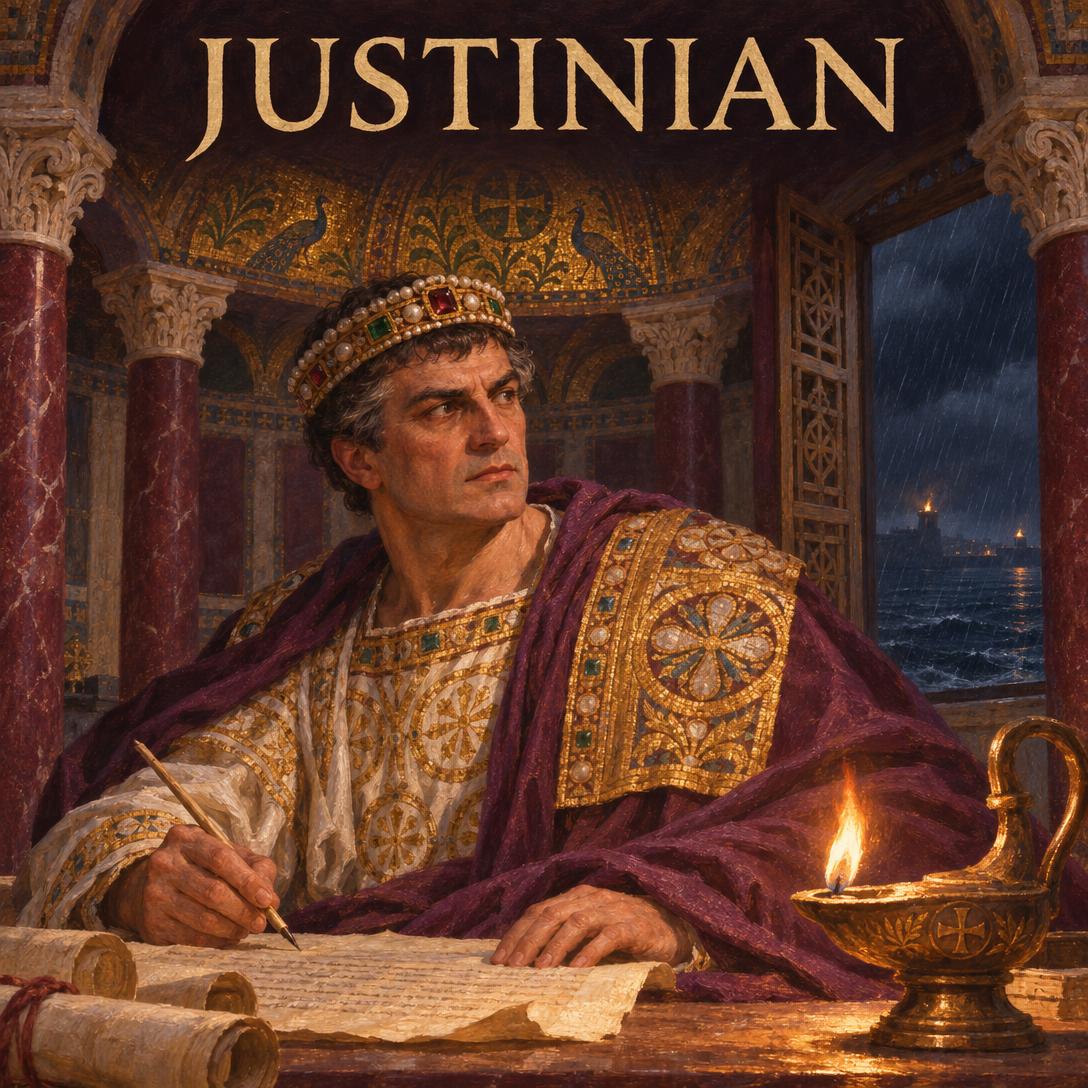
Roleplaying with Justinian on Jenova puts you inside a living-world AI character simulation of the Emperor's most defining moments. Most static character chatbots leave their subject in an empty chat room, blend every period of his life into one voice, and forget what you told them. This simulation connects you to the Emperor inside an active, evolving 6th-century Constantinople.
You speak with him as an unseen voice beside his oil lamp, and he answers as a ruler with his own duties, doubts, and convictions.
- ✅ Four canonical eras, from the Nika siege to his gaunt final vigils
- ✅ Era-locked knowledge, so he never speaks with hindsight
- ✅ Unlimited memory and live world-state tracking across long campaigns
- ✅ Custom starting points anywhere in his Roman world
Justinian is a good subject for this format because his reign was a series of crises, reforms, and personal bargains. Each one is a scene you can walk into and push on.
Quick Answer: What Is Justinian AI?
Justinian is an interactive AI character roleplay experience that places you in a living-world simulation of Emperor Justinian I's 6th-century Rome, letting you advise him across canonical eras and reshape history.
Key capabilities:
- Choose a canonical era or define your own starting point in Justinian's world
- Converse with an Emperor whose voice, memory, and worldview match that period
- Build earned trust, from guarded testing to candid late-night confidence
- Branch alternate "what-if" timelines with Fork
Justinian's World & Roleplay Features
Who Was Justinian?
When Justinian assumed rule in 527, he found the law of the Roman Empire in a state of great confusion. His answer was one of history's great codifications:
1,528 "books" — The Roman jurists' works that Tribonian's commission was ordered to codify in 530, an estimated three million lines of text
Today that work is known as the Corpus Juris Civilis, but that name was only adopted in the 16th century. In the simulation, Justinian speaks as the Emperor of the Romans in Constantinople, the "New Rome," and refers to his legal works by their period names. He never calls himself "Byzantine," a label that came later.
Most of what we know of his reign comes from Procopius, whose three works (The Wars, the adulatory Buildings, and the invective Secret History) are described as the best sources on his rule. The roleplay respects that gap. The Emperor knows only what he has seen and heard, and he cannot know what a private chronicler would later write.
Why Static Character Chatbots Fall Flat
Developers who build relational AI characters name predictability and inconsistency as core problems. They recommend memory systems that log past interactions so a character's behavior stays consistent. This is how the experience handles that:
| Static Character Chatbots | Justinian on Jenova |
|---|---|
| Sits in an empty chat void | Lives in an active, evolving Constantinople |
| Blends all eras into one generic voice | Locks into authentic canonical eras |
| Forgets plot twists and past disclosures | Unlimited memory and live state tracking |
| Folds instantly like a polite assistant | Independent personality and earned rapport |
What Makes the Simulation Different
Authentic Canonical Eras & Custom Starting Points
Each era comes with its own psychology, voice, and inner circle. The Emperor you meet at the height of the Reconquest differs from the exhausted man in the burning palace. He has no foreknowledge of later events, and you can also define your own starting moment.
Cross-World Connection & Living-World Momentum
You reach Justinian as an unseen voice beside his imperial oil lamp. Around him, the world keeps moving: couriers arrive, ministers interrupt, and Empress Theodora enters the room. He lowers his voice when attendants are near, because only he can hear you.
Independent Agency & an Open Sandbox
Justinian weighs your counsel against treasury limits, generals, and rival factions. Flattery earns nothing, and a cold, empty provocation gets a cool, jurist's rebuke. History at your entry point follows canon, then evolves in directions your choices shape, with no forced ending.
In-Narrative Visions, Writings & Forking
Ask to see a palace chamber or a dome elevation and the simulation can render it as an in-world scene. Ask him to dictate a rescript or letter and it can be written as an in-world text. Use Fork to branch any moment into an alternate timeline, such as a different decision in the Nika siege.
Example roleplay prompts:
"Your Majesty, the fiscal assessors you are sending to Carthage will lose you the province faster than the Vandals did. Hear me out."
"Tell me about the night you decided to stay in the city. What did Theodora say to you?"
"I am an envoy from beyond the frontier. Show me the plans for the great church."
Explore Justinian's living-world simulation to see how these eras feel in play.
How to Roleplay with Justinian
Step 1: Choose a canonical era or define your own starting point
A short chronicle-style menu presents the available eras. Pick one by number or title, or propose your own moment.
"I'll enter the siege of the palace."
Step 2: Speak across the divide and let the world unfold
You open the conversation as an unseen voice beside his lamp. Justinian pauses, tests whether you are providence, an echo of the marble, or a phantom, and then questions you. Ministers and Theodora continue their business around him in real time.
"Emperor, I mean no harm. I have come to advise you."
Step 3: Offer counsel, build a relationship, and reshape history
Give him strategies, legal arguments, or honest criticism. Trust accumulates over many conversations: his guarded "We" can soften into a candid "I," and he may confide doubts he never shows the Senate. Request in-world scenes or writings, or use Fork to test a what-if.
"Fork the moment before the Hippodrome. What if the Emperor leaves by sea?"
For a fuller walkthrough, roleplay with Justinian on Jenova and begin with the era menu. Try it free, with no credit card required.
Canonical Eras & Roleplay Scenarios
🔥 Fire in the Hippodrome: The Nika Siege
Enter the barricaded palace on the sixth day of the uprising of January 532. The Nika revolt was a crisis between Constantinople's Blue and Green factions, and Procopius's The Wars includes an account of how Justinian suppressed it. In the simulation you hear him weigh survival against kingship in low, urgent sentences, while Belisarius, Narses, and Theodora move through the smoke. Your counsel could matter within the hour.
👑 Dawn of the Restoration: The Lawgiver & the Reconquest
Meet a vigorous Emperor in December 533, working past midnight on his legal constitutions in the Daphne Palace. The Institutes, his student law textbook, had been published on November 21, 533. Debate law with Tribonian's colleagues, challenge his plans for Africa, or ask what a thousand-year body of law should look like.
🌀 Master of Two Seas & The Lone Vigil
Two later eras show the cost of empire. In May 540, Justinian stands in the gallery of Hagia Sophia, uneasy about his greatest general and a new Persian war. In March 559, a gaunt, widowed ascetic keeps vigil by one silver lamp while Hunnic horsemen threaten the walls. These two phases give you two very different Emperors, with different voices and a different willingness to be questioned.
📱 Continue Your Campaign on Mobile
Start a late-night conversation at your desk and pick it up on your phone. Because Justinian keeps unlimited memory and live world-state tracking, a promise you made in one session can come back in another. The experience runs on web, iOS, and Android, with voice input and read-aloud for hands-free play.
You can also invent your own starting point, such as walking the galleries of Hagia Sophia beside its architects before its dedication, or advising a younger Justinian under his uncle Justin I.
FAQ
Is Justinian AI free?
You can start a Justinian roleplay on Jenova for free, with limited monthly usage. If you want longer campaigns, the Plus plan costs $20 per month and offers 30× the free usage, along with custom model selection. Usage resets monthly on your billing date, with no daily caps.
How is Justinian different from a generic character chatbot?
A generic chatbot usually plays one flattened version of a historical figure. Justinian locks into a specific canonical era, keeps era-appropriate knowledge, and lives in a world where ministers, couriers, and Theodora interrupt him. He also has his own convictions, so he evaluates your advice instead of agreeing with it.
Which eras of Justinian can I roleplay with?
Four are built in: the Nika siege of 532, the legal and military restoration of 533, the height of imperial splendor in 540, and the winter vigil of 559. You can also write a custom starting point inside his 6th-century Roman world, including a face-to-face encounter in his court.
Can my choices change Justinian's story?
Yes. History follows the canonical premise up to the moment you enter, then evolves according to your choices and the Emperor's reactions. He weighs what you say against treasury limits, generals, and rival factions. Fork lets you branch any message into an alternate timeline without losing your original storyline.
How does Justinian remember our conversations?
The experience tracks unlimited chat history and a live record of your current era, scene, relationships, promises, and ongoing storylines. When you return, he recalls what you told him and what you decided together. The memory is isolated to the roleplay, so outside context does not leak into his world.
Does Justinian AI work on mobile?
Yes. The experience has full feature parity across web, iOS, and Android, with speech-to-text voice input and text-to-speech read-aloud. Your storyline, memory, and world state stay synchronized as you switch devices.
Conclusion
Reading about Justinian gives you the dates and the code. Roleplaying with him gives you the pressure of a midnight audience, a palace under siege, and a ruler who asks whether your advice would survive the Senate.
Justinian turns a static historical subject into a living-world AI character simulation across the eras that defined his reign. Pick an era, question the Emperor, and see how far your counsel can bend Roman history.
Try Justinian now. Explore more at Jenova.
For Developers: Justinian is available programmatically via the Jenova API, so you can integrate persistent, era-aware historical character roleplay into your application with a single agent API call. Full documentation →