AI Journaling Assistant: Turn Daily Reflection Into Real Insight
2026-08-15
An AI journaling assistant helps you write more consistently and understand yourself more clearly by prompting reflection, surfacing patterns across entries, and turning raw thoughts into actionable insight. Blank pages and abandoned notebooks are the norm for most would-be journalers. Jenova replaces that friction with specialized AI agents that remember your history, ask the right questions, and help you act on what you write.
✅ Persistent memory across every session — your agent remembers past entries, goals, and recurring themes ✅ Specialized agents for reflection, writing craft, mindfulness, and emotional processing ✅ Available on web, iOS, and Android with full feature parity and voice input ✅ Data never used to train public AI models — encrypted in transit and at rest
To understand why an AI-assisted approach matters, it helps to look at what actually happens when people try to journal on their own. The research is clear that the practice works — and equally clear that most people struggle to sustain it long enough to see results.

Quick Answer: What Is an AI Journaling Assistant?
An AI journaling assistant is a conversational tool that guides your reflective writing with adaptive prompts, remembers your entries across sessions, and surfaces patterns and insights you would otherwise miss. Unlike a static notes app, it responds to what you write and helps you move from venting to understanding.
Key capabilities:
- Adaptive prompting — generates questions tailored to what you actually wrote, not generic templates
- Cross-session memory — recalls goals, people, and recurring themes from weeks or months ago
- Pattern recognition — identifies emotional trends, avoidance behaviors, and blind spots across entries
- Action orientation — converts reflection into concrete next steps rather than leaving insight on the page
On Jenova, this isn't a single app but a set of specialized agents you combine — a Writing Assistant for craft, a Meditation Guide for contemplative practice, a Relationship Advisor for interpersonal processing — each with its own domain depth and shared memory of you.
The Problem: Journaling Works, But Consistency Doesn't
The evidence supporting reflective writing is substantial. Expressive writing has been studied for decades, and the American Psychological Association reports that writing about stressful events produces measurable improvements in health and psychological well-being. Researchers studying AI-augmented journaling note that journaling has consistently been shown to improve mood, provide stress relief, and enhance mental well-being.
But translating that evidence into a sustained personal practice is where almost everyone breaks down:
- The blank page problem — no idea what to write, so nothing gets written
- Surface-level venting — entries capture emotion but never progress toward understanding
- Zero pattern visibility — 200 entries sitting in a file with no way to see what connects them
- Abandonment within weeks — motivation fades once novelty wears off
- Privacy anxiety — hesitation to write honestly when unsure where the data goes
📝 The Blank Page Kills Momentum
Researchers examining journaling as a research method identified a consistent set of obstacles. A study on journaling methodology found that three main challenges affect journaling: poor participation, feeling exposed, and staying on track. Those same three barriers describe personal journaling almost perfectly.
Poor participation is the entry-level failure. You open the notebook, stare at it, and close it. Without a prompt calibrated to where your head actually is that day, the cognitive cost of starting exceeds the perceived benefit — so you don't start.
🔍 Writing Without Reflecting
Even consistent journalers frequently plateau. Entries become logs — what happened, who annoyed you, what's due tomorrow. The mechanism that makes expressive writing effective involves constructing narrative and meaning, not just recording events.
Academic work on journaling barriers documents attitudinal and situational obstacles that prevent writers from engaging deeply with the practice. Without someone asking "why do you think that bothered you so much?", most entries stay at the surface.
📊 No Way to See Across Time
The real value of journaling compounds over months. But a folder of text files offers no retrieval, no synthesis, no thread-pulling. You cannot notice that every energy crash in your entries follows the same type of meeting, or that the same relationship dynamic has surfaced eleven times since spring.
Digital journaling products have recognized this gap. Market analysis of digital journal apps notes that AI-assisted journaling features such as sentiment analysis and guided prompts are increasing engagement and retention rates by 15 to 20 percentage points. Prompting and pattern-surfacing measurably change whether people keep showing up.
🔒 Privacy Is a Legitimate Concern
Journaling only works if you write honestly, and honesty requires trust. That trust has been repeatedly violated in the wellness app category. The FTC banned BetterHelp from revealing consumers' data and required a $7.8 million payment for deceiving consumers about keeping sensitive personal data private.
The FTC's guidance for developers is explicit: if you develop an app and share consumers' health information with third parties after telling or implying that information will be kept private, you could be violating the FTC Act. Duke University researchers have noted that many wellness apps can legally collect and even sell health data to third parties without a user's knowledge or consent.
Notably, MIT Media Lab's randomized controlled trial of an AI journaling tool found that users with privacy concerns may limit their usage but still seek the flexibility to engage with AI features — privacy hesitancy suppresses the practice rather than eliminating the desire for it.
This is exactly what Jenova was built for.
The Jenova Solution: Specialized Agents Instead of One Generic Journal
Most AI journaling products are a single chatbot wrapped in a notebook UI. Jenova takes a different approach: a gallery of expert agents, each built with deep domain knowledge for a specific kind of reflection, all sharing persistent memory of your history and preferences.
| Traditional Journaling | Jenova AI Agents |
|---|---|
| Blank page, no guidance | Adaptive prompts calibrated to what you wrote |
| Entries forgotten after writing | Persistent memory across every session |
| Surface-level venting | Follow-up questions that push toward meaning |
| No cross-entry pattern visibility | Themes and trends surfaced across months |
| One-size-fits-all approach | Specialized agents for writing, mindfulness, relationships, career |
| Insight stays on the page | Concrete next steps and accountability |
The research on AI-augmented journaling supports this direction. MIT Media Lab's two-week randomized controlled study (N=55) of an AI journaling tool found that using the tool significantly improved mental health outcomes, reducing users' PHQ-8 scores. Critically, the study found that the effectiveness of suggestions was higher when they were personal, novel, and referenced the user's logged memories.
That finding is the entire argument for memory-backed AI journaling. Generic prompts underperform. Prompts that reference your actual history work better.
🧠 Persistent Memory Changes Everything
Jenova agents retain unlimited chat history and persistent cross-session memory. Your agent remembers the project you were stressed about in March, the boundary you decided to set with a colleague, and the writing goal you committed to and quietly dropped.
This is what allows an agent to say something a blank page never can: "You wrote something almost identical six weeks ago. Want to look at what's driving the pattern?"
✍️ Craft and Depth, Not Just Capture
The Writing Assistant adapts to any format, audience, and domain — producing output that sounds like you while offering sharp editorial instincts when you want to collaborate. For journaling, that means help turning fragmented thoughts into coherent narrative, which is precisely the mechanism expressive-writing research points to.
Try prompts like:
"Here's my raw journal entry from today. Help me find the actual thing I'm circling around without saying."
"I want to write a letter I'll never send to my former manager. Help me structure it so it's honest, not just angry."
🧘 Contemplative Practice Alongside Writing
The Meditation Guide is trained across every major contemplative tradition, offering technique matching, structured practice programs, script generation, and troubleshooting — including expert guidance on adverse effects, an area most wellness apps ignore entirely.
Pairing a short sit with a journaling session is a well-established combination. Having both in one platform with shared memory means your meditation guidance reflects what you've been writing about.
"I've been journaling about work anxiety for three weeks. Recommend a meditation technique that matches what I'm dealing with and build me a two-week practice program."
💬 Domain-Specific Reflection
Journaling frequently orbits specific life domains. Jenova offers agents built for those domains rather than forcing everything through one generalist:
- Relationship Advisor — a warm, wise coach for processing romance, family, and friendship dynamics with honest perspective and actionable advice
- Career Advisor — expert frameworks and direct guidance for reflecting on career exploration, transitions, and advancement
- Personal Nutritionist — evidence-based guidance and accountability for anyone tracking food, energy, and habits alongside mood
🔐 Privacy as Architecture
Given the documented track record of the wellness app category, this matters. On Jenova, your data is never used to train public AI models, is encrypted in transit and at rest, and is not sold or shared with advertisers.
Specialized AI Agents for Reflection and Personal Growth
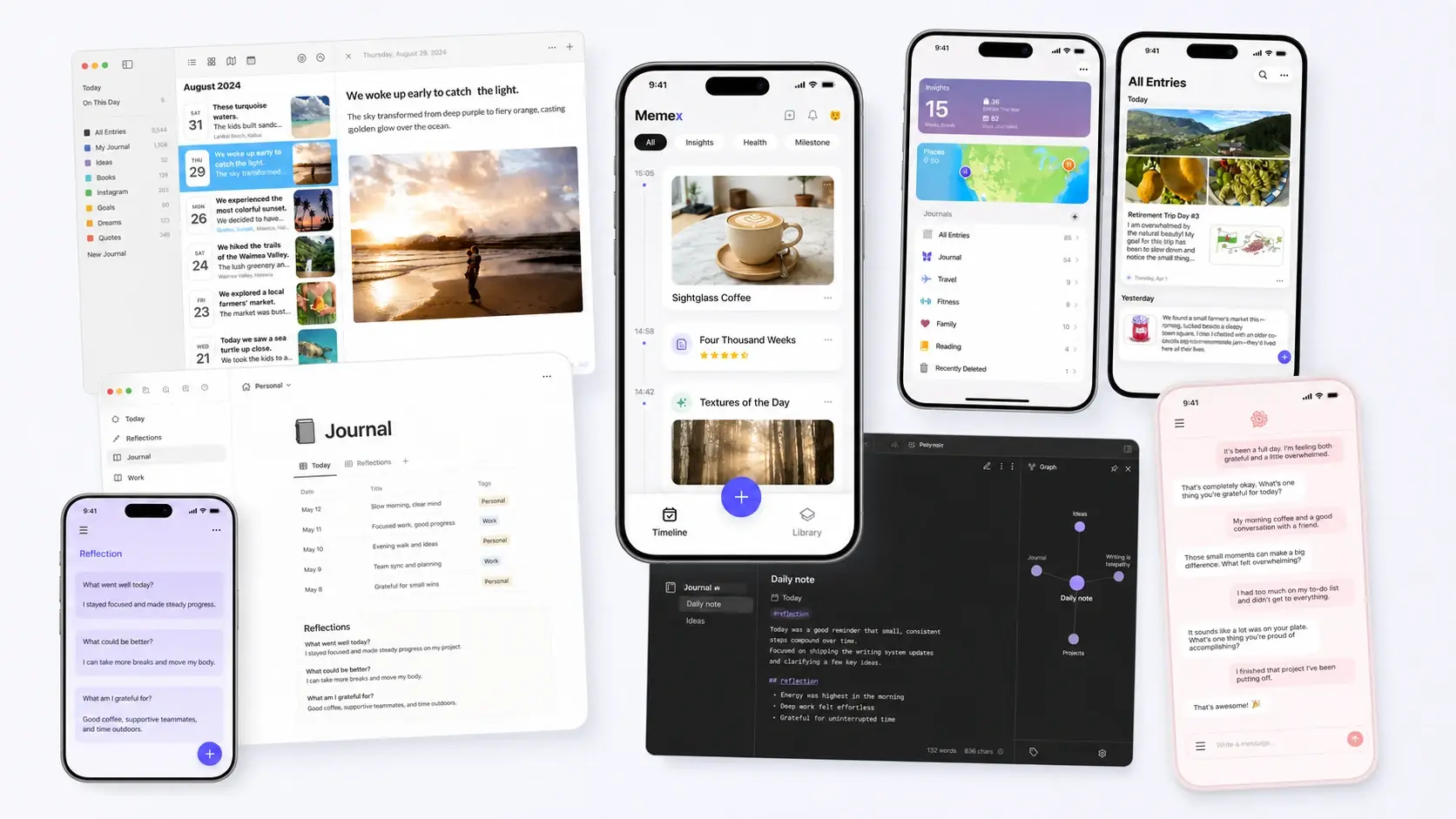
A journaling practice rarely stays confined to journaling. Here are the agents most useful to build around a reflection habit.
For Writing and Expression
Writing Assistant — Your bespoke writing partner. Adapts to any format, audience, and domain with polished output that sounds like you. The workhorse for turning journal fragments into something coherent.
- Adapts to your voice rather than imposing a generic style
- Sharp editorial feedback when you want collaboration
- Handles any format, from morning pages to long-form personal essay
Creative Fiction Writer — A storytelling partner for original fiction across any genre, with deep research for authentic worlds and expert editorial insight.
- Useful for narrative journaling and processing experience through fiction
- Editorial guidance from first draft to final manuscript
- Works across any genre and length
For Mindfulness and Emotional Processing
Meditation Guide — Deeply trained across every major tradition, with technique matching, practice programs, and expert guidance on adverse effects.
- Matches techniques to your actual state, not a generic beginner track
- Generates custom guided scripts
- Troubleshoots when practice stalls or becomes difficult
Relationship Advisor — Practical guidance for romance, family, and friendships with honest perspective rather than reflexive validation.
- Processes interpersonal conflict with clear-eyed feedback
- Helps script difficult conversations before you have them
- Remembers the people and dynamics you've discussed before
For Direction and Accountability
Career Advisor — World-class career strategist for all stages and markets, combining expert frameworks with real-time research.
- Structures reflection on transitions and advancement
- Turns vague dissatisfaction into a defined decision
- Direct guidance rather than hedged generalities
Fitness & Workout Coach — Custom programs, real-time session coaching, and progress tracking.
- Connects physical routine to the energy and mood patterns in your entries
- Progress tracking that pairs naturally with written reflection
- Form guidance with video demonstrations
Personal Nutritionist — Personalized, evidence-based guidance with ongoing accountability.
- Ties food and energy logs to the mood data in your journal
- Adapts to your goals, lifestyle, and preferences
- Provides sustained accountability, not one-time advice
Try Jenova free — no credit card required.
How an AI Journaling Assistant Works
Step 1: Choose the agent that matches your reflection goal
Browse the agent gallery at Jenova and pick based on what you actually need. Writing craft and narrative work → Writing Assistant. Contemplative practice → Meditation Guide. Interpersonal processing → Relationship Advisor. You can bring another agent into an existing conversation at any time using the @ mention, and it arrives with full context of everything discussed.
Step 2: Write the entry — typed or spoken
Dump the raw material. No structure required, no polish expected. Voice input works if speaking is easier than typing, which for emotional processing it often is.
"Rough day. Third time this month I've left the standup feeling completely deflated and I can't tell if it's the meeting or me."
Step 3: Let the agent push deeper
This is the step a notebook cannot perform. The agent responds to your specific content with follow-up questions, reframes, and observations — turning a one-way entry into an actual exchange.
"Ask me three questions that would help me figure out whether this is a meeting problem or something I'm carrying into it."
Step 4: Surface patterns across your history
Because memory persists across sessions, you can query your own reflective history directly. This is where months of entries stop being an archive and start being data.
"Looking across everything I've written since January, what themes keep coming back that I haven't addressed?"
Step 5: Convert insight into action
The MIT study found suggestions were most effective when personal and action-oriented. Close each session by asking for something concrete.
"Based on this entry, give me one specific thing to do this week — small enough that I'll actually do it."
Results & Use Cases
📊 Breaking a Six-Week Rumination Loop
Scenario: You've been writing about the same workplace conflict since spring without progress.
Traditional Approach: Re-reading old entries manually, if you re-read them at all. No synthesis, no external perspective, and a high chance of simply rehearsing the same grievance.
Jenova: The Relationship Advisor recalls the full arc of what you've written, identifies the recurring trigger, and offers honest perspective on your role in the dynamic — then helps you script the conversation you've been avoiding.
- Cross-session memory eliminates re-explaining context
- Honest feedback rather than reflexive validation
- Moves from repetition to resolution
💼 Career Clarity From Scattered Entries
Scenario: Eight months of entries mention burnout, but you can't tell whether the problem is the role, the company, or the field.
Traditional Approach: A weekend of anxious reading and a pro/con list that resolves nothing.
Jenova: The Career Advisor applies structured frameworks to your reflective history, distinguishing situational frustration from a genuine misfit — and researches concrete alternatives in real time.
- Turns diffuse dissatisfaction into a defined decision
- Frameworks applied to your actual writing, not hypotheticals
- Real-time market research alongside personal reflection
📱 Two Minutes on the Commute
Scenario: You want a daily practice but only have fragments of time on your phone.
Traditional Approach: A notebook you never carry and an app you open twice before forgetting it exists.
Jenova: Full feature parity across web, iOS, and Android with state-of-the-art speech-to-text. Speak an entry on the bus; the agent responds with a prompt; everything syncs across devices automatically.
- Voice input removes typing friction entirely
- Settings and memory sync across every device
- Short sessions still build cumulative context
🧘 Pairing Reflection With Practice
Scenario: Your entries show a consistent anxiety pattern, and you want a contemplative practice that addresses it specifically.
Traditional Approach: Generic app-based meditation tracks unrelated to what you're actually experiencing.
Jenova: The Meditation Guide matches technique to your documented pattern, builds a staged program, and troubleshoots when practice becomes difficult — including guidance on adverse effects that most consumer apps never address.
- Practice informed by what you've actually written
- Custom scripts rather than fixed library tracks
- Expert handling of difficult practice territory
✍️ From Journal Fragment to Finished Essay
Scenario: A late-night entry contains the seed of something you want to publish.
Traditional Approach: The entry sits in a file for two years.
Jenova: The Writing Assistant develops the fragment into structured prose in your own voice, offering editorial pushback where the argument is thin.
- Preserves your voice instead of flattening it
- Editorial instincts on demand
- Any format, from newsletter piece to long-form essay
Frequently Asked Questions
What is an AI journaling assistant?
An AI journaling assistant is a conversational tool that supports reflective writing by generating adaptive prompts, responding to your entries with follow-up questions, remembering your history across sessions, and identifying patterns over time. On Jenova, this takes the form of specialized agents — for writing, mindfulness, relationships, and career — rather than one generic chatbot.
Is an AI journaling assistant free?
Jenova's free tier includes all core features with limited usage, so you can build a full journaling practice without paying. Paid tiers start at $20/month for 30× the free usage plus custom model selection. Check "Subscribe" in the menu for current plan details.
Does AI journaling actually help mental health?
Research is encouraging. MIT Media Lab's randomized controlled study of an AI journaling tool found significant improvement in mental health outcomes, including reduced PHQ-8 depression scores. The broader evidence base for expressive writing is well established, with the APA documenting improvements in health and psychological well-being. An AI assistant is a support for reflective practice, not a substitute for professional mental health care.
Is my journal data private?
On Jenova, your data is never used to train public AI models, is encrypted in transit and at rest, and is not sold or shared with advertisers. This matters given the category's history — the FTC's $7.8 million action against BetterHelp illustrates what can go wrong when wellness apps mishandle sensitive information. For full details, see "Terms and Policies" in the menu.
Can it remember what I wrote weeks ago?
Yes. Jenova agents retain unlimited chat history and persistent cross-session memory, so your agent recalls past entries, stated goals, and recurring themes. This is what makes pattern recognition possible — and the MIT research found that suggestions referencing a user's logged memories were more effective than generic ones.
Does it work on my phone?
Yes. Jenova offers full feature parity across web, iOS, and Android, including state-of-the-art speech-to-text for spoken entries. All settings and memory sync across devices, so you can start an entry on your phone and continue on desktop.
Start Journaling With an AI Assistant That Remembers
Journaling works — the research has said so for decades. What fails is the practice: the blank page, the surface-level entry, the archive nobody ever reads, the privacy doubt that keeps you from writing honestly.
An AI journaling assistant addresses each of those failure points directly. Adaptive prompts remove the blank page. Follow-up questions push past venting. Persistent memory makes your history searchable and your patterns visible. And an architecture that keeps your data out of public model training means you can write what you actually think.
Build your practice around the agents that match your goals: the Writing Assistant for craft and depth, the Meditation Guide for contemplative pairing, the Relationship Advisor for interpersonal processing, and the Career Advisor for direction.
Explore the full agent library at Jenova and write your first entry today.
For Developers: Every agent in this article is available programmatically via the Jenova API — build AI-powered reflection and writing features into your application with a single integration. Full documentation →