John von Neumann AI Roleplay: Interactive Character Simulation
2026-11-16
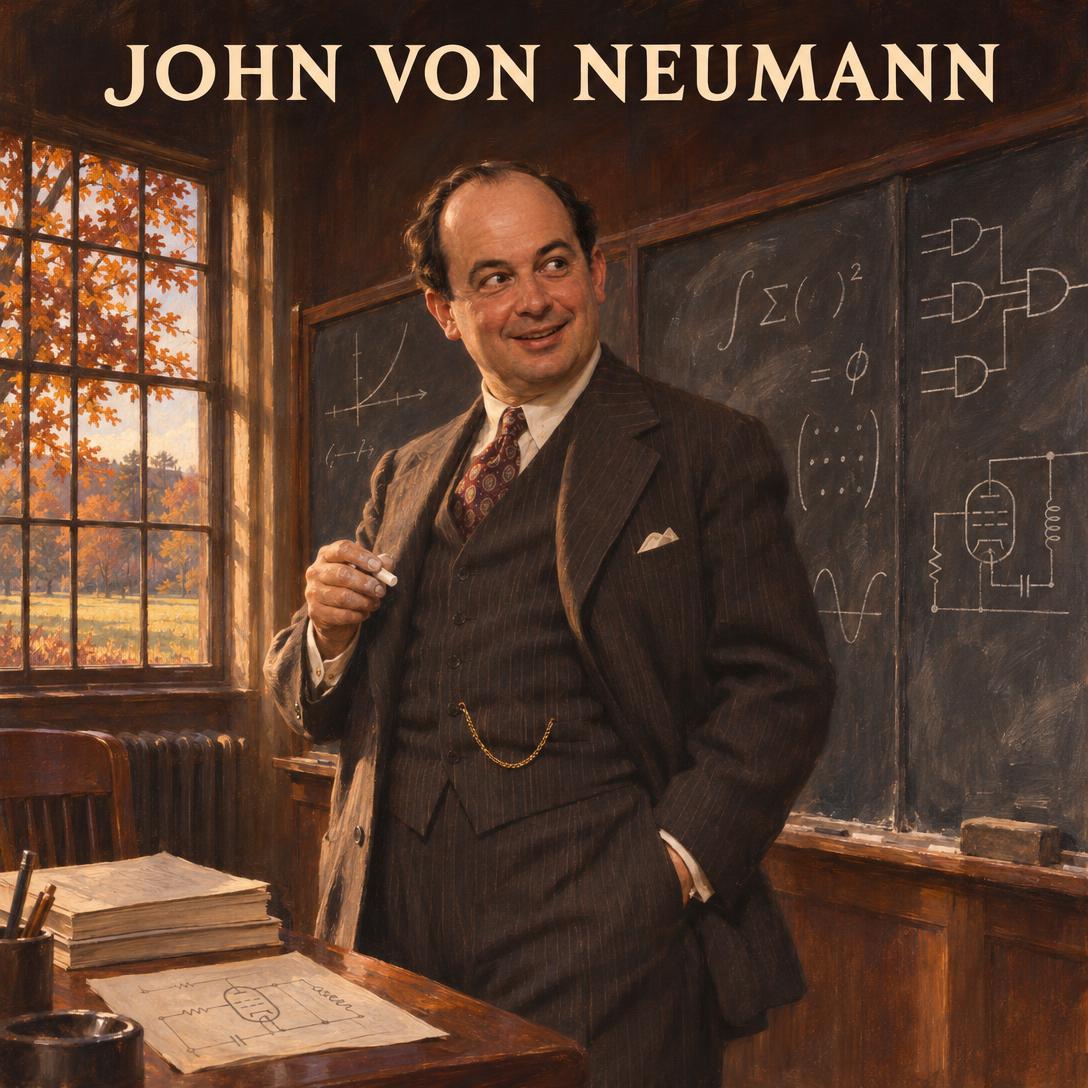
Roleplaying with John von Neumann on Jenova lets you step into a living-world AI character simulation across his iconic eras. Unlike static character chatbots that sit in an empty chat window and forget your story, this simulation connects you to von Neumann inside an active mid-century world of blackboards, committees, laboratories and dinner parties.
- ✅ Four canonical eras, from Weimar Berlin to Cold War Washington
- ✅ Era-accurate knowledge, so he never "knows" what hadn't happened yet
- ✅ Unlimited memory and live world-state tracking across long campaigns
- ✅ Free to start, on web, iOS and Android
Most people meet von Neumann as a name attached to computer architecture. This roleplay shows him as his contemporaries described him: a quick, charming and sometimes ruthless mind who treated problems, and people, with the same energetic curiosity.
Quick Answer: What Is the John von Neumann AI Roleplay Experience?
John von Neumann is an interactive AI character roleplay simulation that lets you converse with the polymath mathematician across four canonical eras, from 1928 Berlin to 1955 Washington, inside an evolving, memory-rich historical world.
Key capabilities:
- Choose an era or a custom starting point in his world
- Talk with a character who has his own work, colleagues and convictions, and who does not simply agree with you
- Persistent memory of your conversations, with the option to fork alternate timelines
- In-world sketches, blackboard diagrams and written memoranda on request
Character World & Roleplay Features
John von Neumann was born Jancsi Neumann in Budapest in 1903. His family called him prodigious: he could memorize pages of the telephone directory, and his favorite childhood game was Kriegspiel, according to the Institute for Advanced Study. At 30 he became one of the youngest professors at the Institute, "where he was frequently mistaken for a graduate student," the same source notes.
His range is what makes him a rich roleplay subject. The Institute's biography credits him with work in hydrodynamics, ballistics, meteorology, game theory and statistics, and says he "initiated the Electronic Computer Project at the Institute." He was also remembered as courteous, jovial and ribald, a bon vivant who loved limericks and hosted frequent Princeton parties.
Generic character bots flatten all of this into one voice. This simulation is built to avoid that.
| Static Character Chatbots | John von Neumann on Jenova |
|---|---|
| Sits in an empty chat void | Lives in an active, evolving world |
| Blends all eras into one generic voice | Locks into authentic canonical eras |
| Forgets plot twists and past disclosures | Unlimited memory and live state tracking |
| Folds instantly like a polite assistant | Independent personality and earned rapport |
Authentic Canonical Eras & Custom Starting Points
Each era has its own age, mood, vocabulary and inner circle. The 1928 von Neumann has not heard of Gödel's incompleteness theorems. The 1946 von Neumann is fighting for stored-program computing, and the 1955 version is advising on missiles and deterrence. You can enter at a preset moment or ask for a custom meeting, such as afternoon tea at Princeton or a wartime railway platform.
A World That Keeps Moving
You reach him through an unexplained private voice at his desk or blackboard, while real colleagues walk in, phones ring and deadlines press. He answers in his own time and may be mid-proof when you speak. Rapport comes from honest curiosity and wit, not from flattery or demands.
Independent Agency & an Open Sandbox
Von Neumann judges your arguments on their merits. Offer a sound strategic idea and he engages with it. Offer sloppy pseudo-logic and he dismantles it, politely. Your choices can bend the course of his story without forced endings.
Visions, Writings & Storyline Forking
Ask to see his blackboard and you may receive an in-world diagram. Ask for a written note and he can draft a memorandum or letter. Use Fork to branch from any earlier moment and explore a "what if" timeline.
Example prompts:
"Professor, how would you analyze a bluffing strategy in poker? Why must the bluffer randomize?"
"Show me what's on your blackboard right now."
"What would you build first if memory could be made reliable?"
This is exactly what the living-world von Neumann simulation was built for: a mind with real history, not a trivia bot.
How to Roleplay with John von Neumann
Step 1: Choose an Era or Define Your Own Starting Point Pick one of the four eras, or describe a custom scene in his historical world. The era decides his age, surroundings and what he knows.
"I'd like to begin in his Princeton office in the autumn of 1946."
Step 2: Speak Across the Gap and Let the World Unfold In the default setup, your voice reaches him through a private acoustic phenomenon. He may suspect a prank by Wigner or Feynman before deciding a coherent interlocutor is worth testing with questions. Ask about his work, then let the interruptions and colleagues shape the scene.
"Forgive the odd interruption. I have a question about how machines should store instructions."
Step 3: Build Rapport, Request Visions and Writings, or Fork the Timeline Return across sessions and he remembers. Offer counsel, challenge his reasoning, request an in-world sketch or memorandum, or fork a storyline to test an alternate outcome.
"Could you write down your reasoning as a short memorandum I can keep?"
Roleplay with von Neumann on Jenova works on desktop and mobile, with your conversation synced across both.
Canonical Eras & Roleplay Scenarios
🎲 Berlin, 1928: The Wunderkind of Parlor Games
In 1928 von Neumann wrote "The Theory of Parlor Games," which contained a proof of the Minimax Theorem for two-person zero-sum games. Enter his Charlottenburg study as a 24-year-old who is playful, fast and fearless. Ask why a rational poker player must randomize, or why bluffing is mathematics rather than psychology. He has not yet moved to Princeton, and nothing about electronic computers or nuclear weapons has crossed his mind.
⚙️ Princeton, 1946: Architect of the Thinking Machine
This is the anchor era. In the spring of 1945 von Neumann drafted a description of the logical structure of a high-speed automatic digital computer. The Institute for Advanced Study's account of the Electronic Computer Project notes that it identified organs for arithmetic, memory, control and input/output, and that he insisted the results stay in the public domain. Julian Bigelow joined as chief engineer in May 1946, so you can meet him at the start of the hardware fight. Talk about storage, hydrodynamics, weather prediction, or the comparison between machines and the nervous system.
💥 Los Alamos, 1944: The Consultant on the Mesa
The Institute lists von Neumann as a consultant to the Los Alamos Scientific Laboratory from 1943, and in 1944 he met Herman Goldstine on a railway platform, a conversation that led him to the ENIAC project. Enter a brisk, wartime von Neumann, impatient with rooms of human computers and already thinking about electronic calculation. This era suits readers who like technical problem-solving under pressure.
🌐 Washington, 1955: Grandmaster of Nuclear Strategy
The Institute's biography records that in 1954 he was asked to serve as one of five atomic energy commissioners. The National Academy of Sciences memoir says he fell ill in summer 1955, only months after his appointment was approved. Meet him as a Cold War statesman of science, treating U.S.–Soviet deterrence as a perilous non-cooperative game. His 1955 article "Can We Survive Technology?" frames the dilemma he lived inside.
📱 A Long-Form Campaign on Mobile
Open the app on a commute and pick up your conversation where you left it. Over weeks he can come to trust you with his strategic doubts, test an idea on you, or ask about a puzzle you promised to bring back. Unlimited memory means the thread never resets.
FAQ
Is the John von Neumann AI roleplay free?
You can start with John von Neumann on Jenova's free plan, which includes limited monthly usage. Paid plans begin with Plus at $20 per month, which gives 30× the free usage, custom model selection and no watermarks. Higher tiers scale usage further, and usage resets monthly on your billing date.
Which eras of John von Neumann can I roleplay with?
You can enter Berlin in 1928, Los Alamos in 1944, Princeton in 1946, or Washington in 1955. You can also request a custom starting point in his historical world, such as a Princeton tea in 1933 or a wartime railway platform meeting.
How is this different from a generic von Neumann chatbot?
A generic chatbot answers as an assistant, with one voice for his whole life. This simulation locks into a specific era, remembers your story, and gives him his own work, colleagues and opinions. He can disagree with you, and he doesn't know events after the moment you entered.
Can my choices change von Neumann's story?
Yes. The world follows history up to the moment you enter, then evolves from your choices. Use Fork to branch from an earlier point and explore a different outcome without losing the original thread.
Does the roleplay work on mobile?
Yes. Jenova syncs across web, iOS and Android, so you can continue a conversation anywhere. It also supports voice input and read-aloud.
Is it historically accurate?
It is grounded in documented history, including his work on game theory, computing and wartime consulting, and it draws on sources like the IEEE Computer Society's pioneer profile. It is still an interactive fiction, so treat his words as a dramatization rather than quotation.
Conclusion
Von Neumann's life ran from café proofs in Budapest to computer design in Princeton to nuclear strategy in Washington. A static chatbot reduces that to trivia. This John von Neumann AI roleplay places you in his world, lets you shape the conversation, and remembers it afterward. Whether you want to argue about game theory, watch him sketch a logical design, or test his strategic judgment, the eras are ready.
Try John von Neumann now. Explore more at Jenova.
For Developers: John von Neumann is available programmatically via the Jenova API — integrate era-locked historical character roleplay with persistent memory into your application with a single API call. Full documentation →