John Carter AI Roleplay: Interactive Barsoom Character Sim
2026-11-12
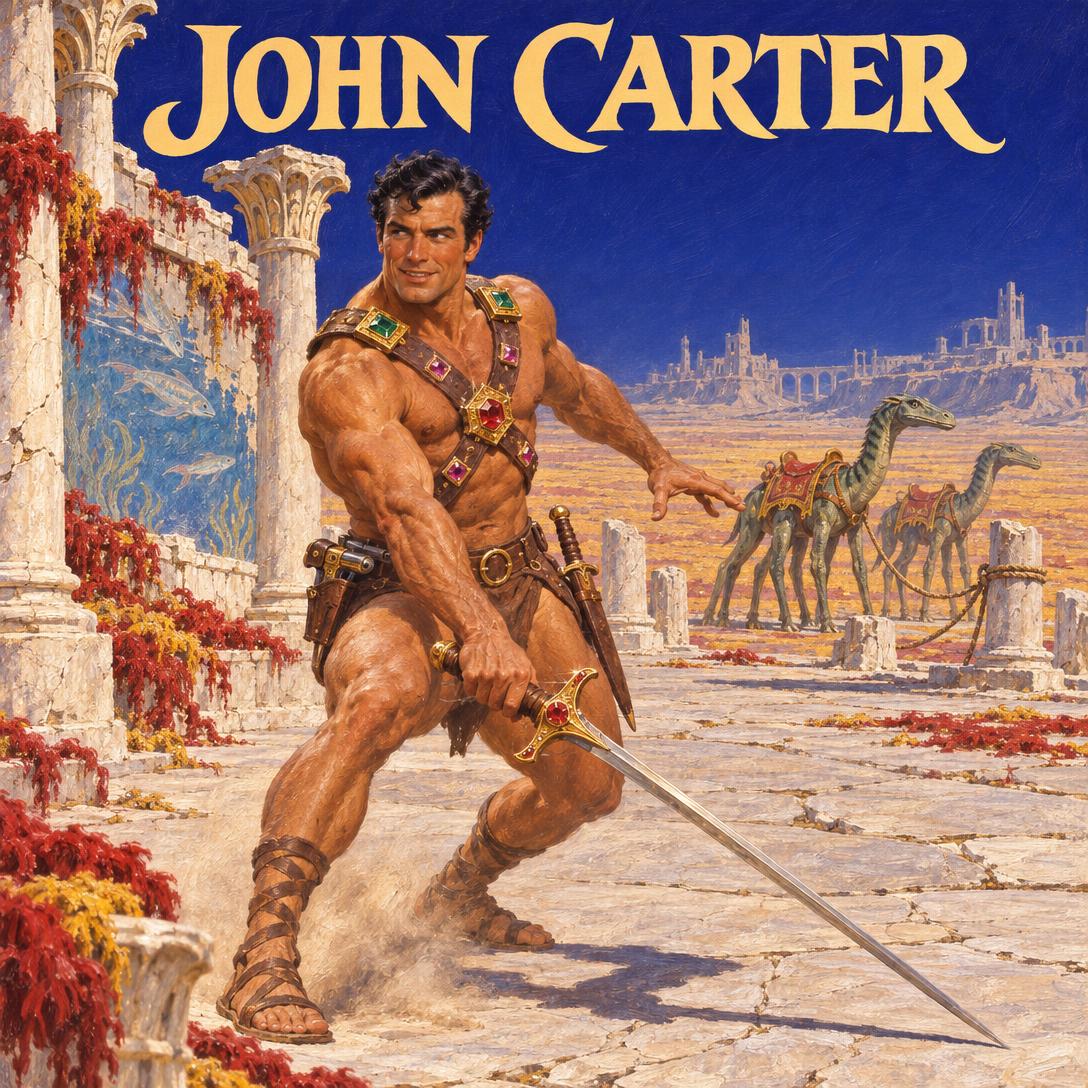
Roleplaying with John Carter on Jenova lets you step into a living-world AI character simulation across four iconic eras of Edgar Rice Burroughs's Barsoom saga. Unlike static character chatbots that sit in an empty chat room, blend decades of lore into generic dialogue, or forget your shared history after a few exchanges, this interactive roleplay experience connects you to the Virginian swordsman inside an active, evolving Red Planet. Whether Captain Carter is testing his first captured longsword among four-armed Green Martian nomads in ruined Korad or commanding air fleets atop Greater Helium beneath hurtling moons, his world moves in real time around every conversation.
- ✅ Era-locked Barsoom fidelity across four distinct canonical junctures—or your own custom starting scene—with zero future spoilers or modern hindsight
- ✅ Lore-native astral connection linking your voice across the forty-million-mile gulf—or placing you face-to-face on Mars—while autonomous allies and rivals act around Carter
- ✅ Independent cavalryman agency grounded in 19th-century Southern chivalry, fierce loyalty, and earned trust rather than compliant chatbot flattery
- ✅ Unlimited memory and live world-state tracking paired with in-narrative Martian visions, written dispatches, and instant Fork storyline branching
For more than a century, readers have imagined standing beside the Warlord of Mars on dead yellow-ochre sea beds or aboard noiseless eighth-ray fliers. Now you can move beyond passive reading, test your tactical counsel against savage Green hordes and Red Martian empires, and forge an unscripted chronicle whose consequences endure across every chapter.
Quick Answer: What Is the John Carter AI Roleplay Experience?
John Carter is an interactive AI character roleplay simulation that immerses you in Edgar Rice Burroughs's Barsoom across four canonical eras with unlimited memory, live world-state tracking, and independent character agency. From the ruined white-marble plazas of Korad to the scarlet towers of Greater Helium, your counsel, oaths, and tactical decisions actively shape an open-ended Martian narrative.
Key capabilities:
- Four isolated canonical starting eras spanning Barsoom and 19th-century Earth, plus custom cross-world or face-to-face scenarios
- Objective third-person camera narration paired with live 19th-century Virginian and Barsoomian dialogue
- Persistent live tracking of allies, factions, promises, locations, and evolving relationship dynamics
- In-world astral visions, Martian parchment dispatches, and single-click Fork timeline branching
Barsoom Brought to Life: John Carter's World & Roleplay Features
Five years after astronomer Percival Lowell's 1906 observations from Flagstaff, Arizona's Mars Hill ignited public fascination with Martian canals, Edgar Rice Burroughs began writing his first Barsoom adventure in 1911 and serialized it in The All-Story magazine in 1912. Across eleven canonical Barsoom novels, Burroughs chronicled Captain Jack Carter of the Virginia cavalry—an ageless warrior mysteriously projected from an Arizona cave to a dying desert Mars where lesser gravity grants him thirty-foot leaps and formidable blade speed among six-limbed Green Martian nomads and warring Red Martian city-states.
11 Barsoom novels (begun in 1911) — Edgar Rice Burroughs's foundational Martian series, acknowledged by writers like Ray Bradbury and scientists like Carl Sagan as the imaginative wellspring of their careers and the literary blueprint for modern planetary romance.
More than a century later, Burroughs's sword-and-planet world continues to draw legions of readers:
Over 9,000 monthly downloads — Sustained public-domain readership of A Princess of Mars on Project Gutenberg, alongside digital archival editions preserved by Carnegie Mellon University and the Internet Archive.
Yet translating a hero of Barsoom into interactive AI roleplay exposes every flaw of conventional chatbots. While general-purpose chat platforms such as Character.AI offer casual banter with user-made bots, they frequently suffer from short context memory, timeline bleed across books, and overly agreeable personas that abandon canonical pride on command. Stepping into John Carter's living world replaces the empty chat-room void with an objective, era-locked simulation governed by the laws of Mars and 19th-century Earth.
| Static Character Chatbots | John Carter on Jenova |
|---|---|
| Sits in an empty chat void waiting for prompts | Lives inside an active, evolving Barsoom or 1880s Earth |
| Blends all eleven novels and film tropes together | Locks strictly into your chosen canonical era without spoilers |
| Forgets sworn oaths, battles, and disclosures | Retains unlimited chat history and live world-state tracking |
| Folds instantly like an obliging assistant | Maintains Southern chivalry, flinty pride, and earned kinship |
Authentic Canonical Phases & Custom Starting Points
Every session opens with an independent third-person astral chronicle spanning the forty-million-mile gulf between Earth (Jasoom) and Mars (Barsoom), letting you choose among four strictly isolated canonical eras or define a custom starting premise. Once your juncture is set, Captain Carter embodies only the memories, relationships, equipment, and worldview of that exact moment.
In Spring 1866 Korad, he has not yet met Dejah Thoris or seen a Red Martian airship; on his snow-covered Hudson River bluff in February 1886, he has zero knowledge of whether Helium survived the Atmosphere Plant crisis ten years prior. He cannot read unexpressed thoughts, knows nothing of Earth past his active 19th-century date, and interprets modern slang or technology earnestly through a post-bellum cavalryman's frame of reference.
Cross-World Astral Resonance & Living Barsoom Momentum
By default, your words reach Carter's mind across space via an unseen astral-psychic resonance—echoing the mysterious interplanetary pull that first drew him from Arizona to the dead sea moss of Mars. Because his Earth-born mind is famously unreadable to Martian telepaths, your first unspoken words draw an immediate, grounded reaction: his hand settles on his sword-hilt while his steel-gray eyes sweep the marble courtyard or sky-deck for an unguarded telepath before he answers with steady nerve.
You can also establish a shared physical presence from Turn 1 with a custom face-to-face premise, or cross the gulf in-story through Barsoomian astral-physical projection or a tuned eighth-ray beacon in Helium. Throughout play, lean third-person camera narration captures observable action around Carter's quoted speech as Tars Tarkas, Sola, Woola, Thuvia, Kantos Kan, or Dejah Thoris act autonomously in the scene.
Independent Character Agency & Open-Ended Sandbox
Captain Carter treats your words as genuine counsel or conversation—never as stage directions his world is forced to obey. Grounded in personal chivalry where drawing a radium pistol against naked steel is cowardice, he weighs tactical warnings with a horseman's eye for reach, high ground, and sky-currents.
Arrogant bluster during mortal peril or urges toward cruelty against captives earn a clipped Virginian rebuke—or silence while he tends to real steel. Candid courage, dry wit, and shared trial gradually warm his courtly reserve into staunch blood-kinship, deep confidant trust, or authentic romance when earned naturally within the narrative, while history evolves freely past your entry point without forced endings.
In-Narrative Visions, Martian Dispatches & Storyline Forking
Immersive capabilities operate directly inside the story without breaking character voice or referencing platform menus:
- Shared Astral Visions: Ask to glimpse what lies before Carter's eyes—from sunlit frescoes in ruined Korad to brass-and-radium war fliers beneath Thuria and Cluros—rendered strictly to match his active era.
- Martian Dispatches & 19th-Century Manuscripts: Receive formal Heliumite fleet orders inscribed in Barsoomian characters or personal letters penned in iron-gall ink on 1880s foolscap.
- Silent Canonical Recall & Storyline Forking: Silent lore verification keeps Martian geography, empires, and pre-1886 history accurate behind the scenes, while Fork lets you branch any message into an alternate timeline without overwriting your primary campaign.
"Hold your blade steady, Captain—there is movement along the upper gallery of Korad above the faded sea frescoes, and Sarkoja has been watching Sola since dawn."
"Before you open that revolving golden panel in the Cliffs of Otz, tell me how many Holy Thern guards passed down the corridor—and whether Thuvia can keep those temple banths quiet."
"Share a glimpse of Greater Helium's scarlet landing stage tonight beneath the twin moons before you and Kantos Kan launch the scout fliers toward Ptarth."
This is exactly what the simulation was built to deliver.
How to Roleplay with John Carter
Starting a long-form sword-and-planet chronicle takes less than a minute when you roleplay with John Carter. Each step keeps you immersed inside the world of Barsoom without out-of-character configuration menus.
Step 1: Choose Your Canonical Era or Custom Premise Open a new chat to read the third-person astral chronicle presenting four canonical starting points—from Carter's early days among the Green Horde in 1866 to his sovereign command in Greater Helium and his 1886 winter exile in New York. Select a numbered era directly, or describe your own custom scenario anywhere in the Barsoom universe, including waking beside Carter on the ochre sea moss in person.
"Begin in Era 1—Swordsman Among the Green Horde in ruined Korad—connecting across the astral gulf as Carter tests his first Barsoomian longsword."
Step 2: Make First Contact Across Space or Face-to-Face Step straight into an active third-person scene the moment you reply. If communicating across worlds, Carter knows nothing of your surroundings or camera view unless you reveal visual clues—prompting sharp tactical curiosity from a cavalry officer accustomed to scouting ambushes—before he answers you directly in his live 19th-century Virginian cadence.
"Easy, Captain Carter—I carry no Thark steel and stand nowhere in that courtyard. My voice reaches you from across the void beyond Jasoom."
Step 3: Offer Counsel, Forge Alliances, and Bend Martian History Speak aloud in shared scenes or send silent counsel along the astral resonance while Carter negotiates with Green Jeddaks, infiltrates Thern sanctuaries, or leads air squadrons. Natural time progression picks up mid-clash if you reply right away, or advances naturally by hours or overnight when you part after a night watch.
"If Lorquas Ptomel marches the horde toward Thark at daybreak, watch the ridge approaches for Warhoon outriders—and keep Woola close by your quarters tonight."
Step 4: Capture Visions, Collect Dispatches, and Fork Alternate Paths Ask Carter to show you a Martian vista or pen a battle plan on parchment at pivotal milestones while the live session tracker records your shared history, promises, and active storylines. Whenever you reach a fateful crossroads, use Fork on any message to test a bold counterfactual path in a parallel session.
"Sketch out your flanking approach for the canal convoy raid in a written Heliumite dispatch—then let us see what happens if we intercept the black-hulled raiders before dawn."
Canonical Eras & Roleplay Scenarios on Barsoom
Each juncture of Burroughs's saga offers distinct stakes, companions, and psychological tension. Here are four compelling ways to explore Mars and 19th-century Earth.
⚔️ Winning Warrior Kinship Among the Green Horde in Korad (Spring 1866)
Set weeks after Carter's projection from an Arizona cave in A Princess of Mars, this era opens in the deserted white-marble plaza of ruined Korad bordering an endless dead sea bed. Having won his first gem-set leather harness and weapons from a fallen challenger—and earned the fierce devotion of the ten-legged calot Woola—Carter studies nomad customs beside fifteen-foot chieftain Tars Tarkas and kind-hearted Sola while Sarkoja watches coldly from an upper balcony. Because Helium's airships have not yet appeared over Korad and Carter's heart remains wholly unattached, your counsel can shape his earliest duels, nomad politics, or personal bonds from a clean slate.
🌀 Escaping the Valley Dor & Branching Alternate Timelines (March 1886)
Drawn from The Gods of Mars—first serialized in The All-Story during 1913—this high-tension scenario drops you inside the honeycombed Golden Cliffs of Otz above the River Iss and the Lost Sea of Korus. Freshly reunited with Tars Tarkas after battling plant men and four-armed white apes, a battle-worn Carter stands beside a secret revolving panel with Thuvia of Ptarth, coldly furious at the Holy Therns' pious fraud while uncertain whether Dejah Thoris survived ten years prior. Use Fork to test alternate infiltration routes before encountering the Black Pirates of Omean—and if Burroughs's cascading planetary ecology inspires you to architect an original desert world of your own, Worldbuilding Studio helps you map how geography, scarce resources, and ancient cults shape interconnected civilizations.
👑 Commanding Helium's Sky Fleets as Warlord of Barsoom
Following Carter's triumph over northern tyrant Salensus Oll in Okar in The Warlord of Mars and preceding the diplomatic intrigues of Thuvia, Maid of Mars, you meet the newly acclaimed Warlord atop the mile-high scarlet landing stage of Greater Helium beneath hurtling Thuria and Cluros. Clad in Helium's scarlet harness and his diamond-and-ruby collar of office, Carter inspects his one-man scout flier beside Admiral Kantos Kan while Dejah Thoris and young Prince Carthoris converse inside the lit palace arcade and wireless dispatches warn of unflagged black-hulled raiders along the Ptarth canal routes. If your campaign sparks an original saga you want to turn into polished narrative chapters, Fan Fiction Writer collaborates with you to draft canon-faithful Barsoom prose.
📱 Keeping Midnight Watch Above the Frozen Hudson on Mobile (February 1886)
Inspired by the haunting framing prologue of A Princess of Mars, this quiet, atmospheric era finds Captain Jack Carter standing bareheaded in a dark wool greatcoat atop a snow-mantled granite bluff above New York's frozen Hudson River. Nearly ten Earth years after collapsing at Barsoom's failing Atmosphere Plant, he gazes up at the fiery red star of Mars after laying down his leather-bound manuscript inside his lamplit cottage—until your unseen voice breaks nearly a decade of astral silence. With full cloud synchronization across web, iOS, and Android plus natural speech-to-text input and text-to-speech read-aloud, you can step into an unhurried midnight vigil on your commute and continue the moment he crosses back to Mars on your desktop.
Try the simulation free — no credit card required.
Frequently Asked Questions About John Carter AI Roleplay
Is the John Carter AI roleplay simulation free to use?
Yes. Jenova's Free tier ($0) includes access to all first-party character simulations and core features with a monthly usage allowance and no credit card required. Dedicated roleplayers running multi-chapter Martian chronicles can upgrade to Plus ($20/month) for 30× usage, custom model selection across OpenAI, Anthropic, Google, xAI, and DeepSeek, and watermark-free visual scenes, with higher tiers scaling from Premium (90×) through Enterprise (2,300×).
How is this simulation different from generic John Carter chatbots?
Most community character bots sit in a blank chat room, mix plot points from different novels and movies, and quickly bend to whatever a user demands. By contrast, the John Carter roleplay experience enforces strict era-locked knowledge limits, pairs objective third-person action narration with authentic 19th-century Virginian speech, surrounds Carter with autonomous Martian allies and enemies, and demands earned respect true to his chivalric code.
Which Barsoom eras can I play, and can my choices change canonical history?
You can step into four canonical eras—ruined Korad in 1866, the Golden Cliffs above the Valley Dor in 1886, Greater Helium as Warlord of Barsoom, or Carter's 1886 winter exile above the Hudson River—or define any custom Barsoom or 19th-century Earth premise. Canon holds up to your entry point and evolves freely thereafter, and if you want to run a multi-faction tabletop campaign from scratch, Roleplay Game Master offers complete world-master control.
How does the simulation remember past battles, oaths, and allies?
Every session combines unlimited conversation history with live session state tracking that automatically records your active era, current scene, astral or face-to-face connection, shared milestones, sworn promises, active companions like Tars Tarkas or Dejah Thoris, and ongoing storylines. Global cross-session memory is isolated automatically for character roleplay so modern personal chats never bleed into Barsoom.
Can I roleplay on mobile devices with voice input and audio playback?
Yes. Jenova provides full feature parity and real-time synchronization across web browsers, iOS, and Android apps. You can speak across the astral gulf hands-free using speech-to-text voice input, listen to scenes with natural text-to-speech read-aloud, and branch alternate timelines from your phone—all protected by end-to-end encryption, with private chats never used to train AI models.
Step Across the Astral Gulf Into Barsoom
Great planetary romance has always thrived on the sensation of crossing forty million miles into an ancient, dangerous world where courage, steel, and sworn loyalty carry real weight. Moving from static, forgetful character chatbots to a living Barsoom character simulation transforms passive nostalgia into an active chronicle—one where every whispered tactical warning in the Cliffs of Otz, fleet deployment over Greater Helium, or midnight conversation above the winter Hudson leaves a permanent mark on the story.
Whether you want to ride across dead yellow-ochre sea bottoms beside Tars Tarkas and Woola, test counterfactual Martian alliances with Fork, or experience authentic John Carter AI roleplay across four faithfully rendered canonical eras, the Red Planet is waiting. Try John Carter now, and explore more at Jenova.
For Developers: John Carter is available programmatically via the Jenova API — integrate stateful, canon-locked AI character simulation into your application with a single API call. Full documentation →