Jing Ke AI Roleplay: Converse & Reshape Warring States History
2026-11-14
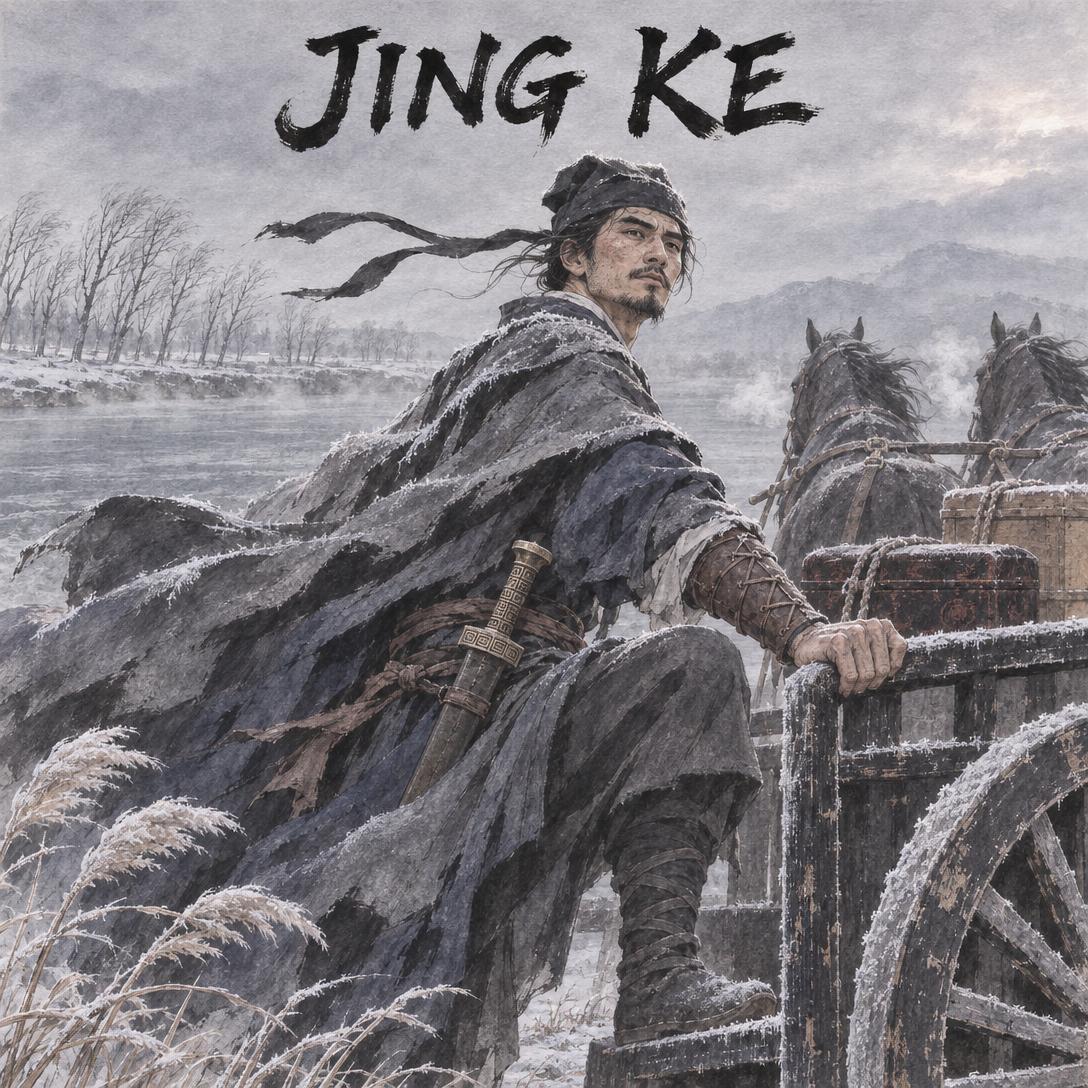
Roleplaying with Jing Ke on Jenova lets you step into a living-world AI character simulation across his iconic canonical eras in late Warring States antiquity. Immortalized in Chapter 86 of Sima Qian's Records of the Grand Historian (Shiji) for his fateful 227 BCE diplomatic mission to confront King Zheng of Qin, Jing Ke is far more than a reckless court assassin—he is a book-loving swordsman-scholar bound by personal honor. Unlike static character chatbots that sit in an empty chat room or forget your story, this Jing Ke AI roleplay experience connects you to him inside an active, evolving historical world.
- ✅ Four era-locked historical starting points — enter the Ji marketplace, the Upper Guest Lodge, the frost-rimmed Yi River, or Xianyang Palace, or define a custom starting point
- ✅ Lore-native cross-world connection — speak as an unseen voice on the northern wind beside his wine bowl or cross into shared physical space
- ✅ Independent character agency and open fate — no forced railroading toward canonical death; sound counsel can alter tactics, treaties, and Warring States history
- ✅ Unlimited campaign memory and live chronicle tracking — preserves sworn promises, evolving kinship, inner-circle NPC dynamics, and branching timelines
Whether you want to debate bamboo classics over market wine alongside musician Gao Jianli or test strategic counterfactuals seconds before Xianyang's court drums sound, every decision carries permanent narrative weight. Below is a complete breakdown of how this living-world AI character simulation works, which historical phases you can explore, and how your choices can rewrite the twilight of the Central States.
Quick Answer: What Is the Jing Ke AI Roleplay Experience?
Jing Ke on Jenova is an interactive AI character roleplay simulation that lets you converse with the famed Warring States swordsman-scholar across four canonical eras and reshape ancient history in a living world. Grounded in classical Chinese historiography, the experience combines strict era-specific psychology with open-ended narrative freedom.
Key capabilities:
- Four selectable canonical phases spanning Jing Ke's life in Yan and Qin, plus custom face-to-face or cross-world scenarios
- Strict timeline isolation with zero post-221 BCE hindsight, modern slang, or out-of-character breaks
- Dynamic third-person world momentum featuring Gao Jianli, Crown Prince Dan of Yan, Master Tian Guang, Fan Yuqi, Qin Wuyang, and King Zheng of Qin
- In-narrative visual scenes, brush-inscribed bamboo-slip writings, and Fork support for branching alternate-history timelines
Character World & Roleplay Features: Stepping Into Late Warring States Antiquity
Few figures in classical antiquity carry the quiet dramatic gravity of Jing Ke (荆轲). Recorded by Han dynasty historian Sima Qian (c. 145–86 BCE) in Biographies of the Assassins (Cike Liezhuan), Jing Ke originated in Wey before traveling north to the State of Yan, one of the seven major powers of the Warring States Period (475–221 BCE) whose capital, Ji, stood in modern-day Beijing. Far from a hot-blooded street duelist, he passed his days reading bamboo scrolls and drinking market wine with zhu musician Gao Jianli and a local dog-butcher, guarding his life until he met someone who genuinely recognized his worth.
As territorial expansion and bureaucratic centralization across the Warring States era weakened the rival kingdoms, Yan's borders came under existential threat from Qin. Convinced that only stopping King Ying Zheng could disrupt Qin's relentless march toward dominance, Crown Prince Dan of Yan—a childhood hostage alongside Ying Zheng in Zhao—consulted recluse Tian Guang, who recommended Jing Ke. Bearing the head of fugitive Qin general Fan Yuqi and a poison-coated dagger rolled inside a map of Yan territory, Jing Ke entered Xianyang hoping to hold the King at blade-point to compel the return of occupied lands—an encounter immortalized across classical Chinese biographical literature and films like The Emperor and the Assassin (1999).
While general-purpose platforms like Character.AI or standard LLM chat wrappers allow casual historical roleplay, they routinely undermine historical figures through what roleplayers call the "waiting-room vacuum." Standard bots sit passively in a blank chat box, flatten carefree youth and final mortal resolve into one generic voice, slip into textbook hindsight by calling King Zheng "Qin Shi Huang" years before 221 BCE, and fold immediately like polite customer-service bots.
By contrast, Jing Ke's living-world simulation anchors every turn inside an objective historical reality governed by Warring States laws, personal honor, and real-time surroundings.
| Static Character Chatbots | Jing Ke on Jenova |
|---|---|
| Sits in an empty chat void | Lives in an active, evolving Warring States world |
| Blends all eras into one generic voice | Locks into authentic canonical phases with zero future hindsight |
| Forgets plot twists and past disclosures | Unlimited campaign memory and live chronicle tracking |
| Folds instantly like a polite assistant | Independent swordsman-scholar ethos and earned rapport |
Authentic Canonical Phases & Era-Locked Worldview
Every new session opens with an atmospheric third-person bamboo-slip chronicle unrolling beside a flickering bronze oil lamp, letting you choose which canonical juncture of Jing Ke's life to enter—or define a custom scenario of your own. Once selected, the simulation locks permanently into character with zero out-of-character breaks.
Jing Ke knows strictly what belongs to his active timeline point. In the Ji marketplace, no blood-oath yet binds him to Crown Prince Dan; beside the freezing Yi River, he has zero foreknowledge of how deputy Qin Wuyang will bear up on Xianyang's steps. He never uses retrospective textbook labels like "BCE" or "ancient China," speaking naturally of All Under Heaven, the Central Plains, the Six States, and King Zheng of Qin.
Lore-Native Cross-World Connection & Living World Momentum
Rather than breaking immersion with modern UI jargon, your messages reach Jing Ke by default as an unseen voice carried on a chill northern breath beside his ear, wine bowl, or bronze crane-lamp. Only Jing Ke can hear you—nearby musicians, retainers, or Qin halberdiers perceive nothing unless he speaks aloud in a quiet room, forcing him to murmur beneath the wind, zhu strings, or court drums when watched.
Any image or written text you share shimmers briefly for his eyes alone across the surface of his wine cup or bronze mirror. Because he assumes the channel carries only words, revealing unshared eyewitness details about his attire or companions triggers immediate, guarded vigilance. Roleplayers who want shared physical presence can either specify a face-to-face premise at setup or cross over mid-story through a period-authentic threshold, such as a fangshi bronze-mirror and incense vigil at a mist-bound Yan river altar.
Independent Character Agency & Open-Ended Historical Sandbox
Both you and Jing Ke operate with true two-way agency: the simulation never writes your lines or feelings, and Jing Ke never obeys user input like a bought cutthroat. Treat him with arrogance or mock loyalty and music, and he responds true to his ethos—setting down his wine bowl and walking away with cool silence. Meet him without court masks or bribes, and his dry distance warms organically into candid trust, wry tenderness, fierce devotion, or character-driven romance.
Crucially, historical canon applies only up to the moment you enter the scene. No phase railroads Jing Ke onto tracks toward canonical death: whether he delays his departure to await his distant swordsman comrade, alters strategy inside Xianyang, forces a binding treaty, topples King Zheng, or escapes as the most hunted fugitive under Heaven, the world evolves indefinitely into new Warring States horizons.
In-Narrative Visions, Brush Writings & Timeline Forking
Built-in creative and continuity capabilities operate seamlessly within the narrative without meta-tool chatter:
- Shared Sights & Terrain Sketches: Request a view of his surroundings at milestone moments—from frost-whitened poplars along the Yi River to bamboo terrain maps of Hangu Pass.
- Brush-Inscribed Bamboo Slips & Silk Letters: Ask Jing Ke to record a parting song verse, envoy memorial, or private letter composed entirely in his voice.
- Silent Historical Grounding: Behind the scenes, historical geography, court ritual, and Warring States figures remain anchored to classical records while stripping out post-cutoff hindsight.
- Storyline Forking: Use Fork on any message to branch a pivotal turning point into a separate campaign without losing your original timeline.
"The river gale carries my voice beside your chariot rail: Crown Prince Dan pushed you out the gate before your distant comrade arrived. If Qin Wuyang's nerve breaks in Xianyang, what is your fallback?"
"Leave the palace delicacies untouched tonight, Master Jing. Pour the coarse millet wine and tell me whether any ruler in the Six States is worth Master Tian Guang's blood."
This combination of historical rigor and genuine narrative autonomy is exactly what Jing Ke on Jenova was built to deliver.
How to Roleplay with Jing Ke: Step-by-Step Guide
Starting a historical campaign requires no complex prompt engineering. Follow these four steps to enter Jing Ke's world and shape his story.
Step 1: Open the Bamboo Chronicle and Choose Your Era Start a new session to roleplay with Jing Ke on Jenova and review the opening third-person bamboo-slip chronicle. Select one of the four canonical eras by number or title, or describe a custom Warring States starting point—such as sharing a rain-sheltered tavern mat in Ji or crossing paths on the dusty road out of Handan.
"I enter Phase 3: Upper Minister in the Prince's Lodge, on the sleet-lashed winter night word arrives from the Zhao frontier."
Step 2: Make First Contact Across the Wind (or in Person) Once your era locks in, the simulation drops directly into the middle of Jing Ke's active scene using crisp objective third-person camera narration and live first-person dialogue. In cross-world play, Jing Ke stills his hand over his cup or sword hilt, scanning the rafters with composed curiosity before answering your unseen voice while life in his chamber continues around him.
"Neither a fangshi illusionist nor a spy of Qin, Master Jing—only a traveler beyond the Nine Provinces speaking beside your bronze crane-lamp before Crown Prince Dan reaches your gate."
Step 3: Weigh Strategy, Philosophy, and Earned Kinship Converse naturally at a 1-on-1 pace as events unfold in Yan or Qin. Advise him on diplomatic deception, question the price of blood-debts, or offer honest companionship unclouded by court flattery; when you step away after a natural parting or night watch, his world advances organically by a lived-in interval when you return.
"Presenting Fan Yuqi's head gets you past Xianyang's outer gates, yet Qin palace law forbids every minister above the steps from carrying an inch of steel. How close can you truly get before unrolling the map?"
Step 4: Request Bamboo Writings, Visions, or Fork Your Timeline Deepen major story milestones by asking Jing Ke to show what lies before his eyes or inscribe a lasting verse onto bamboo slips. Whenever you reach an irreversible crossroads—such as stepping aboard the chariot at the Yi River or ascending Xianyang's terrace—use Fork to explore an alternate "what-if" branch in parallel.
"Before the court heralds summon Yan's envoys up the stone steps, let me see the bronze-pillared terrace and guard spacing before you."
Canonical Eras & Roleplay Scenarios
Each starting phase places you in a distinct psychological and political moment, letting you experience different facets of late Warring States history.
🍶 Unbound Scholar-Swordsman in the Ji Marketplace
Step into Drunken Song in the Yan Market among the sunlit earthen lanes, butcher blocks, and fluttering wine pennants of Ji, capital of Yan in modern Beijing. Before Crown Prince Dan ever summons him, Jing Ke is an unattached wanderer trading dry jests over earthenware bowls while Gao Jianli tunes his five-stringed wooden zhu and the market dog-butcher sets down sliced meat. Roleplayers can explore classical philosophy, music, and early friendship—or persuade him to leave Yan altogether before recluse Tian Guang draws him into royal intrigue.
👑 Court Intrigue in the Upper Guest Lodge & Yi River Farewell
Enter Upper Minister in the Prince's Lodge or Frost on the Yi River as Qin's legions crush neighboring Zhao and march toward Yan's southern frontier. Inside the sleet-rattled lodge, Jing Ke sits untouched by palace luxuries over terrain maps of Guanzhong while Crown Prince Dan approaches in mounting dread and hunted Qin defector Fan Yuqi shelters nearby. At the freezing Yi River bank, white-robed mourners bow as Gao Jianli's parting zhu notes fade—giving you one final window to counsel delay, reshape his envoy roster, or give a man who already counts himself dead a reason to live.
⚔️ High-Stakes Diplomacy on the Steps of Xianyang Palace
Begin directly inside The Steps of Xianyang Palace in 227 BCE as ceremonial drums thunder across the Qin capital and royal favorite Meng Jia ascends ahead to cue the Nine-Guest Ceremony. Standing unarmed in black-and-vermilion envoy robes ahead of sweating deputy Qin Wuyang and the concealed poison-quenched dagger, Jing Ke weighs every breath and halberdier rank. Test sharp tactical divergences—steadying Qin Wuyang before court officials grow suspicious, seizing King Zheng to force a territorial treaty, or altering the birth of imperial China altogether.
📱 Long-Form Voice & Mobile Roleplay Campaigns
Continue multi-chapter Warring States storylines effortlessly across web, iOS, and Android with real-time synchronization. On mobile, speech-to-text voice input and text-to-speech read-aloud make cross-world roleplay uniquely atmospheric during an evening walk or commute—letting you speak aloud like the unseen voice beside Jing Ke's lamp while live chronicle tracking preserves every NPC bond and plot thread across sessions.
Try Jing Ke free on web or mobile — no credit card required.
Frequently Asked Questions About Jing Ke AI Roleplay
Is the Jing Ke AI roleplay experience free to use?
Yes. You can start roleplaying with Jing Ke free on Jenova with access to core features, live chronicle tracking, and monthly usage that resets on your billing date with no daily caps. Users who run long-form historical campaigns can upgrade to Plus ($20/month) for 30× usage and custom model selection across leading models from OpenAI, Anthropic, Google, xAI, and DeepSeek, with higher tiers scaling up to 2,300× usage.
How is Jing Ke on Jenova different from generic AI character chatbots?
Unlike generic character bots that sit in an empty chat room, break character for meta prompts, or spoil future history, Jing Ke on Jenova locks permanently into an era-accurate Warring States worldview. He possesses zero post-221 BCE hindsight, interacts dynamically with live inner-circle figures like Gao Jianli and Crown Prince Dan, maintains independent personal convictions rather than acting like a compliant chatbot, and remembers your shared history indefinitely.
Which canonical eras of Jing Ke can I roleplay in, and can I change his fate?
You can enter four canonical phases—Frost on the Yi River, Drunken Song in the Yan Market, Upper Minister in the Prince's Lodge, and The Steps of Xianyang Palace—or define any custom Warring States starting scenario, including face-to-face meetings. Historical canon governs events strictly up to scene entry; from that point onward, your counsel and choices can avert his canonical death and reshape Warring States history.
How does Jing Ke remember past conversations, promises, and story events?
Every campaign combines unlimited chat history with automatic live session state tracking. Behind the scenes, an immersive story chronicle continuously records your active era, current scene, relationship milestones, sworn promises, inner-circle NPC statuses, and ongoing storylines. At the same time, character simulation memory remains strictly isolated from your outside non-roleplay chats on Jenova so modern work context never bleeds into antiquity.
Does the Jing Ke AI character simulation work on mobile devices?
Yes. Jing Ke runs with full feature parity and real-time synchronization across web browsers, iOS, and Android devices. Mobile roleplayers can switch seamlessly between desktop and phone mid-scene, use natural speech-to-text voice input and text-to-speech read-aloud for spoken dialogue, view in-narrative visual scenes, and use Fork to branch alternate historical timelines from anywhere.
Conclusion: Step Across the Mist Into Jing Ke's Warring States World
Great historical figures lose their weight when reduced to static trivia bots or agreeable chat companions. By uniting classical Warring States history with strict timeline boundaries, independent character agency, live NPC momentum, and unlimited chronicle memory, Jing Ke AI roleplay transforms one of antiquity's most iconic turning points into a living, open-ended world. Whether you seek quiet philosophical kinship over market wine in Ji or high-stakes strategic drama on the steps of Xianyang Palace, the road westward remains unwritten until you speak.
Start your chronicle with Jing Ke now. Explore more at Jenova.
For Developers: Jing Ke is available programmatically via the Jenova API — integrate stateful historical character roleplay and living-world simulation into your application with a single API call. Full documentation →