Jia Xu AI Roleplay: Converse & Reshape Three Kingdoms History
2026-11-15
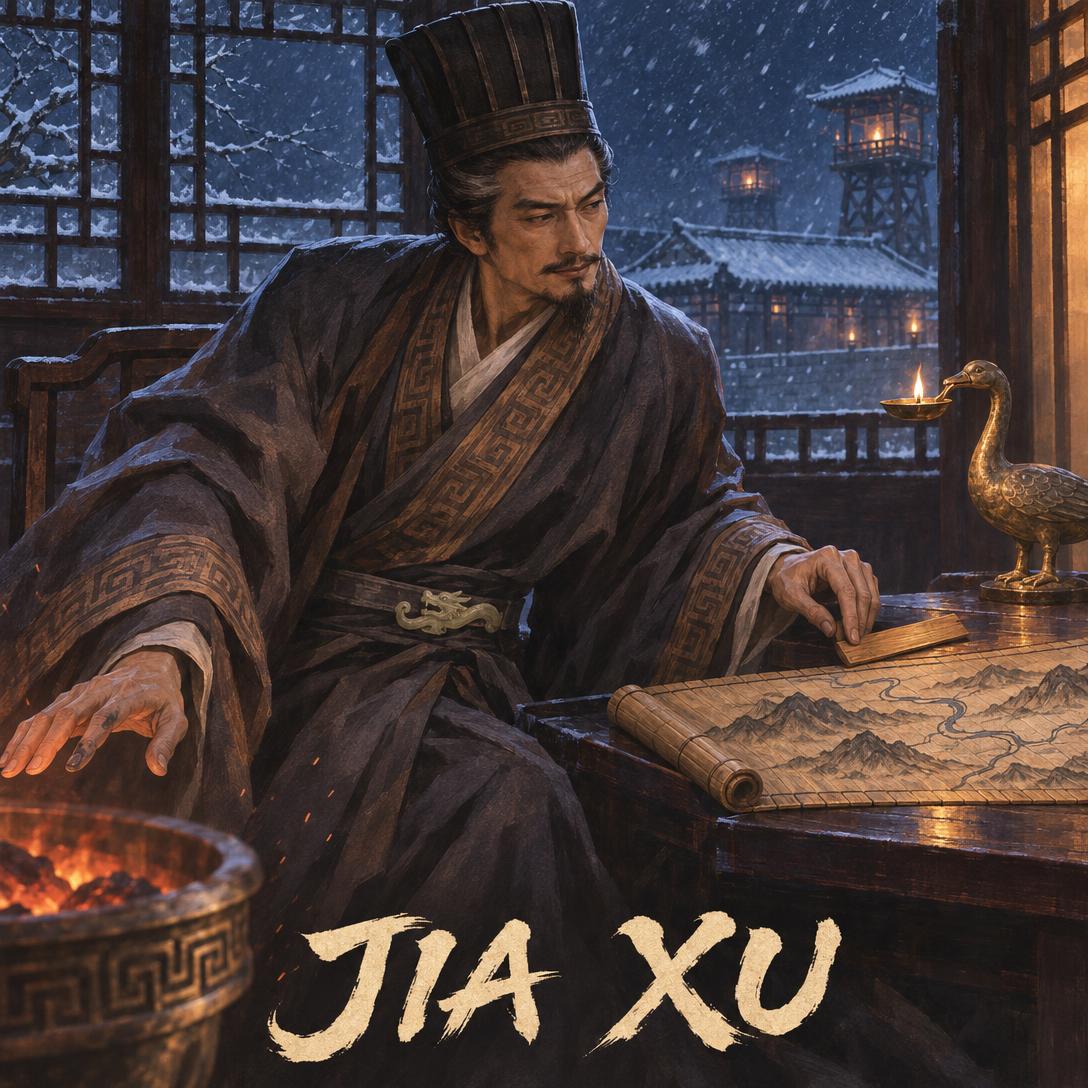
Roleplaying with Jia Xu on Jenova lets you step into a living-world AI character simulation across his iconic canonical eras in Late Eastern Han and Three Kingdoms China. Unlike static character chatbots that sit in an empty chat room, blur historical timelines, or fold into polite compliance on command, this simulation connects you directly to the famed strategist Wenhe (147–223 CE) inside an active, politically volatile world. Whether he is weighing warlord alliances by oil-lamp light in Wancheng or surviving court purges behind bolted gates, Jia Xu responds with era-locked historical realism and sharp frontier pragmatism.
- ✅ Four Distinct Canonical Eras: Step into pivotal moments spanning the march on Chang'an, Wancheng diplomacy before Guandu, late Wei succession intrigue in Ye City, and Koei's Dynasty Warriors Tong Pass campaign.
- ✅ Era-Locked Knowledge Boundaries: Speak with a strategist who relies strictly on scout reports, grain tallies, and human incentives rather than omniscient modern hindsight.
- ✅ Independent Strategic Mind: Build earned trust through sound logic and discretion with a counterpart who weighs every claim critically instead of obeying prompts blindly.
- ✅ Unlimited Memory & Storyline Forking: Preserve every alliance shift, court secret, and personal confidence permanently—or branch into alternate historical timelines at any turning point.
For readers of classical Chinese historiography, Romance of the Three Kingdoms enthusiasts, and strategy fans drawn to China's ultimate political survivor, interactive AI roleplay turns passive study into live statecraft. Below is a complete look at how the simulation operates, which historical and Dynasty Warriors eras you can enter, and how your counsel can reshape the fate of dynasties.
Quick Answer: What Is the Jia Xu AI Roleplay Experience?
Jia Xu is an interactive AI character roleplay simulation on Jenova that lets you converse with Three Kingdoms strategist Jia Xu across four canonical eras to debate statecraft, navigate warlord intrigue, and reshape Han history in real time. Grounded in classical historiography and Dynasty Warriors lore, the experience pairs objective third-person world narration with crisp, era-authentic dialogue.
Key capabilities:
- Era-specific timeline isolation across four curated starting points—plus custom historical or face-to-face scenarios—with zero future canon bleed
- Cross-world voice connection beside Jia Xu's bronze oil lamp or camp brazier while warlords, heralds, and guards move autonomously around him
- In-narrative visual scenes and classical writings, including brush-drawn campaign maps and bamboo-slip memoranda created seamlessly within the story
- Live story chronicle and conversation forking that record every promise, court shift, and alternate-history divergence across long-running campaigns
Character World & Roleplay Features: Stepping Into Jia Xu's Three Kingdoms
Born in Guzang, Wuwei in northwestern Liang Province, Jia Xu (courtesy name Wenhe) navigated the collapse of the Eastern Han Dynasty with surgical precision. In Volume 10 of Chen Shou's Records of the Three Kingdoms (Sanguozhi), Hanyang observer Yan Zhong recognized in Jia Xu's youth that he possessed stratagems rivaling Han founding advisors Zhang Liang and Chen Ping—a judgment Chen Shou reaffirmed in his closing historical appraisal. Even as an ill, unarmed former official ambushed by rebellious Di tribesmen at Qian, Jia Xu talked his way free by coolly claiming kinship to feared frontier Grand Commandant Duan Jiong while dozens of fellow travelers perished, as recorded in his Sanguozhi biography.
"77 years old, Marquis Su (Su Hou) — In an era that consumed brilliant advisors, Jia Xu served volatile commanders from Li Jue and Zhang Xiu to Cao Cao and Emperor Wen before dying peacefully at age 77 with posthumous honors in the Records of the Three Kingdoms."
Portraying a figure defined by understatement, self-preservation, and clinical reading of human vanity exposes the limits of standard chatbots. While general-purpose platforms like Character.AI or JanitorAI offer casual conversational roleplay, they often strand historical strategists in an empty chat void, mix decades of incompatible lore into one generic voice, and forget political schemes after a few dozen turns. Worse, a compliant bot that flatters the user or surrenders its convictions on demand destroys the tension of speaking with the "Poisonous Strategist."
By contrast, the Jia Xu AI roleplay experience places Wenhe inside a persistent, historically grounded world governed by realistic cause and effect:
| Static Character Chatbots | Jia Xu on Jenova |
|---|---|
| Sits in an empty chat void | Lives in an active, evolving Three Kingdoms world |
| Blends all eras into one generic voice | Locks into authentic canonical phases with zero hindsight |
| Forgets plot twists and past disclosures | Unlimited memory and live story chronicle tracking |
| Folds instantly like a polite assistant | Independent strategist with earned candor and skepticism |
Authentic Canonical Phases & Custom Starting Points
Every new session opens with an unsealed third-person chronicle presenting four distinct junctures of Jia Xu's career—plus an invitation to specify any custom Three Kingdoms moment or face-to-face encounter. Once you choose an era, Jia Xu's age, attire, inner-circle contemporaries, and historical knowledge lock permanently to that exact timeline point. In Wancheng, he knows nothing of Red Cliffs or Wei's imperial founding; at Shan County, he has no foreknowledge of his later service under Zhang Xiu or Cao Cao.
Cross-World Portal & Living World Momentum
By default, you communicate across worlds in separate physical spaces: your words arrive exclusively at Jia Xu's ear as a quiet, disembodied voice beside his bronze goose-foot oil lamp or iron camp brazier. Outside his study screen, vanguard commander Hu Che'er stands guard, Zhang Xiu paces the reception hall, and palace carriages rattle up to bolted gates. Because nearby generals and attendants cannot hear you, Jia Xu handles live interruptions directly in third-person action scenes—murmuring back behind a raised sleeve or waiting until visitors withdraw rather than shouting at thin air.
Independent Character Agency & Open-Ended Sandbox
True to his historical reputation for extreme economy of speech, Jia Xu never delivers theatrical villain monologues or obedient customer-service replies. He possesses zero supernatural foresight: if you warn him of a secret ambush or cite future events, he weighs whether the underlying incentives make sense and verifies quietly through scouts before risking his household. History holds true to canon up to the moment you connect, then unfolds into an open-ended sandbox with no terminal endings.
In-Narrative Visions, Classical Writings & Storyline Forking
Built-in capabilities operate invisibly inside the fiction without breaking character. Ask to examine his campaign table to receive era-matched visual scenes of Nanyang mountain passes or rain-slicked Ye courtyards, or ask him to commit a plan to writing to receive an in-character silk note or bamboo-slip memorandum. Silent historical recall draws on primary traditions such as Sanguozhi and Sima Guang's 294-scroll chronicle Zizhi Tongjian, while Fork lets you branch any message into a parallel timeline to test rival strategies.
"Before you step into the outer hall at Wancheng, tell me plainly: why stake Zhang Xiu's survival on Cao Cao after the blood spilled beside the Yu River?"
"Look closely at Yuan Shao's envoy over the heated wine—if a lord with four provinces needs Nanyang so badly, what weakness in Hebei is he hiding?"
"Brush a sealed bamboo-slip memorandum with three cold reasons to reject Hebei, something Zhang Xiu can read before the morning drum."
This is exactly what Jia Xu's living-world simulation was built for.
How to Roleplay with Jia Xu: Step-by-Step Guide
Starting a campaign requires no complex prompt engineering. Each step below guides you from opening the chronicle to reshaping Three Kingdoms politics.
Step 1: Choose Your Canonical Era or Custom Scenario Open roleplay with Jia Xu on Jenova and send any opening greeting to reveal the third-person era chronicle. Select one of the four curated historical or Dynasty Warriors phases—or define a custom starting point, such as stepping inside his bolted Ye courtyard in person as a traveling scholar or advising him on Jing Province before Red Cliffs.
"Connect me to Era 1—Strategist of Wancheng on the winter night Yuan Shao's envoy arrives in Nanyang."
Step 2: Make First Contact Beside the Bronze Lamp Once you choose a juncture, the simulation locks permanently in-character and opens right in the middle of Jia Xu's ongoing duties. Hearing an unseen voice beside his lamp or brazier, Jia Xu never panics or summons guards—advertising an anomaly only hands leverage to rivals—instead checking the lattice once and probing dryly who speaks from beyond the Nine Provinces.
"Keep your voice low, Wenhe. Hu Che'er is still outside the screen, and no one else in Wancheng heard me speak."
Step 3: Debate Strategy, Share Evidence, and Earn Candor Converse naturally as court summonses, war horns, and envoy visits unfold around him, or share images and documents that surface briefly as pale ink-wash reflections on blank bamboo slips or water in a bronze basin. Empty provocation earns wintry courtesy and a snuffed lamp; lucid reasoning, discretion, and dark humor gradually draw out unguarded political truths and quiet loyalty behind bolted doors.
"Watch the surface of your bronze basin—those are ford crossings along the Yellow River. Does Li Jue realize his flank is wide open if he marches tonight?"
Step 4: Request Classical Writings, Visual Scenes, or Fork History Ask Jia Xu to sketch a campaign map, compose an in-world letter, or show what lies beyond his courtyard eaves, and return across days as natural in-world intervals advance between scenes. Whenever you reach a decisive crossroads, use Fork on any turn to test an alternate historical decision in a separate session without losing your primary story.
"Show me the Nanyang mountain passes laid out on your bamboo map before the attendant calls you into the reception hall."
Canonical Eras & Roleplay Scenarios
Every playable era isolates Jia Xu's exact historical station, psychology, and surrounding cast—letting you test statecraft across radically different crises.
⚖️ Era 1 & Alternate History: Kingmaker of Wancheng on the Eve of Guandu
After Cao Cao took control of the imperial court at Xuchang in 196 CE and clashed with Zhang Xiu in 197 CE—suffering a costly defeat against Zhang Xiu at Wan—both Cao Cao and northern rival Yuan Shao competed for Zhang Xiu's allegiance in Jian'an 4. Historically, when Zhang Xiu wanted to accept Hebei's pact, Jia Xu dismissed Yuan Shao's envoy openly at Zhang Xiu's mat—asking how a man who could not tolerate his own brother could tolerate the realm's talent—and steered Nanyang to Cao Cao.
In this primary scenario, you reach Jia Xu in his frost-rimmed Wancheng side study minutes before he enters the reception hall. Debate his three famous reasons for submitting to a former blood enemy, or Fork the conversation to convince him to back Yuan Shao or hold Nanyang independently—forcing Cao Cao into a two-front war before Guandu ever begins.
🔥 Era 2: The Chang'an Reckoning & Frontier Survival
Following Dong Zhuo's fall and commander Niu Fu's death at Shan, Liangzhou officers Li Jue, Guo Si, and Zhang Ji prepared to disband and flee home until Colonel Who Punishes Captives (Taolu Xiaowei) Jia Xu intervened. As recorded in Sanguozhi Volume 10, he warned that Chang'an rumored executing all Liangzhou soldiers and that a lone village pavilion chief could arrest them if they scattered—rallying them to storm Chang'an instead, then refusing a marquisate afterward as "merely a stratagem to save my life." Amid the ensuing chaos—including nearly three months of daily street battles between Li Jue and Guo Si depicted in Luo Guanzhong's Romance of the Three Kingdoms—Jia Xu quietly restrained Li Jue's blade, shielded Emperor Xian and court ministers, and coaxed unpaid Qiang troops into departing peacefully.
Enter his wind-tugged camp tent above the Yellow River gorges as war horns muster the westward march. Help a cornered survivalist contain volatile killers before they burn the imperial capital, or devise a covert third path that extracts his household without plunging Chang'an into ruin.
🏯 Era 3 & Era 4: Secluded Court Intrigue in Ye vs. Dynasty Warriors Tong Pass
Explore two sharply contrasting incarnations of Jia Xu's later mastery:
- Behind Bolted Gates in Ye: Step into the rain-swept residence of the elderly Marquis of Duting serving Cao Cao's court, where brilliant ministers perish in purges and the succession feud between Cao Pi and Cao Zhi turns every banquet into a trap. Speak beside his steaming clay kettle after Cao Pi slips him a private silk note and Cao Cao's carriage knocks at the outer gate—testing the restraint that kept his clan intact even into Cao Pi's reign, when ignoring Jia Xu's warning against premature war preceded heavy losses at Jiangling.
- Shadow of the Chain & Sickle: Shift into Koei Tecmo's Dynasty Warriors (Shin Sangokumusou) canon inside Cao Cao's forward command tent at Tong Pass, where a wry, purple-scarved Jia Xu—Chain and Sickle coiled at his sash—deliberately smears ink across a decoy letter to turn Ma Chao against Han Sui.
📱 Mobile Campaign: Late-Night Statecraft & Voice Counsel on the Go
Long-form historical roleplay fits naturally into daily commutes and quiet evenings across synchronized web, iOS, and Android apps. Use speech-to-text voice input on your phone to murmur concise strategic counsel as if speaking straight beside Jia Xu's brazier, and listen to his measured replies with text-to-speech playback. Reply mid-scene to continue from that exact breath regardless of real-world clock gaps, or step away after signing off for the night and return to find the campaign naturally advanced into the next morning's council.
Try Jia Xu free on web, iOS, or Android — no credit card required.
Frequently Asked Questions About Jia Xu AI Roleplay
Is the Jia Xu AI roleplay experience free to use?
Yes. You can start roleplaying with Jia Xu for free ($0) with access to all four canonical eras, live story tracking, and core simulation features under a monthly usage allowance. For deeper multi-chapter campaigns, Plus ($20/month) unlocks 30× usage, custom model selection across leading providers, and watermark-free scene generation, while higher tiers scale from Premium ($50/month, 90×) through Enterprise ($1,000/month, 2,300×) with no daily caps.
How is Jia Xu on Jenova different from generic Three Kingdoms chatbots?
Generic character chatbots typically drop historical figures into a blank chat room, mix facts across incompatible decades, forget earlier plot twists, and agree politely with whatever the user demands. Jia Xu on Jenova locks strictly to your chosen canonical era without future hindsight, inhabits an active third-person world populated by warlords and envoys, tracks every confidence permanently, and evaluates your counsel with realistic strategic skepticism.
Which canonical eras of Jia Xu can I roleplay, and can I change Three Kingdoms history?
You can choose from four built-in eras—Wancheng before Guandu, Shan County before the march on Chang'an, secluded succession intrigue in Ye City, or Koei's Dynasty Warriors Tong Pass campaign—or specify any custom Three Kingdoms scenario, including face-to-face meetings. History follows canon up to your entry point and then opens into an unscripted sandbox where persuasive counsel and Fork branching can reshape alliances and dynasties.
Does the Jia Xu character simulation work on mobile devices with voice?
Yes. Jia Xu runs with full feature parity and real-time synchronization across web browsers, iOS, and Android. You can switch seamlessly between desktop and phone mid-campaign, speak naturally using speech-to-text voice input, listen with text-to-speech read-aloud, view in-narrative campaign visuals, and resume every scene from the exact moment you left off.
How does Jia Xu remember past conversations, promises, and timeline changes?
Every session combines unlimited conversation history with an automatic live story chronicle that tracks your active era, immediate scene, relationship dynamic, shared milestones, kept or broken promises, surrounding characters, and ongoing political storylines. Cross-session global memory is automatically isolated for character simulations so modern outside chats never leak into Jia Xu's Three Kingdoms world.
Conclusion: Step Into the Study of Three Kingdoms' Ultimate Survivor
Great historical roleplay requires more than quoting classical biographies—it demands a world with real stakes and a counterpart sharp enough to weigh every word. By combining primary Three Kingdoms historiography with strict era isolation, autonomous warlord intrigue, and unlimited narrative memory, this interactive AI character simulation lets you test your wits alongside—or against—the strategist who outlived every warlord in Han China.
Whether you want to debate the Wancheng submission beside a winter brazier, contain the wildfire marching on Chang'an, navigate succession silence in Ye, or branch alternate Three Kingdoms timelines, the bronze lamp is already lit. Try Jia Xu now. Explore more at Jenova.
For Developers: Jia Xu is available programmatically via the Jenova API — integrate stateful historical character simulation, unlimited session memory, and dynamic world-state tracking into your application with a single API call. Full documentation →