What Is the Best AI Jewelry Design Tool for Custom Pieces?
2026-10-06
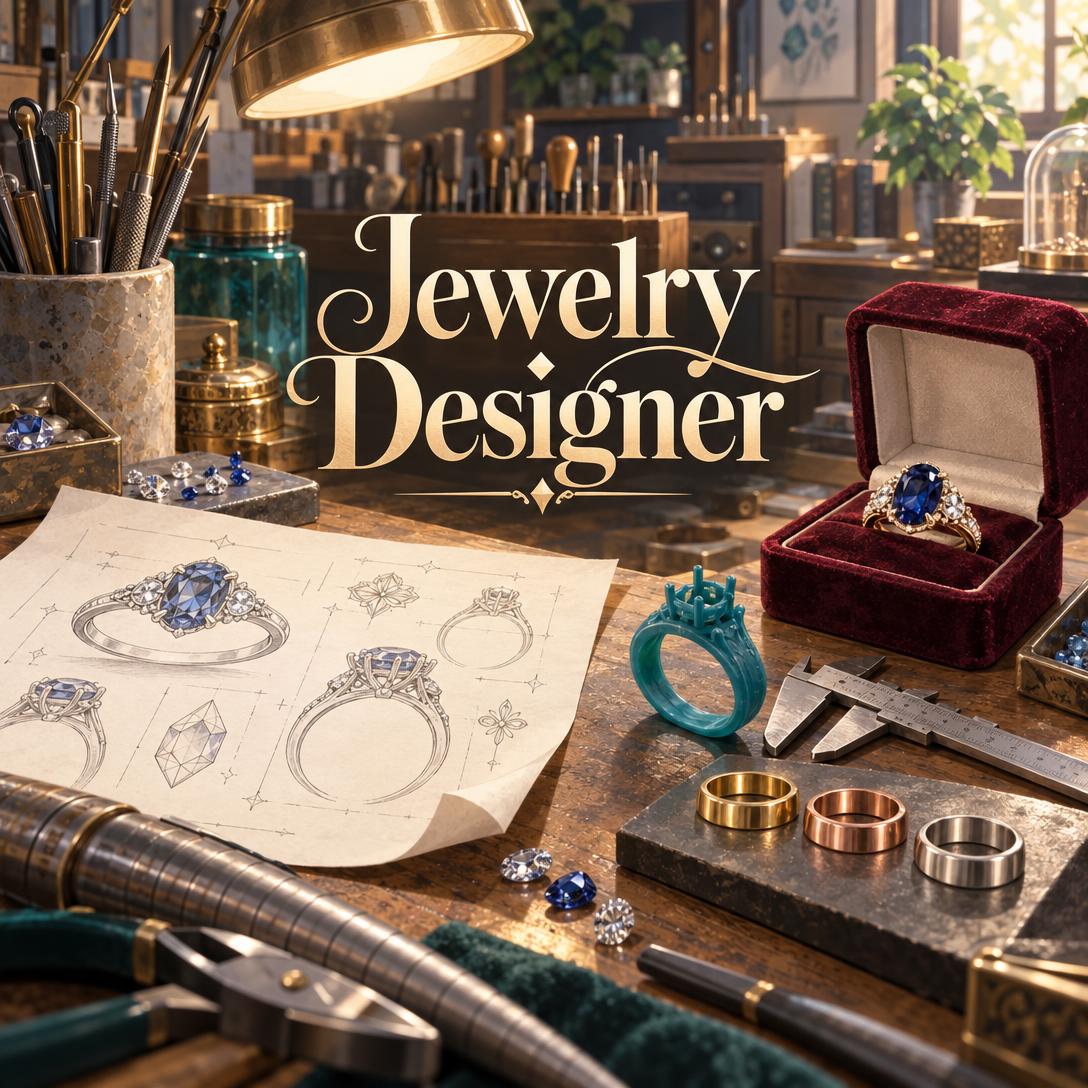
How Do AI Jewelry Designers Compare With CAD Software and Custom Jewelers on Wearability Guidance?
The right tool depends on what you need. Jewelry Designer from Jenova is strongest for turning an idea into a wearable, well-specified concept. MatrixGold by Gemvision is the professional choice for production-ready CAD models, and an in-person custom jeweler is still required to cast, set, and finish the piece.
As of 2026, these options are complementary rather than interchangeable. An AI designer handles discovery, visualization, and material counsel. CAD software handles precision geometry, at a $5,995 full license that includes Rhino 8. The bench jeweler handles physical execution.
Key factors that separate useful AI jewelry design help from generic image generation:
✅ Wearability engineering. The tool should account for ring profile height, earring weight per ear, and pendant-to-chain gauge, not just appearance.
✅ Gemstone durability counsel. It should flag stones below 7 on the Mohs scale for daily-wear rings, and brittle stones like emerald that need protective settings.
✅ Treatment and origin honesty. It should disclose common treatments and decline to certify grades or origin, which is a laboratory's job.
✅ A brief a jeweler can use. The concept should translate into a written spec covering piece type, metal, stones, dimensions, and budget range.
✅ Realistic expectations. Concepts should be presented as visual starting points, not CAD files.
To compare these tools meaningfully, it helps to start with what is driving demand for AI-assisted jewelry design.
Why Is AI-Assisted Jewelry Design Gaining Traction in 2026?
AI-assisted jewelry design is growing because demand for personalized pieces is rising, and more buyers now research and decide online before they ever reach a jeweler's counter. That shift leaves a gap between having an idea and describing it precisely enough to commission. AI design tools fill that gap.
The market context is substantial:
The global jewelry market reached $381.54 billion in 2025, and the industry is expected to grow at a CAGR of 5.41% from 2026 to 2034. McKinsey expects jewelry to be the fastest-growing fashion category by unit sales, growing four times faster than clothing.
Personalization sits at the center of that growth. Jewel360's 2026 retail analysis identifies customized and personalized jewelry as a key growth driver, particularly among younger buyers who value individuality and meaning. The same analysis reports that 78% of Americans consider ethical sourcing when buying jewelry. It also notes that direct-to-consumer ecommerce grew from 11.5% to 14.5% of the US jewelry market.
📱 Discovery Has Moved Online
As of 2023, 22% of global jewelry sales were made online, and that share continues to rise. Among Gen Z, 28% of jewelry discovery happens via social platforms. Buyers arrive with screenshots and half-formed ideas, which is exactly the input an AI designer is built to refine.
🎯 Trends Favor Customization
2026 trend data points toward bolder, more personal pieces:
- Color is surging. Sapphire jewelry is up 184%, reflecting demand for colorful statement pieces.
- Pearls are evolving. Pearls are going bold, with organic shapes and mixed materials across genders.
- Silver and geometry are rising. Industry trend reports highlight darkened sterling silver, vivid gemstone hues, bold geometric designs, and layered, stackable pieces.
- The trend list is long. Glimpse tracks 39 distinct jewelry trends in 2026. That volume makes it harder for buyers to know which styles suit a piece they plan to wear for decades.
📊 A Note on Market-Size Estimates
US market forecasts diverge sharply, so any single figure should be treated cautiously. [Renub Research puts the US jewelry market at US$105.2 billion in 2024](https://www.renub.com/united-states-jewelry-market-p.php), rising to $159.6 billion by 2033. [Verified Market Research valued it at $77.57 billion in 2023](https://www.verifiedmarketresearch.com/product/u-s-jewellery-market/), projecting $121.78 billion by 2031. That is a gap of roughly $28 billion for adjacent baseline years, a reminder that methodology shapes the headline number.
What Should You Look for in an AI Jewelry Design Tool?
Look for a tool that treats jewelry as both art and engineering. It should produce attractive visuals, but it should also tell you when a design will snag, wear unevenly, or fail under daily use. This guide evaluates every option across six dimensions, weighted differently for clients and working professionals.
| Dimension | What to Test | Weight for Clients | Weight for Professionals |
|---|---|---|---|
| Wearability engineering | Does it address profile height, comfort fit, catch points, and earring weight? | High | High |
| Material and gemstone accuracy | Does it apply hardness, toughness, and stability correctly, and disclose treatments? | High | Medium |
| Visual concept quality | Do renders look like jewelry photography rather than generic CG? | High | Medium |
| Production handoff | Does it output a usable spec, brief, or manufacturing file? | Medium | High |
| Learning curve and cost | Can a non-expert use it, and what does it cost to start? | High | Medium |
| Honesty boundaries | Does it refuse to certify grades or quote exact prices as fact? | Medium | Medium |
🧪 A Simple Stress Test
The fastest way to evaluate any AI jewelry tool is to request something structurally questionable:
"Design me an everyday engagement ring with a large opal center stone in a high six-prong setting. I work in a hospital and wash my hands constantly."
A tool built for jewelry should push back. Opal is soft, sensitive to moisture loss, and poorly suited to constant handwashing and impact, and a tall prong setting snags on gloves. A strong response proposes alternatives: a protective bezel, a lower profile, or a harder stone in a similar color family.
A generic image generator will simply render the ring. That gap shows the difference between visualization and design counsel.
How Does Jenova Jewelry Designer Compare to MatrixGold, Rhino 8, and Custom Jewelers?
Jenova Jewelry Designer leads on conversational design guidance and accessibility. MatrixGold and Rhino 8 lead on production precision. Custom jewelers remain the only option that delivers a finished physical piece. AR virtual try-on tools serve a different need: previewing existing catalog pieces.
| Dimension | Jenova Jewelry Designer | MatrixGold (Gemvision) | Rhino 8 (McNeel) | Custom Jeweler Consultation | AR Virtual Try-On |
|---|---|---|---|---|---|
| Primary output | Design concepts, written briefs, spec guidance | Parametric 3D jewelry CAD models | General 3D NURBS models | Finished physical piece | Virtual preview of existing pieces |
| Wearability and material guidance | Built-in, covering proportions, durability, and settings | Depends on user expertise | Depends on user expertise | Strong, depending on the jeweler | Not designed for this |
| Production-ready files | No | Yes | Yes | Handled in-house | No |
| Skill required | None | Jewelry design experience recommended | 3D modeling skills | None for the client | None |
| Pricing (as of 2026) | Free tier; paid plans from $20/mo | $5,995 with Rhino 8; $5,495 without | Unverified | Varies by project and region | Unverified; usually retailer-provided |
| Best For | Clients exploring ideas; professionals seeking critique and business support | Professional CAD designers and manufacturers | Designers building custom jewelry workflows | Fabrication, stone setting, final execution | Trying on catalog pieces before purchase |
💎 Jenova Jewelry Designer
Jenova Jewelry Designer works as a conversational master jeweler for two audiences. Clients get help commissioning, buying, or learning about jewelry. Working jewelers, bench workers, CAD designers, and students get technical and business support. It infers which audience you belong to from context and adjusts its tone, from patient discovery to peer-level technical shorthand.
Strengths:
- Structured design guidance. It follows a collaborative flow from Discovery to Concept and Material Direction, then Design and Visualization, then Specification and Production guidance.
- Visual concepts. It generates design images and composes prompts in the vocabulary of jewelry editorial photography rather than generic 3D-render language, which helps avoid the glossy CG look.
- Broad tradition coverage. It spans Georgian through Art Deco, Indian Kundan and Polki, Japanese mokume gane, and Navajo, Zuni, and Hopi silverwork, with cultural context included.
- Specific proportion guidance. For example, it recommends a 2mm band under a 1ct round and a 5–7mm total ring height for daily-wear round brilliants under 1.5ct.
Limitations:
- No manufacturing files. It does not produce STL, 3DM, or other files a caster can use; concepts are visual starting points.
- No certification. It will not certify stone grades or origin, and it provides pricing frameworks and ranges rather than exact quotes.
- No scheduled tasks. It cannot set recurring reminders, such as annual prong-check alerts, or monitor metal prices in the background.
- Bench work still required. Repairs, stone replacement, laser welding, and antique restoration need an in-person jeweler. The agent explains what to ask for but cannot perform the work.
🛠️ MatrixGold (Gemvision)
MatrixGold is a professional jewelry CAD suite developed by the creators of Matrix and RhinoGold, built around parametric workflows.
Strengths:
- Parametric precision. Repeatable models with technical accuracy.
- Production-ready output. Generates files suitable for 3D printing and casting.
- Customizable environment. Supports deep customization of both the interface and the models.
Limitations:
- High upfront cost. The full license costs $5,995, a significant investment for independents and hobbyists.
- Experience expected. Industry educators note that MatrixGold runs on top of Rhino and is intended for people with jewelry design experience.
- No design counsel. It models what you tell it to model; it does not advise on wearability or stone choice.
📐 Rhino 8 (McNeel)
Rhino is the general-purpose 3D modeling platform beneath MatrixGold. Its plugin ecosystem, distributed through Food4Rhino, includes jewelry-specific tools.
Strengths:
- Flexible foundation. Lets designers assemble their own jewelry workflow from plugins.
- Rendering quality. Some practitioners on the McNeel forum suggest Rhino Cycles delivers better rendering quality than MatrixGold's built-in options.
Limitations:
- Not jewelry-specific. Jewelry tools come from add-ons rather than the core software.
- Steep learning curve. It requires 3D modeling skills, with no built-in jewelry design guidance.
🏪 Custom Jeweler Consultation and AR Try-On
Traditional custom jewelers remain essential. Jewel360 notes that leading retailers now emphasize one-on-one appointments and simple customization tools, and stresses that trust and craftsmanship still drive the sale. The limitation is practical: exploration is bounded by appointment time and the jeweler's visualization tools.
AR virtual try-on, which lets customers preview jewelry on themselves using a smartphone, excels at confirming fit and scale for existing pieces. It does not help you design something new.
How Does an AI Jewelry Designer Handle Gemstone Durability and Metal Selection?
A capable AI jewelry designer evaluates every stone on three axes: hardness, toughness, and stability. It then pairs the stone with a metal and setting suited to how the piece will actually be worn. This is where design counsel separates from image generation.
💠 The Three-Factor Durability Check
- Hardness (Mohs scale). Stones below 7 are generally poor choices for daily-wear rings and bracelets.
- Toughness. Emerald is hard but brittle, so it needs protective settings such as a bezel.
- Stability. Opals need moisture, tanzanite is heat-sensitive, and pearls are acid-sensitive. Each changes both the design and the care routine.
Jenova Jewelry Designer also treats treatment disclosure as non-negotiable. It explains common treatments (heat for sapphire, ruby, and tanzanite; oiling or resin filling for emerald; irradiation for blue topaz; coatings for mystic topaz) and how each affects value and durability. It distinguishes natural diamonds, lab-grown diamonds, moissanite, and cubic zirconia as separate categories and never conflates them.
🥇 Metal Trade-Offs in Practice
| Metal | Strength | Watch-Out |
|---|---|---|
| Platinum | Densest, hypoallergenic, ideal for prong-set valuable stones | Heaviest and highest cost; develops a patina |
| 14K gold | Best balance of durability and color (58.3% pure) | Industry standard in North America |
| 18K gold | Richer color (75% pure), good for detailed settings | Softer than 14K |
| White gold | Modern look for diamond settings | Rhodium plating wears; nickel alloys are not hypoallergenic |
| Titanium / tungsten | Lightweight (Ti) or very hard (W) | Cannot be resized traditionally |
🧭 How to Ask for Material Guidance
The most useful prompts describe lifestyle, not just aesthetics:
"I want a sapphire anniversary ring. I garden on weekends and have a mild nickel sensitivity. Budget is around $4,000. What metal and setting would you recommend?"
A strong response would steer away from nickel-based white gold. It would suggest platinum or a palladium-based alloy, recommend a bezel or low six-prong setting for gardening, and explain how to split the budget between stone quality and metal weight.
Can AI-Generated Jewelry Concepts Be Turned Into a Real Piece?
Yes, but an AI concept is the first stage of production, not the last. It becomes a real piece only after CAD modeling or wax carving, casting, stone setting, and finishing by a skilled jeweler, a process that typically takes 4–8 weeks from consultation to finished piece.
🔄 Where the AI Concept Fits in the Pipeline
- Concept and sketching. The AI designer is strongest here.
- CAD/CAM modeling. MatrixGold, Rhino, 3Design, or ZBrush for organic forms.
- Wax. Either hand-carved for sculptural pieces or 3D-printed castable resin.
- Prototyping. Physical try-on to verify fit and weight.
- Casting or fabrication. Fabrication from sheet and wire produces denser metal for wide cuffs and forged rings.
- Stone setting. Handwork under magnification.
- Finishing and quality control. Polish, texture, hallmarking, and stone security testing.
CAD and hand carving are complementary, not competing. CAD excels at precision and repeatability. Hand carving excels at organic, sculptural forms, and many pieces combine both.
📝 Handing Off to Your Jeweler
Jenova Jewelry Designer can structure your concept into a design brief any jeweler can work from. The brief covers piece type, style, metal (alloy, karat, finish), stones (type, cut, quality, quantity), dimensions, the occasion and its meaning, elements to include or avoid, and budget range. It can export that brief as a PDF.
To hand off a concept:
- Finalize the visual concept and confirm the material direction.
- Ask the agent to compile a brief:
"Turn our final design into a one-page brief I can send to a custom jeweler, including dimensions and stone specs."
- Share the brief and concept images with your jeweler or CAD designer, who models it in software like MatrixGold.
- Review the jeweler's CAD render against the brief before wax or printing begins.
How Can Professional Jewelers Use an AI Design Partner?
Working jewelers use AI design partners for three jobs that CAD software does not do: structured design critique, business problem-solving, and fast visual ideation for client presentations. With professionals, Jenova Jewelry Designer shifts to a direct, peer-level technical tone.
🔍 Five-Point Design Critique
When reviewing a design or photo, the agent evaluates it in a fixed order:
- Structural integrity. Metal thickness, prong adequacy, stress points.
- Proportions and wearability. Scale on the body, comfort, catch points, weight distribution.
- Material choices. Whether the metals and stones fit the application and price point.
- Style coherence. Whether every element supports the design intent.
- Craftsmanship. Setting quality, finish consistency, detail execution.
Feedback follows a consistent pattern: what works, what needs attention, and specific suggestions.
💼 Business and Sourcing Support
The agent works through pricing using a materials, labor, overhead, and margin framework, along with deposit structures and revision scope for custom work. It covers ethical sourcing standards, including the Kimberley Process, the Responsible Jewellery Council, and CIBJO guidelines. It also advises on recycled metals and lab-grown disclosure.
Independent designers selling online often pair it with related Jenova agents:
- Etsy Business Advisor for listing optimization and pricing.
- Product Photo Editor for background editing and retouching of jewelry photography.
- Jewelry Expert for stone identification and valuation guidance when sourcing or appraising.
This is not a replacement for CAD. Designers already fluent in MatrixGold will still model there. The AI partner sits upstream (ideation, client discovery) and alongside (critique, pricing) the CAD workflow.
How Do You Get Started Designing a Custom Piece With AI?
Start by describing the person and the occasion, not the stone. Effective jewelry design begins with how the piece will be worn and what it means, and the best AI tools are built around that discovery step.
Getting Started With Jenova Jewelry Designer
- Open Jewelry Designer at jenova.ai/a/jewelry-designer.
- Describe the occasion, wearer, lifestyle, and budget:
"I'm designing a 10th anniversary pendant for my wife. She loves Art Deco, wears jewelry daily, works as a nurse, and her existing pieces are mostly yellow gold. Budget is $2,500–3,500."
- Review the recommended materials and trade-offs, then confirm a direction.
- Request visual concepts and iterate with specific changes:
"Keep everything the same but make the bail slimmer and switch the accent stones to calibré-cut sapphires."
- Switch image generation models with the App button beneath the chat input, since different models render metal and stone differently.
- For engagement or wedding jewelry, invite a partner or family member through Group Chat from the Settings menu so they can join the same session.
Jenova offers a free tier with limited usage. Paid plans start at $20/month (Plus, 30× the free usage). Persistent memory carries your design concept across sessions.
Getting Started With MatrixGold
- Choose a license. As of 2026, the Rhino-bundled license is $5,995, including a Rhinoceros 8 license, a six-month MatrixGold membership, and technical support.
- If you are a student, check eligibility for the student license at $299 or $399, with an optional six-month renewal at $149.
- Existing users can review MatrixGold 4 upgrade options, starting at $1,290.
- Work through Gemvision's MatrixGold overview video, which covers UI customization, parametric modeling, and rendering.
What Do Jewelry Design Experts Say About AI-Assisted Design?
The consensus among practitioners is that AI is most valuable before CAD and after the client conversation begins. It is useful for clarifying intent, catching structural problems early, and producing a brief precise enough that the bench jeweler builds the right piece the first time.
"The most expensive mistakes in custom jewelry happen at the concept stage, not the bench. A client falls in love with a render of a tall six-prong opal ring, the jeweler builds it, and six months later the stone is chipped. We designed Jewelry Designer to interrupt that moment by asking about lifestyle before style, and flagging durability issues while changes are still free."
"Wearability details are what separate jewelry that photographs well from jewelry that lives well on the body. Drop earrings over roughly 8–10 grams per ear become uncomfortable for extended wear without lever-backs or thicker posts. A heavy pendant on a chain thinner than about 1.5mm will kink. None of these show up in an image, so an AI tool that only generates images is solving half the problem."
"We are deliberate about what the agent won't do. It won't certify a stone's grade or origin, because that is a gemological laboratory's role. It won't quote exact prices as fact, because metal costs move and labor varies by region. Those boundaries are part of why a concept from the agent is trustworthy when it reaches a real jeweler."
"Our view is that AI concepting, CAD, and hand craftsmanship form a pipeline, not a competition. The goal is a better first conversation with your jeweler, not skipping that conversation."
— Jenova Product Team, AI Agent Design — 8 years in AI agent design
References
- Gemvision — MatrixGold Professional 3D CAD for Jewelry Design, licensing and pricing
- Jewel360 — 10 Key Jewelry Industry Trends: 2026 Market Insights
- Whidegroup — Jewelry Ecommerce Trends: How to Adapt in 2026
- Trendalytics — The Bold and Brilliant: The Hottest Jewelry Trends of 2026
- Mvraki — Predicting Jewelry Trends 2026: A Practical Guide
- LinkedIn (HALIFE Jewelry Co.) — 2025-2026 Jewelry Trends: Colors, Styles, and Materials
- Glimpse — Top 39 Jewelry Trends of 2026
- Renub Research — U.S. Jewelry Market Trends, Growth & Forecast
- Verified Market Research — U.S. Jewellery Market Report: Size, Growth, Trends
- Food4Rhino — MatrixGold plugin overview and parametric workflows
- PJ Chen Design — "Should I learn Rhino or MatrixGold?"
- McNeel Forum — MatrixGold rendering discussion
- Stuller — MatrixGold by Gemvision, 3D Jewelry Design Software licensing
- Gemvision — MatrixGold Student License Eligibility & Pricing
- Gemvision — MatrixGold Latest Version, Features & Upgrade Pricing
- YouTube (Gemvision LLC) — MatrixGold Overview: Explore Next-Level Jewelry CAD Software