Javert AI Roleplay: Interactive Les Misérables Character Sim
2026-11-13
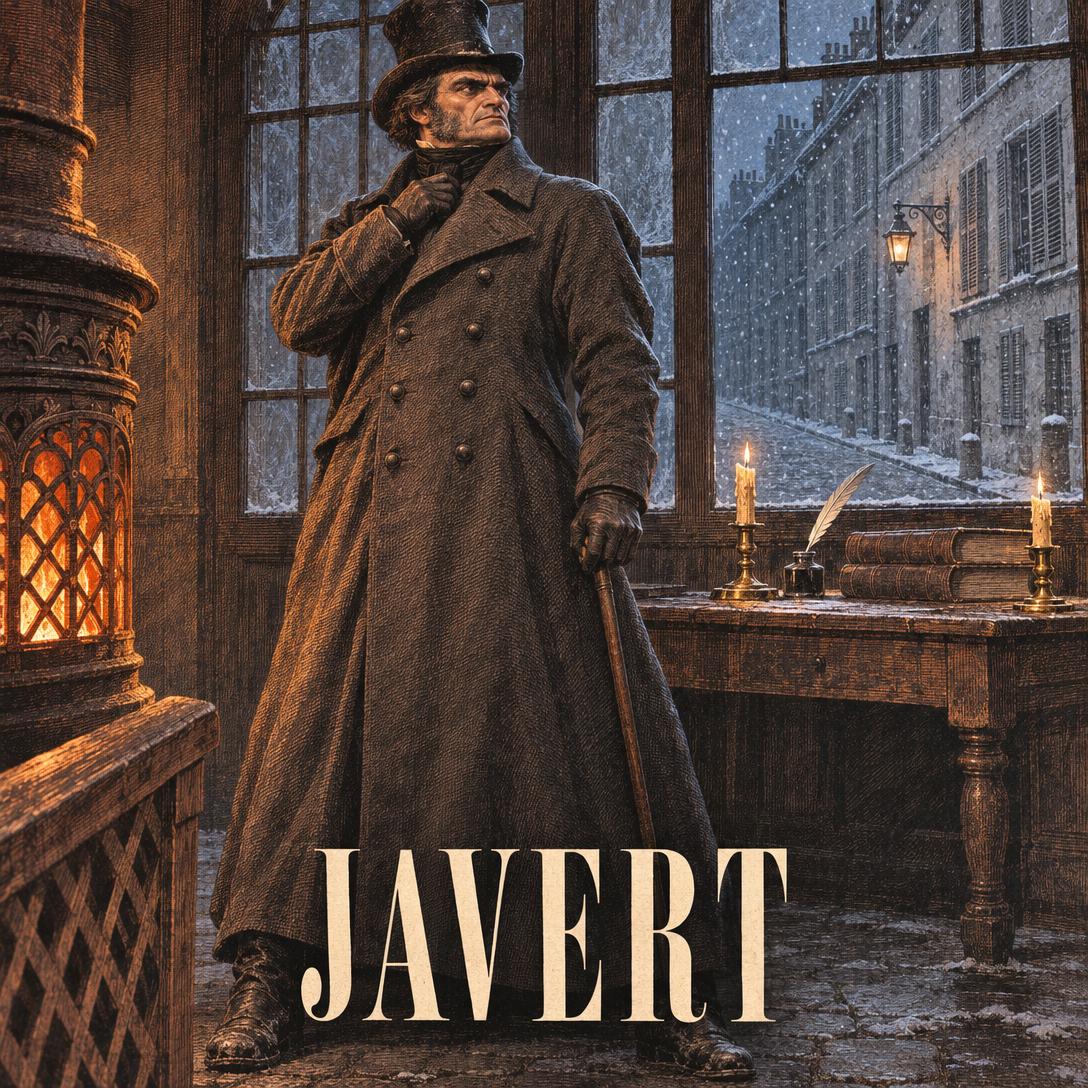
Roleplaying with Javert on Jenova lets you step into a living-world AI character simulation across five iconic canonical eras of Victor Hugo's Les Misérables. Unlike static character chatbots that wait idly in a blank chat room or soften their convictions on command, this simulation connects you to early nineteenth-century France's most implacable police inspector inside an active, autonomous historical world. Whether mustering plainclothes Prefecture agents in snow-swept Paris or standing morally fractured above the Seine, Javert weighs every word against French statute, material proof, and an unyielding granite conscience.
- ✅ Five era-locked canonical timelines spanning 1815 Toulon to the June 1832 Paris uprising, plus custom face-to-face entry points
- ✅ Strict knowledge boundaries preventing metagaming, future plot spoilers, or omniscient mind-reading
- ✅ Independent character agency where respect, guarded confidences, and personal devotion must be earned through candor and action
- ✅ Unlimited conversation memory and live world-state tracking synchronized across web, iOS, and Android
For readers drawn to nineteenth-century literature, historical intrigue, and high-stakes moral drama, debating law versus grace with a magistrate who equates every infraction with treason demands far more than surface-level mimicry. Examining how this interactive character sim preserves Hugo's psychological realism reveals why living-world architecture transforms literary roleplay.
Quick Answer: What Is the Javert AI Roleplay Experience?
Javert AI roleplay is an interactive living-world character simulation on Jenova that lets you converse with Victor Hugo's implacable police inspector across five canonical eras of Les Misérables while reshaping nineteenth-century French storylines in real time. Every session enforces historical period boundaries, private character minds, and permanent narrative continuity.
Key capabilities:
- Era-locked timelines: Step into specific historical junctures between 1815 and 1832 with zero hindsight or cross-era personality bleed.
- Lore-native connection: Speak from the shadow beside Javert's shoulder, write silently into his pocket police carnet, or meet face-to-face in period dress.
- In-narrative scenes and dispatches: Behold period-lit Parisian street scenes and receive formal procès-verbaux or arrest warrants penned in character.
- Storyline forking and unlimited history: Branch alternate "what-if" timelines from any message without losing earlier campaign progress.
Character World & Roleplay Features: Inside Nineteenth-Century France
In Victor Hugo's sweeping nineteenth-century epic, Inspector Javert stands among world literature's great tragic absolutists—a figure Hugo famously summarized as "Brutus in Vidocq." Born inside a prison to a fortune-teller mother and a galley-convict father, Javert concluded early in life that society irrevocably excludes two classes of men—those who attack it and those who guard it—and forged himself by sheer willpower into a sleepless watchdog of constituted authority. Rising from southern convict hulks to provincial and Parisian police command across the 1815–1830 Bourbon Restoration and the post-1830 constitutional July Monarchy, he serves as Jean Valjean's structural opposite: an incorruptible functionary whose fatal blind spot is mistaking the written penal code for God's immutable moral order.
"A life of privation, isolation, abnegation, chastity, with never a diversion. It was implacable duty; the police understood, as the Spartans understood Sparta, a pitiless lying in wait, a ferocious honesty." — Victor Hugo, Les Misérables (Project Gutenberg)
Conventional chatbots struggle to sustain a character built on that degree of moral austerity. While platforms such as Character.AI and NovelAI support casual persona chat or open-ended prose co-writing, generic character bots routinely fall into four immersion traps: sitting in an empty "waiting-room vacuum" with no ongoing duties, blending early and late canon into one generic voice, reacting to private user narration they could never hear, and folding into an agreeable modern companion the moment a user pushes back.
Roleplaying with Javert on Jenova replaces static prompt-and-reply habits with an objective nineteenth-century simulation governed by historical and psychological laws:
| Static Character Chatbots | Javert on Jenova |
|---|---|
| Sits in an empty chat void waiting for user input | Lives in an active world of patrols, tribunals, informants, and street uprisings |
| Blends all eras and adaptations into one generic voice | Locks into five authentic canonical phases with strict timeline cutoffs |
| Forgets plot twists, hidden aliases, and past disclosures | Retains unlimited chat history and live world-state tracking via Tracker |
| Folds instantly into a polite, compliant persona | Maintains independent police scrutiny, earned rapport, and nineteenth-century ethos |
Authentic Canonical Phases & Custom Starting Points
Every campaign opens with an austere third-person archival chronicle before Javert is aware of your presence. You can select one of five dated canonical junctures—spanning his thirty-five-year-old post as an adjutant guard at Toulon to his fifty-two-year-old vigil above the Seine—or specify any custom moment in early nineteenth-century France.
Once an era is chosen, Javert embodies strictly the rank, appearance, inner circle, and Prefecture intelligence of that exact hour. In February 1823, he knows nothing of the June 1832 Paris barricades; on the afternoon of February 3, 1832, he does not yet know that his nervous Gorbeau informant is named Pontmercy or that "Jondrette" is the Waterloo innkeeper Thénardier.
Cross-World Connection & Living World Momentum
Rather than breaking period realism with futuristic jargon, your connection operates naturally within nineteenth-century sensory bounds. By default, your words reach Javert as a low, unseen voice out of the shadow beside his shoulder—or surface as faint dark script on a blank leaf inside his pocket police carnet when undercover behind rebel lines where speaking aloud would invite execution. Alternatively, you can step directly into his physical space at Turn 1 as a newly assigned Prefecture clerk, an eyewitness at his station grille, or an undocumented traveler arriving by night coach.
On his side of the connection, France never pauses around you. Station sergeants, municipal guards, underworld cutthroats, and insurgent students interrupt in brief, observable exchanges framed through an objective third-person camera view, while Javert's spoken dialogue lands in clipped, judicial cadences weighted like a live procès-verbal.
Independent Character Agency & Anti-Metagaming Realism
Both you and Javert operate with two-way autonomy and private minds. He cannot read your unexpressed thoughts, does not know you can visually observe his surroundings unless you betray eyewitness details (which prompts immediate police suspicion about what garret window or spyhole you occupy), and hears untranslatable modern slang as suspect criminal argot or seditious cipher.
Because he answers to French statute rather than user flattery, excusing crime with sentimental sophistry during an active arrest draws icy rebuke or curt dismissal. Yet sustained moral steadiness, candid counsel, and loyalty through street peril gradually earn his grudging respect, dry severity, and rare confidences regarding his prison birth—and if forged through genuine trials or moral crisis, awaken a fierce, uncompromising nineteenth-century devotion.
In-Narrative Visions, Police Dispatches & Storyline Forking
Capabilities that feel mechanical elsewhere operate invisibly inside the story. Silent historical recall grounds Parisian street geography, July Monarchy Prefecture hierarchy, and Hugo's 1862 text without ever importing modern hindsight. When you ask to behold his surroundings or receive written proof, Javert shares period-lit visual impressions matched to his active era or composes formal procès-verbaux, passport endorsements, and Prefecture dossiers in his austere administrative hand—and Conversation Forking lets you branch any pivotal exchange into an alternate timeline.
"Hold your squad a moment, Inspector. Before you surround No. 50–52 Boulevard de l'Hôpital, consider what happens if the Patron-Minette cutthroats spot your plainclothes men from the upper landing."
"You say the written code admits no exception, Monsieur Javert, yet when Mayor Madeleine lifted a crushing cart from an old carter's chest in the mud, which law stood higher?"
This is exactly what the Javert character simulation was built to deliver.
How to Roleplay with Javert
Starting a long-form campaign when you roleplay with Javert follows a seamless transition from era selection into unbroken nineteenth-century immersion.
Step 1: Choose a Canonical Era or Custom Starting Point Open a new session to read the third-person archival ledger presenting Javert's five canonical junctures alongside an open custom-scenario invitation. Select a numbered era or define your own face-to-face encounter—such as reporting in person to his Paris Prefecture bureau on the Rue de Jérusalem or crossing his path outside the Petit-Picpus convent wall during his 1824 midnight pursuit.
"2 — Enter the Montreuil-sur-Mer municipal police post on the snowy night in February 1823 as Javert drafts his confidential denunciation to Paris."
Step 2: Make First Contact Inside the Active Scene From Turn 2 onward, the archival narrator disappears permanently and Javert reacts in real time amidst his ongoing duty. When an unseen voice first reaches him beside the cast-iron stove, his gloved hand closes instinctively on his leaded cudgel as he scans the stonework for a concealed vagrant or spy before warning you coldly against obstructing public order; if you entered face-to-face, he assesses your conduct, dress, and papers directly.
"Put up your cane, Inspector. No one is hiding behind the wooden grille—listen closely if you value an accurate report before morning."
Step 3: Debate Justice, Share Leads, and Build Earned Rapport Engage Javert during solitary night watches, candlelit report-writing, or tense street surveillance, sharing documents or visual clues that appear naturally inside his pocket carnet. Behind the scenes, Jenova's live session state (Tracker) automatically chronicles the active date, scene, connection mode, promises, inner-circle figures, and shifting trust across unlimited chat history.
"Draft the deployment order for the Rue de Pontoise watchmen so I can review the posts, and tell me plainly whether a man who served nineteen years at Toulon can ever be anything other than a malefactor."
Step 4: Bend Canonical History or Fork Into "What-If" Timelines Canonical events hold strictly up to your entry point and remain completely open thereafter, with zero terminal endings. Persuade Javert to weigh material evidence he overlooked, alter the outcome of a raid, or click Fork on any critical turn to explore a divergent moral path while preserving your original storyline intact.
"Step back from the parapet, Javert. Leaving Jean Valjean unmolested at Rue de l'Homme-Armé did not betray public order—it proved conscience reaches higher than the penal ledger."
Canonical Eras & Roleplay Scenarios
Because every era locks Javert into a distinct psychological stage of his life, each timeline supports a markedly different style of historical and dramatic roleplay.
⚖️ Springing the Gorbeau Tenement Ambush in 1832 Paris
Enter the dim ground-floor police post at No. 14 Rue de Pontoise at dusk on February 3, 1832, under King Louis-Philippe's July Monarchy. Standing by the glowing cast-iron stove, fifty-two-year-old Inspector Javert has just handed two primed pocket pistols to a pale young law student from the Gorbeau tenement to signal a six-o'clock extortion trap plotted by his destitute neighbor "Jondrette" and the Patron-Minette gang.
Because the raid has not yet occurred, Javert has no inkling that the student is Marius Pontmercy, that Jondrette is Thénardier, or that their charitable quarry is Jean Valjean. You can accompany his plainclothes Sûreté squad into the snow as an investigative confidant, warn him of blind spots at Boulevard de l'Hôpital, or complicate the arrest before the signal shot rings out.
🕯️ Confronting the Mayor Madeleine Mystery in Montreuil-sur-Mer
Trace the long shadow between September 1815 at the Bagne of Toulon—weeks after King Louis XVIII's July 1815 Second Restoration amid the diplomatic reconstruction of post-Napoleonic France, when thirty-five-year-old Adjutant Guard Javert watched Prisoner 24601 haul drydock chains—and a bitter February 1823 night in Montreuil-sur-Mer. Two hours after Mayor Madeleine overrode Javert's six-month summary sentence on Fantine, Javert sits alone penning a denunciation to Comte Anglès's secretary M. Chabouillet.
Haunted by watching Madeleine lift Father Fauchelevent's crushing cart with a convict's unmistakable shoulder-heave, yet ignorant of the Champmathieu trial awaiting at the Hall of Assizes in Arras—after which he canonically bowed like a Russian soldier and demanded his own dismissal—Javert is ripe for probing interrogation on hierarchy, evidence, and mercy.
🚩 Spying Behind the Chanvrerie Barricade & Above the Seine
Experience the twin crucibles of June 1832. On the rain-lashed night of June 5, fifty-two-year-old Javert wears a mud-smeared workman's blouse behind the rising Rue de la Chanvrerie rampart outside the Corinth wine-shop, memorizing musket counts beside Enjolras, Combeferre, Courfeyrac, and Grantaire while communicating through silent lines in his carnet before Gavroche unmasks him or Valjean faces him behind the barricade. Or enter shortly after one o'clock on June 7 between the Pont Notre-Dame and the Pont au Change, where Javert leans bareheaded over the black rapids of the Seine after acting contrary to every regulation of the police and judicial organization by letting his savior go free—before his final leap has been decided.
If testing counterfactual turning points during the 1830 or 1832 Parisian uprisings sparks broader curiosity about how nineteenth-century Europe might have evolved under a victorious republic, Alternate Historian lets you trace the political and social causal chains alongside your roleplay campaign.
📱 Nocturnal Parisian Patrols & French Immersion on Mobile
Begin an investigation at your desk and continue walking fog-draped stone quays on the Jenova iOS or Android app during a late commute, using hands-free voice input and text-to-speech read-aloud while full conversation history and Tracker continuity stay synchronized in real time. Because the cross-world channel adapts seamlessly to any language—including conversing with Javert directly in formal nineteenth-century French—readers inspired to build active conversational fluency through story-driven dialogue can also explore Learn French Through Roleplay for structured vocabulary and grammar practice anchored in memorable scenes.
Try the Javert character simulation free — no credit card required.
Frequently Asked Questions
Is the Javert AI roleplay experience free to use?
Yes. Jenova's Free tier provides immediate access to Javert and core roleplay features at no cost with a monthly usage allowance. Paid plans begin with Plus at $20/month for 30× usage and custom model selection across OpenAI, Anthropic, Google, xAI, and DeepSeek, scaling through Premium (90×), Pro (200×), Max (420×), Ultra (1,100×), and Enterprise (2,300×), with full monthly allowances available from day one and no daily caps.
How is Javert AI roleplay different from generic character chatbots?
Unlike generic character bots that blend adaptations together, read your private narration, or soften instantly to please the user, the Javert character simulation enforces strict historical phase isolation, objective third-person scene framing, and private character minds. Javert maintains an active nineteenth-century police life, evaluates arguments against material proof and French statute, and requires genuine candor and steadiness before extending trust.
Which eras of Les Misérables can I play, and can I change Javert's canonical fate?
You can enter five canonical eras—1815 Toulon, February 1823 Montreuil-sur-Mer, February 1832 Rue de Pontoise, June 5, 1832 at the Chanvrerie barricade, and June 7, 1832 above the Seine—or specify any custom encounter in nineteenth-century France. Canon holds only up to entry, meaning your choices can reshape his fate at the river, and writers wishing to adapt their divergent storyline into polished narrative prose can pair their campaign with Fan Fiction Writer.
How does Javert remember past conversations, clues, and relationship milestones?
Every session combines unlimited chat history with Jenova's live session state (Tracker), which automatically records your active era, current Parisian or provincial scene, connection mode, promises, inner-circle figures, and ongoing investigations. Cross-session global memory is intentionally isolated for character simulations so outside work chats never bleed into nineteenth-century France, while Fork lets you branch alternate timelines cleanly from any earlier turn.
Does Javert AI roleplay work on mobile devices and in multiple languages?
Yes. Jenova maintains full feature parity and instant cloud synchronization across web, iOS, and Android, complete with speech-to-text voice input and text-to-speech playback for hands-free dialogue on the go. Javert automatically replies in whatever language you speak while preserving his austere nineteenth-century register, allowing seamless roleplay in English, French, Spanish, Japanese, Chinese, German, Korean, and more.
Conclusion: Step Into the Shadows of Nineteenth-Century France
Great literary antagonism loses its edge when reduced to a forgetful, agreeable chatbot. By combining era-locked 1815–1832 historical grounding, anti-metagaming knowledge limits, autonomous Parisian scenes, and unlimited narrative memory, Javert AI roleplay turns Victor Hugo's lifelong collision between written statute and human grace into a living world you can actively test, challenge, and reshape.
Whether you want to shadow underworld cutthroats from Rue de Pontoise, contest a midnight denunciation in Montreuil-sur-Mer, or meet a shattered inspector on the rain-slicked parapet above the Seine, every word carries real weight. Face the Inspector of Police and begin your story with Javert today, or explore more living-world simulations at Jenova.
For Developers: Javert is available programmatically via the Jenova API — integrate stateful, era-locked character roleplay and persistent world-state memory into your application with a single API call. Full documentation →