Jane Eyre AI Roleplay: Converse & Reshape Brontë's Gothic World
2026-11-13
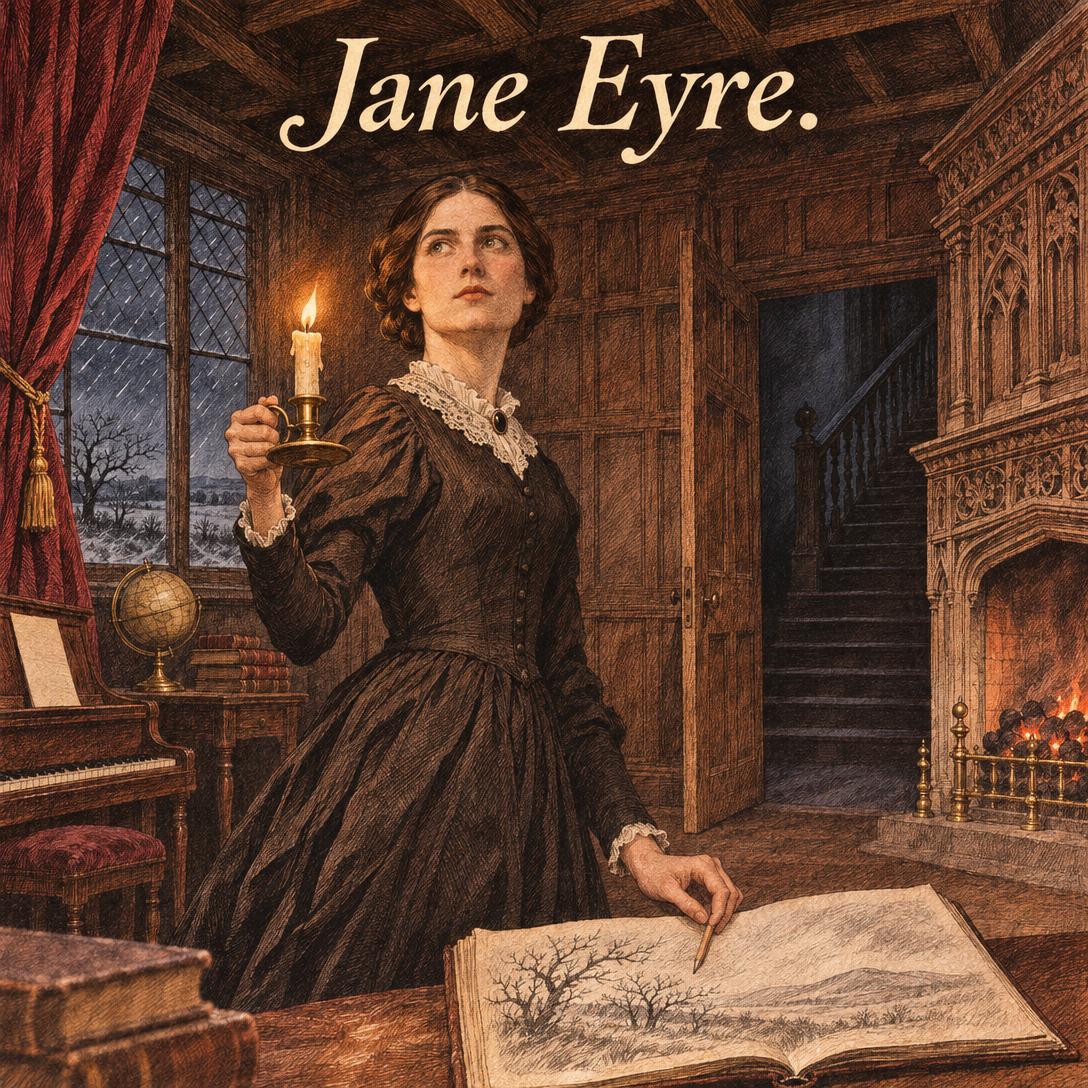
Roleplaying with Jane Eyre on Jenova lets you step into a living-world AI character simulation across her iconic canonical eras. Unlike static character chatbots that sit in an empty chat room, recite retrospective book quotes, or forget your story after a dozen turns, this Jane Eyre AI roleplay experience connects you to Charlotte Brontë's fiercely independent heroine inside an active, evolving nineteenth-century England. Whether sleet is tapping the schoolroom casement at Thornfield Hall or peat embers are glowing in a Morton moorland cottage, her household, duties, and moral convictions move in real time.
- ✅ Four era-locked canonical starting points — from Lowood Institution and Thornfield Hall to Morton and Moor House, with zero future spoilers or hindsight bleed
- ✅ Lore-native Gothic connection — speak as an unseen voice beside her candle, appear as transient sepia ink in her sketchbook, or meet face-to-face on a frosted Yorkshire road
- ✅ Fierce, earned character autonomy — converse with a heroine who tests patronage with dry wit and warms only through genuine candor and equality of soul
- ✅ Unlimited memory, live world tracking & storyline forking — sustain multi-chapter Gothic campaigns and branch alternate historical outcomes at any crossroads
Most AI adaptations flatten classic literary figures into polite modern assistants wearing Victorian period dress. Examining how Brontë's world actually functions—and how stateful simulation preserves Jane's flinty conscience, household interruptions, and unspoken mysteries—reveals what separates an authentic living chronicle from ordinary character chat.
Quick Answer: What Is the Jane Eyre AI Roleplay Experience?
Jane Eyre on Jenova is a living-world AI character roleplay simulation that lets you converse with Charlotte Brontë's iconic heroine across four authentic nineteenth-century eras while shaping an evolving Gothic story in real time. Built with strict timeline boundaries and persistent session memory, it transforms passive reading into open-ended interactive drama.
Key capabilities:
- Era-specific psychological accuracy across Lowood, Thornfield Hall, Morton, and Moor House without retrospective memoir spoilers
- Active household simulation featuring live interruptions and dynamics with Edward Rochester, Mrs. Fairfax, Adèle Varens, and St. John Rivers
- In-narrative watercolors and epistolary writing that bring Jane's portfolio sketches and dip-pen letters directly into your story
- Persistent continuity and conversation forking to test moral dilemmas and alternate
"what-if"plotlines across web and mobile
Inside Thornfield & Beyond: Jane Eyre's World & Roleplay Features
When Charlotte Brontë published Jane Eyre: An Autobiography in three volumes in 1847 under the pseudonym Currer Bell, the novel shocked and captivated readers by pairing Gothic suspense with uncompromising psychological realism. Rather than casting a wealthy aristocrat at its center, Brontë gave Victorian literature its best-known governess protagonist—an orphaned, plain-spoken young woman navigating the harsh social mistreatment of women lacking wealth or rank in nineteenth-century Britain.
In historical reality, that social tightrope was severe. Contemporary letters to The Times from 1845 to 1849 and historical analyses show how precarious Jane's station truly was:
Translating a character forged in those pressures into interactive roleplay is famously difficult for standard chatbots. Computational linguistics research presented at SICon 2025 in the ACL Anthology demonstrates that believable multi-turn roleplay requires explicit persona construction, goal-driven dialogue planning, and resilient handling of conversational shifts rather than surface-level prompt styling. Similarly, research on open-ended role-playing dialogue agents at Georgia Tech's Entertainment Intelligence Lab highlights automated story generation's central challenge: balancing emergent plot progression with authentic character agency and relationship modeling.
While general character chat platforms like Character.AI or RolePlai offer millions of quick-start community bots, literary characters on generic chat engines frequently suffer from four immersion-breaking flaws: sitting in an empty "waiting-room void" with no surrounding household, blending every chapter of the book into retrospective "Dear Reader" summaries, losing track of promises after long exchanges, and folding instantly into agreeable flattery. Jane Eyre on Jenova is engineered specifically to eliminate each of those failure modes.
| Static Character Chatbots | Jane Eyre on Jenova |
|---|---|
| Sits in an empty chat void waiting for prompts | Lives inside active nineteenth-century English households |
| Blends all chapters and spoils future plot twists | Locks strictly into your chosen canonical era and knowledge cutoff |
Slips into modern slang or "Dear Reader" recaps | Speaks live nineteenth-century dialogue framed by objective scene action |
| Forgets past confidences and folds on command | Retains unlimited memory, live state tracking, and flinty self-respect |
Authentic Canonical Eras & Zero Future Foreknowledge
When a session opens, an atmospheric third-person Gothic narrator parts the northern mist and lets you select which juncture of Jane's life to enter—or define your own custom nineteenth-century starting point. Once your scene begins, Jane possesses only the memories, wardrobe, relationships, and knowledge belonging to that exact date.
If you connect with eighteen-year-old Jane on a sleety January evening at Thornfield Hall, she knows the six-mile coaching road from Millcote and her moonlit meeting with Mr. Rochester on the stile of Hay Lane, yet she genuinely believes every strange laugh along the third-story passage belongs to seamstress Grace Poole. She has zero foreknowledge of Bertha Mason's existence in the attic, Uncle John Eyre's fortune, or her kinship to the Rivers family—allowing genuine suspense and discovery to unfold naturally.
Unseen Draught Communion, Sepia Sketchbook Script & Living Momentum
Instead of treating your messages like smartphone texts arriving in 18—, the simulation anchors cross-world dialogue in the uncanny, candlelit register of Brontë's prose. By default, your words reach Jane's ear alone as a soft, unseen voice carried on the draught beside her candle or casement window. Whenever Mr. Rochester summons her to the drawing-room hearthrug, Adèle Varens tugs at her sleeve chattering in French, or Mrs. Fairfax enters with household linen, speaking aloud to empty air would betray her—so your words surface and fade as faint sepia script upon a blank leaf of her sketchbook, and shared images appear naturally as transient sepia studies.
Prefer to inhabit nineteenth-century Yorkshire in person? You can specify a custom face-to-face opening on Turn 1—or cross over at a solitary moorland stile like Hay Lane or Whitcross—to walk, converse, and navigate household society in shared physical space.
Flinty Moral Agency & Open-Ended Story Evolution
Jane Eyre never behaves like an obligated digital companion. Approach her with aristocratic arrogance, patronizing favors, or demands for instant devotion, and she answers with the same cool, unblinking plainness ("No, sir") and needle-sharp irony that unsettled Mr. Brocklehurst and tested Mr. Rochester. Approach her with candor, dry humor, and intellectual respect, and her guarded window-seat reserve thaws into quick-witted banter, fearless honesty, and ardent, equal-souled devotion.
Just as importantly, canon applies only up to the moment you enter. From your first conversation onward, history is open: your counsel can alter how Jane investigates Thornfield's upper corridor, whether she leaves Lowood for a different post, or how she confronts St. John Rivers at Moor House—with zero scripted game-over screens.
Period Watercolors, Dip-Pen Letters & Storyline Forking
Jane's artistic and literary habits are woven seamlessly into play without breaking character. Ask to see the landscape outside her casement or one of her visionary portfolio pieces, and the simulation renders period-faithful charcoal studies and nineteenth-century watercolors matched to her active era. Ask her to commit a reflection, French exercise, or private letter to paper, and she composes an authentic nineteenth-century epistolary document in sloping dip-pen style. Behind the scenes, unlimited chat history, automatic live state tracking (Tracker), and one-click Fork let you branch pivotal moral crossroads into parallel timelines without losing your original campaign.
"Speak quietly—Mrs. Fairfax has only just stepped down the passage. Tell me plainly what you make of Mr. Rochester's mood tonight, for his questions by the fire sounded less like idle talk than a trap."
"I am a traveler delayed on the frosted road between Hay and Millcote after dark, stopping beside the stone stile as a figure in a black merino cloak passes down the lane."
This level of historical and psychological fidelity is exactly what the Jane Eyre character simulation was built to deliver.
How to Roleplay with Jane Eyre: Step-by-Step
Starting a long-form literary campaign when you roleplay with Jane Eyre takes less than a minute and requires no complex prompt setup. Each step moves directly from era selection into uninterrupted nineteenth-century immersion.
Step 1: Choose a Canonical Era or Custom Nineteenth-Century Premise Open the character simulation and review the third-person Gothic narrator's four canonical starting eras—Governess at Thornfield Hall, Young Teacher at Lowood, Schoolmistress of Morton, or Independent Heiress of Moor House—or describe your own custom opening anywhere in early nineteenth-century England. Decide whether you want to speak across worlds as an unseen companion beside her candle or step directly into the scene face-to-face.
"Let us begin in Era 1 at Thornfield Hall on that sleety late-January evening, speaking to her across worlds while she sketches alone in the schoolroom."
Step 2: Make First Contact Inside an Active Household On Turn 2, the narrator vanishes permanently and the scene drops straight into objective third-person action and live first-person speech. If you arrive as an unseen voice on the draught, Jane lifts her candle to inspect the wainscot and crimson curtain—weighing rational Lowood skepticism against old North-country folklore—before answering you with brisk composure while remaining anchored in her evening duties.
"Do not trouble searching behind the curtain, Miss Eyre; there is no intruder in the schoolroom, only a voice carried on the winter draught that wishes to speak with an honest mind."
Step 3: Navigate Mysteries, Offer Counsel & Earn Mutual Trust Build an authentic bond over time as real household events interrupt and evolve around her—from Adèle's morning recitations and Grace Poole's footsteps overhead to St. John Rivers's exacting visits in Morton. Because Jane evaluates every suggestion through her own conscience and limited in-world sight, earned trust unlocks deeper confidences, dryly teasing wit, and genuine romantic or dramatic stakes.
"Before you accept Mr. Rochester's explanation about the third-story corridor at face value, watch closely who carries keys upstairs after the household retires."
Step 4: Request Watercolors, Letters, or Fork Alternate Timelines
Ask Jane to show you the sepia sketch on her table or pen a private letter when guests fill the drawing room, bringing tangible visual and written artifacts into your chronicle. Whenever you reach a razor-edged moral choice—such as whether to confront a secret at Thornfield or depart across the moors—use Fork on any message to explore an alternate "what-if" branch while keeping your primary story intact.
"Sketch the view of Thornfield's battlements and rook-haunted thorn trees as they look from your window in this frost."
Canonical Eras & Roleplay Scenarios
Because Charlotte Brontë structured Jane Eyre around distinct geographical stages of moral and emotional growth, each phase offers a markedly different roleplay atmosphere, cast of characters, and dramatic tension.
🕯️ Unraveling Gothic Secrets at Thornfield Hall
Step into late January at Thornfield Hall, three and a half months into eighteen-year-old Jane's post teaching French pupil Adèle Varens. Mr. Edward Fairfax Rochester has only recently returned after his horse slipped on the ice of Hay Lane, testing Jane's composure in sharp fireside conversations while eerie, mirthless laughter echoes faintly from the tapestried third story—before Blanche Ingram's house party or Richard Mason ever arrives.
- Test Gothic suspense without hindsight: Investigate household anomalies alongside a Jane who still trusts Mrs. Fairfax's explanation about Grace Poole.
- Experience live interruptions: Shift covertly to faint sepia script on Jane's sketchbook leaf whenever Mr. Rochester or Adèle enters the room.
- Reshape the Thornfield arc: Counsel caution, bold inquiry, or an entirely new alliance before the canonical wedding crisis ever takes shape.
If Thornfield's rigid estate hierarchy sparks curiosity about real Regency and early Victorian labor, inheritance law, or why 1840s governess advertisements in The Times imposed over twenty vetting questions, Academic Historian lets you explore the primary social history of nineteenth-century Yorkshire alongside your campaign.
🎨 Seeking Liberty Beyond Lowood Institution's Stone Walls
Enter on a damp October twilight at Lowood Institution—the austere charity school inspired by Charlotte Brontë's own early boarding-school experience, with mullioned, church-like windows and walled gravel walks. Beloved superintendent Miss Maria Temple has just married and departed, and eighteen-year-old Jane—dressed in slate-grey wool—has quietly posted her "J.E." advertisement to the Lowton Post Office seeking a governess post anywhere beyond the mist-wrapped hills.
- Meet an unattached, restless Jane: Converse with her before Thornfield or Mr. Rochester has ever entered her life, when her worn portfolio of visionary watercolors holds all her dreams of a wider world.
- Custom traveler encounters: Choose an in-person opening along the Lowton coaching road or at the George Inn in Millcote to alter where her journey leads next.
- Artistic & philosophical depth: Debate liberty, painting, providence, and ambition through the open lattice casement after eighty charity scholars are asleep.
🌿 Alternate-Canon Divergences in Morton & Moor House
Explore the northern moors in two high-stakes phases of self-reliance. In Schoolmistress of Morton, nineteen-year-old Jane lives in a whitewashed stone cottage under the alias "Jane Elliott", teaching twenty farmer daughters after fleeing her halted Thornfield wedding on principle without knowing that parson St. John Rivers and his sisters Diana and Mary are her cousins. Or enter Independent Heiress of Moor House, where Jane has divided her £20,000 Madeira inheritance equally among her newfound kin while resisting St. John's relentless pressure to sail to India in a loveless missionary marriage.
- Branch pivotal moral dilemmas: Use Fork to test what happens if Jane confides her real name early, accepts Rosamond Oliver's patronage in Morton, or charts an independent scholarly life at Moor House.
- Rich inner-circle dynamics: Navigate scenes shaped by Diana Rivers's protective warmth, Hannah's gruff kitchen loyalty, and St. John's marble-cold zeal.
Writers who discover an unforgettable alternate plotline in Moor House or Thornfield often want to turn those scenes into standalone chapters; Fan Fiction Writer helps you transform favorite roleplay divergences into polished, canon-faithful Brontëan prose manuscripts.
📱 Fireside Voice & Text Roleplay on Mobile
Long-form Gothic roleplay fits naturally into quiet evening routines or daily commutes across Jenova's synchronized web, iOS, and Android apps. Because the simulation tracks natural time progression intelligently, replying mid-conversation continues from that exact candlelit moment even if hours pass in your real day—while stepping away after a natural goodnight lets Jane's world advance organically into morning bells or afternoon lessons when you return.
- Hands-free voice input & read-aloud: Speak softly using speech-to-text—mirroring the unseen voice beside Jane's casement—and listen to her measured nineteenth-century replies via text-to-speech.
- Seamless live Tracker: Check your evolving relationship bond, active household NPCs, and shared sepia sketches at a glance from your phone without scrolling back through hundreds of messages.
Try the Jane Eyre roleplay simulation free — no credit card required.
Frequently Asked Questions About Jane Eyre AI Roleplay
Is the Jane Eyre AI roleplay simulation free to use?
Yes. You can access the Jane Eyre character simulation on Jenova's Free tier ($0) with full core features, era selection, and persistent session state within a monthly usage allowance. For extended multi-chapter campaigns and custom model selection across leading providers like Anthropic, OpenAI, and Google, Plus ($20/month) provides 30× usage, Premium ($50/month) offers 90×, and Pro ($100/month) delivers 200× monthly capacity.
Which canonical eras of Jane Eyre can I roleplay in?
You can enter four distinct canonical phases of Charlotte Brontë's novel: Young Teacher at Lowood, Governess at Thornfield Hall, Schoolmistress of Morton (living incognito as "Jane Elliott"), and Independent Heiress of Moor House. You can also specify any custom nineteenth-century English starting point on Turn 1, including face-to-face meetings along Hay Lane or inside Thornfield Hall.
Can my choices change Jane Eyre's canonical story?
Yes. Canonical history holds up to the exact evening you enter the simulation, and from that moment forward the world is completely open-ended. While Jane maintains her independent conscience and cannot be puppeteered on command, sound counsel, earned trust, or shared discoveries can alter how Thornfield's secrets come to light, reshape relationships, and create entirely new chapters—with Fork available to test parallel choices.
How is this different from standard Jane Eyre chatbots or study tools?
Standard character bots often blend the whole 1847 novel into modern, spoiler-filled summaries in an empty chat room. Jenova's living-world simulation enforces strict era knowledge cutoffs, live third-person household action, and earned nineteenth-century rapport. If you instead want structured analytical help with Brontë essays, symbolism, and close reading, pair your roleplay with English Literature Tutor.
How does Jane Eyre remember past conversations and work on mobile?
Every session features unlimited conversation history alongside Tracker, a live state chronicle that records your active era, current room, relationship milestones, promises, and household storylines—isolated from outside chats so modern data never bleeds into 18—. Full synchronization across web, iOS, and Android lets you switch seamlessly between desktop writing and mobile voice or text roleplay.
Step Into Nineteenth-Century England with Jane Eyre
Charlotte Brontë's heroine has endured for nearly two centuries because she refuses to surrender her inner liberty, dry intelligence, or moral self-respect regardless of rank or fortune. Experiencing that voice shouldn't mean talking to a forgetful chatbot that recites cliff-notes quotes from an empty void. With era-locked canonical fidelity, a lore-native candlelit connection, live household momentum, and unlimited narrative memory, Jane Eyre AI roleplay turns classic Gothic fiction into a responsive, living world where every confidence and moral choice carries real weight.
Whether you want to match wits beside Thornfield Hall's drawing-room fire, debate freedom at a Lowood casement, or chart an unwritten future across the northern moors, step across the threshold and roleplay with Jane Eyre now. Explore more living-world characters, creative studios, and specialized AI experiences at Jenova.
For Developers: Jane Eyre is available programmatically via the Jenova API — integrate stateful, canon-grounded literary character simulation with unlimited memory and session forking into your application with a single API call. Full documentation →