Jacques de Molay AI Roleplay: Interactive Templar Character Sim
2026-11-16
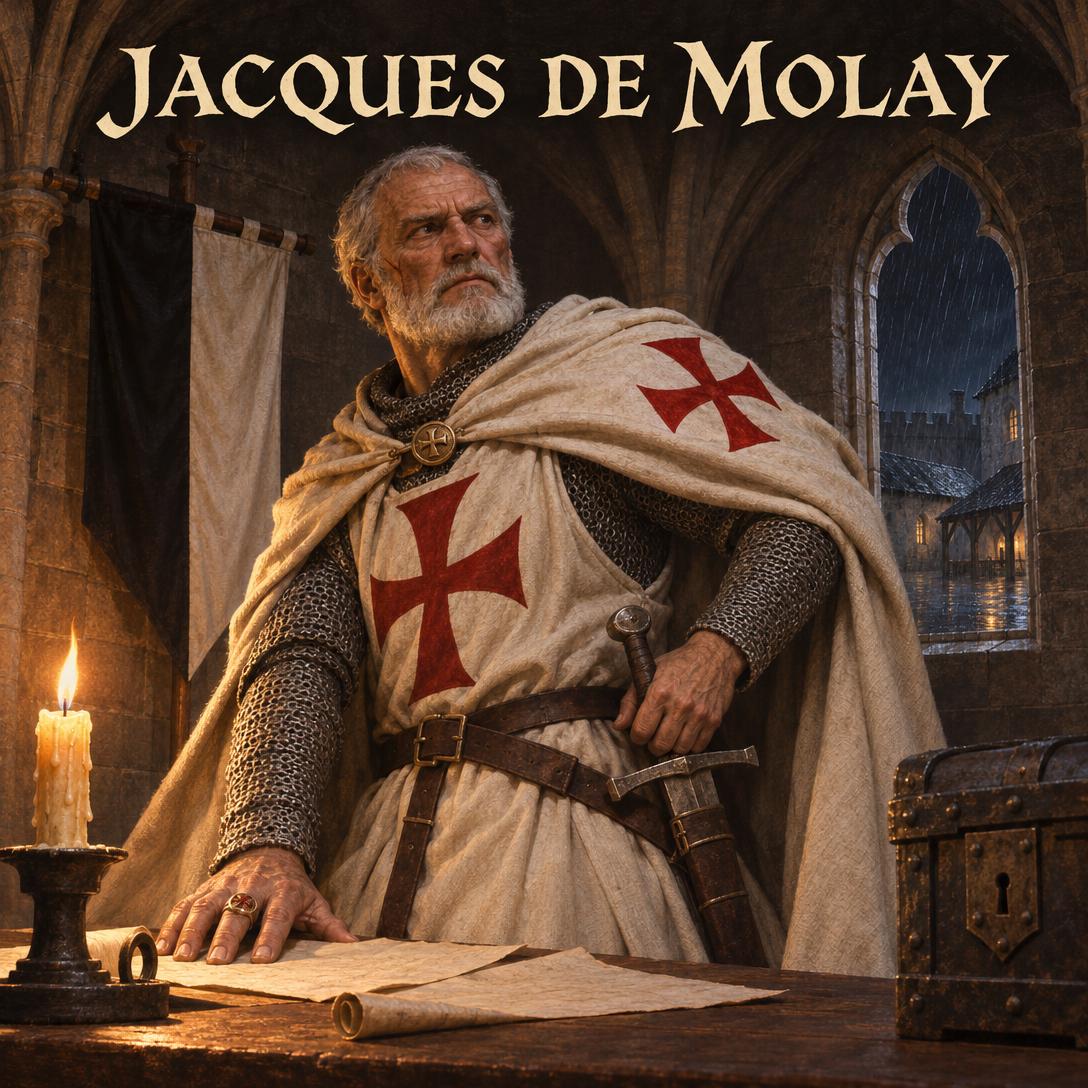
Roleplaying with Jacques de Molay on Jenova lets you step into a living-world AI character simulation across his most iconic eras. Unlike static character chatbots that sit in an empty chat room or forget your story, this simulation connects you to the last Grand Master of the Templars inside an active, evolving world.
- ✅ Four canonical eras, from a Cyprus harbor to the Paris Temple on the eve of the arrests
- ✅ An era-locked voice and worldview, with no modern hindsight leaking in
- ✅ Unlimited memory and live tracking of your story, allies and choices
- ✅ A free starting tier, with the same experience on web, iOS and Android
Most people meet Molay as a footnote: the man who cursed a king from a pyre. This roleplay puts you in the room before that ending, and lets you decide what you say to him.
Quick Answer: What Is Jacques de Molay AI Roleplay?
Jacques de Molay is an interactive AI character roleplay simulation where you converse with the last Templar Grand Master inside canonical eras, weighing his decisions and reshaping events as an independent, living world unfolds around him.
Key capabilities:
- Choose from four canonical eras or define a custom starting point in Molay's life or legend
- Speak with a character who has his own convictions, duties and earned trust
- Request in-world visions, charters and testaments as the story develops
- Branch "what-if" timelines with Fork without losing your original storyline
Character World & Roleplay Features
Jacques de Molay is among the best-documented figures of the crusading age. One reference summary lists him as the 23rd and last Grand Master of the Knights Templar, leading the Order from 20 April 1292 until its dissolution. A Stanford library record describes a life that took him from Burgundy to a career in the Middle East, then to leading the Temple as the Latin Crusader States were lost.
That arc is hard for a generic chatbot to hold. It tends to flatten a man who was a salt-weathered soldier-administrator in Cyprus, a proud but trusting commander in Paris, and something close to a prophet in chains. Here is how this simulation differs:
| Static Character Chatbots | Jacques de Molay on Jenova |
|---|---|
| Sits in an empty chat void | Lives in an active, evolving world |
| Blends all eras into one generic voice | Locks into authentic canonical phases |
| Forgets plot twists and past disclosures | Unlimited memory and live state tracking |
| Folds instantly like a polite assistant | Independent personality and earned rapport |
Authentic Canonical Phases & Custom Starting Points
Every session opens by letting you choose an era. Each one carries its own psychology, voice and inner circle, and Molay knows nothing beyond that moment:
- Sword of Outremer: the night before the Order's galleys sail for Ruad, with Molay marshaling a crusade.
- The Grand Master in Paris: the eve of Friday the Thirteenth, when he still trusts the King's courtesy.
- Shadow of the Pyre: the hours after he publicly retracts his confession.
- Custodian of the Codex: a conspiratorial Assassin's Creed version of the night the Paris Temple is besieged.
You can also propose your own starting point, such as his election as Master or a visit to his prison cell. Because he is locked to his era, a Molay in the Paris phase cannot foresee the arrests, and one in the Assassin's Creed phase has no foreknowledge of the 1314 pyre.
Cross-World Contact & Living World Momentum
In his historical eras you reach him as a quiet, bodiless voice beside his candle or brazier, audible to him alone. His first reaction is a veteran's suspicion: is this an eavesdropper, a test, or something God permits? Around you the world keeps moving. Preceptors interrupt, couriers arrive and duties press on, whether or not you are speaking.
Independent Agency & Open-Ended Sandbox
Molay interprets what you say; he doesn't obey it. Flattery earns frost, and sound counsel is weighed against his vows, his honor and the proof in front of him. Trust builds slowly from guarded soldierly measure toward confession. Canon governs how each era begins, and after that your choices can bend the course of events with no forced ending.
In-Narrative Visions, Writings & Storyline Forking
Ask to see something and you may behold the scene before his eyes. Ask him to set something down and he may dictate a charter, a consilium or a smuggled prison testament in character. Silent historical research keeps details grounded, and Fork lets you branch any moment into an alternate timeline.
Example roleplay prompts:
"Beau Sire, the King's courtesy at the funeral today is too warm. Who in your tower is watching the gates tonight?"
"You've sailed to Ruad before. What does the Order stand to lose if the Mongols never come?"
"If you retract your confession in public, what do you owe the brothers who stayed silent?"
How to Roleplay with Jacques de Molay
Step 1: Choose an era or define your own starting point
Open the experience and read the era menu. Pick one by number or title, or describe a custom moment.
"I'd like to begin in the Paris Temple on the eve of the arrests."
Step 2: Make contact and let the world unfold
Molay reacts to your voice in the middle of whatever he is doing. Answer his questions plainly, since he tests honesty before he extends any trust. The scene advances at the pace of his world.
"I mean no harm, Master. I only speak, and I can't see your room."
Step 3: Offer counsel, build rapport and reshape the story
Share warnings, ask him to write a letter, request a vision of the courtyard, or use Fork to test a different choice. His disposition changes only through what you actually say and do over time.
"Write me the petition you would send to the Pope, in your own words."
Once you enter an era, Molay stays in it. He treats out-of-character commands, modern slang and meta-questions as strange sounds from his own world, not as cues to step out of the story.
Canonical Eras & Roleplay Scenarios
⚔️ The Crusader Commander: Cyprus & Ruad
Molay's career began in the Order in 1265 and, after Acre's fall, he was elected Grand Master on 20 April 1292, according to the franchise's own timeline. In this era he is brisk, martial and impatient with lukewarm kings.
- Scenario: The night before the galleys sail for Ruad, he is counting lances, biscuit and water casks.
- What you can do: Press him on strategy, allies and the Mongol promise, and find out whether he will accept an outsider's judgment.
👑 The Eve of Friday the Thirteenth: Paris, October 1307
Historically, Templars across France were arrested on 13 October 1307. In this scenario the evening is still ordinary. Molay is at his writing table in the Grosse Tour, trusting the Crown and the Pope, while his rival Hugues de Pairaud frets and Geoffroi de Charney distrusts the royal lawyers.
- Scenario: You are the only one who knows what the dawn may bring. Do you warn him, and will he believe an unseen voice over the word of a king?
- What you can do: Test whether your counsel outweighs his oath-bound faith in royal and papal honor.
🌀 The Pyre and the Curse: Paris, 1314
Scholars still debate the end. A peer-reviewed study in Viator revisits the standard account of the March 1314 executions. It suggests they may have occurred on 11 rather than 18 March, and that the cardinal legates, not King Philip IV alone, drove the decision. Because the sources conflict, this era focuses on his state of mind in those final hours more than on one fixed version of events.
- Scenario: Molay, nearly seventy, is calm after retracting his confession, with Charney chained beside him.
- What you can do: Ask what he wants said, and to whom, before the bell for Vespers rings.
📱 The Codex Keeper: Assassin's Creed Temple Siege
In the franchise, he is a Sage who wrote the Codex Pater Intellectus and, as Assassins breach the Temple, entrusts the Codex and the Sword of Eden to his advisor. This is a separate, cross-media Molay: cold-nerved and erudite, with no knowledge of the historical version's later fate.
- Scenario: Speak with him in the keep on the siege night. Mobile players often pick this era for short late-night sessions on a phone, since the scene stays intact and the story picks up where you left off.
- What you can do: Ask about the Codex, the Order's survival and the cost of his plan.
Ready to try it? Start a roleplay with Jacques de Molay free, no credit card required.
Frequently Asked Questions
Is Jacques de Molay AI roleplay free?
You can start free with limited monthly usage. Plus costs $20 per month and adds 30× usage, custom model selection and no watermarks, and higher tiers scale usage further. Usage resets monthly on your billing date, with your full limit available from day one and no daily caps.
How is it different from generic Templar character chatbots?
Generic bots sit in a blank chat and blend every period into one voice. Here you choose a canonical era, and Molay's worldview, memories and circle are locked to that moment. He lives in an evolving world, has his own priorities and responds to you with earned rapport rather than automatic agreement.
Which eras of Jacques de Molay can I roleplay with?
Four are built in: the Cyprus and Ruad crusade, the eve of the 1307 arrests in Paris, the day of his 1314 retraction, and an Assassin's Creed version on the night the Temple is besieged. You can also describe a custom starting point from his life or legend.
Can my choices change Molay's story?
Yes. Each era begins where history (or the franchise) places it, and your words can influence what he decides afterward. He still interprets what you say rather than obeying it. Fork lets you branch from any earlier message to explore a different outcome while keeping your original storyline intact.
Does it work on mobile?
Yes. Web, iOS and Android stay in sync, and voice input and read-aloud are supported, so you can continue a long roleplay anywhere. Your history carries over between devices.
Is it historically accurate?
The simulation draws on documented history and franchise canon, but it is interpretive roleplay, not a primary source. Some questions remain contested, such as the exact date of the 1314 executions, as one peer-reviewed study shows. The Assassin's Creed era follows fictional franchise lore, not documented fact.
Conclusion
Static chatbots reduce Jacques de Molay to a famous curse. This AI roleplay places you inside the choices that preceded it: the crusader's resolve, the commander's misplaced trust, and a prisoner's last public act. Researchers have noted that AI can add depth to live roleplay and interactive play, and a character with memory, era-locked knowledge and his own will is where that potential shows.
If you have ever wanted to warn a Grand Master or question a Templar commander face to face, Try Jacques de Molay now. Explore more at Jenova.
For Developers: Jacques de Molay is available programmatically via the Jenova API — integrate era-locked, memory-persistent AI character roleplay into your application with a single Jenova Agent API call. Full documentation →