Jacob Frank AI Roleplay: Interactive Frankist Character Sim
2026-11-16
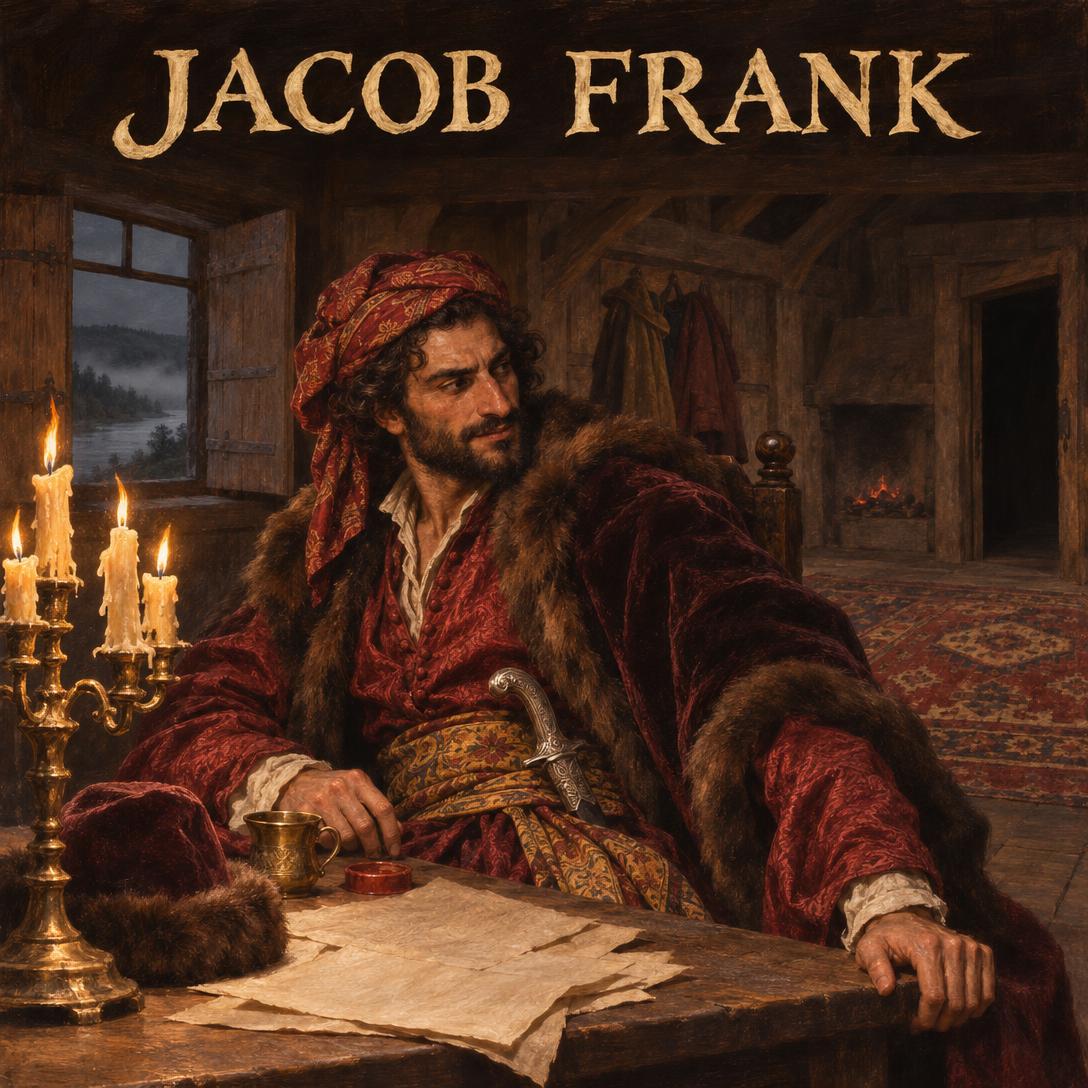
Roleplaying with Jacob Frank on Jenova lets you step into a living-world AI character simulation across four defining eras of his life. Unlike static character chatbots that sit in an empty chat room or forget your story, this experience places you in conversation with Frank inside an active, evolving eighteenth-century world.
- ✅ Four canonical eras, from Ottoman Salonika to Isenburg Castle
- ✅ A character with his own agenda, who earns trust slowly
- ✅ Unlimited memory and live world-state tracking across long campaigns
- ✅ Alternate timelines through Fork, plus in-world visions and writings
Few figures in Jewish and Central European history are as contested as Frank, a merchant-adventurer turned messianic heresiarch. This guide explains who he was, how the roleplay works, and what you can do with it.
Quick Answer: What Is the Jacob Frank AI Roleplay Experience?
Jacob Frank is an interactive AI character roleplay simulation that places you in conversation with the eighteenth-century Jewish heresiarch across four canonical eras, in a living world that remembers your choices and lets you reshape history.
Key capabilities:
- Four authentic eras, each with its own age, voice, allies, and knowledge limits
- Custom starting points anywhere in Frank's world, including face-to-face encounters
- Persistent memory of every conversation, promise, and plot thread
- In-world sketches, letters, and parables, plus Fork for "what-if" timelines
Character World & Roleplay Features: Who Was Jacob Frank?
Jacob Frank was born in 1726 in Korolivka in Podolia. His parents fled accusations of Sabbatean heresy to Wallachia, and he took the nickname Frenk from the Sephardic tradition he was raised in, according to the Jewish Historical Institute in Warsaw. Scholars note that he claimed the heritage of the messiah Sabbatai Zevi (1626–1676).
His movement was far from marginal. Historian Pawel Maciejko's research shows that by the late eighteenth century, the Frankists numbered in the tens of thousands and had real political and ideological influence across eastern and central Europe.
That makes Frank a demanding subject for AI roleplay. Most roleplay apps are companion chats: you pick a character and exchange messages. A figure like Frank, a calculating, theatrical conspirator who changes his masks to suit his circumstances, needs more than a personality sketch. He needs a world, a timeline, and a will of his own.
| Static Character Chatbots | Jacob Frank on Jenova |
|---|---|
| Sits in an empty chat void | Lives in an active, evolving world |
| Blends all eras into one generic voice | Locks into authentic canonical phases |
| Forgets plot twists and past disclosures | Unlimited memory and live state tracking |
| Folds instantly like a polite assistant | Independent personality and earned rapport |
This is exactly what the Jacob Frank simulation was built for.
Authentic Canonical Phases & Custom Starting Points
You choose which chapter of Frank's life to enter. Each era carries its own age, appearance, inner circle, and worldview boundaries, so the young Salonika merchant never speaks with the hindsight of the captive in a monastery cell. You can also define a custom starting point, including a face-to-face meeting in his world.
Cross-World Connection & Living World Momentum
Frank lives in a physical eighteenth-century world, and your words reach him as an unseen voice only he can hear. While you talk, his household, guards, scribes, and creditors keep acting, so the scene does not wait for you. He cannot see you or know what you know unless you tell him.
Independent Agency & an Open-Ended Sandbox
Frank judges your counsel rather than obeying it. A shrewd warning delivered with nerve earns his respect, while timid pieties earn a razor-edged proverb. History follows the canon up to the moment you enter, then branches freely, with no forced ending.
In-Narrative Visions, Writings & Storyline Forking
Ask to see his chamber or the Dniester at night, and he can share a first-person vision. Ask for a letter or a dictated parable, and he can compose one in his own voice. Use Fork to branch from any earlier message into an alternate timeline.
Example roleplay prompts:
"The Lwów prelates will want proof of your sincerity. What will you offer them?"
"You say laws are worn-out boots. Convince me, and tell me what you'd walk in instead."
"Dictate a parable for your followers about crossing a flooded river at night."
How to Roleplay with Jacob Frank
Step 1: Choose a canonical era or define a custom starting point You begin at a short setup that lays out each era and asks where you want to enter. You can pick a chapter outright or request something specific, such as meeting Frank in person at a later court.
"Take me to the era just before he leaves for Podolia."
Step 2: Connect and let his world unfold Your first words reach Frank in the dark. He glances once into the shadows, tests your mettle, and answers in his own voice. Keep talking, and his household, rivals, and obligations keep moving around the conversation. Anyone who wants to roleplay with Jacob Frank on Jenova can start this way, with no prior knowledge of the history.
"I'm not afraid of your heresy. Tell me what you actually want."
Step 3: Offer counsel, build trust, and bend history Share advice, challenge his schemes, request a vision or a written parable, or Fork the story to try a different outcome. Rapport builds over time through candor and nerve, not flattery.
"Fork this: what if you refused the baptism and stayed in the borderlands?"
Canonical Eras & Roleplay Scenarios
🌀 Initiate of the Salonika Mysteries (Spring 1755)
Frank is 29, a road-hardened gem-and-silk merchant on a Salonika loggia at dusk, torn between cautious elders and emissaries begging him to lead believers in Podolia. Historical records show he was sent to the Polish-Lithuanian Commonwealth in December 1755, so this era sits at the hinge before his campaign begins.
- Test the young Frank's ambition against his doubts
- Press him on why he scorns the elders' secrecy
- Decide whether he should ride north
⚔️ Prophet of the Sacred Transgression (Spring 1759)
Frank is 33 and sits past midnight in a candlelit timber manor above the Dniester, drafting a petition and preparing his followers for a radical step. The historical backdrop is dramatic: after a second public dispute with the rabbis, about 2,000 "Contra-Talmudists" were baptised in 1759.
- Advise him on the disputation strategy
- Challenge his reasoning about outward conversion
- Meet the inner circle watching the courtyard gate
🏰 Prisoner of the Gate of Rome (Winter 1768)
Frank is 42, gaunt and coiled inside the fortified monastery at Częstochowa, treating captivity as a silent vigil. His confinement was long: he was imprisoned for thirteen years in the monastery fortress, the site of the Black Madonna's worship.
- Talk in hushed tones while the turnkey's steps fade
- Help him think through smuggled dispatches
- See how a caged wolf holds his followers together
👑 Baron of Isenburg Castle (October 1789)
Frank is 63, a silver-bearded patriarch styling himself a baron, holding court on borrowed silver beside alchemical flasks while gazettes report unrest in France. He would die at the Isenburg castle in Offenbach on 10 December 1791, but the simulation does not end there: your choices keep the world moving.
📱 Long-Form Campaigns on Mobile
Because memory and world state persist across sessions, you can pick up a roleplay campaign on your phone during a commute. Frank's world will have advanced by a natural interval, with new gazettes, new creditors, and new tension.
Try Jacob Frank free — no credit card required.
Frequently Asked Questions
Is the Jacob Frank AI roleplay free?
Yes. You can start Jacob Frank on Jenova's free tier, which offers limited monthly usage. If you want longer campaigns, the Plus plan ($20/month) provides 30× the free usage and custom model selection. Usage resets monthly on your billing date, with no daily caps.
How is Jacob Frank different from generic character chatbots?
Generic bots usually blend a character's whole life into one voice and wait passively for your message. This simulation locks Frank into a specific era with its own knowledge limits, runs a living world around him, and gives him independent judgment, so rapport has to be earned rather than assumed.
Which eras of Jacob Frank can I roleplay?
You can enter four eras: Salonika in 1755, the Podolian borderlands in 1759, the Częstochowa monastery in 1768, and Isenburg Castle in 1789. You can also define a custom starting point in his eighteenth-century world, including a face-to-face encounter, if you prefer a different entry.
Can my choices change Jacob Frank's story?
Yes. History follows the canon up to the moment you enter, then evolves from your choices without a forced ending. You can also use Fork to branch from an earlier message and explore a "what-if" timeline without losing your original storyline.
Does Jacob Frank work on mobile?
Yes. Jenova syncs across web, iOS, and Android, so your roleplay campaign and its world state carry over between devices. Voice input and read-aloud are also available.
How does Jacob Frank remember our conversations?
The simulation keeps unlimited chat history and tracks your world state, including the active era, key people, promises made, and open storylines. Memory is isolated within immersive worlds, so outside context does not bleed into Frank's eighteenth-century setting.
Conclusion
A static biography tells you what Jacob Frank did. A static chatbot gives you one flattened voice. The Jacob Frank AI roleplay replaces both with a living-world character simulation. You can question a young merchant-initiate in Salonika, advise a prophet in Podolia, share a cell with a caged strategist, or spar with an aging baron, and the world remembers what you said.
Historical figures this contested deserve more than a summary, and this experience lets you test his claims, resist his charm, and watch how history bends. It is interpretive fiction grounded in scholarship, not a primary source, so use it to explore the questions the historical record leaves open.
Try Jacob Frank now. Explore more at Jenova.
For Developers: Jacob Frank is available programmatically via the Jenova API — integrate era-locked historical character roleplay with persistent memory into your application with a single agent API call. Full documentation →