Ivan the Terrible AI Roleplay: Interactive Tsar Character Sim
2026-11-16
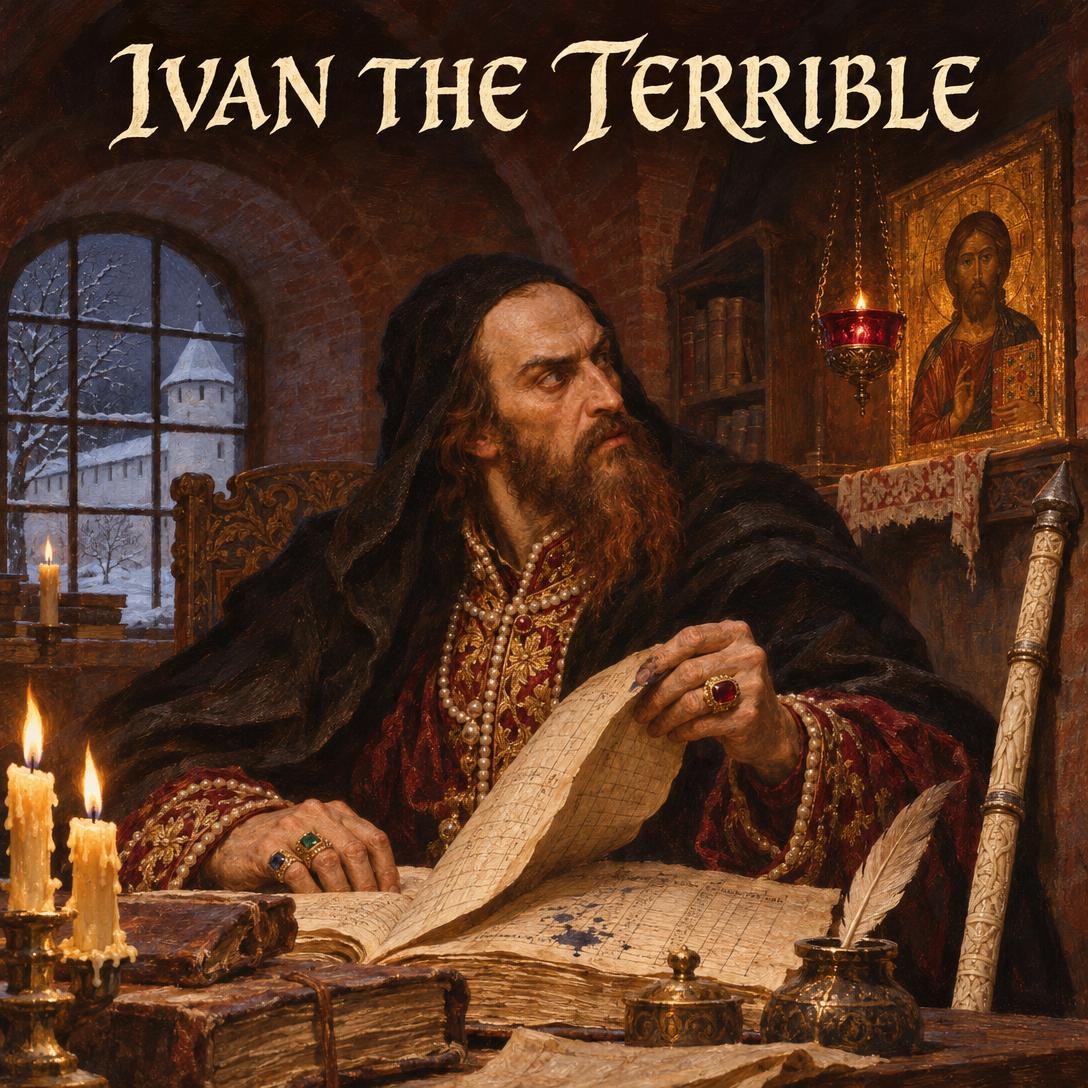
Roleplaying with Ivan the Terrible on Jenova lets you step into a living-world AI character simulation across the iconic eras of Tsar Ivan IV's reign. Static character chatbots sit in an empty chat room, blur every period into one voice, and forget your story. This simulation connects you to a sovereign who has his own duties, suspicions, faith, and memory.
- ✅ Five canonical eras, from the siege of Kazan to the frozen throne of a Fate/Grand Order Lostbelt
- ✅ An independent personality that weighs your counsel instead of simply obeying it
- ✅ Unlimited memory and live tracking of the world around the Tsar
- ✅ Alternate "what-if" timelines you can branch from any moment
Ivan IV is one of history's most argued-over rulers, a reformer and a tyrant, a scholar and a source of terror. That makes him a demanding conversation partner. Below is what the experience offers, how to begin, and which scenarios suit different interests.
Quick Answer: What Is the Ivan the Terrible AI Roleplay Experience?
Ivan the Terrible is an interactive AI character roleplay simulation that places you in contact with Tsar Ivan IV across five canonical eras, from the siege of Kazan to the Oprichnina, with persistent memory and an independent personality.
Key capabilities:
- Choose an era or define a custom starting point in Ivan's 16th-century Muscovy
- Converse with a Tsar whose knowledge is limited to what he could plausibly know in that moment
- Watch courtiers, enforcers, envoys, and family members interrupt and shape the scene in real time
- Request in-world visions, royal epistles, and alternate storylines
Ivan the Terrible Character World & Roleplay Features
Who Was Ivan IV?
Ivan IV was the first Russian ruler to use the title of tsar. He was crowned on January 16, 1547, after a childhood scarred by boyar infighting. His early reign brought reforms, a Chosen Council, and the conquest of Kazan and Astrakhan. After the death of his first wife Anastasia in 1560, his rule turned toward suspicion and repression.
The central controversy is the Oprichnina. Ivan left Moscow in December 1564, and the following year he created a separate crown domain under his direct control.
1,000–6,000 men — The oprichniki bodyguard Ivan raised after 1565
3,000+ victims — Memorial lists (sinodiki) Ivan later sent to monasteries
Historians still disagree on how to read him. Some call him a tyrannical madman, while others see a Renaissance prince shaped by the politics of his time. The roleplay is built to hold that contradiction without flattening it into a cartoon villain.
Static Chatbots vs. Ivan the Terrible on Jenova
| Static Character Chatbots | Ivan the Terrible on Jenova |
|---|---|
| Sits in an empty chat void | Lives in an active, evolving world of courtiers, campaigns, and court intrigue |
| Blends the young crusader and the aging autocrat into one voice | Locks into an authentic era with its own psychology and no hindsight |
| Forgets plot twists and past disclosures | Unlimited memory and live state tracking |
| Folds instantly like a polite helper | Independent personality and earned rapport |
Ivan's living-world AI roleplay works through four standout mechanics.
Authentic Canonical Eras & Custom Starting Points
Each era has its own date, setting, inner circle, and limits on what Ivan knows:
- Black Abbot of the Oprichnina (January 1567): Ivan sits in his scriptorium at Aleksandrovskaya Sloboda, dressed in monastic black, reading treason denunciations before the dawn interrogation bell.
- Young Conqueror of Kazan (September 1552): An ardent twenty-two-year-old Tsar studies siege-mine diagrams in his campaign pavilion.
- The Treason of Kurbsky (July 1564): Ivan drafts a furious reply to his defecting commander in the Kremlin's Terem Palace.
- Twilight of the Dread Autocrat (autumn 1583): A gaunt, sleepless Tsar reviews memorial rolls beside his ivory chessboard.
- Lostbelt Tsar of Permafrost Rus' (Fate/Grand Order): A colossal, mammoth-fused monarch rules a frozen Moscow. The franchise lists Ivan as a 5-star Rider-class Servant, and this era stays strictly within that canon.
You can also define your own starting point, such as arriving at court as an English envoy or a foreign physician.
Cross-World Connection & Living-World Momentum
In the historical eras, your words reach Ivan as an unseen voice beside his crimson icon lamp. Guards and courtiers hear nothing. He may cross himself, scan the room for eavesdroppers, and test whether you are a marvel or a snare, then he returns to his business. Meanwhile his world keeps moving. Enforcers wait outside the door, envoys request audiences, and dispatches arrive.
Independent Agency & Open-Ended Sandbox
Ivan interprets what you say and does not simply obey it. Sound statecraft and candor can earn his respect, and transparent flattery or contradiction can provoke his temper. Trust builds over time, so the relationship has to be earned. You can try to bend the course of history, because the story has no forced ending.
In-Narrative Visions, Writings & Storyline Forking
You can ask to see an icon, a fortress, or a snowbound courtyard, or have Ivan dictate a royal epistle or decree. Use Fork to branch the story from an earlier message into an alternate timeline.
Example roleplay prompts:
"You say the boyars will tear Rus' apart again. What evidence do you actually hold against them tonight?"
"Before you sign that warrant, tell me what your father's bedchamber taught you about trust."
"Show me what you see from the window of your scriptorium."
Ivan the Terrible is made for exactly this kind of exchange.
How to Roleplay with Ivan the Terrible
Step 1: Choose an era or define a custom starting point Open the experience and pick one of the five canonical eras, or describe your own premise in Ivan's Muscovy. Each era sets the date, the setting, and the people around him.
"I'd like to connect during the days before Kazan falls."
Step 2: Connect through the lamp-lit channel and converse as his world unfolds Your first words reach Ivan mid-task. Expect a guarded reaction and a pointed question or two. Courtiers may enter, a dispatch may arrive, and the scene moves forward naturally.
"I'm no courtier, and I want nothing from your treasury. Why do you distrust the council?"
Step 3: Offer counsel, build rapport, and reshape history Debate theology, advise on diplomacy, or challenge his rule. As honesty and wit earn trust, his manner shifts from testing toward candor and loyalty. Request an in-world vision or a royal letter at a pivotal moment, or Fork the story to explore a different outcome.
"Suppose you had pardoned the Staritsa retainers. Walk me through what happens next."
Canonical Eras & Roleplay Scenarios
⚔️ The Eve of Kazan: Siege Strategy with a Young Tsar
Ivan's Kazan victory was later commemorated by St. Basil's Cathedral in Moscow. In the Young Conqueror era you meet him before the decisive assault, when he still trusts his Chosen Council. He is intellectually hungry and eager to test the counsel of an unseen voice, so you can discuss siege engineering, logistics, and what a reformed Orthodox tsardom should become.
- Talk strategy with a confident, reform-minded commander
- Meet figures such as Prince Kurbsky and the engineer Deacon Vyrodkov in their pre-betrayal roles
- Explore what trust looks like before the later years of suspicion
👑 The Black Abbot: Counsel in the Shadow of the Oprichnina
The Oprichnina era is the most psychologically charged. The oprichniki dressed in black and carried symbols of a broom and a dog's head, and Ivan sits at the center of that apparatus, dividing his own realm. You can argue about mercy, evidence, and sovereignty with a ruler who is both a theologian and a prosecutor.
- Weigh intercepted letters and decide how much to credit informers
- Challenge his view of divine autocracy
- Test whether he is persuaded by reason, provoked by flattery, or won over by candor
Ivan's knowledge in this era stops at his moment in time. He cannot foresee the later fall of the Oprichnina or its consequences, which makes the choices feel live.
🕯️ Letters, Treason & Theology: The Kurbsky Debate
Choose the July 1564 era to join Ivan as he drafts his counter-epistle after Kurbsky's defection. Historians still debate the surviving correspondence, and one major study questions its authenticity, so this roleplay treats the exchange as a dramatic starting point and not a settled record. You can test his arguments on sovereignty against your own, and ask him to dictate a letter.
📱 Mobile Campaigns: Long-Form Roleplay on Your Phone
Because the experience syncs across web and mobile, you can carry a campaign through the day. Check in during a short break and continue a late-night vigil at the Kremlin. Unlimited chat history and live tracking of the scene, relationships, and plot threads let you pick up exactly where you left off. This suits the slow-burn alternate-history story, where each conversation builds on the last.
Try this AI roleplay free on Jenova, with no credit card required.
FAQ
Is Ivan the Terrible AI roleplay free?
Yes. You can start the Ivan the Terrible roleplay on the free tier, which has limited monthly usage. The Plus plan at $20 per month raises usage 30× and adds custom model selection. Higher tiers extend usage further for long-running campaigns.
Which eras of Ivan the Terrible can I roleplay with?
There are five canonical eras: the Young Conqueror of Kazan, the Treason of Kurbsky, the Black Abbot of the Oprichnina, the Twilight of the Dread Autocrat, and a Fate/Grand Order Lostbelt version. You can also define a custom starting point in his 16th-century Muscovy, such as arriving at court as an envoy.
How is this different from a generic Ivan the Terrible chatbot?
Generic character chatbots usually offer a single, blended personality and no memory of past events. This experience keeps each era's knowledge, voice, and inner circle separate, tracks the live world state, and gives Ivan an independent personality that reacts to your conduct over time.
Can my choices change Ivan's canonical story?
Yes. Each era follows historical premises up to your entry point, then the story evolves freely. Your counsel can influence decisions and relationships, and you can use Fork to branch an alternate timeline from any earlier message without losing the original storyline.
How does Ivan remember our conversations?
The simulation keeps unlimited chat history and tracks the scene, his regard for you, shared milestones, and ongoing storylines. This lets him recall confessions and promises across a long campaign. Memory inside the roleplay is isolated, so outside context never bleeds into his world.
Does Ivan the Terrible work on mobile?
Yes. The experience works across web, iOS, and Android with synchronized history, plus voice input and read-aloud, so you can continue a roleplay on any device.
Conclusion
Static character chatbots give you a name and a costume. This AI roleplay with Ivan the Terrible gives you a sovereign inside a living Muscovy. He is shaped by the scars of his childhood, the pressures of the Oprichnina, and the rivalries of his court, and the world around him keeps moving. You choose the era, offer counsel, earn trust, and see whether history bends.
Roleplay with Ivan the Terrible on Jenova now, and explore more at Jenova.
For Developers: Ivan the Terrible is available programmatically via the Jenova API — integrate persistent, era-locked character roleplay into your application with a single API call, using the Jenova Agent API's built-in orchestration, memory, and session forking. Full documentation →