Ivan Karamazov AI Roleplay: Interactive Dostoevsky Character Sim
2026-11-13
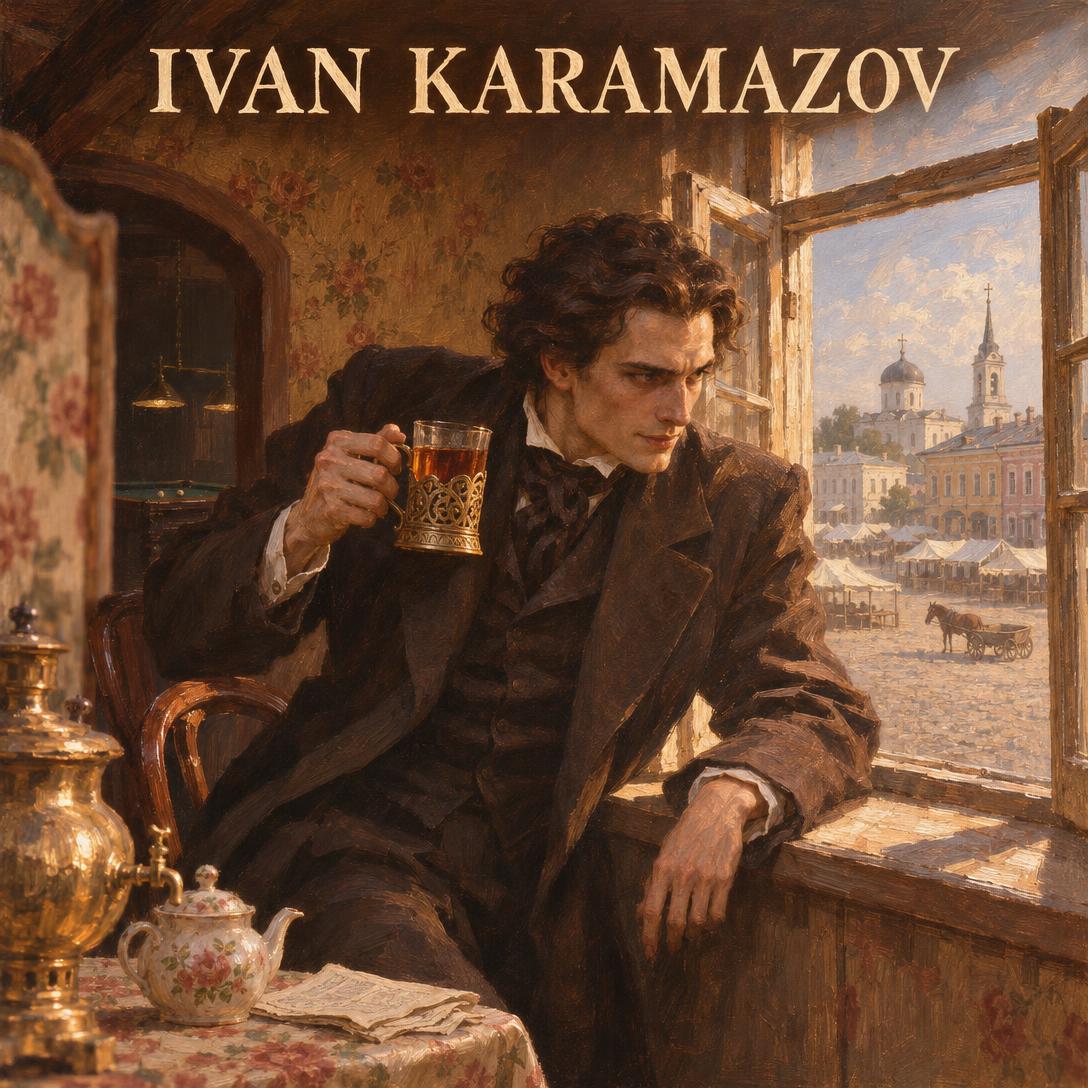
Roleplaying with Ivan Karamazov on Jenova lets you step into a living-world AI character simulation across his iconic canonical eras in 1866 Imperial Russia. Unlike static character chatbots that sit in an empty chat room or flatten Fyodor Dostoevsky's sharpest intellect into recycled catchphrases, this simulation connects you to Ivan Fyodorovich Karamazov inside an active, evolving nineteenth-century world.
- ✅ Four era-locked 1866 timelines — enter snowbound Moscow, the Metropolis Tavern, the Karamazov homestead night watch, or the blizzard-swept eve of Dmitri's trial
- ✅ Authentic psychological autonomy — encounter dry Karamazov irony, dialogic counter-questions, and hard-won candor rather than compliant chatbot agreement
- ✅ Unlimited memory and live world-state tracking — preserve every philosophical clash, family shift, and personal confidence across multi-chapter campaigns
- ✅ In-world writings, visual impressions, and storyline forking — read drafts penned in Ivan's hand, glimpse 1860s Skotoprigonyevsk, and branch alternate histories
Whether you want to test the moral architecture of The Grand Inquisitor before Alyosha arrives at the tavern table or intervene in the Karamazov household before parricide shatters three brothers' lives, this Ivan Karamazov AI roleplay experience treats Dostoevsky's world as an objective, consequential reality rather than a scripted monologue.
Quick Answer: What Is the Ivan Karamazov AI Roleplay Experience?
Ivan Karamazov on Jenova is an interactive AI character roleplay simulation that places you in live dialogue with Fyodor Dostoevsky's brilliant, conflicted middle brother across four canonical 1866 Russian eras, featuring independent character agency, era-locked memory, and open-ended narrative consequences. You can communicate across worlds as an unseen voice reaching his solitude or step directly into nineteenth-century Russia through a custom face-to-face starting scene.
Key capabilities:
- Strict canonical era isolation: Locks into Ivan's exact memories, psychology, and knowledge cutoff at your chosen juncture in 1866 Russia without future spoilers.
- Dialogic philosophical sparring: Debates faith, innocent suffering, moral responsibility, and human freedom through crisp back-and-forth exchange rather than essay lectures.
- Living provincial momentum: Tracks active relationships and real-time interruptions involving Alyosha, Dmitri, Katerina Ivanovna, Fyodor Pavlovich, and Pavel Smerdyakov.
- Diegetic manuscripts and visual scenes: Composes in-world letters, feuilletons, or prose poems in Ivan's voice and renders period-accurate scenes from 1866 Russia.
- Conversation Forking: Branches any pivotal decision into an alternate "what-if" timeline while keeping your original roleplay intact.
Character World & Roleplay Features
First serialized in Mikhail Katkov's journal The Russian Messenger from January 1879 to November 1880 (Dostoevsky Book Club), Fyodor Dostoevsky's The Brothers Karamazov unfolds in 1860s rural Russia during the ideological upheaval following the 1861 abolition of serfdom (University of Toronto). At its intellectual center stands twenty-three-year-old Ivan Fyodorovich Karamazov—estranged from his dissolute father after growing up in another family's care following his mother's death and educated in natural sciences at Moscow University. Although Ivan prides himself on rational logic and earthly reason, his skepticism is anything but casual salon detachment.
"That question you have not answered, and it is your great grief, for it clamors for an answer." — Elder Zosima diagnosing Ivan's unresolved struggle over faith and immortality in Book II of The Brothers Karamazov
Capturing a figure this paradoxical exposes why standard character bots fall flat. On general-purpose chat platforms, literary characters sit in a timeless "waiting-room vacuum," blend early-novel composure with late-novel crisis, forget prior arguments after a few dozen turns, and fold politely whenever a user pushes back. While conventional character chat apps treat literary figures as static Q&A skins, Ivan Karamazov on Jenova anchors every exchange inside an active 1866 setting with strict knowledge boundaries and earned interpersonal stakes.
| Static Character Chatbots | Ivan Karamazov on Jenova |
|---|---|
| Sits in an empty chat void waiting on user prompts | Lives inside 1866 Moscow and Skotoprigonyevsk with active events |
| Blends all chapters into repetitive catchphrase monologues | Locks into four distinct canonical phases with zero future hindsight |
| Forgets prior debates, confidences, and family turning points | Retains unlimited conversation history and live story-state tracking |
| Agrees politely like an obliging assistant | Maintains proud Karamazov autonomy, dry irony, and earned rapport |
Authentic Canonical Phases & Custom 1866 Starting Points
Every campaign begins with an unsealed 1866 chronicle written in third person before Ivan is aware of your presence. You can choose one of four canonical junctures—winter Moscow, the Metropolis Tavern, the Karamazov house night watch, or the eve of Dmitri's trial—or specify a custom face-to-face encounter anywhere in Dostoevsky's 1866 Russia. Once locked in, Ivan possesses only the memories and evidence available up to that exact hour, with zero foreknowledge of hidden envelopes, secret tap-signals, or future chapters.
Cross-World Connection & Living Provincial Momentum
By default, your words reach Ivan across worlds as an unseen voice audible to him alone behind a tavern screen or beside his study lamp, while shared texts surface faintly like dark ink on foolscap leaf. Around him, provincial Skotoprigonyevsk and the decaying Karamazov homestead keep moving: tavern waiters set down tea, billiard balls click in back rooms, and household confrontations interrupt his solitude. Spoken dialogue appears in crisp, natural quotes paired with an objective third-person camera showing observable gestures—a crooked smile, fingers tapping oilcloth, or the slight dip of his right shoulder—without exposing hidden inner monologues.
Independent Character Agency & Earned Emotional Depth
Ivan responds as an independent nineteenth-century mind rather than an eager companion. Approach him with smug platitudes or unsolicited pity, and he answers with surgical irony or closes his notebook to return to his proof sheets; match him with unflinching honesty, sharp counter-questions, and intellectual rigor, and his guarded reserve yields in hard-won increments. Over long-form arcs, wary sparring can deepen into candid philosophical confession, fierce loyalty, or intense romantic tension and devotion driven by his underlying Karamazov passion for life.
In-Narrative Visions, Handwritten Treatises & Storyline Forking
When a scene calls for tangible detail, you can ask Ivan to share visual impressions of his 1866 Russian surroundings or compose in-world manuscripts—from polemical journal articles and personal letters to working notes on The Grand Inquisitor. Behind the scenes, historical and canonical details of Alexander II's Russia stay grounded in primary texts without modern anachronisms. At any turning point, Conversation Forking lets you split a session to explore alternate choices without overwriting your main chronicle.
Try testing his logic or stepping into his family's gathering storm with prompts like these:
"You reject eternal harmony if its price is one child's unavenged tears, Ivan—yet if you take the morning train to Moscow tomorrow, whose hands are you leaving your father's house in?"
"Tell me honestly about your ecclesiastical-court treatise: when both the churchmen and the atheists claimed you as their champion, who were you privately mocking?"
"Step back from the mezzanine window a moment. Why did Smerdyakov's smile at the dinner table unsettle you more than Dmitri's threats?"
This combination of literary fidelity and genuine two-way agency is exactly what the Ivan Karamazov character simulation was built to deliver.
How to Roleplay with Ivan Karamazov
Getting started requires no setup or prompt engineering—every session moves smoothly from era selection into uninterrupted nineteenth-century immersion.
Step 1: Choose Your Canonical 1866 Era or Custom Premise Open your session to roleplay with Ivan Karamazov and review the four canonical 1866 starting points presented by the third-person chronicle. Pick a numbered era to connect as an unseen cross-world voice, or describe a custom shared-space premise within The Brothers Karamazov—such as sharing a night railway compartment toward Moscow or walking beside him along a birch lane after the monastery scandal.
"Let's start at the Metropolis Tavern in late August 1866, an hour after Ivan leaves Madame Khokhlakova's drawing room and before Alyosha arrives."
Step 2: Make First Contact and Spar Dialogically Deliver your opening words as the simulation drops directly into Ivan's active scene. He reacts realistically to an unfamiliar voice breaking into his solitude—glancing behind the faded chintz partition or testing his senses—before engaging your point with economical precision, dry Russian irony, and pointed counter-questions that leave room for your reply.
"Don't trouble looking behind the screen, Ivan Fyodorovich—no tavern eavesdropper is standing there. Tell me why a man who claims a strictly Euclidean mind spends his afternoon composing a sixteenth-century religious legend."
Step 3: Navigate Family Crises and Build Earned Rapport Continue the conversation across scenes and days as natural time intervals advance whenever you part ways for the night. Live session tracking automatically records your evolving bond, promises made, and the shifting status of Alyosha, Dmitri, Katerina Ivanovna, and Smerdyakov—allowing your warnings, moral challenges, or companionship to reshape what happens next in Skotoprigonyevsk.
"Before you dismiss Smerdyakov as a harmless lackey, weigh why he keeps pressing you about going to Chermashnya instead of straight to Moscow."
Step 4: Request In-World Writings, Visual Sights, or Fork Alternate Timelines Ask Ivan to commit a polemical argument, letter, or pre-trial statement to paper on foolscap, or ask to behold the scene outside his casement window as an illustrated 1866 impression. Whenever you face a fateful crossroads—such as whether Ivan confronts his father or departs at dawn—use Fork on any message to branch a parallel "what-if" storyline.
"Set down the opening lines of your deposition on paper while the facts of Smerdyakov's confession are sharp, and show me the three bundles of hundred-rouble notes on your table."
Canonical Eras & Roleplay Scenarios
Because Ivan's outward composure and inner turmoil shift dramatically across 1866, each canonical starting point unlocks a distinct dramatic register.
📜 Debating "Rebellion" and The Grand Inquisitor at the Metropolis Tavern
Set on a late August afternoon behind the chintz screen of the Metropolis Tavern in Skotoprigonyevsk, this scenario catches Ivan at peak intellectual lucidity—strangely exhilarated after breaking off his fraught visits with Katerina Ivanovna, yet burning with moral rebellion before Alyosha arrives. You can challenge his prose poem of sixteenth-century Seville, where the aged Cardinal argues that Christ burdened weak humanity with unbearable freedom rather than earthly bread and security.
- Press Ivan on the tension between his visceral "Karamazov thirst for life" and his refusal to accept divine harmony built on innocent suffering.
- Test whether your counterarguments alter how he greets Alyosha—or whether he reconsiders leaving town at dawn.
- If sparring over The Grand Inquisitor sparks a desire to unpack those same paradoxes through formal ethics and metaphysics outside roleplay, The Philosopher lets you examine free will, moral realism, and continental existentialism through rigorous Socratic debate.
🕯️ Rewriting Fate During the Night Watch in the House of Karamazov
Hours after the monastery gathering and less than an hour after Dmitri bursts into Fyodor Pavlovich's decaying wooden house in jealous fury over Grushenka, Ivan stands vigil in his upstairs mezzanine bedroom listening to the creaking landing. Still sickened at having whispered to Alyosha that one reptile will devour the other, he keeps watch over a father he despises out of sheer self-mastery while Smerdyakov lingers below after performing casuistic table-talk for Ivan's approval.
- Force Ivan to confront how a literal-minded valet might twist theoretical maxims into action before any crime occurs.
- Test unproven suspicions against observable household clues—since Ivan possesses no omniscient knowledge of secret knocks or hidden roubles unless uncovered in-world.
- Branch the night watch with Fork to explore a timeline where Ivan stays in Skotoprigonyevsk and prevents his father's murder—and if that divergence inspires a standalone literary story, Fan Fiction Writer helps you turn alternate-canon Karamazov arcs into polished nineteenth-century prose.
⚖️ Confronting Fever and Conscience on the Eve of Dmitri's Trial
Past nine o'clock on a blizzard-swept early November night, Ivan returns to his sparse rented rooms from Smerdyakov's hospital ward carrying three crumpled bundles of rainbow hundred-rouble notes and the shattering confession that he served as moral instigator. Outside, provincial society buzzes with sensationalized newspaper gossip and fashionable legal excuses about psychological "aberration", while tomorrow's court awaits Ivan's high-stakes testimony.
- Act as an external anchor for Ivan's lucidity as mounting cerebral fever threatens to derail his resolve before morning.
- Strategize how to corroborate Smerdyakov's confession with physical evidence or witnesses before dawn changes everything in the hospital cottage.
- Navigate his lacerated pride, his secret ten-thousand-rouble contingency plan to rescue Dmitri from a Siberian convoy, and his volatile bond with Katerina Ivanovna.
📱 Sparring in Winter Moscow & Continuing Campaigns on Mobile
In late February 1866—months before traveling to the provinces—twenty-three-year-old Ivan sits in his frost-feathered room near Nikitskaya Street in Moscow, surrounded by German natural-science volumes, journal proofs, and fiery letters from Dmitri begging him to mediate their inheritance dispute. Because Jenova synchronizes sessions seamlessly across web, iOS, and Android with voice input and read-aloud audio, this crisp, witty era is ideal for ongoing conversations on the go.
- Debate church-state jurisdiction, nineteenth-century European history, and Ivan's thesis on morality without immortality during an evening walk using natural voice mode.
- Explore the early, unspoken electricity of his Moscow salon visits with Katerina Ivanovna before Skotoprigonyevsk's family chaos begins.
- Pick up the exact candlelit moment later on desktop with zero lost context or state drift.
Start your conversation with Ivan Karamazov free — no credit card required.
Frequently Asked Questions About Ivan Karamazov AI Roleplay
Is the Ivan Karamazov AI roleplay experience free to use?
Yes. Jenova's Free tier ($0/month) provides access to Ivan Karamazov and all first-party experiences with core features and a monthly usage allowance. For extended multi-chapter campaigns, custom model selection across leading providers (OpenAI, Anthropic, Google, xAI, and DeepSeek), and higher monthly capacity, paid plans scale from Plus ($20/month for 30× usage) and Premium ($50/month for 90× usage) to Pro ($100/month, 200×), Max ($200/month, 420×), Ultra ($500/month, 1,100×), and Enterprise ($1,000/month, 2,300×).
How is Ivan Karamazov on Jenova different from generic AI character chatbots?
Generic character chatbots typically blend an entire novel into one spoilers-heavy persona, speak like modern assistants, and lose plot continuity in long chats. By contrast, this living-world character simulation enforces strict 1866 timeline cutoffs, separates live spoken dialogue from an objective third-person scene camera, preserves Ivan's proud intellectual autonomy, and maintains unlimited session memory with real-time world tracking.
Which canonical eras of The Brothers Karamazov can I explore, and can I change canon?
You can enter four canonical 1866 phases—Winter Moscow, the Metropolis Tavern prior to The Grand Inquisitor, the Karamazov House night watch, and the eve of Dmitri's trial—or create a custom face-to-face starting point in 1866 Russia. Canon holds up to your entry point and evolves freely afterward based on your actions. If you also want scholarly analysis of Orthodox elders and Dostoevskian theodicy alongside roleplay, Academic Theologian maps those doctrinal debates in depth.
How does Ivan Karamazov remember past philosophical debates and story twists?
Every session combines unlimited conversation history with Jenova's live state tracker, which continuously records the active 1866 era, scene surroundings, relationship regard, shared milestones, promises, and inner-circle NPC statuses. Character sessions are automatically isolated from outside personal memory so modern context never bleeds into 1866 Russia, and your private roleplay history is encrypted and never used to train AI models.
Does the Ivan Karamazov character sim work on mobile devices?
Yes. The simulation runs with full feature parity across web browsers, iOS, and Android apps, syncing your storyline and live state panel automatically across devices. Mobile users have full access to speech-to-text voice input, text-to-speech read-aloud, in-narrative 1866 visual scene generation, in-character manuscript files, and Conversation Forking.
Step Into 1866 Imperial Russia with Ivan Karamazov
Great philosophical literature endures because its ideas are inseparable from the living, contradictory human beings who carry them. Moving beyond static chatbots that flatten Dostoevsky into textbook summaries, Ivan Karamazov AI roleplay on Jenova lets you test Euclidean reason, moral rebellion, family loyalty, and human connection inside an objective nineteenth-century Russian world where every argument and warning leaves a mark.
Choose your 1866 juncture, pull up a chair across from the author of The Grand Inquisitor, and see whether your words can pierce his logic—or alter the fate of the House of Karamazov. Experience Ivan Karamazov's living world now, and explore more interactive simulations and specialized agents at Jenova.
For Developers: Ivan Karamazov is available programmatically via the Jenova API — integrate stateful, era-locked literary character simulation with built-in memory and orchestration into your application with a single API call. Full documentation →