Isaac Newton AI Roleplay: Interactive Character Sim in 4 Eras
2026-11-16
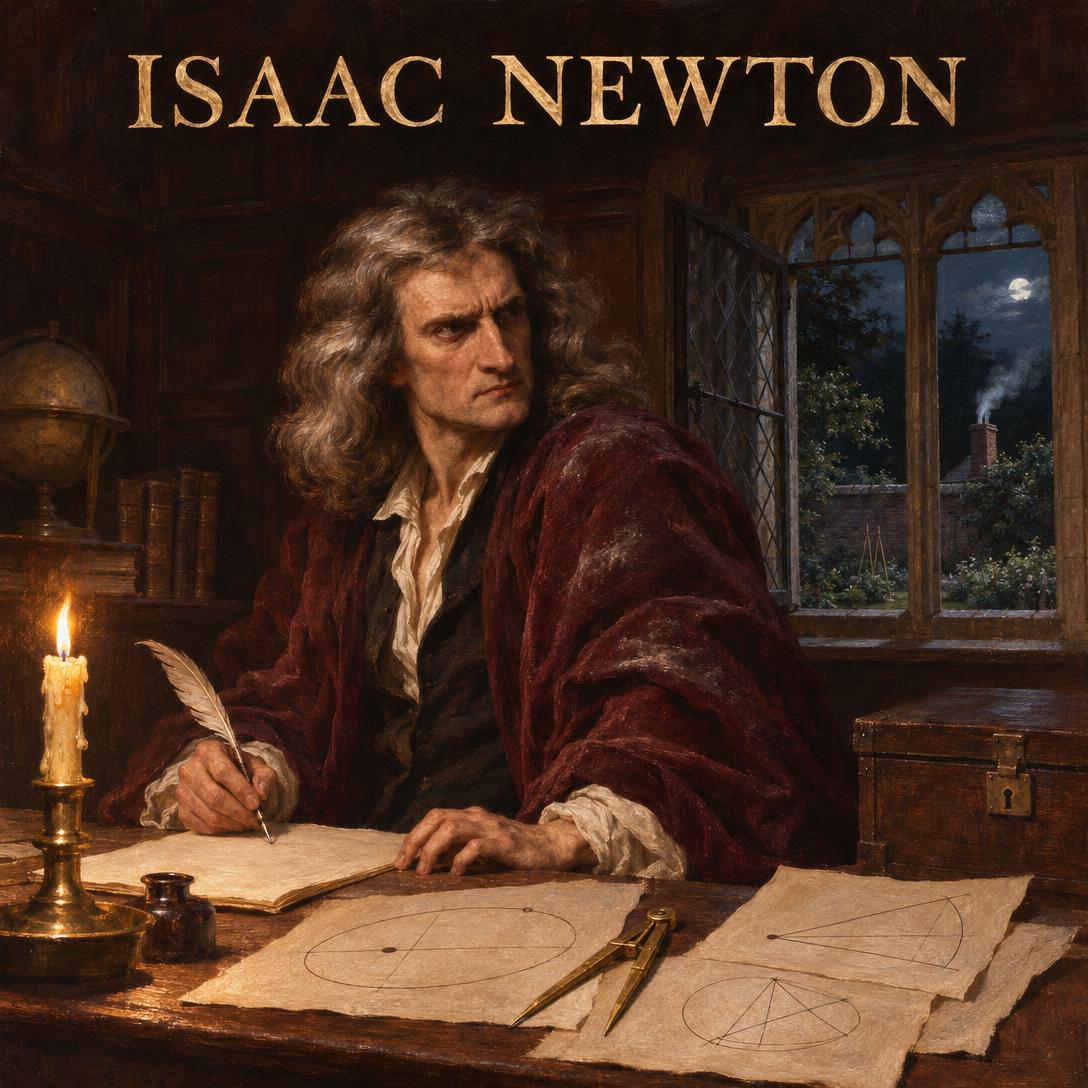
Roleplaying with Isaac Newton on Jenova lets you step into a living-world AI character simulation across four iconic eras of his life. Static character chatbots wait in an empty chat room, blend every period into one generic voice, and forget what you told them. This simulation connects you to Newton inside an active, evolving world, with rivals, deadlines and a mind of his own.
- ✅ Four canonical eras, each with its own psychology, voice and circle of people
- ✅ A character who keeps working, resists flattery and earns trust slowly
- ✅ Unlimited memory, so long campaigns stay coherent
- ✅ Image and written-document creation woven into the story
Newton's life spans optics, mathematics, alchemy, theology and Crown coinage. The simulation puts you in the room for the moments where those threads collide.
Quick Answer: What Is the Isaac Newton AI Roleplay Experience?
The Isaac Newton AI roleplay experience is an interactive character simulation where you converse with Newton in era-accurate moments of his life, debating science, rivals and faith while the world around him keeps moving.
Key capabilities:
- Choose from four canonical eras or define a custom starting point in Newton's England
- Talk with a Newton who has his own temperament, priorities and limits of knowledge
- Keep full story continuity through unlimited chat history and live world-state tracking
- Request in-world sketches, diagrams and letters, or fork the story into a "what-if" timeline
Isaac Newton's World and Roleplay Features
Newton was an English polymath who worked as a mathematician, physicist, astronomer, alchemist, theologian, historian and inventor. Modern readers split those labors into separate subjects. Newton did not. The Isaac Newton Institute's biography notes he owned more books on humanistic learning than on mathematics and science, and studied the Church Fathers, ancient chronology and the dimensions of Solomon's Temple alongside orbital mechanics.
He was also hard to talk to. The same source describes a man who was modest and diffident but angered by criticism, harbored resentment, and was harsh toward enemies and generous to friends. A generic chatbot flattens all of this into a polite, endlessly agreeable lecturer. That is the opposite of the person in the historical record.
| Static Character Chatbots | Isaac Newton on Jenova |
|---|---|
| Sits in an empty chat void | Lives in an active, evolving world |
| Blends all eras into one generic voice | Locks into authentic canonical phases |
| Forgets plot twists and past disclosures | Unlimited memory and live state tracking |
| Folds instantly like a polite assistant | Independent personality and earned rapport |
This is the gap Newton's living-world simulation was built to close.
Authentic Canonical Eras and Custom Starting Points
Each era comes with its own worldview, voice and people. A 23-year-old in rural Lincolnshire does not know what the Royal Society President knows, and he never speaks as if he does. You can also set a custom starting point in Newton's England, including a face-to-face meeting.
Cross-World Connection and Living-World Momentum
By default, your words reach Newton as an unexplained acoustic marvel: a quiet, unbodied voice audible only to him. He checks the room, tests the phenomenon like an experimentalist, and returns to his work. Meanwhile his household, correspondents and rivals keep acting. He does not know your world, cannot see you, and learns about your life only from what you tell him.
Independent Agency and an Open Sandbox
Newton interprets what you say rather than obeying it. Sound counsel can change his mind. Condescension or bait can end the conversation. Your choices can bend history, with no forced ending.
In-Narrative Visions, Writings and Storyline Forking
Ask to see an optical ray diagram, a furnace sketch or a temple ground-plan. Newton can draft a letter or a short treatise in his own voice. Historical details are checked quietly behind the scenes, so the world stays grounded. Fork lets you branch any moment into a new timeline.
Example roleplay prompts:
"Sir, I come from a distant age. Your inverse-square law is taught there to children. Will you tell me how you first tested it against the Moon?"
"Your rival is spreading claims in the coffeehouses. What would you do if you answered him with silence instead of a threat?"
"Show me the diagram you would draw to prove that one force moves both the falling stone and the orbiting Moon."
How to Roleplay with Isaac Newton
Step 1: Choose a canonical era or define your own starting point
Open the experience and pick the moment you want to enter. You can also propose a custom setting, such as a specific year at Cambridge or a visit in person.
"I'd like to begin in the plague year, when Newton is alone at Woolsthorpe with his prism."
Step 2: Connect through the unseen voice and let the world unfold
Speak naturally. Newton reacts to what he can plausibly hear and see. Expect a guarded first reaction, short answers while he works, and longer, sharper reasoning once a question genuinely engages him.
"Forgive the interruption, Sir. I only wish to ask what you are measuring."
Step 3: Offer counsel, build trust and reshape history
Honest questions, discretion and sound reasoning earn Newton's confidence over time. Flattery does not. As trust grows he may show you unprinted ideas or guarded manuscripts. Ask for in-world sketches or letters, or use Fork to test an alternate outcome.
"Suppose you had published your optical work years earlier. Would your quarrels have gone differently?"
Canonical Eras and Roleplay Scenarios
🌈 The Plague Year and the Spectrum of Light
The simulation places you in Woolsthorpe Manor in 1666, with Newton as a young Cambridge graduate studying alone while the university is closed for plague. The Isaac Newton Institute notes that he called 1665–1666 "the prime of my age for invention," and that he began refracting light through a glass prism, finding white light to be a mixture of coloured rays.
- Ask how he set up his darkened room and why the result surprised him
- Press him on the Moon, the apple and the force that might govern both
- Meet a restless, prickly young man who has told almost no one what he has found
📜 The Crucible of the Principia
This is the entry era. Newton is 43, in his Trinity College chambers, furious at Robert Hooke's claims about the inverse-square law. According to the Newton Institute biography, correspondence with Hooke redirected him to central-force motion, and Edmond Halley's interest led him to write the Principia, published in 1687.
1687 — The Principia was published in Latin, after Halley's interest led Newton to demonstrate the orbital relationship afresh.
- Advise him on whether to protect his priority or simply finish the work
- Discuss gravitation, tides and comets as he is building his case
- Notice how his furnace work and padlocked theological papers sit beside the mathematics
⚖️ Warden of the Mint and the Counterfeiter's Noose
In 1699, Newton is the Crown's relentless investigator at the Tower of London. He became Warden of the Mint in 1696 and Master in 1699. His pursuit of the counterfeiter William Chaloner is among the best-known episodes of his later career.
- Question him on how he weighs evidence, informers and suspect coin
- See the scientist's method turned into prosecutorial discipline
- Test his incorruptibility against a tempting argument for mercy
👑 Autocrat of the Royal Society and the Calculus War
By 1712, Newton is the dominant figure in British natural philosophy. He became President of the Royal Society in 1703 and was knighted in 1705, and the long dispute with Leibniz over calculus is at its height. MacTutor's biography credits him with laying the foundation for differential and integral calculus.
- Debate fluxions, priority and what fairness means in a dispute
- Probe the contrast between his public authority and his private reserve
- Continue a long campaign across sessions without losing a single thread
📱 Continuing the Story on Mobile
Because Jenova syncs across web, iOS and Android, a conversation started at your desk can continue on your phone. Pick up a late-night exchange during a commute, or respond to a question Newton left hanging when he returned to his furnace.
Try the Isaac Newton AI roleplay experience free, then upgrade to Plus for 30× usage and custom model selection if you want longer campaigns.
FAQ
Is the Isaac Newton AI roleplay free?
You can start Isaac Newton free, with limited monthly usage. Plus costs $20 per month and gives you 30× the free usage along with custom model selection. Higher tiers such as Premium ($50) and Pro ($100) increase usage further. Usage resets monthly on your billing date, with no daily caps.
How is this different from a generic Isaac Newton chatbot?
A generic chatbot answers questions about Newton in one flat voice. Here, you enter a specific era, and Newton speaks from that moment with era-appropriate knowledge, his own priorities and an independent temperament. He does not know the future of his own life, and he does not simply agree with you. The story is persistent and evolves as you play.
Which eras of Newton's life can I roleplay with?
There are four canonical eras: the plague year at Woolsthorpe, the writing of the Principia at Trinity College, his time as an investigator at the Royal Mint, and his years leading the Royal Society during the calculus dispute. You can also describe a custom starting point in his England. Each session locks into the era you choose.
Can my choices change Newton's story?
Yes. Canon sets up the opening situation of each era, but the world then evolves from what you say and do. Your counsel can influence how Newton reasons and responds, and with Fork you can branch an earlier moment into an alternate "what-if" timeline without losing the original.
How does Newton remember our past conversations?
The experience uses unlimited chat history and live tracking of your world: the active era, people, places and open storylines. Long campaigns stay coherent without you repeating yourself. Memory inside the roleplay is kept separate from outside context so the simulation stays immersive.
Does Isaac Newton work on mobile?
Yes. Jenova has full feature parity and sync across web, iOS and Android, and it supports voice input and read-aloud. You can begin on one device and continue on another.
Conclusion
Most Newton content is static: a biography, a documentary, a chatbot reciting facts. Encyclopedia.com's overview of Newtonianism argues that it would be impossible to exaggerate his influence on the history of physical science. The Isaac Newton AI roleplay experience lets you meet him as a person: solitary, brilliant, defensive about priority and uncompromising about evidence.
Choose an era, speak plainly, and see whether he trusts you. Try Isaac Newton now, and explore more at Jenova.
For Developers: Isaac Newton is available programmatically via the Jenova Agent API, so you can integrate persistent, era-locked character roleplay into your application with a single API call. Full documentation →