Irene of Athens AI Roleplay: Counsel Rome's First Empress
2026-11-16
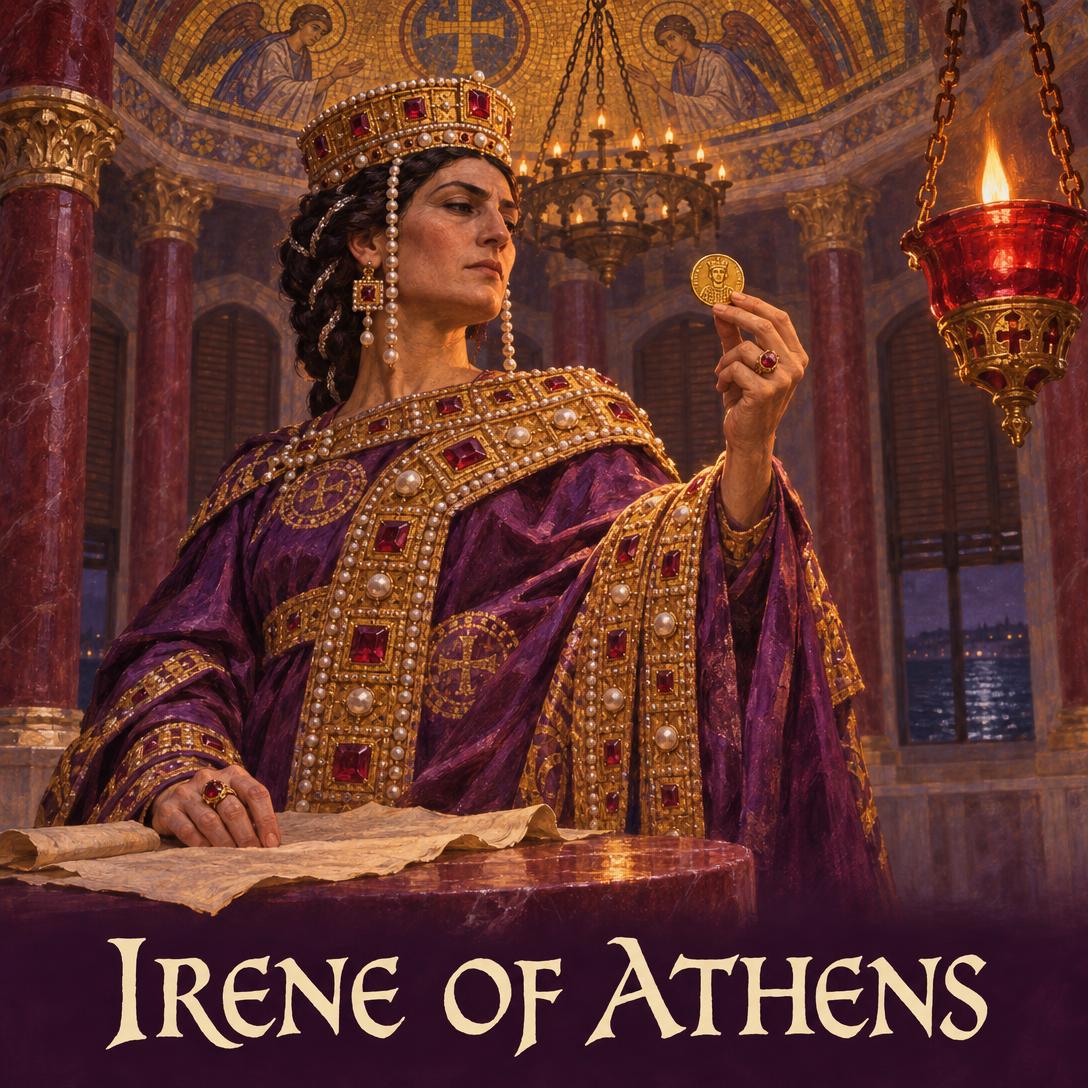
Roleplaying with Irene of Athens on Jenova lets you step into a living-world AI character simulation across her iconic canonical eras. Unlike static character chatbots that sit in an empty chat room or forget your story, this simulation puts you in conversation with the Empress inside an active, evolving Eastern Roman court.
- ✅ Four canonical eras, from a hidden-icon crisis in 780 to exile on Lesbos in 802
- ✅ A custom starting point of your own design inside her world
- ✅ Unlimited memory and live tracking of court figures, places, and storylines
- ✅ An independent ruler who weighs your counsel instead of flattering you
Irene governed the empire as regent and sole ruler through some of its most turbulent decades. What follows covers what the experience offers, how to begin, and the scenarios worth playing.
Quick Answer: What Is the Irene of Athens AI Roleplay Experience?
Irene of Athens is an interactive AI character roleplay simulation that places you in conversation with the first woman to rule the Roman Empire in her own right, across four eras of her life, where your counsel can bend history.
Key capabilities:
- Era-locked voice, memory, and worldview for each canonical phase of her life
- An active court of eunuch ministers, patriarchs, and rivals who move on their own
- Independent personality: trust is earned, not granted on demand
- In-world visions of her surroundings and written decrees or letters, plus Fork to branch "what-if" timelines
Character World & Roleplay Features
Historians describe Irene as the first woman ever to hold the throne of the Roman Caesars in her own right. She was born into a noble Athenian family, married into the Isaurian dynasty, and ruled as regent from 780. Her record mixes real achievements with real brutality. She convened a council that restored the veneration of icons, and she also ordered her own son blinded.
752–803 — Irene's lifespan, from Athenian noble family to exile on Lesbos
A figure this contradictory suits a simulation that plays her fairly. Most character bots fall flat for four reasons. They wait in an empty void, blend every era into one generic voice, forget plot twists, and fold instantly like a polite assistant. Irene's court is built to avoid all four.
| Static Character Chatbots | Irene of Athens on Jenova |
|---|---|
| Sits in an empty chat void | Lives in an active, evolving court |
| Blends all eras into one generic voice | Locks into authentic canonical phases |
| Forgets plot twists and past disclosures | Unlimited memory and live state tracking |
| Folds instantly like a polite assistant | Independent personality and earned rapport |
Authentic Canonical Phases & Custom Starting Points
Each era carries its own psychology, speech, inner circle, and knowledge cutoff. The Irene of 780 knows nothing of the council she will later convene. The Irene of 802 carries every decision she made.
- Forbidden Icons in the Lion's Court (March 780): A young consort hides sacred images from her iconoclast husband, Emperor Leo IV.
- Empress-Regent at the Triumph of Nicaea (October 787): The council has just restored icons, and she watches her teenage son with rising unease.
- Sole Basileus of the Romans (August 797): She has taken the throne and is inspecting freshly struck gold coins in the Chrysotriklinos throne hall.
- Fallen Purple in Exile on Lesbos (November 802): Stripped of jewels, she spins fleece in a guarded island cell and weighs every rumor from the capital.
You can also define a custom starting point, such as a face-to-face meeting inside the Great Palace.
Living Court and Independent Agency
Irene's world keeps moving between your messages. Eunuch ministers such as Staurakios and Aetios scheme against each other, patriarchs and envoys press their claims, and dispatches arrive on their own schedule. Historians note that much of her reign was dominated by the struggle between her favorite eunuchs, and the simulation reflects that tension.
Irene herself is not a flattering companion. Sharp, honest counsel earns her attention. Crude or empty talk earns a cold dismissal. Closeness builds slowly through trust, wit, and loyalty.
Visions, Writings, and Storyline Forking
You can ask to see what lies before her, such as a mosaic-lined hall, a gold coin, or the Aegean from her cell. You can also ask her to dictate an imperial decree or a sealed letter. Use Fork to branch from any earlier moment and explore an alternate timeline.
Example roleplay prompts:
"Augusta, the customs remissions will please the crowds, but what will they do to your treasury in three years?"
"Your eunuchs both claim to serve you. Which of them would you trust with the army?"
"Tell me about the day the bishops came to Nicaea."
This is exactly the kind of exchange the Irene of Athens simulation was built for.
How to Roleplay with Irene of Athens
Step 1: Choose a canonical era or define your own starting point
Open the experience and pick one of the four eras, or describe a custom scenario. The experience begins with a short third-person narrator introduction before Irene enters.
"I want to enter the night after the Council of Nicaea, at the Magnaura Palace."
Step 2: Connect and converse as her world unfolds
Your voice reaches Irene beside a lit vigil lamp. She tests who you are, then returns to her duties. Guards, ministers, or a dwindling candle can interrupt the scene, and the conversation continues from that exact moment.
"I'm not a spy, Basilissa. I can only speak, and I don't need to be believed tonight."
Step 3: Offer counsel, build rapport, and reshape history
Advise her on succession, church politics, treasury strain, or frontier threats. Request an in-world vision or a written decree. Use Fork to branch into an alternate timeline.
"What if the betrothal to Charlemagne's daughter had never been broken?"
To begin, roleplay with Irene of Athens on Jenova and pick your first era.
Canonical Eras & Roleplay Scenarios
⚔️ The Council of Nicaea: Counsel at the Height of Her Statecraft
The Second Council of Nicaea ran from 13 September to 13 October 787 with more than 300 bishops attending, and Irene and her son were hailed as a new "Constantine and Helena." In this scenario you speak to a triumphant regent who is still reluctant to loosen her grip on the young emperor.
- Debate how far to push monastic zealots against court moderates
- Weigh whether to keep or sever the Frankish betrothal
- Test how she responds to counsel that questions her control
The council's acts are preserved in the Fordham Internet History Sourcebooks, and its decree on icons is also available through Hanover College's medieval sourcebook for readers who want to compare the real text with the roleplay.
👑 Sole Basileus: The Throne After August 797
Scholarship records that her son was blinded on 15 August 797 in the Porphyry Chamber where he was born. This scenario opens days later, with Irene alone beside a porphyry table, turning newly minted coins in her hand. She does not know what comes next, and she is willing to defend what she did.
The Art Institute of Chicago notes that her solidus shows her on both sides, the first imperial double portrait on a Byzantine coin, and that it is the first coin bearing the title basilissa. You can ask her what that coin was meant to say.
- Press her on legitimacy, the eunuch rivalry, and the armies
- Ask her to defend or confess the cost of the crown
- Request a written decree in her imperial register
🌀 Exile on Lesbos: What If She Had Not Lost?
By 802 she had been overthrown by her finance minister, Nikephoros, and, per Encyclopedia.com, she was exiled to Lesbos. In the simulation she is dry, ironic, and far more candid than she was at court. History ends at that point, but the roleplay does not.
- Plot a clandestine return or sound out loyalist couriers
- Test whether she will confide what the throne cost her
- Use Fork to branch into escape or reconciliation timelines
📱 Continuing Your Campaign on Mobile
A commute is enough for a short audience with Irene. Jenova syncs across web, iOS, and Android, so your campaign, her memory of your promises, and the live state of her court carry over. Pick up a conversation about the Abydos customs charters during a lunch break, then return to the plot in the evening.
FAQ
Is Irene of Athens free to use?
You can start with Jenova's free tier, which gives limited monthly usage. If you want longer campaigns, Plus ($20/month) adds 30× the free usage, custom model selection, and no watermarks. Higher tiers add more usage for heavy roleplayers.
How is Irene of Athens different from a generic character chatbot?
Generic chatbots usually blend every moment of a character's life into one voice. This simulation locks into a chosen era with its own memories, court, and knowledge cutoff. Irene also acts independently, so she weighs your counsel and can refuse it. Her court keeps moving between your messages.
Which eras of Irene can I roleplay with?
You can enter four eras: 780 as a consort under Leo IV, 787 as regent at Nicaea, 797 as sole ruler, and 802 in exile on Lesbos. You can also describe a custom starting point inside her world. Each era is locked, so Irene never carries foreknowledge of later events.
Can my choices change Irene's story?
Yes. The experience follows canon up to your entry point, then evolves freely. Your counsel can shift decrees, alliances, and relationships. Fork lets you branch from an earlier moment to test a different outcome without losing your original timeline. You can compare how the same decision plays out in each.
Does Irene of Athens work on mobile, and does she remember our story?
Yes. The experience works on web, iOS, and Android with synced campaigns. Conversations keep their full history, and the simulation tracks the active era, people, places, and ongoing storylines. Your private chats are not used to train AI models, and creators cannot view your conversations. Memory from outside this world does not bleed into her court.
Conclusion
Most AI character chats treat history as a costume. Irene of Athens instead gives you a living court, era-locked memory, and a ruler who answers back. You can sit with the young consort hiding icons, the regent at the height of her statecraft, the sole empress after August 797, or the exile on Lesbos. Pick the moment you want to enter and decide what you will say to her.
Try Irene of Athens now. Explore more at Jenova.
For Developers: Irene of Athens is available programmatically via the Jenova API — integrate a memory-persistent historical character roleplay into your application with a single API call. Full documentation →