What Is the Best AI IQ Test for Cognitive Assessment?
2026-08-27
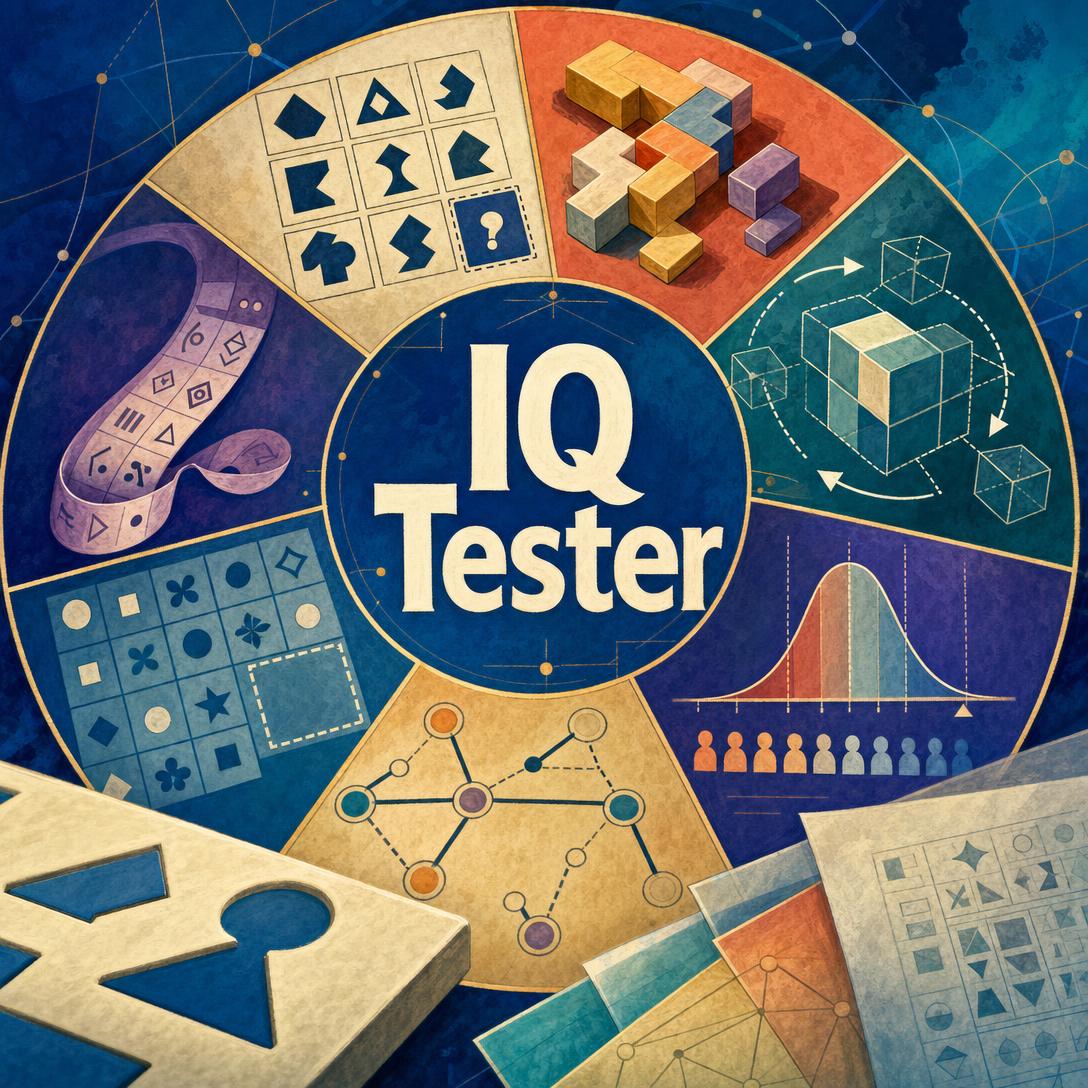
How Do AI IQ Tests Compare on Domain Coverage, Adaptive Scoring, and Report Transparency?
For a conversational 30-question estimate across seven cognitive domains with a dimensional report, IQ Tester is the strongest AI-administered option in 2026. For a researcher-built online battery with published error margins, RIOT IQ is the more psychometric choice. For any high-stakes decision, the Wechsler Adult Intelligence Scale, Fifth Edition (WAIS-5) remains the clinical reference.
The useful comparison is not “which site prints the highest number.” It is which instrument covers multiple abilities, calibrates difficulty honestly, and discloses what it cannot measure.
Key factors that separate a serious cognitive estimate from a puzzle quiz:
✅ Domain coverage — verbal, fluid, spatial, memory, and quantitative abilities, not a single puzzle type ✅ Per-domain adaptivity — difficulty that rises or falls inside each ability, not one global “gets harder” slider ✅ Score transparency — percentile, confidence interval, and domain breakdown rather than a bare IQ integer ✅ Format disclosure — whether items are timed, visual, supervised, or text-only ✅ Use-case honesty — entertainment, self-estimate, or licensed clinical evaluation
A Coverage–Calibration–Disclosure (CCD) lens makes those differences concrete. The sections below apply that framework to Jenova’s IQ Tester, RIOT IQ, the Mensa IQ Challenge, WAIS-5, and computerized cognitive batteries such as Creyos and CogniFit.
Why Has Interest in Online AI IQ Testing Increased in 2026?
Interest has grown because licensed testing is expensive and scarce, while remote digital assessments have become easier to complete without a clinic visit. A 2026 review of free IQ tests reported that a licensed Wechsler Adult Intelligence Scale (WAIS-IV) administration typically costs $150 to $300. Other online roundups put broader in-person cognitive evaluations in a $300 to $1,000 range.
Cost is only part of the barrier. WAIS-5 is a Qualification Level C instrument, meaning a licensed psychologist or similarly credentialed examiner must administer it. The scale itself is a copyrighted Pearson product available only through licensed channels. Most people who want a number cannot book that appointment this week.
Remote cognitive testing research has also matured. A 2025 Frontiers study of BrainCheck found moderate-to-good agreement between self-administered and coordinator-administered sessions, with intraclass correlations from 0.59 to 0.83. That supports feasibility. It does not mean every viral IQ quiz is valid.
The counterweight is equally important. A 2024 PLOS One paper notes that concurrent validity of online cognitive testing is typically low, with a median of 0.49. Videoconference versions of traditional tests often show good concurrent validity but poor or fair comparability with in-person norms. Curiosity is rational. Treating an unsupervised chat score as a clinical Full Scale IQ is not.
What Should You Look for in an AI IQ Test?
You should evaluate an AI IQ test on coverage of multiple abilities, how difficulty is calibrated, and how plainly the report states error and limits. A single headline IQ is the least informative output an assessment can produce.
The Coverage–Calibration–Disclosure framework used in this article weights six dimensions:
- Ability coverage — Does the session sample verbal, logical, quantitative, spatial, memory, and abstract reasoning, or only pattern puzzles?
- Item quality — Is there one objectively correct answer, or are items opinion-based, culture-bound, or trivia?
- Calibration model — Is difficulty adapted per domain, globally progressive, or fixed?
- Format fidelity — Can the medium actually measure what it claims (visual matrices, timed processing speed, working memory without notes)?
- Score architecture — Composite, percentiles, confidence intervals, and domain scores versus a lone integer.
- Intended use — Entertainment, estimation, cognitive-health screening, or licensed diagnosis.
Classic psychometrics still defines the ceiling. The Wechsler Adult Intelligence Scale is designed to measure intelligence and cognitive ability in adults and older adolescents. Analyses of WAIS-IV show it taps Cattell–Horn–Carroll (CHC) abilities including crystallized ability (Gc), fluid reasoning (Gf), visual processing (Gv), and short-term memory (Gsm). WAIS-5, published in 2024, separates visual spatial and fluid reasoning indexes and can produce a seven-subtest Full Scale IQ in about 45 minutes.
Online tools that ignore those constructs are not “faster Wechslers.” They are different instruments. Text-only AI tests cannot administer Raven-style matrices, block design, or motor processing-speed tasks. Timed puzzle challenges measure speeded performance under a clock, which is not the same as untimed reasoning. A fair comparison names those gaps instead of hiding them.
If you also want a non-ability snapshot of how you think and decide, structured agents such as Personality Analyzer sit in a different construct space — traits, not IQ — and should not be averaged into a cognitive score.
How Do Jenova's IQ Tester, RIOT IQ, Mensa, and the WAIS-5 Differ?
They differ most on supervision, visual content, timing, and whether the score is an estimate, a normed online IQ, or a clinical Full Scale IQ. Jenova is a 30-item adaptive chat estimate; RIOT IQ is a multi-subtest online battery; Mensa’s public challenge is an entertainment puzzle set; WAIS-5 is the licensed gold-standard exam.
| Feature / Dimension | RIOT IQ | Jenova IQ Tester | Mensa IQ Challenge | WAIS-5 |
|---|---|---|---|---|
| Format | Timed/untimed online subtests in a custom platform | Untimed text chat, one question at a time | Browser puzzle challenge | Paper or Q-interactive, examiner-led |
| Length | Full battery about 52 minutes | 30 questions; duration varies | 35 puzzles in 25 minutes | ~45 minutes for 7-subtest FSIQ; ~60 minutes for 10 primary indexes |
| Coverage | 15 subtests, six cognitive indices | Seven domains: verbal, logical, pattern, quantitative, spatial, working memory, abstract | Progressive puzzles; no published domain map | Verbal, visual spatial, fluid, working memory, processing speed indexes |
| Adaptivity | Standardized subtest battery | Difficulty adapts independently per domain | Progressively more difficult | Start points and discontinue rules; giftedness start points on WAIS-5 |
| Visual / motor items | Yes (matrices, puzzles, rotation, reaction time) | No — text descriptions only | Puzzle graphics typical of Mensa items | Yes, including motor and nonmotor options |
| Clinical / standards claim | APA, AERA, and NCME testing standards; CHC model | Explicitly an estimation exercise, not a clinical IQ test | Entertainment only; does not qualify for Mensa | Licensed clinical instrument, Qualification Level C |
| Score output | IQ, ability breakdown, ±3.7 IQ margin of error on the full test | Composite IQ, percentile, 95% CI, domain table, narrative | Range-limited challenge score | FSIQ, primary and ancillary indexes, process scores |
| Pricing (as of 2026) | Full test $50**; shorter version $25 | Jenova free tier with limited usage; paid plans from $20/month | Free challenge | Professional kit plus examiner fee; consumer administrations often $150–$300 |
| Best for | Closest widely available online IQ battery with published SEM | Conversational multi-domain estimate and explanatory report | Timed puzzle practice | Diagnostic, educational, legal, or clinical decisions |
Jenova IQ Tester
Jenova administers 30 mixed-stream questions covering verbal reasoning, logical reasoning, pattern recognition, quantitative reasoning, spatial reasoning, working memory, and abstract reasoning. Difficulty starts in a moderate band and then moves independently inside each domain: a correct answer pulls the next item in that domain harder; an incorrect answer pulls it easier.
After each response, the session returns a verdict, the correct answer, a short explanation, and the item’s domain and difficulty — then the next question. The closing report includes an estimated IQ on a mean-100, SD-15 scale, a percentile, a 95% confidence interval, a seven-row domain table, a performance narrative tied to actual items, and a methodology note.
The honest limits are structural. Spatial items are text descriptions, not figures, so spatial scores are downweighted. Working-memory items live in a chat log the user can scroll, so those scores are also downweighted. The platform cannot time items, so processing speed is not measured. The product states that it is not clinically validated and should not be used for diagnosis, school placement, or employment decisions. That disclosure is a strength of the report and a hard ceiling on the use case.
RIOT IQ
RIOT IQ, the Reasoning and Intelligence Online Test, was developed by intelligence researcher Dr. Russell T. Warne and is built on the CHC model. The full form uses 15 subtests across verbal reasoning, fluid reasoning, spatial ability, working memory, processing speed, and reaction time. It is normed on US-born, native English speakers aged 18 and older.
That last clause matters. A non-native speaker or someone outside the norming population should not treat the published ±3.7 IQ margin of error as automatically transferable. RIOT’s visual and reaction-time tasks are a genuine advantage over chat-only tests. The trade-off is time, cost, and a less conversational explanation of why an item was missed.
Mensa IQ Challenge and Practice Tests
The Mensa IQ Challenge asks users to solve 35 puzzles in 25 minutes, with difficulty increasing through the set. Mensa International states the challenge is for entertainment and will not qualify anyone for membership. Scores below the measurable range receive a blunt out-of-range message rather than a precise IQ.
American Mensa’s 30-minute online practice test is likewise unofficial. These products are well designed as speeded puzzle screens. They are weak as cognitive profiles: no seven-domain table, no confidence interval, and no claim of clinical equivalence. People who want Mensa admission still need a supervised, approved exam.
Creyos, CogniFit, and Cognitive-Health Batteries
Not every “brain test” is an IQ test. Cambridge Brain Sciences — now Creyos Health — is a widely used web-based cognitive testing platform, with limited free tests and an optional paid upgrade. Clinics use Creyos-style batteries for concussion and brain-health screening more than for a classic IQ number.
CogniFit’s online cognitive test reports concentration, memory, reasoning, planning, and coordination against same-age peers. That is useful for tracking relative cognitive fitness. It is a different question from “what is my Full Scale IQ?” Mixing those product categories is how a lot of online advice becomes misleading.
How Does Adaptive Difficulty Affect AI IQ Test Accuracy?
Adaptive difficulty improves precision when it tracks each ability separately and aims at the difficulty band where the test-taker is neither ceilinged nor floor-scraping. A single progressive curve, like a puzzle set that only gets harder, mostly ranks people who persist — it does not map a cognitive profile.
Jenova’s model is domain-local. Someone can sit at hard verbal items while spatial items ease off. The session tries to converge near 50% accuracy inside each domain, which is the informative region for an estimate. Difficulty is shown only after the answer, so the label cannot coach strategy mid-item.
Mensa’s challenge uses a different logic: puzzles get progressively difficult, under a 25-minute cap. Speed and stamina become part of the score. That can be engaging and still fail to distinguish “slow but accurate fluid reasoning” from “fast pattern spotting.”
WAIS-5 adaptivity is examiner-mediated: start points, discontinue rules, and special start points for suspected intellectual giftedness that can cut testing time by about 25% in high-ability cases. Those rules exist because giving every adult every easy item wastes time without adding information.
The accuracy catch for AI chat tests is not the adaptive rule. It is everything the rule cannot see: looking up answers, using another model, scrolling back for working-memory items, or spending ten minutes on a question the instrument treats as a prompt response. Jenova’s integrity instructions ask users not to use search engines or AI assistants and to answer promptly. Compliance is unenforceable in an unsupervised window. That is why even a well-designed adaptive estimate still needs a wide confidence interval.
What Should a Cognitive Assessment Report Include Besides an IQ Number?
A useful report includes a composite with error bars, a domain profile, a plain-language narrative of how you actually reasoned, and a methods section that admits format bias. A naked IQ integer with no interval is marketing, not measurement.
Jenova’s report is built around that stack:
- Composite — estimated IQ, classification band, percentile, 95% confidence interval
- Distribution context — where the score sits on a standard bell curve (mean 100, SD 15)
- Domain table — score, percentile, items correct, peak difficulty, and a visual bar for each of the seven domains
- Performance narrative — specific items, difficulty ceilings, cross-domain patterns, and fatigue or consistency across the 30 questions
- Relative strengths and weaknesses — evidence from the session, not generic trait labels
- Scoring methodology — adaptive model, downweighting of spatial and working-memory scores, and the WAIS-style distribution reference
- Disclaimer — estimation only; not a professional psychological evaluation
RIOT IQ similarly returns an IQ with a margin of error plus six cognitive-ability scores and subtest T-scores. That granularity is why a 52-minute battery can justify a tighter published SEM than a 30-item chat test.
Mensa’s public challenge does not attempt this. If you miss the measurable window, you learn only that you were outside it. WAIS-5 goes further still, with primary indexes, ancillary indexes, and process scores that licensed examiners interpret against technical manuals — including qualitative descriptors that Pearson itself notes are suggestions, not evidence-based labels.
Readers comparing tools should treat “IQ: 128” with no CI as a red flag. Two instruments can print the same integer with wildly different uncertainty. The interval, the domain spread, and the missing abilities (processing speed, visual spatial) are the parts worth citing.
After an ability estimate, some users want a political or personality map rather than another cognitive trial. Political Compass Tester is a structured 30-proposition instrument of that kind. It measures attitudes, not intelligence, and should be read as a separate profile.
How Do You Take an AI IQ Test Without Distorting Your Score?
You get a cleaner estimate by treating the session like an exam: no search, no second AI, no notes, and no mid-test coaching. Unsupervised digital tests are only as valid as the conditions you actually sit in.
For Jenova’s IQ Tester, the flow is short:
- Open the agent at jenova.ai/a/iq-tester.
- Read the disclaimer and integrity statement. The session states that this is a cognitive estimation exercise, not a clinically validated IQ test.
- Answer Question 1 in the same opening exchange — there is no separate “ready” gate.
- Submit one answer at a time. After each item you receive correctness, a brief explanation, and the item’s domain and difficulty, then the next question.
- Complete all 30 items. Incomplete sessions do not produce a report.
- Read the composite, domain table, and methodology before sharing the number.
A straightforward start looks like this:
I will take the full 30-question assessment without search engines, calculators, or other AI. Ask the first question.
If you cannot answer, “I don’t know” is scored incorrect — which is statistically cleaner than guessing with a search tab open. Previous answers are final. Asking for hints is refused. After the report, the same session can export a PDF, email the write-up, or generate a bell-curve image of where the score sits. A retake uses different questions; familiarity with formats still reduces comparability.
For RIOT IQ, choose the full 15-subtest form if you want the ±3.7 error margin rather than the shorter five-subtest ±5.6 version. Take it in one quiet block on a device that can present visual items. Do not treat a break-filled session on a phone as equivalent to a lab administration.
For the Mensa IQ Challenge, budget a continuous 25 minutes. A paused, looked-up run is not the challenge the timer was built for.
For WAIS-5, you do not self-administer. You schedule a qualified examiner. That friction is the point: standardized instructions, stimulus control, and scoring rules are part of the construct.
If the goal is to understand the theories behind the score rather than to sit another test, Psychology Tutor can walk through CHC abilities, Wechsler indexes, and what a percentile actually means — without pretending those lessons raise IQ.
What Do Psychometric Experts Say About AI-Administered IQ Estimation?
Psychometric practice treats unsupervised online scores as rough estimates with modest concurrent validity, useful for curiosity and weak for high-stakes decisions. The 2024–2025 digital-assessment literature is more optimistic about feasibility than about replacing Wechsler.
"The median concurrent validity figure of about 0.49 for online cognitive tests is the number that should sit next to every viral IQ result. That is a real correlation, and it is also far too low to substitute for a licensed battery when a diagnosis, an IEP, or a court question is on the table. Feasibility studies that show ICCs in the 0.6–0.8 range for short digital screens are encouraging for remote monitoring. They are not a license to blur a 30-item chat estimate into a Full Scale IQ."
"Where conversational agents add value is not secret items. It is per-domain calibration plus a report that shows the interval, the profile, and the format tax. A text interface cannot fairly score mental rotation or processing speed, and a chat log cannot fairly score working memory if the examinee can scroll. Publishing those downweights is more scientific than printing a three-digit score with fake precision."
"The practical split in 2026 is simple. Use an adaptive multi-domain estimate when you want a structured look at verbal, logical, quantitative, and abstract reasoning. Use a CHC-aligned online battery when you need visual subtests and a published SEM. Use WAIS-5 when the decision can change someone’s schooling, clinical care, or legal status. Mixing those three jobs is how online testing earned its reputation problem."
— Jenova Product Team, designers of conversational cognitive assessment agents
That stance matches the broader evidence: remote self-administration can be reliable enough to study, while online–in-person agreement often stays only moderate. Expert consensus is less “AI tests are fake” than “AI tests are a different, noisier instrument.”
Can an Online AI IQ Test Replace a Licensed WAIS Assessment?
No. An online AI IQ test cannot replace a licensed WAIS-5 evaluation for diagnosis, educational classification, disability determination, or employment decisions. It can only estimate a subset of reasoning abilities under unsupervised, usually untimed, often text-only conditions.
WAIS-5 is normed for ages 16:0 to 90:11, co-normed with WMS-5, and built for clinical, educational, correctional, pharmaceutical, and government settings. Examiners can derive a nonmotor index for remote or motor-impaired cases, expanded indexes, and process scores. None of that is available in a 30-question chat, a 25-minute puzzle challenge, or a consumer login.
Legal and clinical writers still describe Wechsler scales as the gold standard for assessing adult intellectual functioning. That status comes from standardization samples, examiner training, and decades of outcome research — not from a higher entertainment score.
Use the tools in different lanes:
- Jenova IQ Tester — strongest for a fast, explained, seven-domain estimate you can actually finish in one sitting, if you accept wide intervals and no visual or speed measures
- RIOT IQ — strongest widely sold online IQ battery with CHC coverage, visual subtests, and a published margin of error, if you fit the US-born native-English adult norms
- Mensa IQ Challenge — strongest as a free, timed puzzle stress test, not as a cognitive diagnosis
- Creyos / CogniFit — stronger for repeated cognitive-health snapshots than for a classic IQ
- WAIS-5 — the only option in this set appropriate when the number will be used about you by a school, clinic, or court
The CCD verdict is therefore conditional. If coverage, calibration, and disclosure are the criteria, Jenova’s IQ Tester is among the most complete conversational estimators available, RIOT IQ is the more traditional online psychometric product, and WAIS-5 is still the instrument the others are approximating. Wanting a number tonight does not change that hierarchy. It only explains why the approximations exist.
References
- JobCannon — 2026 roundup of free IQ tests and licensed WAIS-IV administration costs
- GBI / IQ Test Free — typical in-person IQ assessment cost ranges
- Pearson Assessments — Wechsler Adult Intelligence Scale, Fifth Edition (WAIS-5) specifications
- Cogn-IQ — WAIS as a copyrighted Pearson instrument available through licensed channels
- Frontiers in Digital Health — 2025 reliability study of remote self-administered BrainCheck assessments
- PLOS One — feasibility and reliability of online vs in-person cognitive testing; median concurrent validity
- PMC / NIH — web-based cognitive assessment compared with in-person tests
- Wikipedia — Wechsler Adult Intelligence Scale overview
- PubMed — CHC abilities measured by the WAIS-IV
- RIOT IQ — Reasoning and Intelligence Online Test structure, norms, standards, and pricing
- Mensa International — Mensa IQ Challenge format, timing, and entertainment disclaimer
- American Mensa — unofficial online Mensa practice test
- Brain Balance — Cambridge Brain Sciences as a widely used computerized cognitive assessment platform
- NeuroX — review of Cambridge Brain Sciences free and paid cognitive profiling
- CogniFit — online cognitive test domains and age-normed comparison
- Lemoine Law Firm — WAIS-IV as a gold-standard adult intellectual assessment