AI Investment Memo Generator: Draft Deal Memos From Filings & Research
2026-08-19
An AI investment memo generator turns scattered filings, management decks, and web research into a structured deal memo — executive summary, business overview, competitive landscape, and financial analysis — without the multi-day drafting cycle. On Jenova, you assemble this workflow from specialist agents that each own a section of the memo, then synthesize the output into a single investment-ready document. The problem isn't a shortage of data. It's that turning that data into a defensible narrative is still largely manual.
✅ Draft full memo sections from uploaded filings, decks, and financials ✅ Pull live competitive and market context from the web ✅ Ground every section in your own documents and knowledge bases ✅ Export polished memos as PDF, Word, or plain text
To understand why this matters, it helps to look at how investment professionals actually spend their time today — and where the bottleneck between "we have the data" and "we have a memo" really sits.
Quick Answer: What Is an AI Investment Memo Generator?
An AI investment memo generator is a research and drafting system that ingests company filings, management materials, and live web data, then produces structured investment memo sections — executive summary, business overview, competitive landscape, and financial analysis — in a fraction of manual drafting time.
Key capabilities:
- Document ingestion — upload management presentations, financials, and internal notes as a persistent knowledge base
- Live research — pull competitive positioning, funding history, and market context from the open web
- Section-level drafting — generate each memo section with a specialist agent rather than one generic prompt
- Synthesis and export — combine sections into a single formatted memo via the PDF Doc Generator or Word Doc Generator
The Problem: Investment Memos Are Still Assembled by Hand
Investment memos sit at the center of every capital allocation decision — and they remain one of the most labor-intensive artifacts in finance. The raw inputs are more accessible than ever. The synthesis is not.
Adoption of AI in finance is real but uneven, and workflow tooling has lagged behind the hype:
Roughly 18% of U.S. firms had adopted AI as of year-end 2025, while about 41% of the workforce reports using generative AI at work — Federal Reserve monitoring of AI adoption
59% of finance leaders report using AI in the finance function, with adoption holding steady rather than accelerating — Gartner finance AI survey
45% of organizations still rely primarily on spreadsheets for planning — FP&A Trends Survey
But turning research into a decision-grade memo is where the process breaks down:
- Source material lives in a dozen places — data rooms, decks, filings, LinkedIn, Crunchbase, internal notes
- Every section requires a different analytical mode, from qualitative business narrative to quantitative financial review
- Generic AI chat tools produce fluent prose with no grounding in your actual documents
- Verification overhead often cancels out the drafting time saved
- Memo quality varies by whoever drafted it, with no consistent structure across the pipeline
Fragmented Source Material
A single memo pulls from management presentations, audited financials, internal diligence notes, competitor filings, and public profile data. Each source arrives in a different format with a different level of reliability. Analysts spend disproportionate time on retrieval and reconciliation before any actual analysis begins — and that fragmentation compounds when a deal moves quickly.
Every Section Demands a Different Analytical Mode
A business overview requires narrative synthesis. A competitive landscape requires live market scanning. A financial overview requires disciplined quantitative reading of statements. An executive summary requires ruthless compression of all three. Asking one generic assistant to switch between these modes in a single conversation produces uniformly mediocre output across all four.
Hallucination Risk in a High-Stakes Document
This is the constraint that keeps most desks cautious. The UK's Financial Conduct Authority is direct about the failure mode: general-purpose AI tools "sometimes provide information that's just incorrect," and the confident tone makes fabrications hard to spot. Their guidance — verify every fact against the original source — is exactly right, and it's why grounding in your own uploaded documents matters more than raw model quality.
The Verification Tax
Research from the CFA Institute found that with sophisticated prompting, certain large language models exceeded human analysts in specificity and depth when producing SWOT analyses — and that advanced prompting improved AI performance by up to 40%. But the same study is clear that output should be treated like a junior analyst's draft: valuable input requiring senior review. Without structure, that review burden lands entirely on the analyst.
Inconsistent Output Across the Pipeline
Two analysts covering similar deals produce memos with different section ordering, different depth, and different standards of evidence. Investment committees then compare documents that aren't actually comparable — a structural problem, not a talent problem.
This is exactly what a structured, multi-agent memo workflow was built for.
The Solution: Building an AI Investment Memo Workflow on Jenova
The fix isn't a single AI that "writes memos." It's a workflow where each memo section is owned by a specialist agent grounded in your own documents, then synthesized into one document at the end.
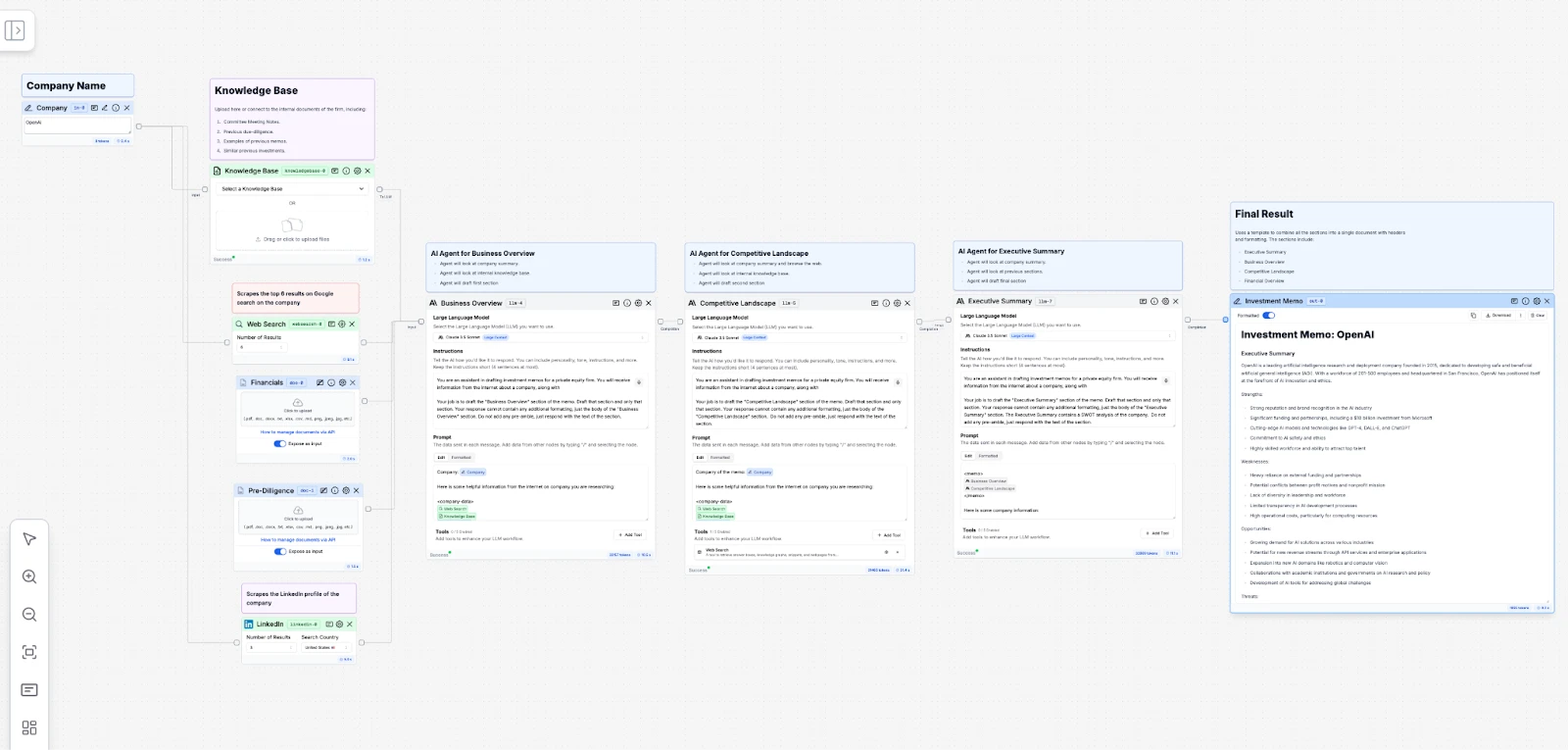
| Traditional Approach | AI Memo Workflow on Jenova |
|---|---|
| Analyst manually reads every filing and deck | Documents uploaded once as a persistent knowledge base |
| One person drafts all four sections sequentially | Specialist agents draft each section in parallel |
| Competitive research done via manual browsing | Live web research pulled directly into the draft |
| Financial review done in a separate spreadsheet pass | Financial analysis grounded in uploaded statements |
| Formatting and assembly done manually in Word | Sections synthesized and exported in a single step |
| Days of drafting before first internal review | First full draft available the same session |
Ground Everything in Your Own Documents
The single most important design choice: the memo is built on documents you supply, not on model memory. Upload management presentations, financial statements, diligence notes, and prior committee memos, and the workflow references them directly. When the Legal & Contract Advisor flags a risk clause or the Accounting & Audit Assistant reconciles a line item, it's reading your actual file — not paraphrasing training data.
Assign Each Section to a Specialist
Rather than one generic prompt, each memo section gets an agent built for that analytical mode:
- Business overview — Business Co-Pilot for business model, unit economics, and operational structure
- Competitive landscape — Real-Time Search for live competitor, funding, and market positioning data
- Financial overview — Fundamental Stock Analyst for statement analysis, relative valuation, and business model assessment
- Macro context — Macro Strategist for rate environment, sector cycle, and cross-asset positioning
- Executive summary — synthesized last, once the underlying sections exist and can be compressed accurately
Use Prompts That Constrain the Output
The CFA research finding on prompt quality applies directly here. A vague request produces a Wikipedia summary; a constrained request produces institutional-grade drafting:
"Using the uploaded management deck and FY financials, draft the Business Overview section: revenue model, customer concentration, go-to-market motion, and operational dependencies. Cite the specific page or statement line for every figure."
"Research the competitive landscape for this company. Identify the top five direct competitors, their funding stage, differentiation, and any recent strategic moves. Flag where public information is thin."
"Review the uploaded financial statements. Summarize revenue growth, gross margin trajectory, burn, and runway. List every assumption you had to make and every figure you could not verify."
That last instruction — surface what you couldn't verify — is what turns AI output from a liability into a usable first draft.
Keep the Human in the Approval Seat
The workflow drafts; the analyst decides. Every figure that reaches an investment committee should trace back to a source document. The value here is compression of drafting time, not delegation of judgment.
Related Agents You'll Also Find Useful
Deal work rarely stops at the memo. These agents extend the same workflow into the surrounding diligence process.
Portfolio Management Strategist
Once a deal clears committee, position sizing and portfolio fit become the live question. This agent handles institutional allocation analysis and stress testing against your existing book.
- Allocation analysis and drift detection across holdings
- Scenario stress tests for downside cases flagged in the memo
- Rebalancing recommendations when a new position changes exposure
Professional Background Investigator
Management quality is a core memo section, and it's the one most often written on impressions. This agent runs structured research across public sources.
- Credential verification and career history reconstruction
- Reputation assessment across web and public records
- Red flag identification before a term sheet goes out
Legal & Contract Advisor
If you're reviewing a term sheet, shareholder agreement, or existing customer contracts as part of diligence, this agent reads the documents and translates them.
- Risk identification across contract language
- Plain-English explanation of dense legal provisions
- Structured summaries of obligations and contingencies
Accounting & Audit Assistant
For quality-of-earnings work and financial statement reconciliation ahead of the financial overview section.
- Financial analysis and statement review
- Audit planning and risk assessment
- Standards guidance for unfamiliar accounting treatments
Try the workflow free — no credit card required.
How It Works: Building the Memo Step by Step
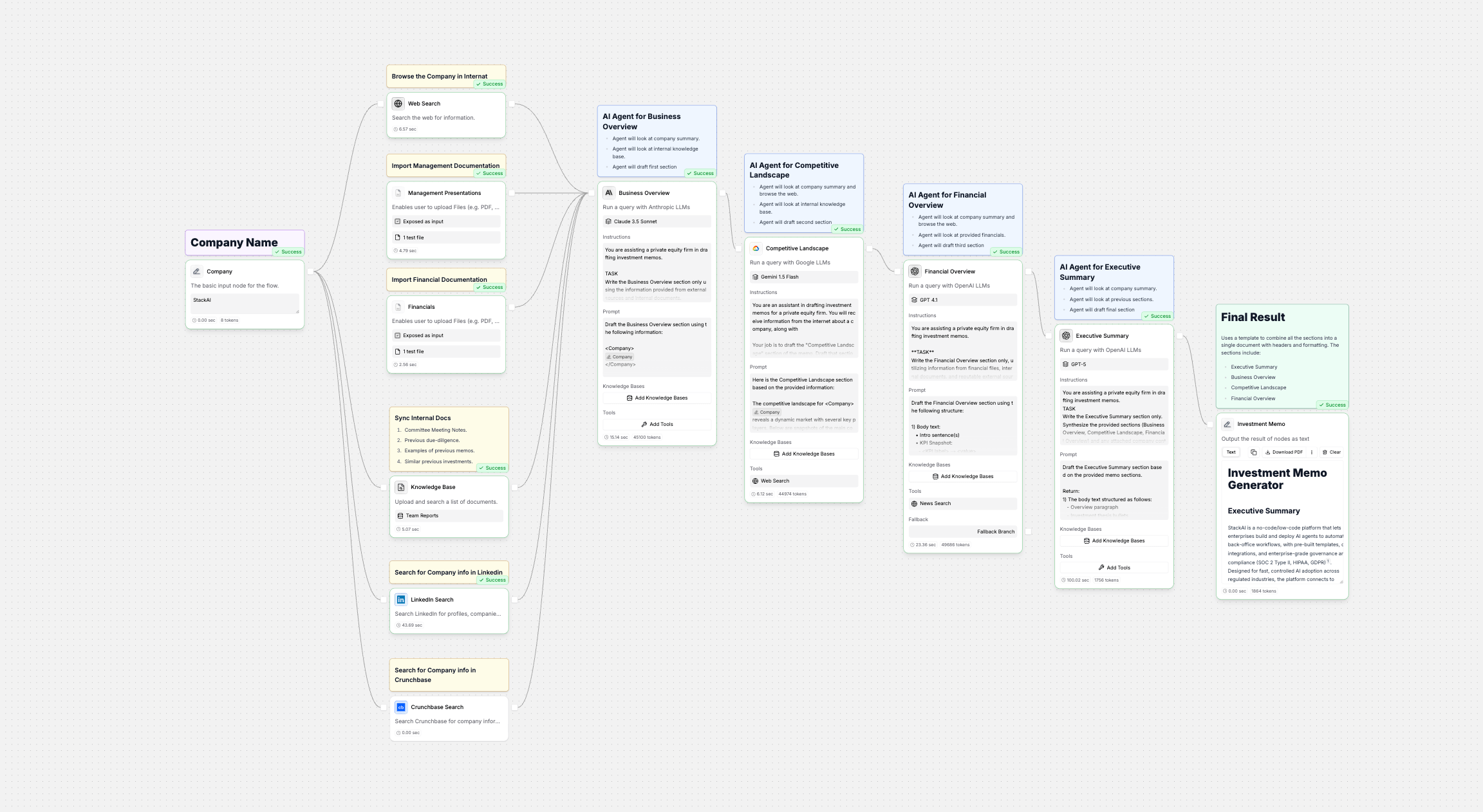
Step 1: Load Your Source Documents
Upload the management presentation, financial statements, internal diligence notes, and any prior committee materials. These become the grounded reference set every subsequent step draws from — so the memo reflects the actual deal, not a generic template.
"Here are the management deck, the FY financials, and our first-call notes. Index these as the source set for this deal."
Step 2: Run External Research in Parallel
While internal documents are being processed, pull the outside view — competitive set, funding history, executive backgrounds, and market context. Real-Time Search covers the open web across Google, Reddit, and other sources for signals that don't appear in a data room.
"Research this company's competitive position: direct competitors, recent funding rounds, notable customer wins, and any public criticism or controversy in the last 18 months."
Step 3: Draft Each Section With Its Specialist
Work section by section rather than requesting a whole memo at once. Business overview, competitive landscape, and financial overview each get their own focused pass — which is where output quality diverges most sharply from generic single-prompt drafting.
"Draft the Financial Overview using only the uploaded statements. Include revenue growth, margin structure, and cash position. Flag any figure you cannot verify from the source documents."
Step 4: Synthesize the Executive Summary Last
Once the substantive sections exist, compress them. Writing the executive summary first is the most common structural error — it forces conclusions before the analysis supports them.
"Now write the Executive Summary based on the three sections above. Lead with the investment thesis, then the two strongest risks. Maximum 300 words."
Step 5: Export the Finished Memo
Assemble the sections into a formatted document with the PDF Doc Generator or Word Doc Generator — committee-ready formatting without a manual assembly pass.
"Combine all four sections into a single formatted investment memo. Standard headers, table of contents, professional business document styling."
Results & Use Cases
📊 Venture Capital Screening Memo
Scenario: A seed-stage fund receives 40 inbound decks a week and needs a consistent one-page screening memo on each before partner review.
Traditional Approach: An associate reads each deck, browses the company site, checks the founders on LinkedIn, and writes a summary — roughly 45 to 90 minutes per company.
AI memo workflow: Deck uploaded, external research pulled automatically, screening memo drafted in the same session with a consistent structure across every company in the pipeline.
- Uniform format makes cross-deal comparison meaningful at partner meetings
- Founder background research runs in parallel rather than sequentially
- Associate time shifts from summarizing to evaluating
💼 Private Equity Diligence Memo
Scenario: A middle-market PE firm is evaluating a target with a full data room — management presentation, three years of financials, customer contracts, and org charts.
Traditional Approach: Multiple analysts split the workstreams, draft in isolation, then reconcile inconsistencies before committee — a multi-week process where regulatory and operational exposure often gets flagged late. PE leaders continue adjusting strategy around market disruption, which makes diligence speed a competitive variable.
AI memo workflow: All data room materials indexed as one knowledge base. Business, competitive, and financial sections drafted against the same grounded source set, eliminating reconciliation drift between workstreams.
- Every section references the same underlying document set
- Legal & Contract Advisor surfaces contract risk in parallel with financial review
- First complete draft available before the second management call
📈 Public Equity Investment Thesis
Scenario: A long-only manager is building a position case on a mid-cap name and needs a written thesis for the investment committee.
Traditional Approach: Analyst reads filings and transcripts, builds a model, then drafts a thesis document — typically a week of work before anything is circulated.
AI memo workflow: Fundamental Stock Analyst handles earnings analysis, relative valuation, and business model assessment against filings and estimates, while Macro Strategist supplies the sector and rate backdrop.
- Filing analysis at scale rather than one document at a time
- Bear case articulated explicitly rather than assumed
- Thesis drafted while the analyst focuses on the model
📱 Mobile Deal Review Between Meetings
Scenario: A partner is between meetings and needs to understand a deal well enough to ask sharp questions in an hour.
Traditional Approach: Skim the deck on a phone, hope the associate's email summary covers the right ground.
AI memo workflow: Full feature parity across mobile means the memo, source documents, and follow-up questions are all available on the phone — with persistent memory carrying the full deal context.
- Ask follow-up questions against the indexed source documents directly
- Voice-to-text for capturing reactions and open questions between meetings
- Session state syncs back to desktop for the full write-up
Frequently Asked Questions
Is an AI investment memo generator free to use?
Yes — Jenova's free tier includes all core features with limited usage, so you can build and test a full memo workflow before committing. Paid tiers start at $20/month for 30× the free usage plus custom model selection. Check "Subscribe" in the menu for current plan details and usage allowances.
How accurate are AI-generated investment memos?
Accuracy depends heavily on grounding. When the memo is built on uploaded filings and financials rather than model memory, factual reliability improves substantially. That said, the FCA advises verifying every fact against original sources — treat AI output as a well-researched first draft requiring analyst review, never as a finished committee document.
Can it analyze uploaded financial statements and data room documents?
Yes. Upload management presentations, financial statements, contracts, and internal notes as a persistent knowledge base, and agents reference them directly when drafting. The Accounting & Audit Assistant handles statement-level reconciliation, while the Fundamental Stock Analyst covers valuation and business model assessment.
How is this different from using ChatGPT to write a memo?
Two structural differences. First, section-level specialization — each memo section is drafted by an agent built for that analytical mode rather than one general assistant switching contexts. Second, persistent grounding — your documents stay indexed across the session and across future sessions, so the memo references your actual deal materials rather than generalized knowledge.
Does it work for both private company and public equity memos?
Both. Private deals lean on uploaded data room materials plus external research for competitive and founder context. Public equity theses lean more on filings analysis and market data. The Portfolio Management Strategist then handles position sizing and portfolio fit once the thesis clears.
Can I export the finished memo to PDF or Word?
Yes. Once sections are drafted and reviewed, the PDF Doc Generator and Word Doc Generator assemble everything into a formatted document with professional business conventions applied automatically.
Conclusion
The bottleneck in investment analysis was never data access — it was the manual labor of turning fragmented source material into a structured, defensible narrative. An AI investment memo generator built as a multi-agent workflow closes that gap: documents grounded once, sections drafted by specialists, executive summary synthesized last, and the analyst's judgment applied where it actually matters.
The evidence points the same direction. AI can now match or exceed human analysts on depth and specificity in structured analytical tasks — but only with disciplined prompting and human review at the decision point. The workflow above is designed around exactly that division of labor.
Build your memo workflow at Jenova — start with the Fundamental Stock Analyst for financial sections and Real-Time Search for competitive research, then layer in the specialists your deal process requires.
For Developers: Every agent in this article is available programmatically via the Jenova API — build automated deal screening and memo generation into your own investment platform with a single integration. Full documentation →