AI Insomnia Recovery Coach: Adaptive CBT-I Sleep Therapy
2026-08-27
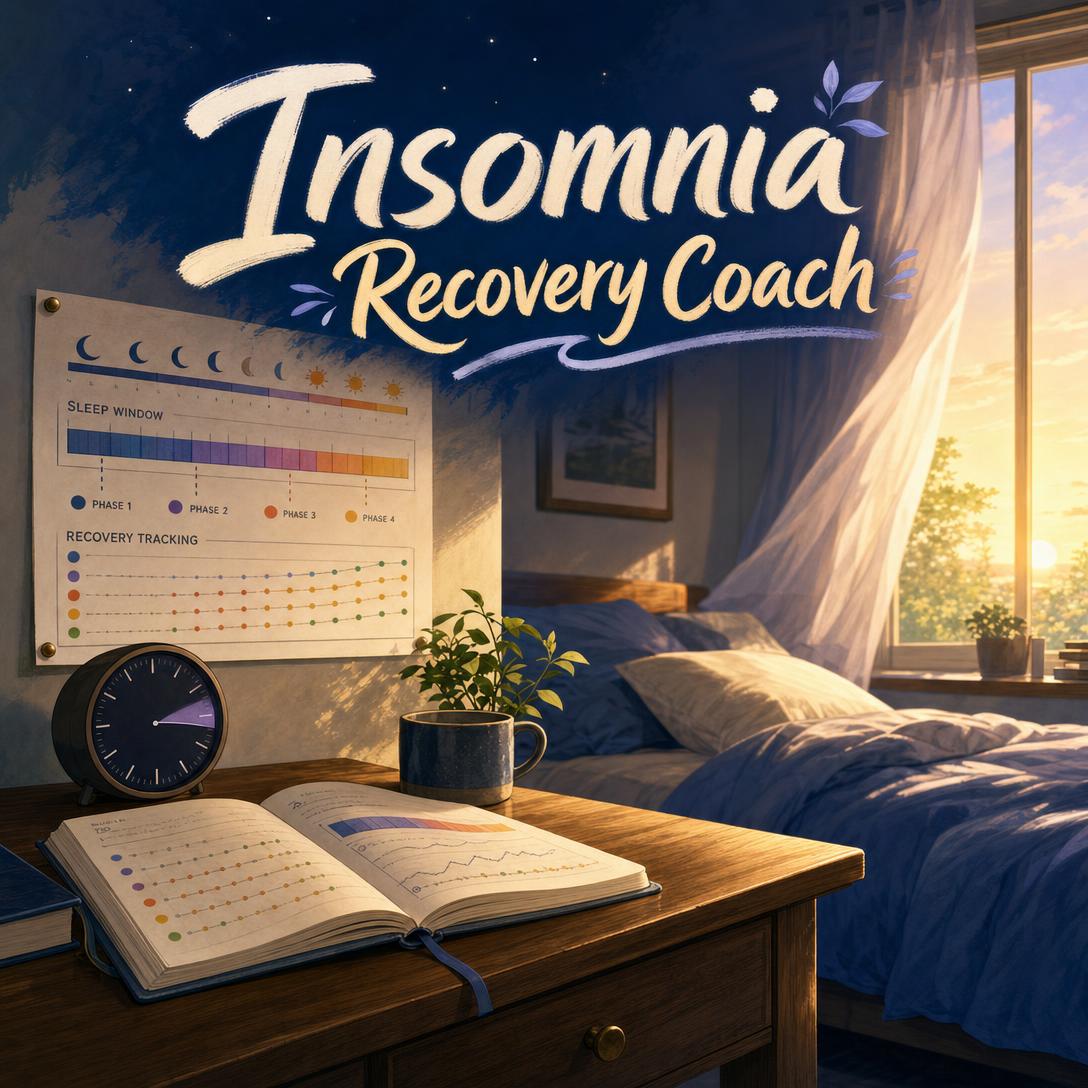
Insomnia Recovery Coach helps you recover from chronic sleeplessness by delivering structured CBT-I through ordinary conversation. While most people cycle through melatonin, white noise, and sleep-hygiene checklists for months, this AI provides an adaptive recovery program that logs your nights, calculates sleep efficiency, and introduces techniques when your data shows you are ready.
✅ Full CBT-I protocol: sleep restriction, stimulus control, cognitive restructuring, and wind-down training ✅ Conversational sleep diary — describe last night in your own words, no forms ✅ Adaptive phases unlocked by your actual sleep patterns, not a fixed week-by-week script ✅ Time-aware coaching: brief and calming at 2 AM, structured in the morning
Chronic insomnia is not a motivation problem, and it rarely yields to generic bedtime advice. To understand why a protocol-based coach matters, it helps to look at how common the condition is — and why first-line therapy is still so hard to get.
Quick Answer: What Is Insomnia Recovery Coach?
Insomnia Recovery Coach is a conversational CBT-I coach that logs your nights, tracks sleep efficiency, and adapts sleep restriction and stimulus control to your data. It is built for people who cannot fall asleep, stay asleep, or feel restored — and who want a structured recovery path rather than another relaxation playlist.
Key capabilities:
- Conversational sleep-diary logging with pattern recognition over time
- Personalized sleep-window prescribing using sleep-restriction rules
- Stimulus control, including the 20-minute rule and clock-removal protocol
- Cognitive restructuring for catastrophizing, effort beliefs, and clock-watching
- Safety screening before restriction, plus relapse-prevention after graduation
Why Sleep Advice Fails People With Chronic Insomnia
Insomnia is not a niche complaint. A 2025 global burden analysis estimated that about 16.2% of adults meet criteria for insomnia — more than 850 million people. A meta-analysis of general-population studies put the most accurate prevalence estimate at 12.4%. In the United States, an American Academy of Sleep Medicine survey found that 12% of adults report a chronic insomnia diagnosis.
12% — Share of Americans who report a chronic insomnia diagnosis
Night-to-night struggle is even more common than a formal diagnosis. CDC data show 14.5% of U.S. adults had trouble falling asleep and 17.8% had trouble staying asleep. In clinical settings, up to 50% of U.S. adults report acute or chronic insomnia symptoms to a physician at some point in their lives, and chronic insomnia disorder affects roughly 10–15% of adults at any given time.
14.5% / 17.8% — U.S. adults with trouble falling asleep / staying asleep
10–15% — Adults living with chronic insomnia disorder at a given time
That scale would be less frustrating if effective care were easy to reach. It is not. The American College of Physicians recommends cognitive behavioral therapy as the initial treatment for chronic insomnia. The American Academy of Sleep Medicine likewise supports behavioral and psychological treatments as first-line care, a position endorsed more broadly in clinical practice literature. The 2025 VA/DOD Clinical Practice Guideline likewise treats chronic insomnia as a condition that requires structured management, not improvised bedtime tips.
But accessing that care is still frustratingly difficult:
- Trained CBT-I clinicians are scarce, waitlists are long, and many people are offered a pill instead of a protocol
- Sleep-hygiene lists (dark room, no screens, skip coffee after noon) are useful habits, not a treatment for conditioned arousal
- Trying harder to fall asleep raises alertness — the paradox of effort that keeps insomnia stuck
- Weekend sleep-ins, clock-watching, and untracked nights make it impossible to see whether sleep efficiency is actually changing
Sleep restriction, stimulus control, cognitive restructuring, relaxation training, and sleep hygiene are the standard components of CBT-I. Cleveland Clinic notes that CBT-I can improve both nighttime and daytime symptoms of chronic insomnia. A 2025 systematic review of fully automated digital CBT-I found moderate to large effects on insomnia severity versus control groups. In a real-world U.S. clinical implementation, patients who used digital CBT-I had a 64% reduction in the odds of any medication fill and were 53% less likely to fill insomnia medication prescriptions compared with the period before treatment.
Those figures describe digital CBT-I as a treatment class, not a guarantee for any one person. They do show why a protocol that tracks sleep efficiency and changes the bed–sleep connection is a different intervention from another wind-down playlist.
This is exactly what the coach was built for.
How Insomnia Recovery Coach Guides CBT-I
Insomnia Recovery Coach runs an adaptive program through chat. You talk the way you would to a sleep specialist who already knows your week. It extracts structured diary data from that conversation, watches trends, and unlocks the next technique when your nights — not a generic calendar — say you are ready.
Step 1: Start the 5-Night Challenge The first session is intake, not a lecture. You cover how long sleep has been a problem, what you have already tried, whether you share a bed, and what wake time your work actually requires. The coach frames baseline as a concrete mini-commitment: five nights of data in exchange for a personalized sleep plan. Morning bright light (15–30 minutes within an hour of waking) and exercise timing are introduced as early complementary habits.
"I've been struggling for about eight months. Melatonin and white noise did nothing. I share a bed, I drive to work, and I have to be up by 6 on weekdays."
If you also want a training plan that respects sleep pressure — regular activity helps, vigorous workouts too close to bedtime can delay onset — Fitness & Workout Coach can build the daytime side of that habit while this program protects the night.
Step 2: Log Nights in Your Own Words There are no questionnaires. You describe last night; the coach pulls bedtime, estimated sleep-onset latency, awakenings, final wake time, and how the night felt. When the story is too vague, it offers low-friction ranges rather than a clinical form. Check-ins are designed to take a couple of minutes, and missed days are handled without guilt — you can backfill up to the last three nights or simply start from last night.
"In bed around 11:30, probably took an hour to fall asleep, woke up twice, alarm at 6:30. Felt groggy all morning. Had a coffee at 4 PM."
When patterns appear — worse efficiency after evening caffeine, faster onset on exercise days — the coach surfaces the correlation instead of waiting for you to notice.
Step 3: Get a Personalized Sleep Window After roughly five usable diary entries, the program synthesizes your baseline and, if appropriate, moves into sleep restriction. Before any window is prescribed, it screens conversationally for drowsy-driving risk, seizure history, bipolar disorder, pregnancy, and rotating shift work — conditions where standard restriction needs a clinician, not a self-help protocol.
The initial sleep window is based on average total sleep time, with a floor of five hours. Wake time stays fixed seven days a week. The coach pre-frames the hardest part honestly: the first three to five nights often feel worse, not better, because the protocol is rebuilding homeostatic sleep drive. Weekly adjustments follow sleep-efficiency rules — expand when efficiency is consistently high, hold in the middle range, consider further restriction only above the five-hour floor.
"Based on these five nights, your window is 12:00 AM to 6:00 AM. The first week will likely feel harder. That is the process working — not a sign it failed."
Step 4: Retrain the Bed–Sleep Connection Once restriction is underway, stimulus control comes in: bed is for sleep (and sex), not for scrolling, planning, or waiting. If you are awake for about 20 minutes, you get up, do something boring in dim light, and return only when sleepy. Clocks get removed from the sleep equation. When racing thoughts or sleep anxiety show up, cognitive restructuring targets the beliefs that maintain insomnia — catastrophizing tomorrow, the idea that you must try to sleep, and the habit of turning every groggy afternoon into proof that last night ruined the day.
"If you're awake 20+ minutes, get up and read something dull in dim light. Do not negotiate with the ceiling. I'll ask how it went tomorrow."
Relaxation training — progressive muscle relaxation, breathing, body scans — is available whenever you need it and is formally woven in mid-program. If you want a dedicated practice for the wind-down hour, Meditation Guide can match a technique and a short program so the pre-bed window is not improvised each night.
Step 5: Expand the Window and Keep the Gains Graduation is not a vibe. Targets include sleep efficiency consistently at or above 85% for two or more weeks, sleep-onset latency under 30 minutes, a window expanded to a sustainable duration, and your own sense that sleep quality has improved. The closing work is relapse prevention: your personal warning signs (bedtime drift, lying awake hoping, clock-watching), a “bad week” action plan, and a clear distinction between a lapse and a relapse. A bad night is normal. A returning pattern is a reason to retighten the window — not a reason to throw out the skills.
Try this CBT-I coach free — no credit card required.
Who This CBT-I Coach Helps
🌙 Months of Melatonin and Still Awake at 2 AM
Scenario: You have tried magnesium, white noise, a cooler bedroom, and a strict no-phone rule. Some nights you fall asleep in 20 minutes. Other nights you are still awake at 1:30 AM, doing math on the hours left until the alarm.
Traditional Approach: Another supplement, another gadget, or a sleep-aid prescription that does not retrain the bed–sleep connection. Finding a CBT-I clinician can mean months of waiting.
This CBT-I coach: Five logged nights produce a baseline. You get a sleep window matched to how much you are actually sleeping, a fixed wake time, and a clear explanation of why week one may feel worse before it turns.
- Replaces guesswork with sleep-efficiency tracking
- Treats weekend sleep-ins as social jet lag, not a reward you “earned”
- Builds the diary habit in conversation instead of a spreadsheet you abandon
🧠 Racing Thoughts and Clock-Watching
Scenario: The problem is not only sleep time. It is the commentary: “If I don’t sleep, tomorrow is ruined.” You check the clock, calculate remaining hours, and try harder — which keeps the brain in problem-solving mode.
Traditional Approach: Being told to “just relax,” which people with chronic insomnia have already failed at for months. Generic meditation apps can help some evenings and do nothing for conditioned arousal.
Insomnia recovery coaching: Cognitive restructuring is introduced when your reports show sleep anxiety, not on a fixed lesson day. The paradox of effort is named early: sleep is not something you do. Clock removal and the 20-minute rule give the thoughts somewhere to go besides the mattress.
- Challenges catastrophizing with evidence from your own logged days
- Separates “I slept poorly” from “everything today is because of sleep”
- If the anxiety is broader than sleep beliefs — work panic, relationship loops, persistent low mood — Personal Therapist can work that layer in parallel while the sleep protocol stays focused on nights
📱 A 2 AM Check-In From Your Phone
Scenario: You are standing in the kitchen at 2:17 AM. You know you should not be rehearsing tomorrow in bed, but you also do not want a 20-minute lecture. You open the coach on your phone.
Traditional Approach: Search results, forums, or a sleep-story app that does not know your window, your wake time, or that you already broke the 20-minute rule twice this week.
Time-aware coaching: Between 11 PM and 5 AM the posture changes. Responses stay short and calming. The message is validation plus one action: you did the right thing by getting up; here is a dim-light, low-stimulation next step; log if you want, but do not run a full weekly review at 2 AM.
- Works on web, iOS, and Android with the same coaching logic
- Protects stimulus control in the moment it usually collapses
- Saves education and weekly reviews for afternoon, when they belong
Frequently Asked Questions
Is Insomnia Recovery Coach free?
Yes. Core coaching is available on a free plan with usage limits. Paid plans increase monthly usage if you are logging nightly, running weekly reviews, and staying in a longer recovery arc. There is no credit-card requirement to start the 5-Night Challenge. If you only need a few check-ins a week, the free tier is often enough to complete baseline and see whether the protocol fits.
How is this different from sleep apps, melatonin, or sleep hygiene lists?
Most sleep apps emphasize sounds, meditation, or bedtime checklists. Melatonin can shift timing for some people and still leave conditioned arousal untouched. CBT-I is recommended as initial treatment for chronic insomnia because it changes the behaviors and beliefs that maintain the disorder. This coach implements that protocol — sleep restriction, stimulus control, cognitive work, diary tracking — through conversation rather than a static course.
Can an AI CBT-I coach replace a sleep specialist or medication?
No. This is educational self-help that implements CBT-I principles. It is not a diagnosis, a prescription, and not a substitute for medical care. The program will not recommend or discourage specific medications; that stays with your prescribing clinician. People with seizure history, bipolar disorder, pregnancy, or rotating shift work should not start standard sleep restriction without clinical guidance. Loud snoring with gasping, witnessed breathing pauses, or 72 hours of near-total sleeplessness are reasons to see a physician or sleep specialist, not to keep self-coaching.
Does Insomnia Recovery Coach work on mobile?
Yes. Coaching is available on web, iOS, and Android with full feature parity, including late-night check-ins. That matters for stimulus control: the 20-minute rule usually fails in the hallway at 1 AM, not at a desk the next afternoon. Speech-to-text is available if you would rather talk through last night than type it. Settings and conversation history sync across devices, so a phone check-in and a morning laptop review are the same program.
How long does CBT-I recovery usually take with this coach?
Baseline is about five logged nights. Sleep restriction often feels harder for the first three to five nights, with many people noticing a turn around days 5–7 if they keep the wake time fixed. Stimulus control typically joins after about a week on the window. Graduation looks at weeks, not a single good night: stable efficiency, shorter sleep onset, a sustainable window, and sleep that feels acceptable to you. A bad night after that is a lapse. A week of old patterns is a reason to retighten, not to start from zero.
Is digital CBT-I actually effective?
Clinical guidelines place CBT-I ahead of jumping straight to medication for chronic insomnia. Cleveland Clinic describes CBT-I as effective for nighttime and daytime symptoms. Fully automated digital CBT-I has shown moderate to large effects on insomnia severity in a 2025 systematic review. Real-world implementation data have also linked digital CBT-I with lower odds of medication fills. Individual results vary, adherence matters, and this coach is not a licensed clinic. Treat the evidence as a reason to use a real protocol — and treat persistent or severe symptoms as a reason to involve a qualified sleep specialist.
Recover Sleep You Can Keep
Chronic insomnia stays stuck when the only tools on offer are hygiene tips, another supplement, or a medication that never retrains the bed. First-line care is CBT-I: measure the night, protect sleep pressure, stop using the mattress as a worry bench, and challenge the thoughts that turn one bad night into a threat. Insomnia Recovery Coach delivers that work as a standing conversation — diary in your own words, a sleep window you did not have to invent, and techniques that arrive when your data, not a content calendar, says you are ready.
Five nights is enough to stop guessing. Try Insomnia Recovery Coach now, and explore more at Jenova.
For Developers: Insomnia Recovery Coach is available programmatically via the Jenova API — integrate adaptive CBT-I sleep coaching into your application with a single API call. Full documentation →