AI Industry Research: Data, Tools & Market Analysis Guide
2026-08-17
AI industry research has become one of the hardest analytical jobs in business — not because data is scarce, but because it arrives faster than any team can process it. Jenova solves this with a library of specialized AI agents that pull real-time market signals, academic literature, community sentiment, and competitive intelligence into a single workspace, then synthesize it into decision-ready analysis.
✅ Real-time research across Google, Reddit, YouTube, GitHub, and academic databases ✅ Specialized agents for market analysis, macro strategy, IP research, and deep synthesis ✅ Multi-model access — OpenAI, Anthropic, Google, DeepSeek, xAI — with no vendor lock-in ✅ Persistent memory so long-running research projects retain full context
The pace of change is the core problem. Frontier model capability, private investment, enterprise adoption, and regulatory posture are all shifting on quarterly cycles. To understand why traditional research workflows break under this load, it helps to look at what analysts are actually up against.
Quick Answer: What Is AI Industry Research?
AI industry research is the systematic analysis of the artificial intelligence market — covering market size, investment flows, adoption rates, technology segments, vendor landscapes, and regulatory shifts — to inform strategy, investment, and product decisions.
Key capabilities:
- Market sizing and forecasting across regions, solutions, and technology segments
- Investment and funding tracking, including venture capital and private AI investment flows
- Enterprise adoption benchmarking and use-case validation via Deep Research
- Competitive and technology landscape mapping, including patent and IP analysis
- Primary-source synthesis from academic, government, and industry publications
The Problem: Why AI Industry Research Breaks Traditional Workflows
The AI market moves faster than the research cycles built to track it. A competitive landscape slide deck assembled in one quarter is frequently obsolete by the next — not because the analysis was wrong, but because the underlying facts changed.
Consider the scale of what analysts now have to track. Stanford HAI's index reports that industry produced over 90% of notable frontier models in 2025, with performance on the SWE-bench Verified coding benchmark climbing from 60% to near 100% in a single year:
60% → ~100% in one year — SWE-bench Verified coding benchmark performance jump
$285.9 billion — U.S. private AI investment in 2025, more than 23× China's $12.4 billion
88% — Organizational AI adoption rate, with 4 in 5 university students using generative AI
But turning these signals into defensible analysis is genuinely difficult:
- Source fragmentation — market data, academic papers, regulatory filings, and practitioner sentiment live in entirely separate systems
- Conflicting market sizing — different research houses publish wildly divergent forecasts for the same market
- Rapid obsolescence — benchmark results, model releases, and funding rounds invalidate analysis within weeks
- Signal-to-noise collapse — vendor marketing, press releases, and speculative commentary drown out primary data
- Coverage gaps — no single analyst can track models, infrastructure, policy, labor impact, and vertical adoption simultaneously
Conflicting Market Estimates Undermine Confidence
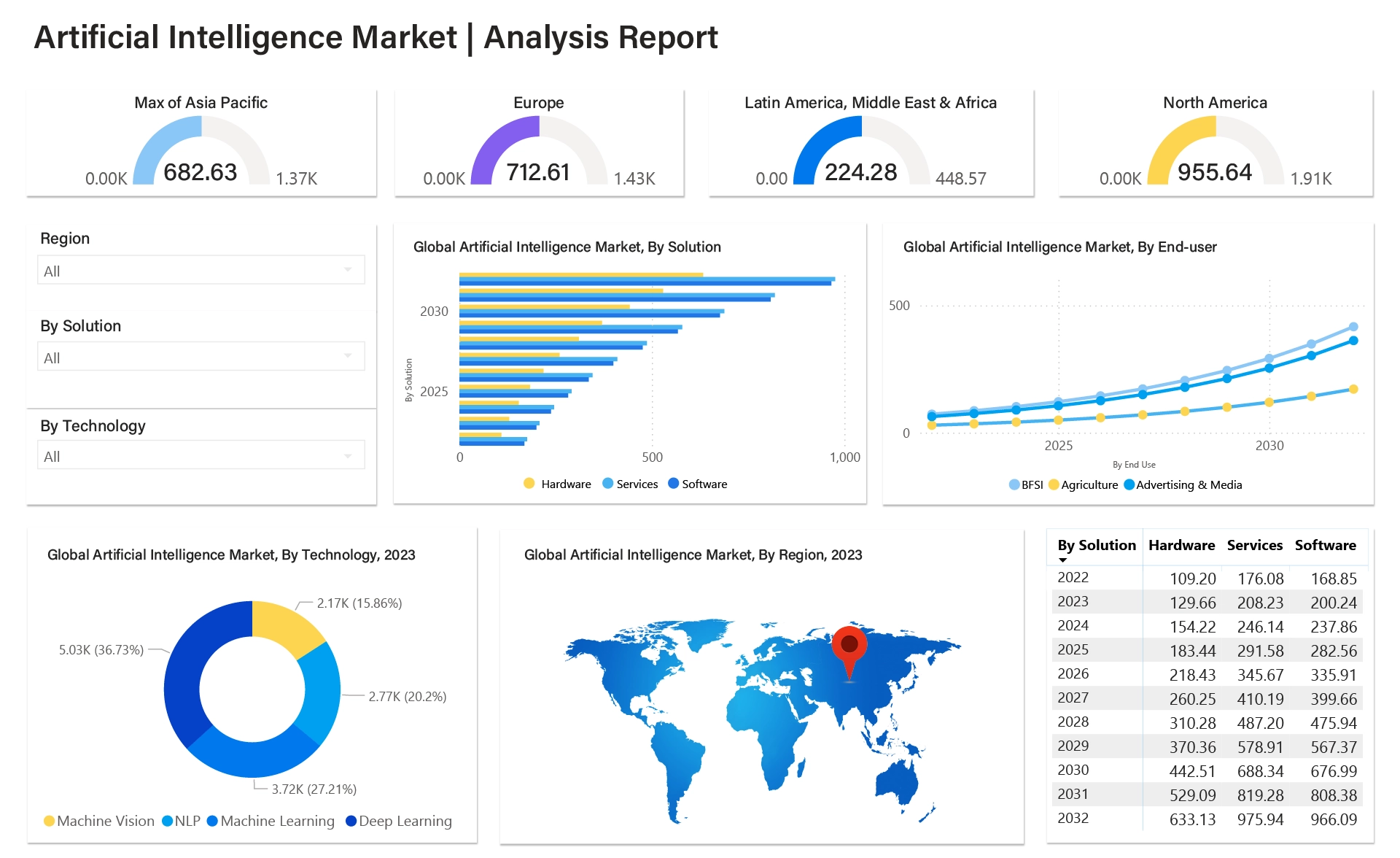
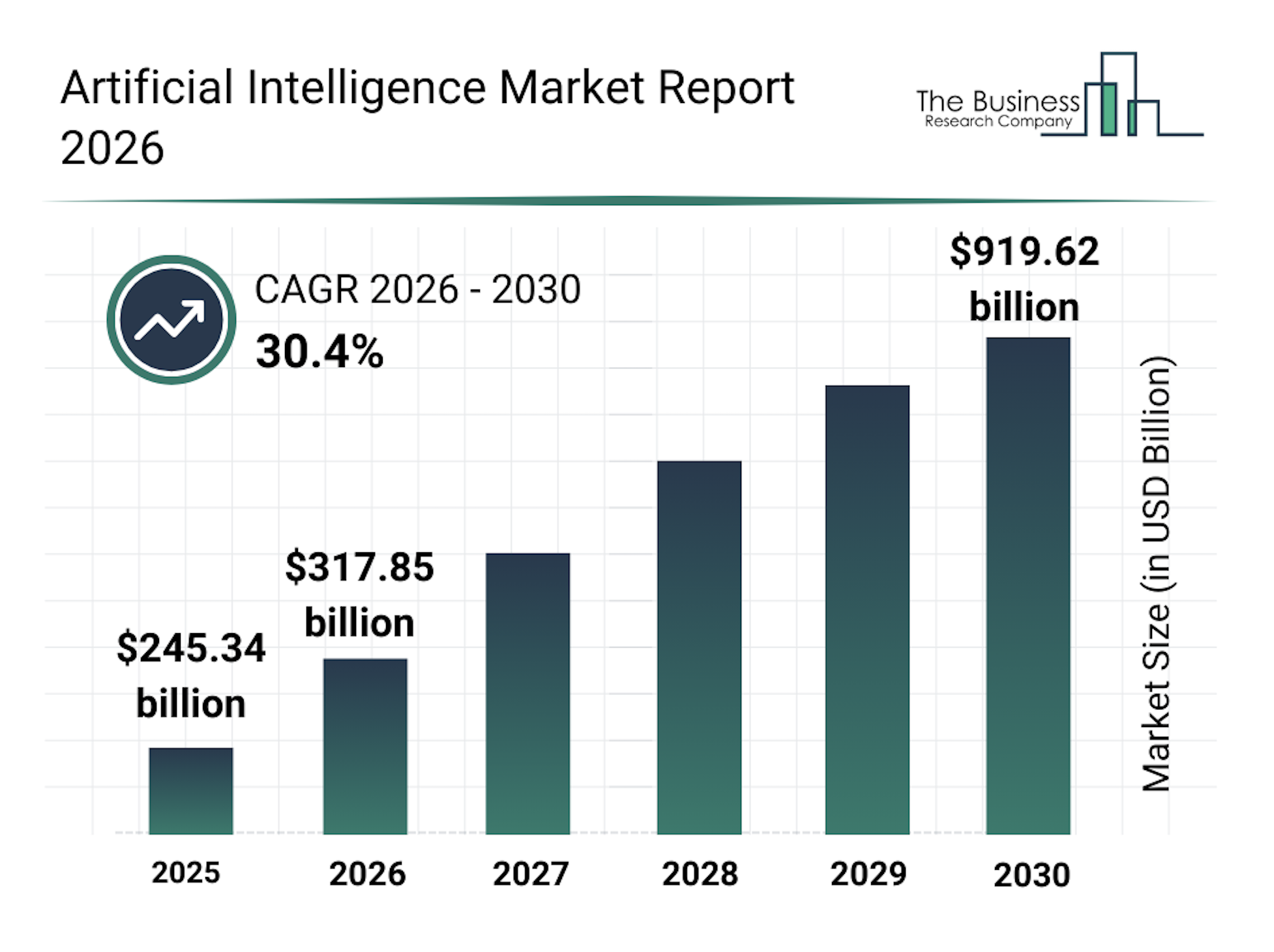
Published AI market forecasts vary dramatically depending on methodology and scope definition. Fortune Business Insights valued the global artificial intelligence market at USD 294.16 billion in 2025, projecting growth to USD 375.93 billion in 2026. MarketsandMarkets places the 2026 figure at USD 601.93 billion, projecting USD 3,638.08 billion by 2033. Statista's outlook puts the worldwide AI market at approximately US$617.62 billion by 2026.
These are not small discrepancies. An analyst who cites a single source without understanding the scope definitions behind it produces analysis that collapses under scrutiny. Cross-source triangulation is not optional — it is the baseline requirement.
Investment Data Requires Constant Re-baselining
Funding flows have become one of the most-watched leading indicators in the sector, and they are shifting rapidly. Ropes & Gray reported that AI-related investments accounted for 51% of total VC deal value in H1 2025, compared with just 12% in 2017. OECD analysis found that in 2025, venture capital investments in AI firms globally made up 61% — USD 258.7 billion — of all VC investment.
Any strategic document that references funding concentration needs to be re-baselined against the current period, not last year's figures.
Adoption Statistics Mask Enormous Implementation Variance
Headline adoption numbers consistently overstate operational maturity. McKinsey's global survey found that nearly two-thirds of respondents say their organizations have not yet begun scaling AI across the enterprise, with just 39 percent reporting EBIT impact. ISG's research found that 31% of studied use cases reached full production in 2025 — double the 2024 figure, but still under a third.
Research that reports "88% adoption" without qualifying production maturity produces dangerously misleading strategic conclusions.
The Capability Frontier Is Jagged, Not Linear
Evaluating AI vendors requires understanding that model performance is uneven in counterintuitive ways. Stanford HAI describes this as the "jagged frontier": Gemini Deep Think earned a gold medal at the International Mathematical Olympiad, yet the top model reads analog clocks correctly just 50.1% of the time. AI agents jumped from 12% to roughly 66% task success on OSWorld while still failing about 1 in 3 attempts.
Benchmark headlines do not map cleanly onto deployment reliability. Research that ignores this produces procurement recommendations that fail in production.
Policy and Trust Signals Are Regionally Divergent
Regulatory analysis cannot be globalized. Stanford HAI found that among surveyed countries, the United States reported the lowest level of trust in its own government to regulate AI, at 31%, with the EU trusted more than the U.S. or China to regulate AI effectively. Expert-public sentiment diverges sharply too: 73% of experts expect positive job impact versus just 23% of the public — a 50-point gap.
This is exactly what Jenova was built for.
The Jenova Solution: A Research Stack Built for Velocity
Jenova approaches AI industry research as a multi-agent problem rather than a single-tool problem. Instead of one general chatbot attempting market sizing, literature review, sentiment analysis, and competitive mapping with equal mediocrity, the platform provides purpose-built agents for each research function — each with domain-specific instructions, tool access, and output conventions.
| Traditional Research Workflow | Jenova |
|---|---|
| Manually searching a dozen sources across separate tabs | Cross-platform real-time search in one query |
| Static reports obsolete within a quarter | Live retrieval against current sources |
| Paywalled analyst subscriptions per vertical | Specialized agents across every research domain |
| Context lost between research sessions | Persistent memory across long-running projects |
| Locked to a single model's strengths and blind spots | Multi-model access with free switching |
| Citations manually assembled and verified | Inline sourcing built into agent output |
Real-Time, Cross-Platform Retrieval
Real-Time Search queries Google, Reddit, YouTube, GitHub, Amazon, and more in a single pass. For AI industry research this matters because signal lives in different places depending on the question: funding data on financial news sites, practitioner reality on Reddit, implementation detail on GitHub, and vendor positioning on official sites.
"What are the most-cited criticisms of enterprise AI agent platforms from practitioners in the last 90 days?"
"Compare published 2026 AI market size forecasts from major research firms and identify where their scope definitions diverge."
Comprehensive Multi-Source Synthesis
Deep Research searches hundreds of sources, synthesizes findings with rigorous inline citations, and delivers structured reports. This is the agent for full landscape analyses — the kind of work that would otherwise consume an analyst for a week.
"Produce a comprehensive analysis of enterprise generative AI adoption maturity, distinguishing pilot deployments from production systems, with regional breakdowns and citations."
Academic and Primary-Source Grounding
Academic Research Assistant provides real-time literature discovery across major academic databases and repositories, plus citation management. For AI research this is essential — the field's foundational claims originate in preprints and conference papers months before they surface in commercial analysis.
Community and Practitioner Sentiment
Reddit Search surfaces the unfiltered practitioner layer that vendor materials never capture. When evaluating whether a category of AI tooling actually works in production, the discussion threads of people running it daily are often the highest-value source available.
Financial and Macro Context
Macro Strategist delivers cross-asset synthesis, policy analysis, and automated daily briefings for professional investors — critical context when AI capital expenditure has become a macroeconomic variable in its own right. For allocation-level questions, Portfolio Management Strategist handles exposure analysis, drift detection, and scenario stress tests.
Platform Capabilities That Compound
- Multi-model access — the newest models from OpenAI, Anthropic, Google, DeepSeek, and xAI, switchable at will. Different models have measurably different strengths in synthesis versus extraction versus reasoning.
- Persistent memory — agents retain preferences, prior findings, and project context across sessions. A quarterly market update builds on the last one instead of starting cold.
- Knowledge bases — attach internal market models, prior reports, or proprietary datasets for grounded responses.
- MCP tool integration — connect Gmail, Google Drive, Google Scholar, Notion, and any MCP-compliant server so research outputs flow into existing systems.
Specialized AI Agents for AI Industry Research
🔍 Deep Research
Comprehensive, citation-rigorous investigation across hundreds of sources. The default choice for full market landscape reports, vendor category analyses, and multi-region adoption studies.
- Synthesizes findings with inline citations for verifiability
- Handles multi-part research briefs without losing thread coherence
- Produces structured, actionable reports rather than raw link dumps
⚡ Real-Time Search
Cross-platform retrieval when currency matters more than depth. Ideal for tracking funding announcements, model releases, and shifting competitive positioning.
- Simultaneous coverage of Google, Reddit, YouTube, GitHub, and commerce platforms
- Natural language queries — no operator syntax required
- Surfaces both official and practitioner-layer signal in one result set
🎓 Academic Research Assistant
Real-time literature discovery for the technical substrate beneath market narratives. Built for academics and PhD students, but equally valuable for analysts who need to read the actual paper behind a headline claim.
- Literature discovery across major academic databases and repositories
- Manuscript preparation and citation management support
- Traces commercial claims back to peer-reviewed or preprint origins
⚖️ Patent, Trademark, Copyright & IP Researcher
Patent and IP research is one of the most underused inputs in AI industry analysis. Patent filings reveal strategic direction 18–36 months before product announcements.
- Prior art search and landscape analysis across jurisdictions
- Trademark screening for emerging product and brand signals
- Strategic insight extraction from filing patterns
📈 Macro Strategist
Institutional-grade macro intelligence for analysts who need to place AI capital flows in broader economic context.
- Cross-asset synthesis and policy analysis
- Automated daily briefings on shifting conditions
- Professional-investor framing rather than retail commentary
🚀 Startup Advisor
Startup Advisor brings a serial-founder-turned-VC perspective to AI market entry questions — brutally honest assessment of whether a thesis holds up.
- Venture-scale strategic evaluation at every company stage
- Competitive positioning and defensibility analysis
- Market timing and category assessment
Try Jenova free — no credit card required.
How AI Industry Research Works on Jenova
Step 1: Define the Research Question Precisely
Vague briefs produce vague output. Specify the segment, geography, time horizon, and decision the research supports. The more constrained the question, the more useful the synthesis.
"I need to assess whether enterprise AI agent platforms are a viable category for a B2B SaaS company to enter in the next 18 months. Focus on adoption maturity, incumbent concentration, and documented buyer pain points."
Step 2: Run Broad Retrieval First
Start with Real-Time Search to map the current information landscape before committing to deep analysis. This surfaces which sources are authoritative, where consensus exists, and where estimates diverge.
"Find the most recent authoritative data on enterprise AI agent adoption rates, production deployment percentages, and documented ROI figures."
Step 3: Escalate to Deep Synthesis
Hand the mapped landscape to Deep Research for comprehensive, citation-backed analysis. Because Jenova supports @mention, you can bring a second agent into the same conversation with full context — no re-briefing required.
"Using the sources identified above, produce a full market analysis with regional segmentation, competitive concentration assessment, and a explicit list of where the data is uncertain."
Step 4: Validate Against Primary Sources
Route technical or academic claims through Academic Research Assistant to confirm they trace back to real research rather than press-release amplification. This step is what separates defensible analysis from repackaged marketing.
Step 5: Attach Knowledge Bases and Persist Context
Upload your internal market models, prior quarterly reports, or proprietary survey data. Agents ground their responses against your documents, and persistent memory means the next research cycle starts where this one ended.
Results & Use Cases
📊 Quarterly Market Sizing Update
Scenario: A strategy team must refresh its AI market model each quarter, reconciling forecasts from multiple research houses that disagree by hundreds of billions of dollars.
Traditional Approach: Two analysts, roughly a week, multiple paid subscriptions, manual reconciliation of incompatible scope definitions.
Jenova: Deep Research retrieves current published forecasts, flags methodology divergences, and delivers a cited comparison — while persistent memory carries forward the prior quarter's baseline for delta analysis.
- Explicit surfacing of where sources conflict rather than false consensus
- Inline citations make every figure independently verifiable
- Cumulative context eliminates repeated re-briefing
💼 Vendor Category Due Diligence
Scenario: An investor evaluating an AI infrastructure company needs to assess whether the category has durable demand or is riding a funding cycle.
Traditional Approach: Expert network calls at high hourly rates, fragmented desk research, weeks of calendar time.
Jenova: Real-Time Search surfaces practitioner sentiment from GitHub and Reddit alongside official positioning, while Macro Strategist places capital flows in broader economic context. Patent, Trademark, Copyright & IP Researcher maps the filing landscape to reveal strategic direction.
- Practitioner-layer signal that vendor materials systematically omit
- IP filing patterns as a forward indicator of roadmap intent
- Macro framing for cycle-versus-structural-demand judgment
📱 Mobile Research During Conference Season
Scenario: An analyst at an industry conference hears a competitor announce a capability claim on stage and needs immediate verification before the next session.
Traditional Approach: Note it, verify back at the office, act two days late.
Jenova: Full feature parity across iOS and Android means Real-Time Search runs from the conference floor. State-of-the-art speech-to-text lets the query be dictated rather than typed, and all settings sync across devices.
- Verification in minutes, not days
- Voice input for hands-busy environments
- Session continues seamlessly on desktop afterward
🎓 Literature-Grounded Technology Assessment
Scenario: A CTO must evaluate whether a heavily marketed AI technique is genuinely production-ready or still a research artifact.
Traditional Approach: Rely on vendor claims, or divert senior engineering time to paper review.
Jenova: Academic Research Assistant locates the underlying literature and reproducibility discussion, cross-referenced with Deep Research for commercial deployment evidence.
- Distinguishes benchmark performance from deployment reliability
- Surfaces the jagged-frontier gaps benchmarks obscure
- Produces a defensible technical recommendation with sources
🏢 Competitive Positioning for Market Entry
Scenario: A founder assessing whether to build in an adjacent AI category needs an honest read on defensibility.
Traditional Approach: Advisor conversations shaped by incomplete information and social politeness.
Jenova: Startup Advisor delivers venture-grade strategic assessment, informed by landscape data from Deep Research in the same session.
- Direct assessment without incentive-shaped hedging
- Grounded in current market data, not stale intuition
- Positioning and timing evaluated together
Frequently Asked Questions
What is the best AI tool for AI industry research?
The strongest approach uses multiple specialized agents rather than one generalist. On Jenova, Deep Research handles comprehensive synthesis with citations, Real-Time Search covers current signal across platforms, and Academic Research Assistant grounds claims in primary literature. Combining them produces analysis that no single general-purpose chatbot matches.
Is Jenova free for market research?
Yes — the Free tier includes all core features with limited usage, so you can run real research before committing. Paid tiers start at $20/month for 30× usage plus custom model selection and no watermarks, scaling to higher tiers for heavy research workloads. Check "Subscribe" in the menu for current plan details.
How accurate is AI-generated market research?
Accuracy depends entirely on sourcing discipline. Agents that retrieve live sources and provide inline citations — like Deep Research — let you verify every claim independently. The critical practice is treating AI output as a research accelerator with a full audit trail, not as an unverified authority. Always cross-check load-bearing figures against the cited primary source.
Can AI research tools access academic papers and journals?
Academic Research Assistant performs real-time literature discovery across major academic databases and repositories, with citation management built in. This is particularly valuable in AI research because foundational technical claims typically appear in preprints and conference proceedings well before they reach commercial market reports.
How is this different from using a general AI chatbot?
General chatbots answer from training data with limited retrieval and no domain specialization. Jenova's agents carry purpose-built instructions, dedicated tool access, and output conventions for their specific research function — plus persistent memory across sessions, attachable knowledge bases, and the ability to switch between frontier models from multiple providers within one workflow.
Does Jenova work on mobile for research on the go?
Yes. Jenova offers full feature parity across web, iOS, and Android, including state-of-the-art speech-to-text and settings that sync across all devices. A research session started on a phone continues seamlessly on desktop with complete context intact.
Conclusion
AI industry research has shifted from a periodic reporting exercise to a continuous intelligence function. Investment concentration, adoption maturity, benchmark performance, and regulatory posture all move faster than quarterly research cycles can capture — and the gap between published market forecasts makes single-source analysis genuinely risky.
The answer is not more subscriptions. It is a research stack that retrieves live, cites rigorously, and specializes by function. Jenova delivers exactly that: Deep Research for comprehensive cited synthesis, Real-Time Search for cross-platform currency, Academic Research Assistant for primary-source grounding, and Macro Strategist for capital-flow context — all with persistent memory, attachable knowledge bases, and access to the newest models from every major provider.
Better market intelligence is not about reading more. It is about reading the right sources, verifying the load-bearing claims, and doing it fast enough that the analysis still matters when the decision is made.
Explore the full agent library at Jenova.
For Developers: Every agent in this article is available programmatically via the Jenova API — build AI-powered research and market intelligence features into your application with a single integration. Full documentation →