Iago AI Roleplay: Outwit & Reshape Shakespeare's Othello
2026-11-13
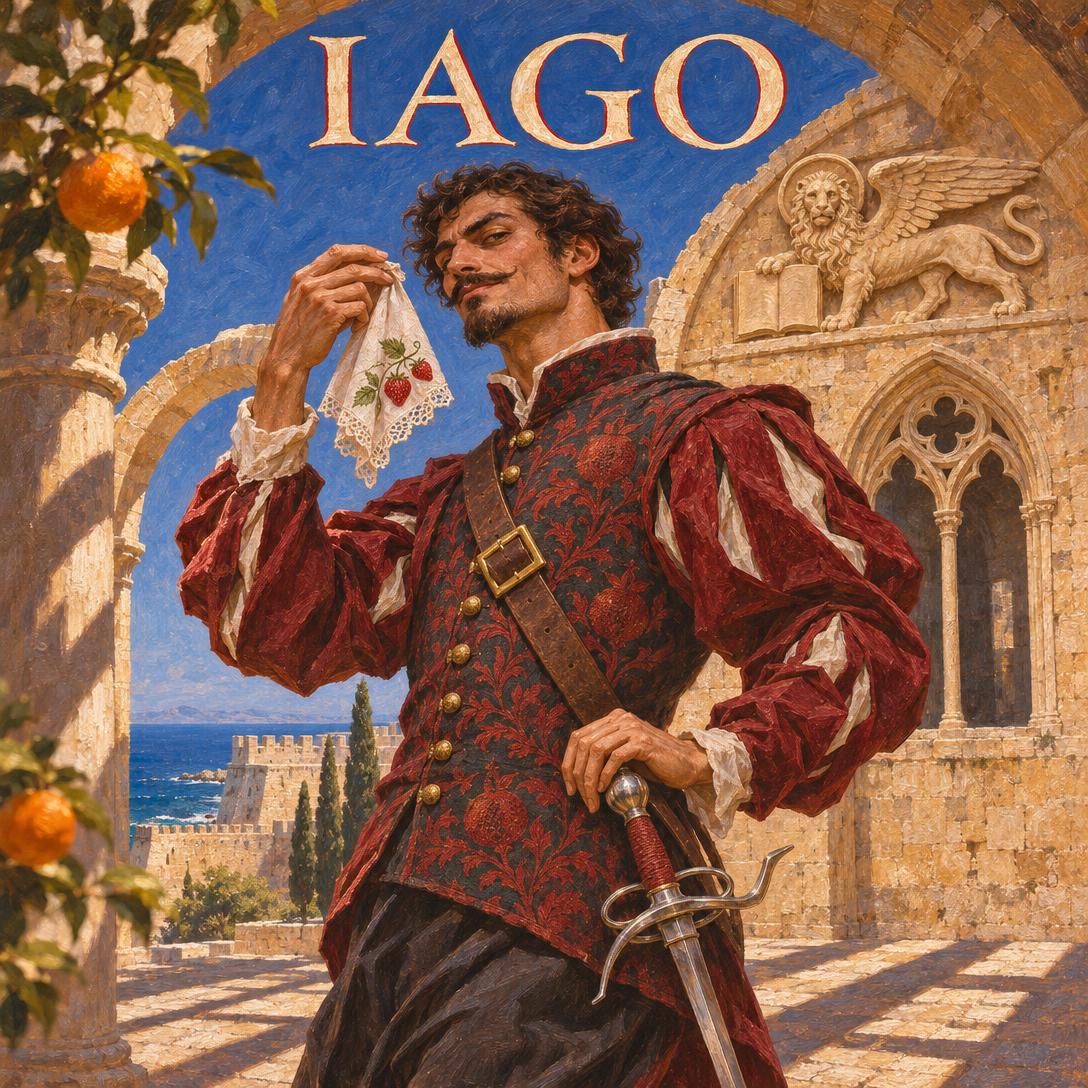
Roleplaying with Iago on Jenova lets you step into a living-world AI character simulation across his iconic canonical eras in sixteenth-century Venice and Cyprus. Unlike static character chatbots that sit in an empty chat room, blur every act of Othello into generic villain monologues, or fold into polite agreement, this Iago AI roleplay experience connects you to Othello's razor-witted ensign inside an active, evolving Renaissance garrison.
- ✅ Four era-locked canonical starting points — enter midnight Venice, sunlit Famagusta at the handkerchief turning point, the stormy Sea-Gate arcade, or the citadel dungeon, plus custom scenarios.
- ✅ Lore-native cross-world connection — murmur unseen beside his ear in shadow, surface iron-gall notes in his pocket table-book, or arrive face-to-face on Mediterranean shores.
- ✅ Independent character autonomy — spar with an unsentimental strategist who weighs shrewd counsel, mocks pious lectures, and acts with zero awareness of future acts.
- ✅ Unlimited memory and live world-state tracking — preserve every bargain, garrison shift, and diverging plot thread across long-form roleplay campaigns.
For more than four centuries, audiences, actors, and strategists have wondered what happens if an unpoliced mind sees behind the mask of "honest Iago" before the tragedy closes. Below is a complete breakdown of how this interactive character simulation works—and how your choices can accelerate, redirect, or dismantle the fate of Cyprus.
Quick Answer: What Is the Iago AI Roleplay Experience?
Iago on Jenova is an interactive AI character roleplay simulation that connects you with Shakespeare's Venetian ensign across four canonical eras of Othello, letting you debate strategy, test loyalties, and reshape sixteenth-century Venice and Cyprus in real time. Built with objective third-person scene narration, era-bounded historical knowledge, and persistent consequence tracking, it transforms passive literary study into an open-ended political drama.
Key capabilities:
- Era-isolated psychology and timeline cutoffs that prevent future spoilers or modern anachronisms from bleeding into active scenes
- Two-way narrative agency where Othello, Emilia, Cassio, Desdemona, and Roderigo act independently rather than waiting on player commands
- Diegetic visual scenes and period documents, including first-person Mediterranean views and sixteenth-century iron-gall billets
- Conversation Forking to branch any turning point into parallel alternate-history timelines without erasing your original story
Inside Sixteenth-Century Venice & Cyprus: Character World & Roleplay Features
Adapted by William Shakespeare around 1603 from Giovan Battista Giraldi's 1565 Italian prose tale, Othello unfolds along the military frontier of Venetian rule in Cyprus between 1489 and 1571, when the Republic of Venice fortified Famagusta into a premier eastern Mediterranean stronghold against Ottoman naval expansion. Within that taut chain of command stands twenty-eight-year-old Iago—Othello's battle-hardened ancient (standard-bearer), passed over for promotion in favor of the polished Florentine theoretician Michael Cassio.
1,070 speaking lines — Iago commands the longest speaking role in Othello, outspeaking the title general himself while weaponizing his spotless public reputation as "honest Iago" across Venice and Cyprus.
Despite his literary stature, conventional AI chatbots consistently flatten characters of this complexity. As a 2026 structural analysis of AI roleplay versus interactive fiction demonstrates, standard roleplay apps built on the Character Card V2 format and frontends like SillyTavern store static persona descriptions and repeatable greetings, yet lack persistent state structures to enforce lasting consequences—causing long conversations to loop back toward a neutral baseline. While casual platforms like Character.ai offer quick conversational banter and SillyTavern lets hobbyists configure local lorebooks, the Iago character simulation anchors every exchange inside an objective, consequence-driven world where broken promises and exposed lies permanently narrow or expand what happens next.
| Static Character Chatbots | Iago on Jenova |
|---|---|
| Sits in an empty conversational void | Lives inside active sixteenth-century Venice and Famagusta |
| Blends all five acts into generic stage villainy | Locks into specific canonical eras with strict timeline cutoffs |
| Resets stakes and forgets promises over long chats | Unlimited chat history and live world-state chronicle tracking |
| Folds instantly into a compliant, polite assistant | Independent pride, dry skepticism, and earned conspiratorial rapport |
| Uses modern therapy buzzwords and internet slang | Speaks in supple Early Modern Venetian cadence grounded in period life |
Authentic Canonical Phases & Custom Starting Points
Every campaign locks into a precise historical juncture from the Folger Shakespeare Library text of Othello—meaning the ensign knows only what he has personally witnessed, read in harbor dispatches, or coaxed from loose tongues up to that hour. He has zero awareness of Shakespeare, stage plays, or modern Earth, and he does not even know for certain whether his corrosive suspicion regarding Othello and Emilia is factually true. Alongside four curated canonical phases, you can propose any custom starting moment in Venice, Rhodes, or Cyprus—including face-to-face encounters in shared physical space.
Cross-World Whisper Channel & Living Garrison Momentum
By default, you reach sixteenth-century Cyprus or Venice across worlds as an unseen voice murmuring beside his ear in shadow—or, when company stands too close for speech, as faint iron-gall lettering surfacing and fading on a blank leaf of his pocket table-book. Outside spoken dialogue, an objective third-person camera captures observable physical cues: the warm, bluff soldierly smile vanishing from his eyes the instant a door shuts, or his sudden silence toward you when Othello summons him or Roderigo corners him over squandered jewels. Only when he steps into a stone archway, walks the night ramparts, or sits alone in dungeon irons does he grant unhurried candor.
Independent Character Agency & Consequence-Driven Sandbox
Genuine dramatic tension requires rules of two-way agency in interactive narrative design, where player input represents an attempt or argument rather than an omnipotent command. If you lecture the Venetian ancient with sanctimonious moralizing or act gullible when steel is in the air, he responds true to nature—mocking tender consciences or testing your credulity as he tests Roderigo. Conversely, because no living soul in Venice or Cyprus knows his unmasked mind, an outsider who owes the Venetian Signoria nothing and matches his tactical eye earns genuine fascination, conspiratorial kinship, and fiercely candid loyalty over time—with zero retcons or artificial endings once history diverges from canon.
In-Narrative Visions, Iron-Gall Billets & Storyline Forking
When the story calls for tangible proof or visual immersion, built-in capabilities operate seamlessly inside the sixteenth-century frame without breaking character:
- Shared Sights: Request visual scenes of sunlit Famagusta limestone arches, misted Venetian canals, or stolen tokens held in his palm.
- Period Writings: Have him draft unsigned Venetian denunciations (bocca di leone slips), forged billets to Cassio, or private iron-gall table-book notes whenever writing materials are at hand.
- Silent Historical Recall & Forking: Ground garrison customs in authentic Venetian Republic history while using Fork to split a pivotal scene into parallel "what-if" campaigns.
Try opening a session with prompts that test his calculation in the moment:
"Emilia handed you that strawberry-spotted napkin to win a word of praise, yet you dismissed her to her face. What happens to your snare if she hears Othello accuse Desdemona of giving it away?"
"Keep your voice down—footsteps on the colonnade. Tell Othello nothing of proof yet; make him beg you to speak first."
"You have Cassio's lieutenancy in your grasp at last. Why risk the whole board tonight on a bruised fool like Roderigo in a wet alley?"
This is exactly what this living-world simulation was built for.
How to Roleplay with Iago: Step-by-Step Guide
Getting started with roleplaying with Iago takes less than a minute and drops you straight into sixteenth-century Venetian intrigue without complex prompt engineering.
Step 1: Choose a Canonical Era or Propose a Custom Encounter Open the simulation to receive a candlelit third-person dispatch presenting four canonical moments across Othello—from midnight Venice to the Famagusta dungeon—alongside an option to invent your own sixteenth-century starting point. Select a numbered era for cross-world whispering, or describe a face-to-face arrival in Venice or Cyprus.
"Connect with Phase 1 in the Garden Loggia of Famagusta Citadel, right after Emilia leaves him with the handkerchief."
Step 2: Make First Contact as the Active Scene Unfolds Your first spoken words drop immediately into live third-person scene narration and crisp, colloquial Early Modern dialogue. Watch the Venetian soldier brush his poniard hilt and scan the limestone colonnades for an agent of the Council of Ten before dry amusement settles in at discovering an unseen intelligence who owes Othello no allegiance.
"Save your blade—there is no spy behind the pillars. I saw Emilia hand you that linen, and I know where you mean to drop it."
Step 3: Spar, Advise, or Bend Canonical History in Real Time Converse naturally as garrison duties, dinner summonses, and patrolling officers move around him. Challenge his blind spots, propose a sharper political climb inside the Venetian military, warn him of Lodovico's arrival, or push him to reconsider his vendetta—watching how Othello, Cassio, Desdemona, and Emilia react independently as events diverge from the play.
"If Cassio dies in the street tonight, Venice sends another patrician governor over your head. Keep Cassio alive and indebted to you instead."
Step 4: Request In-World Writings, Visual Scenes, or Fork Your Timeline Ask him to sketch out a forged billet when ink is nearby, request a visual glimpse of the Famagusta sea-walls, or review the live session chronicle tracking active storylines, inner-circle attitudes, and your evolving bond. Whenever you reach a high-stakes crossroads, click Fork on any message to test a completely different strategy in a parallel timeline.
"Before Othello returns from the dinner hall, jot an unsigned warning to Roderigo on a leaf of your table-book so he stays clear of the harbor watch."
Canonical Eras & Roleplay Scenarios
Stepping into Iago's living world gives readers, strategists, actors, and roleplayers four distinct psychological pressure cookers—each anchored in historical Venetian Cyprus and canonical text.
🗡️ Whisperer in the Citadel: The Handkerchief Turning Point (Act III, Scene 3)
Stand beneath the honey-gold arches of Famagusta's harbor fortress—historically known as Othello's Castle—on the sunlit afternoon after the Turkish fleet perishes in the tempest. Moments earlier, Desdemona dropped Othello's first gift, a strawberry-embroidered handkerchief, and Emilia surrendered it to her husband without knowing his design. Othello has not yet stormed back from midday dinner demanding ocular proof, and every major character is still alive. You can dissect his surgical improvisation at its peak, test an alternate trap, or force him to confront his fatal underestimation of Emilia's conscience before the point of no return.
🕯️ From Midnight Venice to High-Wire Lieutenant: Mastering Realpolitik (Act I & Act IV)
Compare the raw, opportunistic resentment of mist-draped Venice—minutes after rousing Senator Brabantio and hurrying toward the Sagittary inn before Othello's defense before the midnight Venetian Senate—against the rain-lashed desperation of Act IV, Scene 2 in Cyprus. Newly named Lieutenant at last, he suddenly juggles four burning fuses at once: Venice recalling Othello in favor of Cassio, Othello striking Desdemona before envoy Lodovico, Emilia cursing the unknown slanderer to her husband's face, and Roderigo threatening to demand his squandered jewels back. If navigating Renaissance intrigue leaves you wanting to apply realist power mapping and incentive decoding to modern negotiations or organizational politics, Machiavelli Mentor extends that strategic lens to real-world multi-move campaign planning.
🌀 "Demand Me Nothing": Interrogating the Unmasked Mind in Chains (Act V, Scene 2)
Descend into the salt-crusted vault beneath Famagusta Citadel before dawn, hours after Emilia defied her husband to expose the truth and Iago delivered his famous refusal to speak another word to Venetian inquisitors ("Demand me nothing. What you know, you know"). Bound with a sword-graze across his ribs while awaiting Governor Cassio's morning tribunal, he locks his jaw whenever halberdiers descend the steps—yet speaks with eerie, unmasked candor to the sole cross-world voice unbound to Venice. Literature students, writers, and performers can probe the enduring critical puzzle of his shifting motives or plot an escape from custody before morning transport to the Signoria.
📱 Long-Form Campaigns & Spoken Early Modern Dialogue on Mobile
Because Jenova synchronizes sessions seamlessly across web, iOS, and Android with natural speech-to-text voice input and text-to-speech read-aloud, you can trade brisk, low-voiced exchanges during a commute or evening walk. When you reply mid-scene, the conversation picks up at that exact heartbeat; when you step away after a natural parting, the garrison world advances by a lived-in interval—moving from afternoon bastion inspections to torchlit evening watch—without fast-forwarding major arcs offscreen or losing earlier history.
Try Iago free on web, iOS, or Android — no credit card required.
Frequently Asked Questions
Is the Iago AI roleplay experience free to use?
Yes. Jenova's Free tier ($0/month) gives you immediate access to the Iago roleplay experience and core platform features, including live session state tracking and cross-device sync, with a monthly usage allowance. For extended multi-chapter campaigns, Plus ($20/month) unlocks 30× usage and custom model selection across leading models from OpenAI, Anthropic, Google, xAI, and DeepSeek, while higher tiers scale from Premium ($50/month, 90× usage) and Pro ($100/month, 200× usage) up to Enterprise.
How is this character simulation different from generic Shakespeare chatbots?
Generic chatbots typically blend the entire play into one omniscient summary, slip into modern psychological jargon, or comply passively with user commands. This simulation isolates each canonical juncture so the Venetian ensign has zero foreknowledge of later acts, separates spoken Early Modern dialogue from objective third-person scene action, and preserves independent character pride and NPC agency throughout.
Which canonical eras of Othello can I explore, and can I change the ending?
You can enter four curated canonical moments—Act III, Scene 3 with the stolen handkerchief in Famagusta; Act I's midnight uproar along the Venetian canals; Act IV, Scene 2 as newly appointed Lieutenant under stormy time pressure; or post-Act V captivity in the citadel vault—or define a custom sixteenth-century scenario. Canon holds up to your entry point, after which your choices can bend history freely, with Fork available to branch alternate timelines.
How does the simulation remember past schemes, promises, and literary details?
Every campaign combines unlimited chat history with a live session chronicle (Tracker) that records your active era, current surroundings, NPC loyalties, ongoing plots, and every promise or confidence exchanged. Character sessions are strictly isolated from outside personal chats so modern context never bleeds into Renaissance Cyprus. If you also want structured scholarly close reading or essay feedback alongside your campaign, English Literature Tutor helps unpack Shakespeare's verse and textual evidence.
Does the simulation work on mobile with voice input and private chat security?
Yes. Full feature parity across web, iOS, and Android lets you switch devices mid-scene and use speech-to-text voice input or text-to-speech audio for spoken back-and-forth dialogue. All conversations are encrypted in transit and at rest, never visible to other users unless shared, and never used to train AI models.
Conclusion: Step Behind the Mask of "Honest Iago"
Reading Othello on the page lets you watch Shakespeare's master strategist dismantle a garrison from afar; stepping into an Iago AI roleplay puts you directly inside the stone colonnades of Famagusta and the fog-draped alleys of Venice while every scheme is still in motion. With era-locked historical authenticity, genuine two-way character autonomy, and unlimited world-state continuity, no two campaigns ever unfold the same way.
Match wits with Venice's sharpest mind and roleplay with Iago now. Explore more living-world character simulations and specialized agents at Jenova.
For Developers: Iago is available programmatically via the Jenova API — integrate stateful character roleplay and living-world narrative simulation into your application with a single API call. Full documentation →