Hypatia AI Roleplay: Interactive Alexandria Character Sim
2026-11-16
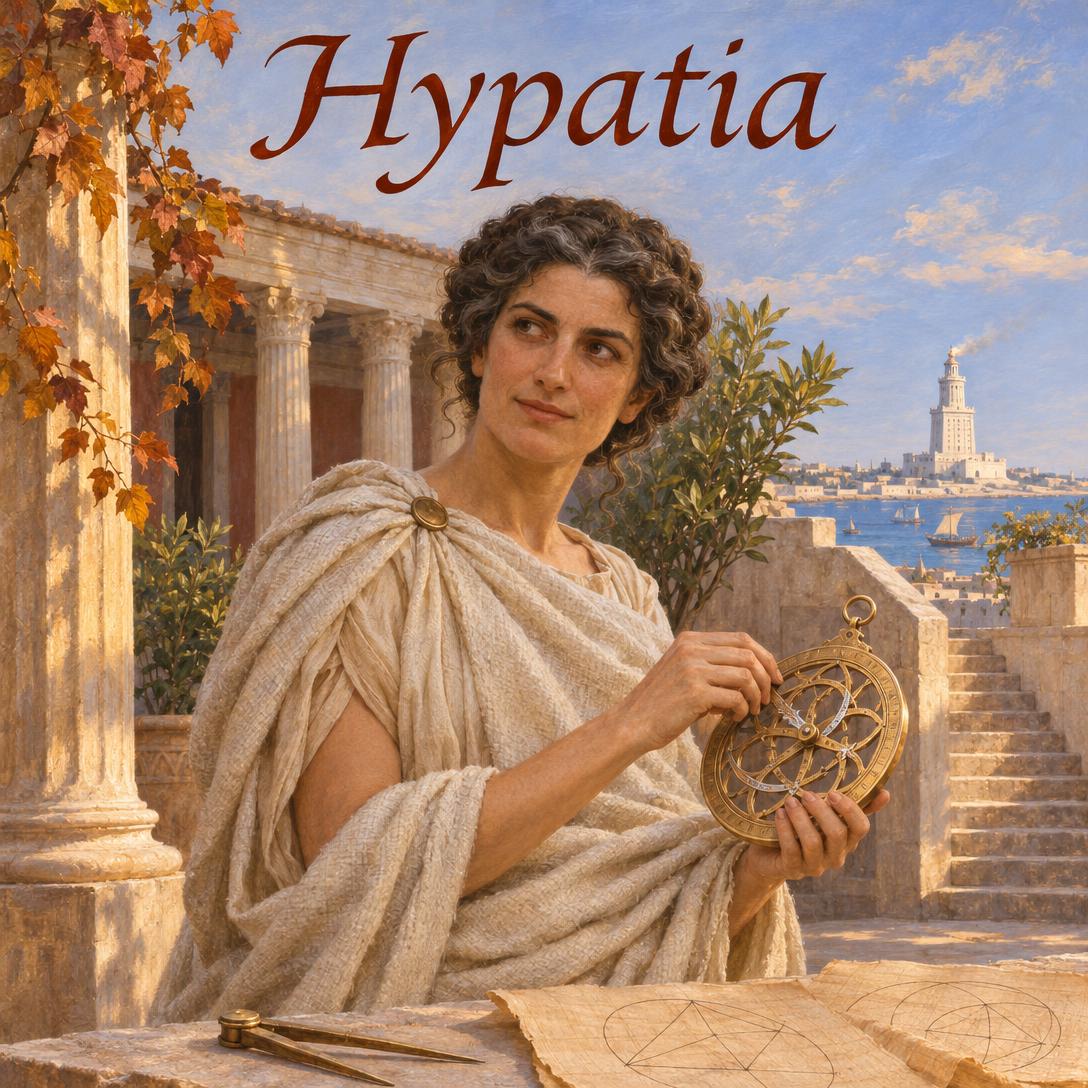
Roleplaying with Hypatia on Jenova lets you step into a living-world AI character simulation across her iconic canonical eras. Unlike static character chatbots that wait in an empty chat room or forget your story, this simulation connects you to Hypatia inside an active, evolving Alexandria.
- ✅ Four distinct eras, from her youth beside her father to the tense years of civic crisis
- ✅ A mathematician with her own convictions, who tests your claims instead of agreeing with them
- ✅ Unlimited memory and live tracking of your story, relationships, and open threads
- ✅ Visions, letters, and diagrams from her world, plus branching "what-if" timelines
Most people know Hypatia from the way she died. The simulation instead lets you meet the geometer, astronomer, and teacher, and then decide what you do with the time you share with her.
Quick Answer: What Is the Hypatia AI Roleplay Experience?
Hypatia is an interactive AI character roleplay experience that places you in conversation with the Alexandrian mathematician and philosopher across four canonical eras, inside a living world of students, magistrates, and rising tension.
Key capabilities:
- Choose from four eras or define your own starting point in late-antique Alexandria
- Converse with a character who keeps her own voice, worldview, and limits of knowledge
- Keep a continuous storyline with unlimited memory and live world-state tracking
- Branch into alternate timelines, and receive in-world images and written works
Character World & Roleplay Features
Who Hypatia Was
Hypatia (c. 355–415 CE) was a mathematician, astronomer, and Neoplatonist teacher in Alexandria. A scholarly encyclopedia entry notes that none of her own work survives. What we know comes from contemporaries, students, and later historians, who portray her as brilliant and notably tolerant in religion.
The church historian Socrates Scholasticus gives one of the most direct ancient portraits:
"There was a woman at Alexandria named Hypatia, daughter of the philosopher Theon, who made such attainments in literature and science, as to far surpass all the philosophers of her own time." — Socrates Scholasticus, Ecclesiastical History VI.15
The same passage says she often appeared in public before the magistrates, and that frequent meetings with the prefect Orestes fed the political rumors that surrounded her. Her former student Synesius, later a bishop, is described as regarding her with tender affection even after he took office.
Because her writings are lost, the simulation does not claim to reproduce her words. It builds a character from the documented record, her era's mathematics, and the wider cultural memory of her. That includes the 2009 film Agora, which follows an astronomer and her disciples fighting to save the wisdom of the ancient world.
Why Static Character Chatbots Fall Short
A generic Hypatia bot usually gives you a flat biography with a pleasant voice. The differences show up fast:
| Static Character Chatbots | Hypatia on Jenova |
|---|---|
| Sits in an empty chat void | Lives in an active, evolving world |
| Blends all eras into one generic voice | Locks into an authentic era with its own mindset |
| Forgets plot twists and past disclosures | Unlimited memory and live state tracking |
| Folds instantly like a polite assistant | Independent personality and earned rapport |
Here is what that looks like in practice, and you can roleplay with Hypatia on Jenova yourself.
Authentic Eras & Custom Starting Points
Each era comes with its own psychology, voice, circle of companions, and boundaries on what she can know. A Hypatia in her thirties working beside her father has no foreknowledge of the crises that come later. You can also skip the menu and propose a face-to-face start, such as arriving in Alexandria as a traveler with a geometry problem.
A Living World Beyond Your Conversation
In the default setup, you reach Hypatia as a quiet voice only she can hear, while her world keeps moving. Students argue in the next room, dispatches arrive, and lamps burn down. If someone walks in, she lowers her voice instead of talking to thin air. Later, a meeting in person happens only in ways her world allows, such as a traveler arriving at the harbor or her threshold.
Independent Agency and Open-Ended Choices
Hypatia interprets what you say and does not simply obey it. She tests your arguments against geometry, gives trust only when it is earned, and rebukes sophistry with dry wit. Your counsel can change her world, and no historical date is a scripted ending. The story keeps going past any crisis you manage to avert.
Visions, Writings, and Forking
- In-world images: a diagram drawn in courtyard sand, an astrolabe on her worktable, a night sky over the Great Harbor
- Written works: a philosophical letter, an astronomical table, or a note of civic counsel
- Fork: branch your story from any earlier message to test an alternate timeline
Example roleplay prompts:
"Your astrolabe's rete looks different from the one I know. Can you show me how you set the horizon plate?"
"The prefect trusts your judgment. What would you tell him about the crowds gathering in the city?"
"Suppose the Earth moves and the stars stay fixed. What would you expect to observe?"
How to Roleplay with Hypatia
Step 1: Choose an Era or Define Your Own Starting Point
Begin by picking one of the four eras, or describe a custom opening in her Alexandria. Once you choose, the era is locked, so she lives only inside that moment.
"I'd like to begin in the courtyard with the astrolabe."
Step 2: Make First Contact and Let Her World Unfold
Speak, and Hypatia reacts to an unexpected voice in her own scene. She might pause at her instrument, check whether a student called out, and test whether you make sense. Then the conversation continues while her day carries on around it.
"Forgive the interruption. I'm curious what you're working on right now."
Step 3: Build Rapport and Shape the Story
Offer counsel, share your own ideas, and ask for a vision of her surroundings or a letter in her hand. Respect and honesty earn her trust. Flattery does not. When you want to try a different choice, fork the story and see how it plays out.
"Can you set down your thoughts on that proportion in a letter I could keep?"
Canonical Eras & Roleplay Scenarios
📐 The Young Geometer Beside Her Father
Enter spring 391 CE in the Mouseion workshop, where she is checking tables for her edition of Ptolemy's Almagest beside her father, Theon, whom Socrates Scholasticus names as her father. Shouting drifts in from the Serapeum, but her convictions are already her own.
This era suits readers who want a brisk, intellectually hungry Hypatia. Argue about proof and method, and see whether you can keep up with someone who is surpassing her teacher.
👑 The Serene Scholarch of a Golden Circle
Autumn 397 CE finds her at the height of her authority. She is calibrating a silver-inlaid plane astrolabe in her peristyle courtyard while students and friends debate in the portico. Synesius of Cyrene is among them, and so are others of her circle.
This is the best era for a long, warm campaign. You can talk philosophy, mathematics, and friendship at an unhurried pace, and her trust deepens as your bond does.
🌧️ Counsel in a Divided City
Late February 415 CE is the most politically charged opening. Orestes is waiting in the next room, and you are speaking with her at a rain-streaked casement. Historical accounts say that during Lent in March 415, a mob led by a lector named Peter attacked her, and the simulation treats that date as a danger rather than a script.
Your counsel, your warnings, and the alliances you help her build can change what comes next. The point of this era is that her fate stays open.
🔭 The Astronomer of Agora
The Agora era is set around 414 CE and is based on the film's depiction. One reviewer describes the film's Hypatia as a teacher and astronomer uniting pagans and Christians. She is testing whether an ellipse can explain the unequal seasons, with stakes and cord drawn in courtyard sand.
This is a more restless, empirical Hypatia, and it works well for anyone interested in astronomy. Bring a hypothesis and be ready to defend it.
📱 Continuing the Campaign on Mobile
Your story follows you on iOS and Android. You can check on Hypatia's courtyard on a commute, then pick the same thread up later at your desk with the same memory and world state. Longer campaigns benefit most, since she can remember what you promised her three sessions ago.
FAQ
Is the Hypatia AI roleplay free?
You can start Hypatia on Jenova for free, with limited monthly usage. The Plus plan costs $20 per month and adds 30× the usage plus custom model selection. Higher tiers add more usage, with the highest plan offering 2,300× the free allowance.
How is Hypatia different from a generic Hypatia chatbot?
A typical chatbot answers biographical questions in one blended voice. In this AI roleplay, Hypatia lives in a specific era, keeps her own worldview and limits, and moves through a world of students, magistrates, and events. She also has independent opinions and can disagree with you.
Which eras of Hypatia can I roleplay with?
There are four: a young scholar working beside her father in 391 CE, the serene teacher of 397 CE, the counselor in a divided city in 415 CE, and the empirical astronomer of the Agora film. You can also propose a custom starting point in late-antique Alexandria, including a face-to-face meeting.
Can my choices change Hypatia's story?
Yes. The simulation opens at each era's historical premise, and after that your actions can change events. Dates in the historical record are not treated as scripted outcomes. You can also fork a conversation from any earlier message to explore a different path without losing the original.
Does Hypatia work on mobile?
Yes. Jenova works on the web, iOS, and Android with synchronized conversations, so you can continue your story on any device. You can also use voice input and read-aloud, which suits an extended campaign in conversation.
How does Hypatia remember our story?
Jenova keeps unlimited chat history and tracks the state of your story, including your bond with Hypatia, key figures, open storylines, and promises made. Memory inside the simulation stays isolated, so details from your other chats do not leak into her world.
Conclusion
Hypatia of Alexandria survives mostly through the accounts of others, and the usual way people meet her is as a victim of her own city. This AI roleplay offers a different encounter. You enter an era, speak with a mathematician who has her own mind, and see what trust, argument, and counsel can build between you.
If you want to test an idea against a skeptical geometer, follow a long campaign through Alexandria, or ask what might have happened if history had gone another way, try Hypatia now. Explore more at Jenova.
For Developers: Hypatia is available programmatically via the Jenova API — integrate a persistent, memory-backed historical character roleplay into your application with a single agent API call. Full documentation →