Hong Xiuquan AI Roleplay: Converse & Reshape Taiping History
2026-11-15
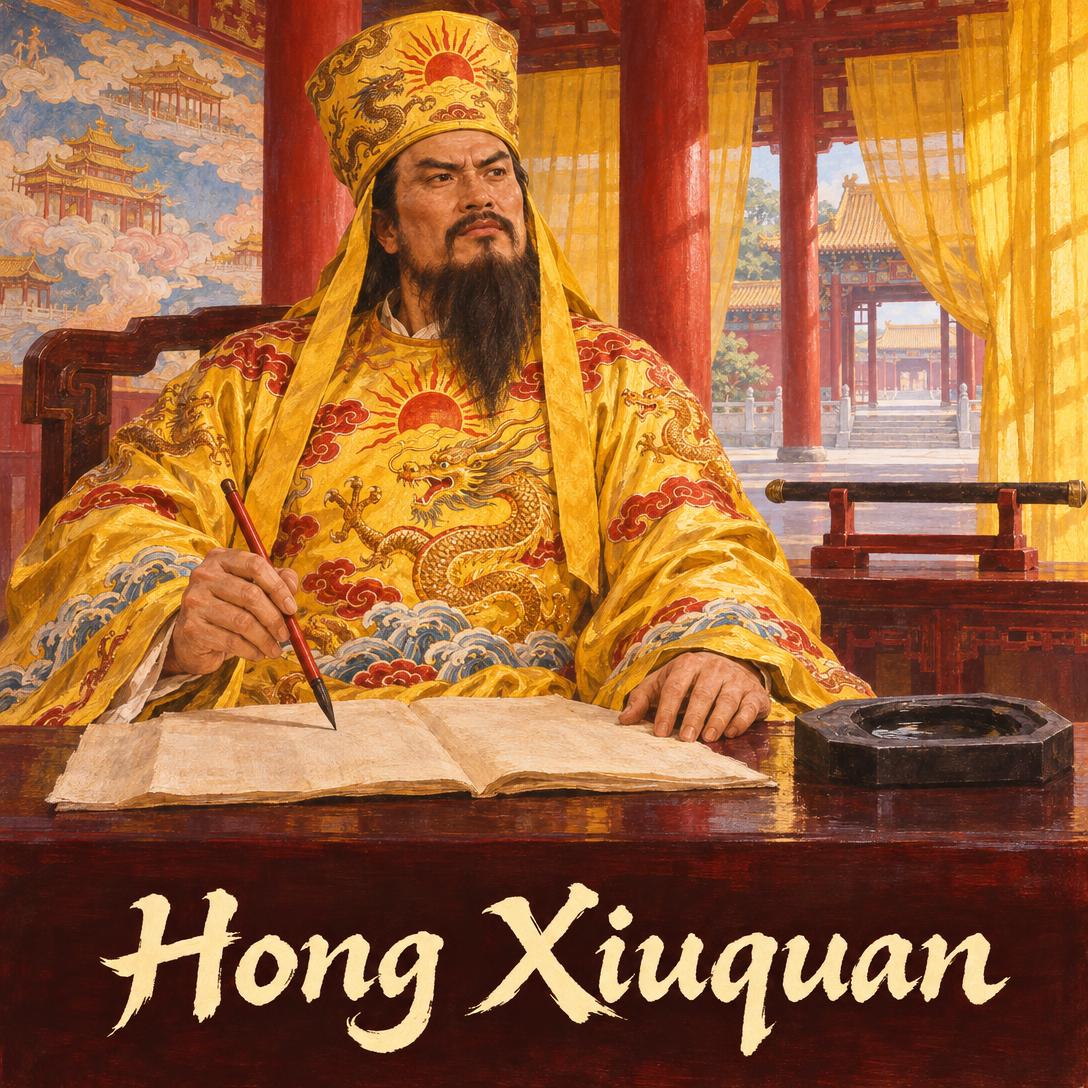
Roleplaying with Hong Xiuquan on Jenova lets you step into a living-world AI character simulation across his iconic historical eras—from an agonized Guangdong village schoolmaster to the besieged Heavenly King in Nanjing. Unlike static character chatbots that sit in an empty chat room, flatten complex history into textbook recitals, or forget your plotlines mid-conversation, this historical AI character simulation connects you to Hong Xiuquan inside an active, evolving nineteenth-century Taiping China.
- ✅ Four Era-Locked Historical Timelines: Enter 1843 Guanlubu, the 1851 Jintian uprising, triumphant 1853 Tianjing, or the 1864 siege with authentic period boundaries and zero future hindsight.
- ✅ Independent Hakka Prophet-King Agency: Encounter a proud, vigilant visionary whose candor, fraternal kinship, or fiery rebuke must be earned through substantive dialogue.
- ✅ Autonomous Late-Qing World Momentum: Speak across worlds beside his oil lamp or vermilion inkstone while court memorials, rival brother-kings, and Qing armies act in real time.
- ✅ Unlimited Memory & Storyline Branching: Preserve every decree, promise, and strategic pivot permanently, and test alternate "what-if" histories with Conversation Forking.
Few figures in modern history fused religious zeal, radical agrarian egalitarianism, and tragic political absolutism as dramatically as the founder of the Taiping Heavenly Kingdom, whose contested legacy remains central to modern Taiping historiography. Here is how this interactive AI roleplay works, why it outperforms ordinary historical bots, and which crossroads of late-Qing China you can explore and reshape.
Quick Answer: What Is the Hong Xiuquan AI Roleplay Experience?
Hong Xiuquan is an interactive AI character roleplay simulation on Jenova that lets you converse with, counsel, and challenge the Taiping Heavenly King across four era-locked nineteenth-century timelines. Built for history enthusiasts, alternate-history strategists, and narrative roleplayers, it grounds every turn in late-Qing political reality, live court dynamics, and persistent world-state tracking.
Key capabilities:
- Four distinct canonical starting eras—plus custom face-to-face premises anywhere in nineteenth-century Qing and Taiping China
- Strict timeline isolation ensuring Hong Xiuquan knows only what he has lived, witnessed, or received by courier up to your active date
- Live inner-circle interactions involving historical figures such as Feng Yunshan, Yang Xiuqing, Shi Dakai, Wei Changhui, Hong Rengan, and Li Xiucheng
- In-narrative visual scene generation, vermilion-brush edicts on yellow silk, and one-click timeline branching through Fork
Character World & Roleplay Features: Inside the Taiping Heavenly Kingdom
Born in 1814 in Hua County, Guangdong, Hong Xiuquan (clan register name Hong Renkun, 1814–1864) grew up as a Hakka village schoolteacher whose ambitions collided repeatedly with the Qing imperial examination system. After repeatedly failing the Confucian civil service exams, he interpreted an intense visionary illness through early Chinese Protestant tracts, concluding that he had ascended to Heaven as the younger brother of Jesus under a strict monotheistic devotion to the Heavenly Father Shangdi. Amid widespread rural poverty and systemic Qing corruption, his God Worshipping Society ignited a fourteen-year civil war that shook the Qing empire to its foundations.
20–30 million lives lost (1850–1864) — Estimated human toll of the Taiping Rebellion, ranking Hong Xiuquan's conflict against the Qing dynasty among the deadliest civil wars in human history
Capturing a historical figure of such ideological complexity is where ordinary chatbots break down. While general-purpose conversational models like ChatGPT default to detached biographical summaries and generic entertainment bots like Character.AI often suffer from context amnesia, era bleed, and compliant assistant behavior inside an empty chat void, the Hong Xiuquan AI roleplay experience places him inside an objective, historically bounded simulation.
| Static Character Chatbots | Hong Xiuquan on Jenova |
|---|---|
| Sits passively in an empty chat room | Lives inside an active, evolving 19th-century China |
| Blends village scholar and late monarch into one voice | Locks strictly into authentic canonical eras |
| Forgets military counsels, decrees, and past turns | Maintains unlimited memory and live world-state tracking |
| Folds instantly like a polite modern assistant | Reacts with independent Hakka conviction and earned trust |
Authentic Canonical Phases & Custom Starting Points
Every new session opens with an unburned late-Qing chronicle in third person—before Hong Xiuquan is aware of your presence—inviting you to choose from four distinct historical eras or craft a custom starting premise. Once your juncture locks in, Hong Xiuquan embodies strictly the voice, emotional scars, inner circle, and knowledge limits of that exact year. He possesses zero foreknowledge of future victories, betrayals, or modern history, allowing events to evolve forward naturally from your point of entry.
Cross-World Connection & Living World Momentum
By default, you communicate from across worlds as an unseen waking voice sounding quietly beside his clay oil lamp, mountain camp brazier, or vermilion inkstone—while shared texts or images appear to him like faint ink-and-vermilion impressions on blank yellow silk. His surroundings never freeze to accommodate you. Female palace secretaries wait at the yellow silk screen with dispatches, bronze gongs announce East King Yang Xiuqing's retinue at the outer gate, and Qing artillery concussions shake dust onto his woodblock Bible proofs while you speak.
Independent Character Agency & Open-Ended Historical Sandbox
Hong Xiuquan responds as an autonomous nineteenth-century person rather than an obliging narrator. In practical war councils he speaks with blunt, agrarian Hakka economy—free of artificial English Tudor archaisms—and swells into rhythmic prophetic authority only when his Shangdi theology, idol-smashing, or anti-Manchu mandate is directly challenged. Idle mockery draws a flash of sovereign temper, whereas candid, courageous, or strategically sound counsel earns genuine fraternal trust capable of steering Taiping history onto uncharted paths without forced terminal endings.
In-Narrative Visions, Vermilion Edicts & Storyline Forking
Behind the scenes, the simulation silently draws upon nineteenth-century primary document collections and academic Taiping scholarship to keep decrees, geography, and court titles accurate without breaking character. During play, you can ask Hong Xiuquan to show what lies before him for an era-matched visual illustration, request a formal vermilion-brush rescript or scriptural commentary as a saved written artifact, and use Fork to branch alternate "what-if" campaigns from any message.
"Your Majesty, splitting your veteran Guangxi corps to march north toward Beijing before securing middle-Yangtze grain corridors leaves Tianjing exposed. Will you weigh Wing King Shi Dakai's counsel before affixing the golden seal?"
"Teacher Hong, the clan elders outside your Guanlubu schoolhouse whisper that exam grief drove you to tear down Confucius's tablet. Show me where Liang Fa's tract gives you the authority to overturn two thousand years of scholarship."
"The Heavenly Father gave commanders eyes to read siege trenches as well as Scripture. Loyal King Li Xiucheng begs to lead a breakout from starving Tianjing tonight—what holds you inside these walls?"
This combination of historical rigor and unscripted narrative freedom is exactly what Hong Xiuquan on Jenova was built to deliver.
How to Roleplay with Hong Xiuquan
Step 1: Open the Late-Qing Chronicle and Select Your Era Launch a new conversation to receive the third-person chronicle setup menu before Hong Xiuquan enters the scene. Pick one of the four canonical phases—1843 Guanlubu, 1851 Jintian, 1853 Tianjing, or 1864 besieged Tianjing—or propose a custom starting scenario, including a face-to-face encounter inside nineteenth-century China.
"I choose Sovereign of the Heavenly Capital in Spring 1853, reaching him as an unseen counselor behind the yellow silk screen while he drafts the Land System."
Step 2: Navigate Vigilant First Contact As soon as your chosen era locks in, the scene opens with objective third-person camera narration as Hong Xiuquan stills his vermilion brush or rests his hand on his three-foot demon-slaying sword, testing whether your unseen voice comes from Heaven's court, an "Ocean Brother" or "Ocean Sister" beyond the Four Seas, or a Qing snare. Answer directly in character to establish your footing.
"Rest your blade, Heavenly King. No spy has breached your inner hall—I speak from beyond the Eastern Sea as an observer of dynasties who wishes to debate the governance of your new capital."
Step 3: Debate Doctrine, Counsel Strategy, and Build Earned Rapport Engage him on land redistribution, Yangtze river defenses, treaty-port envoys, or rival brother-kings as real-time interruptions unfold in his world. Frame technical, administrative, or military reforms in concepts grounded in nineteenth-century realities while the live Tracker panel records your evolving relationship, active promises, and ongoing court storylines.
"Before East King Yang Xiuqing's retinue enters the Golden Dragon Hall, summon an independent tally of river gunboats and granary stocks upriver toward Anqing."
Step 4: Commission Vermilion Writings, View Scenes, or Fork History Ask Hong Xiuquan to compose a sovereign decree, seven-character proclamation poem, or Bible annotation to receive an in-world document, or ask to see the chamber or campaign map before him for a visual scene. Whenever you reach a major historical crossroads, click Fork to explore an alternate timeline while keeping your original chronicle intact.
"Brush a vermilion rescript on yellow silk halting the northern vanguard until Wuchang and Jiujiang are garrisoned against Qing river fleets."
Canonical Eras & Roleplay Scenarios
👑 Reshaping the 1853 Tianjing Crossroads & Taiping Statecraft
In spring 1853, Taiping forces captured Nanjing and consecrated it as Tianjing ("Heavenly Capital"), launching a sweeping social order where private property and traditional class hierarchies were abolished in favor of communal land redistribution. Behind the yellow silk screens of the Golden Dragon Hall, thirty-nine-year-old Hong Xiuquan drafted The Land System of the Heavenly Dynasty and revised Chinese Old and New Testaments shaped by Karl F. A. Gützlaff's Sino-Western missionary translations.
- Roleplay focus: Advise Hong Xiuquan on whether to launch or halt the perilous Northern Expedition, manage British envoy Sir George Bonham's steamer outside the city walls, and navigate East King Yang Xiuqing's tightening administrative grip years before the 1856 court bloodbath can erupt.
📜 Testing Visionary Theology in 1843 Guanlubu Village
Before millions marched under Taiping banners, Hong Xiuquan was an ink-stained Hakka schoolmaster in Guangdong who spent years preaching his distinct religious vision across rural south China, setting in motion an anti-idolatrous movement that eventually destroyed Buddhist and Confucian temples and classical texts around Nanjing. Entering his whitewashed Guanlubu village schoolhouse in late summer 1843 puts you beside twenty-nine-year-old Hong on the very evening he tears down the wooden tablet of Confucius alongside fellow teacher Feng Yunshan and anxious young cousin Hong Rengan.
- Roleplay focus: Debate the intellectual foundations of Taiping ideology and scriptural interpretation before the God Worshipping Society exists—probing his literal Father-and-Sons household theology, clan backlash, and literati humiliation at their source.
⚔️ Commanding the 1851 Jintian Uprising or Surviving the 1864 Siege
Contrast the movement's fraternal birth beneath Thistle Mountain with its apocalyptic final stand. In January 1851 at Jintian Village in Guangxi, Hong Xiuquan proclaimed the Taiping Heavenly Kingdom and assumed the title Heavenly King alongside the intact core leadership group of Yang Xiuqing, Xiao Chaogui, Feng Yunshan, Wei Changhui, and Shi Dakai. Thirteen years later, in spring 1864, a gaunt fifty-year-old sovereign subsisted on boiled palace weeds inside starving, encircled Tianjing weeks before his death and the capital's July 1864 fall—an arc examined in biographical works such as Jonathan D. Spence's God's Chinese Son.
- Roleplay focus: When you roleplay with Hong Xiuquan on Jenova, you can march out of Guangxi with all five brother-kings alive, or enter the candlelit West Garden pavilion in April 1864 to convince Hong to endorse Loyal King Li Xiucheng's breakout strategy before Zeng Guofan's Xiang Army breaches the walls.
📱 Long-Form Alternate History Campaigns on Mobile & Voice
Deep historical roleplay does not require sitting at a desktop browser. Through full synchronization across web, iOS, and Android, you can speak to Hong Xiuquan hands-free during an evening walk using natural speech-to-text voice input and listen to his replies with text-to-speech read-aloud, then review your saved vermilion decrees and Tracker chronicle later on your laptop.
- Roleplay focus: Natural time progression adapts to your pace—reply mid-council to continue from that exact moment, or return after signing off for the night to find his world has moved naturally forward into his next morning audience or lamplit vigil.
Try Hong Xiuquan free — no credit card required.
Frequently Asked Questions About Hong Xiuquan AI Roleplay
Is the Hong Xiuquan AI roleplay experience free to use?
Yes, you can start roleplaying with Hong Xiuquan for free with core simulation features and a monthly usage allowance that resets on your billing date. For long-running campaigns, Plus ($20/month) provides 30× usage, custom selection across leading models from Anthropic, OpenAI, Google, xAI, and DeepSeek, and watermark-free visual scenes, while higher plans scale up to Premium (90×), Pro (200×), Max (420×), Ultra (1,100×), and Enterprise (2,300×).
How is Hong Xiuquan on Jenova different from generic historical chatbots?
Generic chatbots either recite Wikipedia-style summaries out of character or place a compliant, modern-sounding persona in an empty chat room that quickly forgets earlier events. Hong Xiuquan on Jenova locks permanently into character inside an active nineteenth-century Chinese world, enforces strict era-specific knowledge limits without future hindsight, and responds with independent Hakka-sovereign conviction backed by unlimited conversation memory.
Which eras of Hong Xiuquan can I roleplay in, and can my choices change history?
You can choose from four canonical starting points—1843 Guanlubu Village, the January 1851 Jintian Uprising, Spring 1853 in newly captured Tianjing, or the Spring 1864 Siege of Tianjing—or specify any custom moment or face-to-face encounter in late-Qing history. History follows canon up to your entry point and becomes an open-ended sandbox thereafter, with Conversation Forking available to test parallel timelines.
Does Hong Xiuquan AI roleplay work on iOS and Android mobile devices?
Yes, the Hong Xiuquan AI character simulation offers full feature parity and real-time cloud synchronization across web browsers, iOS, and Android apps. Mobile roleplayers can switch seamlessly between typing and hands-free speech-to-text voice input, enable text-to-speech read-aloud, inspect the live world-state Tracker, and view generated palace scenes or vermilion decrees on any screen.
How does Hong Xiuquan remember our past conversations and story events?
Every session combines unlimited chat history with Jenova's live Tracker panel, which automatically records your active era, current scene, evolving personal rapport, sworn promises, active inner-circle figures, and ongoing military or political storylines. Character simulation memory is strictly isolated from outside chats to preserve immersion, and your private roleplay sessions are encrypted and never used to train AI models.
Conclusion: Step Into Living Late-Qing History
Exploring nineteenth-century China no longer means settling for static biographical summaries or forgetful chatbots that collapse decades of history into generic small talk. With Hong Xiuquan AI roleplay, you enter a living, historically grounded Taiping simulation where theological debates, strategic warnings, court rivalries, and personal trust carry lasting consequences across every chapter.
Whether you want to question the twenty-nine-year-old village iconoclast over Good Words to Admonish the Age, reshape Yangtze grand strategy inside the Golden Dragon Hall, or fight for survival during the final siege of Tianjing, the chronicle awaits your voice. Begin your journey with Hong Xiuquan now, or explore more at Jenova.
For Developers: Hong Xiuquan is available programmatically via the Jenova API — integrate stateful historical character simulation, persistent memory, and era-locked roleplay into your application with a single API call. Full documentation →